


To keep millions of devices running successfully, Netflix uses AWS to host a massive microservices ecosystem, alongside Open Connect, its custom CDN, to deliver video smoothly. It also employs Java (Spring Boot) for core logic and Node.js to provide a high-performance UI.
Have you ever wondered how they create that smooth streaming experience for the more than 260 million Netflix subscribers in 190+ countries? This can be answered with one of the most resilient technology architectures ever. Analyzing the Netflix tech stack, one can see the architectural concepts that allow delivering billions of hours of content through the Netflix platform every month without failure.
The global streaming market is projected to grow to approximately $222 billion by 2028, highlighting expanding demand for video content delivery.
Netflix has a wealth of experience in high-availability architecture, microservices design, and cloud-native infrastructure, whether it is because it has developed a DVD rental service and then expanded to become the largest streaming platform in the world. This guide examines the tools, patterns, and philosophies of how it flows in a smooth manner.
Netflix Tech Stack at a Glance
Netflix’s tech stack is designed to support a massive scale, constant delivery, and fault tolerance and incorporates cloud-native microservices, real-time data processing, and resilience-first engineering on all layers.
| Layer | Technologies Used by Netflix | Purpose & Architectural Role |
| Cloud Infrastructure | AWS (EC2, S3, Auto Scaling, Regions & AZs) | Provides elastic scalability, multi-region redundancy, and high availability |
| Backend Architecture | Java, Spring Boot, Microservices | Enables independent service deployment, fault isolation, and rapid scaling |
| Data Streaming & Messaging | Apache Kafka | Handles real-time event ingestion and system communication |
| Data Processing & Analytics | Apache Spark, Flink | Powers recommendations, personalization, and operational analytics |
| Content Delivery | Open Connect (Netflix CDN) | Reduces latency and ensures reliable global video streaming |
| API & Service Communication | REST APIs, GraphQL | Decouples clients from backend services across devices |
| Client Applications | JavaScript, React, Native Mobile SDKs | Supports scalable web and mobile experiences |
| DevOps & CI/CD | Spinnaker, Jenkins | Enables continuous delivery with safe rollouts and fast rollback |
| Resilience & Testing | Chaos Monkey, Simian Army | Proactively tests system reliability under failure conditions |
| Monitoring & Observability | Atlas, Spectator | Provides real-time visibility into system health and performance |
The Monolith-to-Microservices Transformation
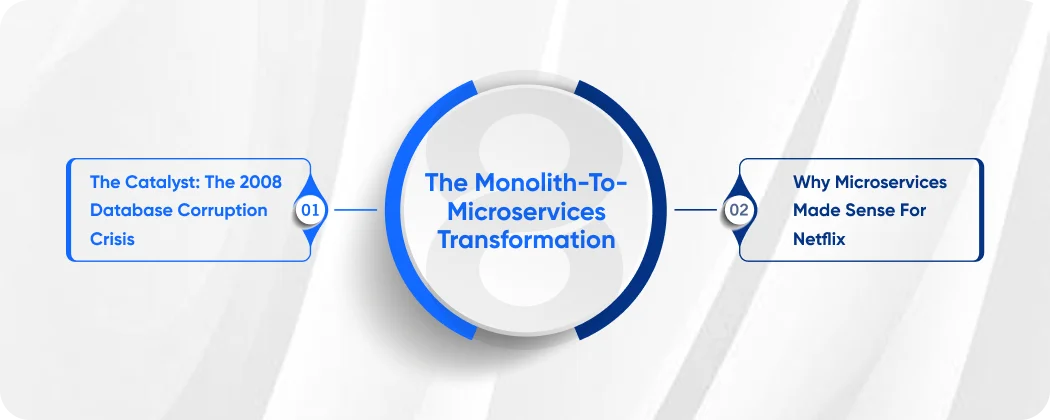
The Catalyst: The 2008 Database Corruption Crisis
It is important to have an idea of what exactly happened at Netflix that sparked their architectural transformation before delving into the Netflix stack of today. In August 2008, Netflix was hit by a disastrous database corruption that brought down its service temporarily (three days), stopping DVD shipment and showing the vulnerability of the monolithic architecture.
The crisis led to seven years of transformation where Netflix broke down its monolith into hundreds of deployable microservices, which demanded significant technology, organizational structure, development practices, and operations changes.
Why Microservices Made Sense for Netflix
The Netflix microservices architecture divides large software applications into smaller and modular units, and services have the responsibility of encapsulating their data. This architectural philosophy provides several transformational advantages:
- Independent Scaling: Each service scales depending on the demand, which leads to optimal resource utilization on the platform.
- Fault Isolation: The failure of one service will not propagate throughout the whole system and the overall platform will remain stable.
- Fast Growth: It is capable of letting teams work on various services at the same time without causing dependencies and bottlenecks.
- Technology Flexibility: Every team has the option of the most suitable technology stack to implement their services.
The Two-Plane Architecture: Control and Data
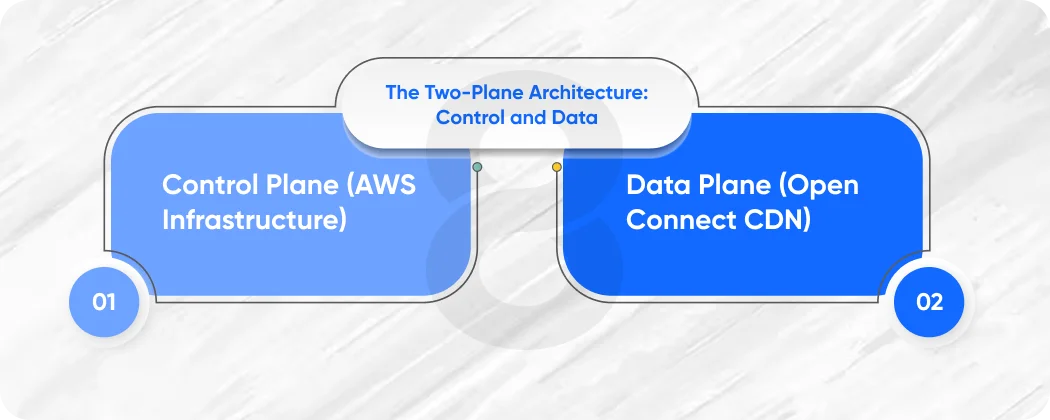
The fact that Netflix is separated into two specialized clouds can be seen as one of the most unique features of the company and its functionality. Such a division of responsibility provides Netflix with the ability to maximize each plane by its intended duties.
Control Plane (AWS Infrastructure)
Microservices running on Amazon Web Services do all user interactions before playback, such as browsing, recommendations, and account management. Control Plane includes:
- User Authentication: Secure session management and identity verification across all devices.
- Content Discovery: Personalized recommendations powered by sophisticated machine learning algorithms.
- Billing Management: Subscription handling, payment processing, and account administration.
- Analytics Processing: Real-time data ingestion and processing for business intelligence.
Data Plane (Open Connect CDN)
After the title is chosen, Open Connect, the proprietary Content Delivery Network of Netflix, assumes the responsibility of streaming the video at the optimal speed. Therefore, this dedicated infrastructure provides:
- High-Throughput Streaming: Optimized video delivery at massive scale across global networks.
- Edge Caching: Content stored close to users for minimal latency and maximum performance.
- Adaptive Bitrate: Dynamic quality adjustment based on network conditions and device capabilities.
Read More: 40 Best Technology Stacks for Mobile App Development
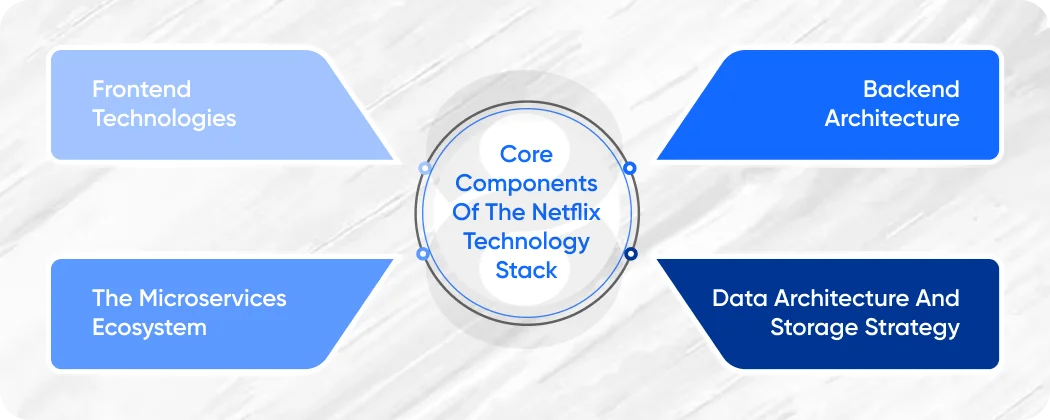
Core Components of the Netflix Technology Stack
Frontend Technologies
The Netflix frontend is developed as a responsive and performing application that can work across platforms. They develop server-side rendering reusable components with code-splitting using React in order to reduce load times. iOS apps are written in Swift and Android apps are written in Kotlin, whereas TV and console apps are based on custom SDKs, which enable users to play smoothly and navigate with ease based on the device.
Backend Architecture
The Java Spring Boot-based backend provides Netflix with the capability to process millions of requests per second. These are Eureka, a service discovery tool, which helps services to find each other dynamically, and the API Gateway called Zuul, which will do routing, authentication, and rate limiting. The storage of data is via polyglot on Cassandra, MySQL, and EVCache.
The Microservices Ecosystem
Netflix’s stack has more than 1,000 microservices that are not linked, and each of them has a particular function to perform. This ecosystem has user profile, billing, content recommendation, video encoding, and playback coordination services. These are asynchronous services executed via APIs, event queues (Kafka), and advanced service discovery systems.
Data Architecture and Storage Strategy
Netflix deploys a polyglot approach to persistence and decides on databases depending on the service requirements. Apache Cassandra is used with high availability and huge writes per second; MySQL is used with structured data, and EVCache is used with distributed caching of user preferences. Elasticsearch is based on full-text search, whereas Apache Kafka, Spark, and Flink contribute to event streaming, processing of data, and real-time analysis to make sure that the data is stored effectively to be used.
Statista forecasts continued growth in Netflix subscriptions across global regions through 2029, particularly in North America and Asia Pacific markets.
Resilience Engineering: The Chaos Monkey Philosophy
The most innovative point of the Netflix technologies is probably its approach to resilience engineering. Instead of making attempts to eliminate failures, Netflix develops systems that anticipate failures and handle them gracefully.
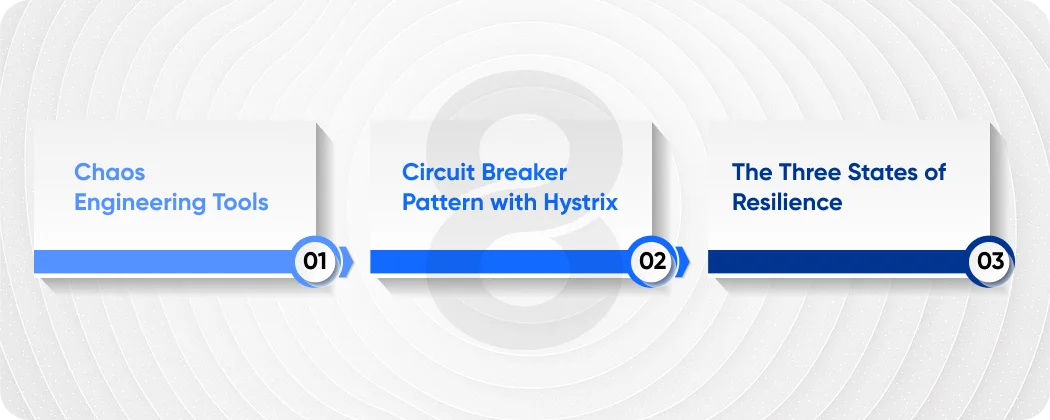
Chaos Engineering Tools
Netflix introduced Chaos Engineering as a set of instruments aimed at system testing resilience:
- Chaos Monkey: Kills instances of production randomly to make sure that services will be able to sustain unforeseen breakdowns.
- Chaos Gorilla: Tests the malfunction of an entire AWS availability zone to test regional resilience.
- Chaos Kong: Tests fail on the whole region and keep things accessible worldwide even when it is critically waning.
- Latency Monkey: Adds fake delays to test the way timeouts are handled and fallback.
Circuit Breaker Pattern with Hystrix
To adopt the circuit breaker pattern, Netflix developed Hystrix to safeguard the services against cascading failures. Once a service begins failing, Hystrix intervenes and trips the connection and then responds with fallbacks. It avoids the exhaustion of the resources and makes sure that localized problems do not destroy the overall platform.
The Three States of Resilience
The circuit breaker pattern has three states. Request flow is normal in the CLOSED. When the number of errors surpasses the limits, it goes to OPEN, and it goes out of control, without being connected to the service. It then goes into HALF-OPEN and accepts test requests. This allows the failing services to recover as the system keeps running. Monitoring can also be provided by real-time dashboards in Hystrix.
Lessons for Modern Application Development
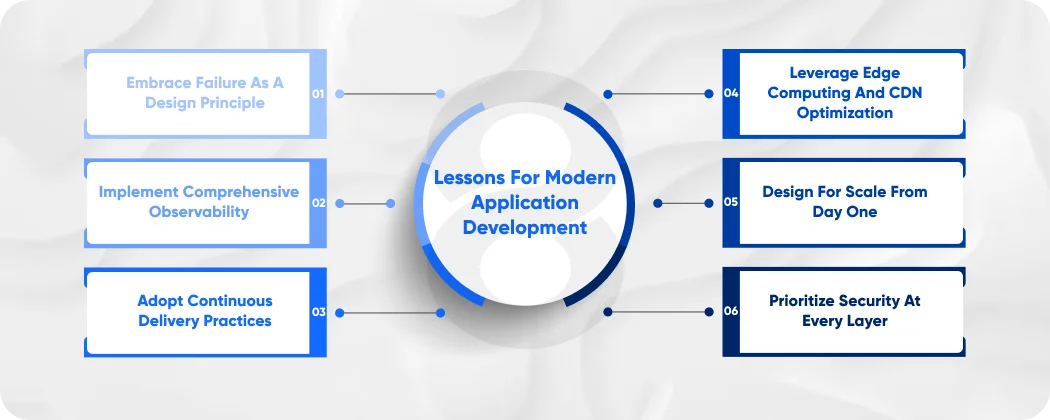
The concepts of the Netflix tech stack are invaluable to any organization proceeding with web app, mobile app development, or an overall years-long enterprise project of developing an entertainment app.
Embrace Failure as a Design Principle
To begin with, develop systems that anticipate failures as opposed to avoiding failures. Always design every part assuming it will fail and put in place graceful degradation programs. Such an attitude change changes the way in which a team handles reliability engineering.
Implement Comprehensive Observability
Netflix developed end-to-end monitoring and observability, to which Atlas (dimensional time-series metrics), Spectator (application metrics), and Mantis (real-time stream processing) are added. On the same note, your applications ought to give emphasis to the visibility into system behavior, performance characteristics, and error patterns.
Adopt Continuous Delivery Practices
Netflix applies Spinnaker to perform deployments, as it lets them auto-roll out hundreds of updates without interruption every day. To support your mobile application development projects or web application development projects, invest in a powerful CI/CD pipelines that allow quick and reliable deployments, automated testing, and rollback.
Leverage Edge Computing and CDN Optimization
The OpenConnect CDN created by Netflix is the best in edge computing, as it introduces caching servers into the ISP network across the globe. This minimizes the content travel distance, reduces latency, enhances the quality of streaming, and reduces bandwidth expenses.
Companies that create apps with a lot of content can also take advantage of edge caching and modern CDN platforms to ensure a high performance level and achieve a high-speed and reliable user experience at scale.
Design for Scale from Day One
The Netflix architecture shows that it is essential to design at scale during its creation. Design choices made at the beginning of development impact not just the startup MVP, but the entire enterprise platform as well. Horizontal scaling, stateless services, and database partitioning should be considered as core requirements, rather than secondary ones.
Prioritize Security at Every Layer
The Netflix tech stack has built-in security, such as OAuth authentication, role-based access control, and at-rest and in-transit encryption using AWS Key Management Service. User data is secured by extensive audit trails and compliance. Use authentication, authorization, encryption, and frequent audits at the very beginning to develop applications and minimize risk.
Applying Netflix Principles to Your Projects
Although your organization might not be as large as Netflix, the architecture principles of the Netflix technology stack are very much applicable. These lessons can be applied to your entertainment app development in the following ways:
Start with a Clear Architectural Vision
Do not embrace microservices because it is a buzzword. Netflix switched to microservices in order to address certain scaling and reliability issues. Thus, first define your architectural objectives, constraints, and metrics of success, and then choose technologies or patterns.
Align Team Structure with Architecture
According to Conway’s Law, organizational structure has a direct influence on architecture. Netflix established service boundaries with team boundaries, allowing autonomous teams to manage their services to the end. Equally, organize your development teams to fit your architectural entities to the utmost efficiency.
Invest in Developer Experience
The culture of engineering at Netflix is based on ownership, responsibility, and empowerment of developers. Give your teams the tools, freedom, and resources that they require to develop and deliver services. This is a cultural base and as significant as the technical architecture.
Implement Comprehensive Testing Strategies
The process of validating every release at Netflix is based on the layered testing that involves unit tests, integration tests, canary deployments, and live monitoring. Adhere to a testing pyramid where the unit coverage is high, the integration testing is robust, and there is selective end-to-end testing and contract testing to ensure that the microservices remain consistent as they change without collapsing dependent services among teams.
Monitor Everything and Respond Fast
The observability stack used by Netflix, Atlas, Mantis, and Vizceral, provides engineers with comprehensive insight into the behavior of a system and enables them to identify the anomalies, troubleshoot, and react to problems.
In the same spirit, applications are to receive metrics, traces, and logs, which are backed up with intelligent alerting and clear incident response to reduce downtime.
Read More: Top 15 Mobile App Monetization Strategies (Beyond Just Ads)
How We Apply Netflix-Grade Architecture Principles for Our Clients
At 8ration, we are not just admirers of the Netflix architecture but put this theory to work in a real-life production setting. We build resilient systems based on the principles of cloud-native, fault-tolerant microservices and resilience to failure, intelligent scaling, and business continuity.
Our teams build resilient platforms in high availability on API-first architecture, automated CI/CD pipelines, and resilience testing based on the Netflix playbook.
Enterprise SaaS or web app development of significant scale, or high-performance mobile app development, we assist CTOs and founders to develop platforms that can remain reliable at scale and increase in size without architectural bottlenecks.
Final Thoughts!
The Netflix Technology stack is not merely a collection of tools, but a philosophy that is founded on resiliency, scalability, and constant growth. Netflix has reinvented the method of design and operation of large-scale distributed systems through microservice-based, cloud-native infrastructure and chaos engineering.
It is not about duplicating certain technologies, but about applying the main principles, such as fault isolation, graceful degradation, deep observability, and constant delivery. With prudent implementation of these concepts, organizations will be able to create the systems that can be expanded reliably, change with the times, and provide a high level of user experience in the long term.