



Twelve weeks until the app is supposed to ship. Your in house team is two people, and one of them is already half buried in the web platform. The board wants a demo at the next meeting, not the one after. Standing up a full mobile crew would burn months you flat out don’t have. So you do what everyone in that spot does. You start looking for someone else to build it.
That’s the moment most teams decide to outsource mobile app development. It’s also where a lot of them trip on the very first step. They treat it like ordering takeout. And then it’s three months later, the build is behind and you’re squinting at invoices trying to figure out where the money actually went.
This is the guide nobody bothers to hand you when you’re tired and behind. How to pick a partner. Which model actually fits the mess you’re in, not the tidy one in a sales deck. What this stuff really costs in 2026. And the small looking cracks that quietly sink a project the second you stop watching them. No fluff. Just the thing you care about, which is handing off your app without handing off your sanity along with it.
One look at the bigger picture first, then the how. The global IT outsourcing market hit around $588 billion in 2025 and is on track to reach $806 billion in the coming five years, with the US alone accounting for about $218 billion of that.
Nobody is pouring that kind of money in because outsourcing is fashionable. They’re doing it because building everything in house, with the team they’ve actually got, stopped making sense a while ago.
Why Teams Outsource App Development in the First Place
There’s a clean version of this answer and a real one. The clean version turns in house vs outsourcing into a tidy spreadsheet, pros in one column, cons in the other. The real one is messier. Most companies go looking for outside help the week their own bench gets too thin and the deadline starts shouting.
Both are true, really. What shifted is the weighting. Cost used to be the entire pitch. Now it’s just one line in a longer story. The share of organizations calling cost reduction their main reason to outsource dropped from roughly 70 percent in 2020 to 34 percent, and access to specialized talent took the top spot at 42 percent.
So teams hand work out because the people they need are hard to find and slow to onboard, not just because those people happen to cost less somewhere else. And the talent crunch is not some vague worry.
IDC has projected that by 2026 more than 90 percent of organizations worldwide will feel the IT skills shortage, with something like $5.5 trillion lost to delays and missed ground on competitors.
When the engineers you actually want are booked solid for months, a vetted outsourcing partner who can start Monday is worth more than shaving a few dollars off the hourly rate.
What outsourcing actually gives you
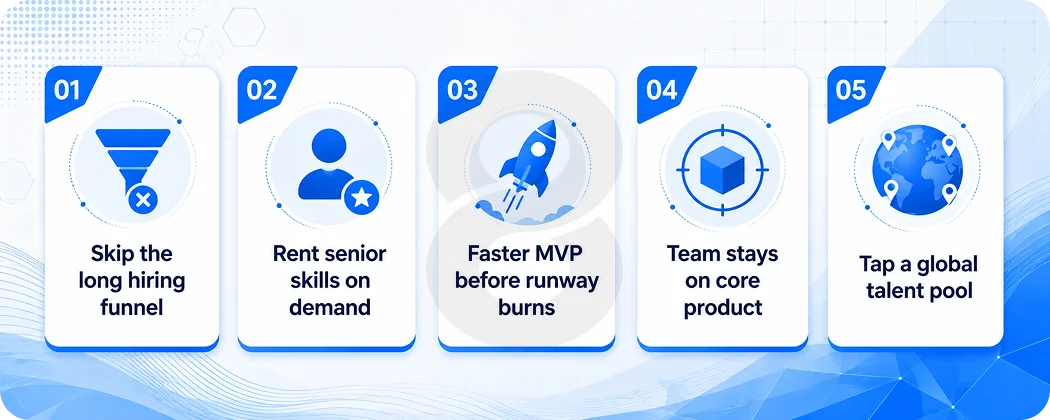
A good partner has a bench, so you skip the hiring funnel entirely and start in days. You also rent expertise you would never justify hiring full time, like a senior iOS specialist for a six week stretch. For a founder racing to get an MVP in front of real users before the runway dries up, that speed, that shorter time to market, is pretty much the entire point.
Hand over the build to a serious crew and your own people stay where they actually belong Get it right and you end up with an app that ships and a team that never once had to look up from the work that mattered.
How to Choose a Partner You Will Not Regret
This is where the work happens, and it’s pretty unglamorous stuff. Choosing which mobile app outsourcing company to trust is a vetting job. A slick website tells you nothing. Their portfolio, references, and the way they handle your tougher questions tell you everything.
The tricky part is that app development outsourcing goes wrong slowly. A lazy pick won’t bite you on day one. It bites months later, once you’re in too deep to back out.
Start with where, then narrow down to who. Geography sets your baseline. It shapes cost, time zone overlap, and how painless the daily back and forth is going to be. Once that’s settled, you’re judging individual companies on evidence, not on how confident the sales rep sounds on the call.
Pick your location model honestly
Offshore app development, nearshore software development, and onshore development are not better or worse. They are trade offs, and the right one depends on how much you value cheap hours versus easy overlap.
| Model | What you gain | What it costs you |
|---|---|---|
| Offshore | Lowest rates, access to a deep global talent pool, round the clock progress | Time zone gaps, more deliberate communication, culture fit work |
| Nearshore | Close time zones, easier real time calls, decent rates | Smaller talent pool, prices above offshore |
| Onshore | Same hours, same language, simplest collaboration | Highest cost, tighter availability of niche skills |
If your project needs constant back and forth, a nearshore or onshore team saves you grief. If the spec is clear and the budget is tight, offshore is hard to beat. Many teams end up blended, with a nearshore lead and an offshore build crew.
Read More: Choosing Time Zone Compatible App Developers
Read the portfolio like a skeptic
Anyone can list logos. What you want is a project that looks like yours in complexity. A vendor whose portfolio is all simple brochure apps is not your pick for a real time, payment heavy build, no matter how nice the screenshots are.
Ask for case studies with outcomes attached, not just pretty mockups. Then check independent reviews on Clutch or GoodFirms, because a company’s own testimonials are marketing and the directory reviews are closer to the truth.
If a partner has shipped polished mobile apps in your category before, they already know the regulations, the edge cases, and the design patterns your users expect.
Read More: Mobile App Development Team – Hiring Tips for Businesses
Ask the questions that reveal the truth
The good questions are boring on purpose. How do you handle scope changes mid project? Who owns the code? What does your QA process look like? What happens after launch? A serious partner answers these crisply because they have lived them. A risky one gets vague.
Picking the Right Engagement Model
Your engagement model is the quiet decision that shapes everything downstream. It sets who carries the risk when the project changes, and projects always change.
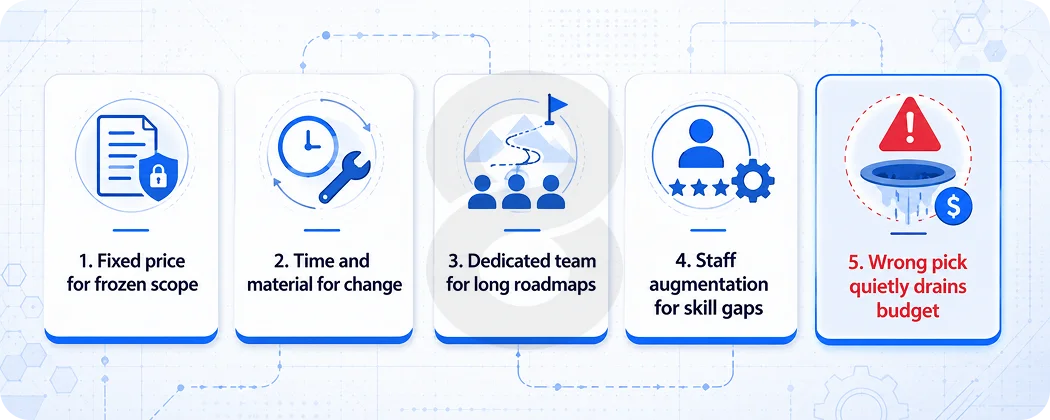
Three models do most of the heavy lifting when you outsource mobile app development, and each one is really there to protect a different thing. There’s a fourth, staff augmentation, hanging off to the side for teams that just need a couple of extra hands, not a whole crew.
Most teams slip up with mobile app development outsourcing by picking the model that feels safest in the gut. And the safe feeling option is usually the one that quietly costs you later.
A locked budget feels safe, until the spec shifts and you cannot move. Hourly billing feels flexible, until the invoice arrives and flexibility looks a lot like a budget overrun.
Fixed price works when the spec is frozen
In a fixed price model, you agree on the full scope and the full cost upfront. The partner carries the risk of going over. This gives you predictability, which finance teams love, and it works beautifully for projects where the requirements genuinely will not move.
The catch is the part nobody enjoys. Once the build starts, change is expensive and slow, because every tweak means renegotiating the contract. Fixed price punishes discovery. If you are still figuring out what the app should be, this model fights you the whole way.
Time and material works when things will evolve
Here you pay for the hours and resources actually used. The upside is flexibility. You can change direction, add a feature, drop one, and the model absorbs it without a contract fight. Most modern app builds, where the product gets clearer as you go, fit this model best.
The downside is the flip side of that freedom. Costs are open ended, so a loose scope or weak project management can let the budget drift. The time and material model rewards teams that track work tightly and trust their partner.
Dedicated teams work for the long haul
A dedicated development team is a full crew, developers, designers, and QA, working only on your product, usually month to month. You get continuity, deep context, and direct control, almost like an extension of your own staff. For a multi phase product or an ongoing roadmap, nothing beats it.
It is also the priciest option if your scope is fuzzy or your project is short. You are paying to reserve people, so you want enough work to keep them busy. If you only need to fill a single skill gap, staff augmentation is the leaner choice, since you pay for the one specialist instead of a whole team.
| Model | Budget | Best for | Flexibility | Who carries scope risk |
|---|---|---|---|---|
| Fixed Price | Locked upfront | Well defined, stable projects | Low | The partner |
| Time and Material | Pay as you go | Evolving products, unclear scope | High | Shared |
| Dedicated Team | Monthly retainer | Long term roadmaps, ongoing work | High | You |
This gets even trickier the second your build leans on heavier tech, machine learning, automation, that sort of thing. Specialist hours cost a fortune, and the last thing you want is to be paying for those people while they sit around idle.
Same story when you start bolting AI features onto a product. Scope has a nasty habit of ballooning the moment the first prototype actually works.
What It Costs to Outsource App Development in 2026
Nobody loves the honest answer here, which is that it depends. But the ranges are knowable, and knowing them is what keeps you from getting quoted a number that has nothing to do with reality.
What actually drives the cost to outsource app development is the complexity, the feature set, the tech stack, where your partner sits, and the engagement model you went with. A simple app with a few screens is a totally different beast from a real time platform juggling multiple user roles, payments, and offline support.
There’s real money riding on getting this right too, which is part of why companies spend like they mean it. The global mobile app market is on track to clear $780 billion by 2029.
Ballpark ranges by app type
The benchmarks are surprisingly consistent. A simple app with basic features puts the app development cost somewhere around $20K to $60K. Add custom design, real integrations, and a proper backend and you’re into the $60K to $150K range. A full enterprise grade build with all the bells and whistles can run $150K to $300K, sometimes a fair bit more.
Where your team sits changes the math more than anything else. The same skillset that bills around $100 an hour in North America can run a quarter of that in South Asia or Southeast Asia, with Europe sitting somewhere in between. That gap is the whole reason offshore exists.
The costs that hide in the gaps
The sticker price is almost never the real price. Ongoing app maintenance and support, app store fees, third party API costs, the odd scope change, they all pile on top of the build figure. Smart move is to park 15 to 20 percent of your budget as a buffer, because something always comes up.
If you want a grounded number before you get on a call with anyone, running your feature list through an app build cost calculator hands you something defensible instead of a wild guess. It won’t be exact. But it stops you walking into a negotiation blind.
Read More: How to Hire a Software Development Team: 12-Step Guide
The Risks That Actually Sink Projects
Most outsourced builds do not fail because the developers could not code. They fail because of soft things that nobody put in the contract. Knowing where the cracks form lets you seal them before they spread.
Fuzzy requirements
The single most common killer. A vague brief gets interpreted, and the interpretation is almost never what you pictured. The fix is unglamorous and works every time. Write the scope down in detail, define what each feature does, and review it together before work starts. Ambiguity on paper becomes rework in production.
Communication drift
Time zones, language, and culture turn small misunderstandings into multi day delays when nobody is watching. Set the cadence early. Decide your meeting times, your tools, and your escalation path on day one. A daily async update and a weekly live call catch most problems while they are still cheap to fix.
IP and data exposure
You are handing a third party your source code and sometimes your users’ data. Without paperwork, that is a real risk. A strong NDA, clear contractual ownership of the code, and compliance with whatever rules govern your industry, GDPR, HIPAA, and the rest, are not optional. Settle ownership before the first commit, not after.
Quality you cannot see
Code that runs in a demo can still be a maintenance nightmare underneath. Insist on code reviews, automated testing, and documentation as part of the deal, not as an afterthought. If a partner treats quality assurance and QA testing as a line item to cut, that tells you what you need to know.
A Practical Hiring Process You Can Actually Follow
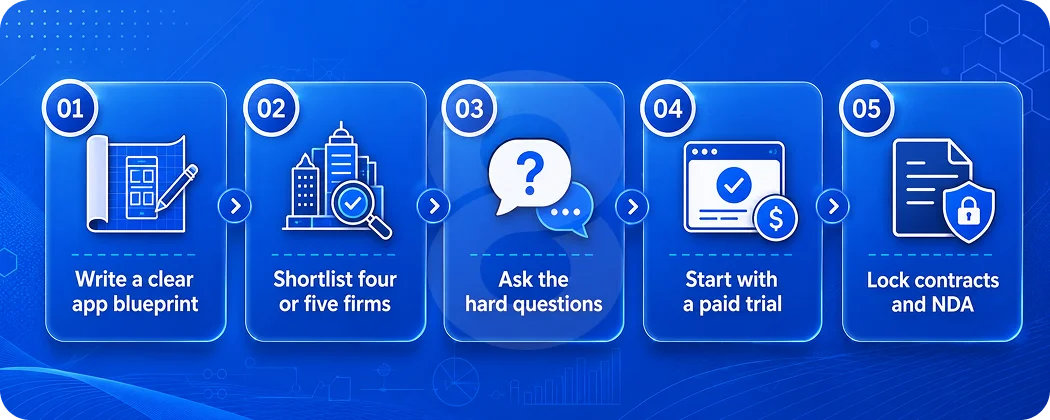
Theory is nice. Here is the sequence that keeps you out of trouble when you go to outsource mobile app development for real. Treat it as your short answer to how to hire app developers without gambling the whole budget on a first impression.
First, write your blueprint. Goals, core features sorted into must have and nice to have, target users, and a rough budget. You cannot evaluate a partner against a vision you have not put on paper.
Second, pull together a shortlist of four or five names from directories and word of mouth. Then start cutting. Their portfolios and the independent reviews will do most of that work for you. Whatever you do, don’t fall for the first slick website you land on.
Third, actually talk to them. Bring the uncomfortable questions about scope changes, code ownership, QA, and support. The real tell is how they handle not knowing something yet, because a project is mostly one long stretch of not knowing things yet.
Fourth, start small. A paid discovery phase or one tiny first milestone will teach you more about a partner than any polished sales call ever could. You find out how they communicate. How they estimate.
Whether the code holds up under a real look. And you learn all of it before you’ve handed over the full budget. The teams that come out of outsourcing happy almost always test the water before they dive in.
Fifth, lock down the paperwork. Scope, milestones, payment terms, IP ownership, an NDA, all of it signed before a single line gets written. Boring? Sure. Also the one thing standing between a clean project and an ugly dispute.
How 8ration Approaches Outsourced App Builds
Plenty of companies can write code. Fewer treat an outside engagement the way it needs to be treated, which is as a partnership with shared skin in the game. That gap is where 8ration tends to do its best work.
It starts with discovery, not development. Nobody opens an editor until the business is understood and everyone knows who the real users are and what winning actually looks like once the app is live.
That early roadmap keeps scope from drifting. It also spares you the rework that quietly eats a budget alive. After that the build moves in short agile sprints. Each one ends with something real to look at, so you’re never left guessing where things stand.
The technical range matters when your product grows past a single app. A build that starts as a mobile front end often needs a real backend, then a web companion, then an integration or two.
One partner who owns the underlying software and the app means you’re not stitching together two vendors who point fingers at each other the moment something breaks. Retail builds are the same story.
A connected eCommerce store only works when the app and the payments and the inventory logic all actually agree with each other.
When your own team is solid but stretched, the model can flex. Rather than handing off the whole project, you can add vetted engineers straight into your existing team, keeping your control while closing the capacity gap.
Read More: Offshore Software Development Guide: How to Find the Right Partner
Post launch maintenance does not just stop when the app ships either. Monitoring and feature work continue because an app that ships is the start of the work, not the end.
None of this is magic. It is mostly the discipline of doing the unglamorous things consistently, which is exactly what tired teams stop having the bandwidth to do themselves.