



Somebody on your team is going to ask this question eventually, usually right before a kickoff call with a development partner… React or Vue? The honest answer is that both frameworks build the same category of product well. The difference matters less for the app itself. It shows up in who you can hire, and in what it costs to maintain three years from now.
This guide skips the framework tribalism. We’ll walk through what each one does well and where the real tradeoffs sit. Then we’ll help you make the call for your product instead of whatever a Reddit thread told you last week.
Neither framework is going anywhere. Both have been around for over a decade, both run at real scale in production, and both will still be reasonable choices five years from now. Picking between them comes down to which one your team will actually build well with, given your timeline and how big this product needs to get.
React vs Vue: A Quick Comparison
Before going deeper, here’s the short version.
| Category | React | Vue |
|---|---|---|
| Maintained by | Meta | Independent core team (created by Evan You) |
| First released | 2013 | 2014 |
| Type | UI library (needs routing and state tools added) | Progressive framework (ships more built in) |
| Template style | JSX, markup and logic mixed in JavaScript | HTML-based templates, closer to plain markup |
| Typical use case | Large, complex, long-lived products | Small to mid-size products, faster builds |
| Mobile path | React Native | NativeScript-Vue or Ionic Vue (smaller ecosystem) |
| Meta-framework | Next.js | Nuxt |
What is React
React is a JavaScript library maintained by Meta. It builds interfaces from components… small pieces of UI that tracks its own state and updates when something changes. Rather than rewriting the whole page React keeps a virtual copy in memory, works out what’s different, and touches only that. That’s where most of its early performance reputation came from.
Being a library rather than a framework means React deliberately stays out of decisions it doesn’t need to make. You pick your own router. React Router is what most teams reach for. You pick your own state management tool, Redux for larger apps, and Zustand when you want something lighter. Teams that want full control over their stack find that freeing.
The side effect is that two teams both working in React can end up with codebases that look nothing alike. There’s no prescribed way to put a React project together, which is either a feature or a problem depending on who’s running the team.
React 19 shipped Server Components and a compiler that automates the performance work developers used to handle themselves. Most production apps today run on Next.js, which adds routing and server rendering so nobody has to wire that up from scratch.
The stronger argument for React isn’t the library itself. It’s everything built around it over the past decade. Off-the-shelf component libraries and a hiring pool deep enough that finding someone who already knows React well isn’t a six-month search.
Read More: React vs Angular: Which Framework Should You Choose for Your Next Web App?
What is Vue
Evan You built Vue in 2014 after getting fed up with how much overhead Angular dumped on a small project. It’s remained its own thing since, no big company calling the shots on its roadmap the way Meta does with React.
React blends markup and logic straight into JavaScript. Vue does it differently, giving each component its own file with the HTML, script, and styling sitting together. Open a random .vue file and it reads almost like a webpage. That sounds like a small detail until you hand a junior developer a Vue component and watch them figure out what it does without anyone walking them through it first.
The Composition API showed up in Vue 3 and it gives developers a way to organize logic that goes toe-to-toe with React hooks. Though the old Options API hasn’t gone anywhere for teams that just want to keep it simple.
Vue also ships with its own routing and state tools baked in, Vue Router and Pinia, so nobody starting a fresh Vue project has to dig through a pile of competing npm packages before writing a single line that matters. Next.js does this for React. Nuxt does the same job for Vue, handling server rendering and file-based routing without anyone having to wire it up by hand.
Ask what Vue is really selling, and it’s this: fewer choices standing between a team and their first line of product code. Routing and state are already sorted, which explains why solo founders and small teams keep reaching for it.
Read More: 10 Top Web Application Development Frameworks
How React and Vue Perform in 2026
Framework debates always want to start with performance, which is usually where the whole argument falls apart. Both frameworks run fast enough for almost anything you’d actually build today. Sure, there are real differences between them. They’re worth knowing about. Just don’t expect them to be the thing that makes this decision for you.
Adoption and market share
On raw adoption, the gap between the two is large and has stayed large for years. Data from npm trends shows react pulling well over ten times the weekly package downloads that vue gets, with a GitHub star count roughly four to five times higher. That gap reflects React’s dominant position in enterprise and startup tooling rather than anything about code quality. W3Techs’ usage tracking tells a similar story on live websites, with react running on several times as many sites as vue.
Rendering approach and bundle size
Where it gets more interesting is bundle size and rendering approach. React leans on a virtual DOM, so it builds a JavaScript version of the page first and checks it against the real thing before touching anything. Vue skips all that. It only cares about the pieces of state a component’s actually using, and it just updates those, nothing more.
Throw them both into a synthetic benchmark and Vue tends to win on raw rendering speed for certain patterns. Get them into a real app, though, and that advantage mostly disappears, because the real bottleneck usually isn’t rendering at all. It’s network calls and third-party scripts.
Bundle size tells a similar story. React itself is lightweight, but by the time a real project pulls in react-dom plus whatever routing and state libraries the team picked, the total climbs fast. Vue starts heavier since more comes bundled in, though tree shaking cuts a good chunk of that once you’ve got a build step running.
Neither number says much about what a user on a slow connection will actually feel. That comes down to network requests and third-party scripts, which matter a lot more than the few kilobytes separating these two frameworks.
What this means for your product
Build a sloppy React app and it’ll drag. Build a sloppy Vue app and the same thing happens. Framework choice barely factors in compared to how your components are structured and whether your team bothers with lazy loading and code splitting.
Read More: Web App vs Native App: A Complete Comparison for Business Owners
Learning Curve and Everyday Developer Experience
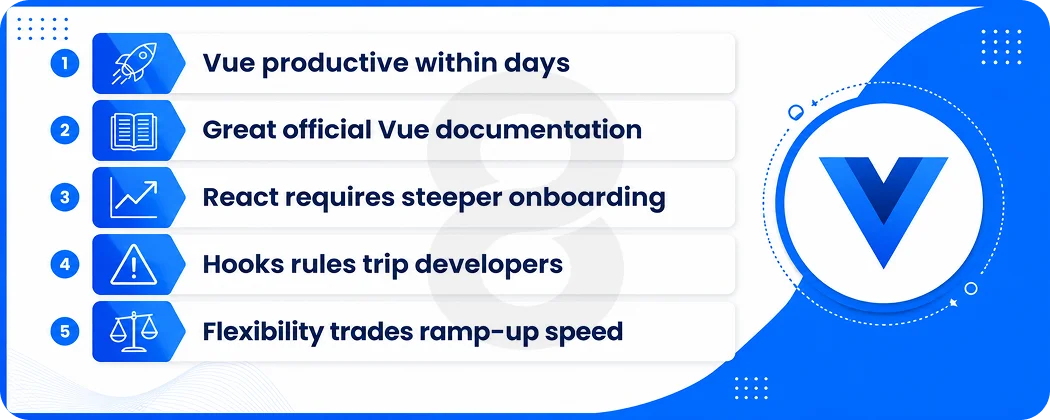
This is where the two frameworks pull apart in a way that shows up directly in your delivery timeline. Vue reads more like the HTML it renders. Its single-file components keep everything for one piece of UI in a single file. New developers tend to get productive in Vue within days rather than weeks. The official documentation is also unusually good, which matters more than people expect when a team is ramping up under deadline pressure.
React asks more of a new developer up front. JSX mixes markup directly into JavaScript, which takes some adjustment. Hooks come with real rules (don’t call them conditionally, respect the dependency array in useEffect) that trip up even experienced developers moving from class components.
And because React doesn’t ship an opinionated way to handle routing or state, a new hire also has to learn whatever combination of third-party libraries your specific team chose. That’s a strength for flexibility and a real cost for onboarding speed.
None of this makes React “harder” in any absolute sense. It makes React slower to onboard into and faster to scale within, once a team has already climbed the curve together.
Read More: Web App Design Pricing in 2026: Packages, Hourly Rates & What You Get
Ecosystem and Hiring for React and Vue

If you’re trying to figure out who you can actually hire two years from now, this part matters more than any technical comparison in this article.
The 2025 Stack Overflow Developer Survey has React sitting at nearly 47 percent among professional developers, about two and a half times what Vue pulls in the same group. Angular’s not far behind Vue either, hovering in the high teens. React edges out Vue on developer satisfaction too, though that gap is nowhere near as wide as the usage gap.
What it comes down to is simple: there are more React developers out there to hire, more job listings written specifically for React, and a deeper bench of freelancers and agencies who already know their way around it.
Vue’s crowd is smaller, but it’s a loyal one, and it’s especially strong in parts of Asia, where companies like Alibaba and Xiaomi have built real scale on top of it. Both ecosystems have their own component libraries and testing tools, but React’s version of everything tends to run longer, mostly because more people are out there building for it.
That doesn’t automatically make it the better pick, though. Vue’s smaller world is also tighter, with less clutter and fewer half-abandoned packages sitting around to trip you up.
Decisions like this are exactly where a second opinion earns its keep, especially if you’re still torn between building this in-house or bringing in a partner. Our software consulting team has these conversations with founders all the time, weighing what the hiring market actually looks like against where your product needs to go, instead of just chasing whatever framework is having a moment.
Architecture and Scalability for Growing Products

Both frameworks scale to large, complex products. Plenty of enterprise-grade apps run on each. The real question is what scaling on top of either one requires from your team.
React’s flexibility means a growing product accumulates architectural decisions over time: which state management library, how components are organized, how shared UI gets built into a consistent design system. That last piece matters more than people expect.
A product without a disciplined component library turns into a patchwork of slightly-different buttons and forms within a year. Getting that structure right early, through proper UI and design system work, saves a rewrite later.
Vue’s defaults are more opinionated, Vue Router, Pinia, one clear way to structure a component, so a lot of that architectural drift just doesn’t happen in the first place. There are still real calls for a team to make. There just aren’t as many of them starting from a blank page. Testing works the same way.
Both frameworks play nice with whatever modern testing setup you throw at them, but honestly, whether a team actually bothers testing well matters a lot more for how the codebase ages than which framework they picked. A product with good test coverage stays easy to change for years. A product without it gets harder to touch with every release, regardless of the framework underneath it.
Neither framework handles your backend for you, and neither one is the piece that usually breaks first as a product grows. That’s almost always the layer connecting your frontend to internal systems and legacy tools. Getting that system integration layer right early tends to matter more for long-term stability than which JavaScript framework renders the buttons.
Read More: Cross-Platform vs Native App Development: Which Should You Choose for Your Business App?
Mobile and Cross-Platform Considerations

Here’s where React and Vue stop being a coin flip: mobile. If there’s even a chance a mobile app shows up on your roadmap, pay attention to this part.
React’s got React Native in its corner and it borrows enough of React’s own syntax and thinking that a team already deep in React can jump into it without relearning everything from scratch. This isn’t some side project either.
Companies pushing apps to hundreds of millions of users run on it daily. Vue’s side of things, NativeScript-Vue, Ionic with Vue, technically works, sure. But the ecosystem’s a lot thinner and you’ll end up burning time on problems that nobody’s already solved and written up somewhere.
Here’s the real test: are you after something that genuinely feels native down the road, or would a mobile-friendly website do the job? If it’s the former, React starts looking like the obvious call. If mobile’s still just a “maybe someday” and not something you’ve actually committed to, don’t let it drive the whole decision.
Teams that get this right tend to think about it in the context of cross-platform app development as a whole, not just assume today’s pick locks them into one mobile route forever.
One more thing worth saying: a frontend that behaves in the browser and one that actually survives contact with real users aren’t the same thing. Skip structured QA and that gap won’t show up in testing. It’ll show up in production, right when you can least afford it.
Where Each Framework Fits in Real Products

Abstract comparisons only get you so far. Here’s how the choice tends to play out on actual products.
Fintech dashboards and trading tools
These lean toward React more often than not, mostly because of deeper data visualization libraries and a larger talent pool for handling the compliance-heavy edge cases these products accumulate. Teams building in this space often work with partners who understand the sector’s specific constraints, from audit trails to data residency, through dedicated fintech software development support rather than treating it like a generic web app.
Read More: Fintech App Development: Complete Guide
Ecommerce storefronts
This split’s more even than the last one. Vue and Nuxt let you ship fast and still get clean server-rendered pages out of the box, which makes it a solid pick for a storefront that needs to rank well and load quick without hiring out a whole frontend team to pull it off. React’s not far behind here either. Pair it with Next.js and you’re covering the same ground, just with a wider ecosystem of plugins and integrations built specifically for commerce.
Read More: eCommerce App Development: Complete Guide
Honestly, most businesses in this space would get more mileage out of nailing down the right expertise for their actual platform, Shopify, headless setups, custom checkout flows, than getting stuck debating frameworks.
SaaS products and marketing sites
SaaS products with complex internal dashboards and long product roadmaps tend to land on React, mostly for the hiring reasons already covered. Marketing sites and smaller internal tools often ship faster on Vue, where a small team doesn’t need to make as many upfront architectural decisions.
Read More: Custom Web App Design for SaaS Startups: Our Process Explained
Healthcare portals and education platforms
These show up on both sides fairly evenly. The deciding factor there is usually less about the framework and more about data privacy and integrations with existing record systems, which is a conversation worth having with whoever builds the product rather than settling on a framework in advance.
Read More: Healthcare Web App Development Guide
Cost and Timeline Implications
Founders usually ask about performance first and cost second, when it should probably be the other way around.
Developer rates for React and Vue are closer than people assume. React’s larger talent pool can mean more competition for senior developers in tight markets (which pushes rates up), while Vue’s smaller pool means fewer options but sometimes faster availability for mid-level work. Neither framework is reliably “cheaper” on an hourly basis.
The real difference in cost shows up in build time. Vue’s built-in tooling and shorter learning curve tend to shave real time off a project’s early weeks, especially for teams without an existing frontend architecture already in place. React’s flexibility can add planning time upfront but often pays that back on larger products where the extra structure keeps a growing team organized.
Cost has less to do with React versus Vue and more to do with how well-scoped your product requirements are before development starts, and how much of the timeline gets eaten by decisions made mid-build instead of before it. If you want a clearer number before committing to either direction, our web app cost calculator gives a realistic range based on your actual feature list rather than a framework name.
Common Mistakes Founders Make Choosing a Frontend Framework

A few patterns show up often enough to call out directly.
Picking based on what one developer already knows
If your only technical input is a single freelancer’s comfort level, you’re optimizing for one person’s ramp-up time instead of your product’s next three years. That’s a reasonable factor to weigh. It shouldn’t be the only one.
Ignoring what a future migration would cost
Switching frameworks after a product has real users and real revenue is a painful, expensive project that can take months, rather than something you knock out over a weekend. Whichever framework you pick, plan as if you’re picking it for good.
Treating performance as the deciding factor
As covered above, both frameworks perform well when built correctly. Teams that pick based on a benchmark blog post often end up with the same performance problems either way, because the problems were architectural.
Underestimating integration complexity
The frontend framework is rarely the hardest part of a product. Connecting to payment processors or legacy internal systems usually eats more engineering time than the UI layer does, and that work looks similar whether the frontend is built in React or Vue.
So Which One Should You Choose: React or Vue?
There isn’t a universal right answer here, but there is a useful framework for making the call.
| If you need this | Choose |
|---|---|
| The largest possible hiring pool and long-term flexibility | React |
| The fastest path to a working product with a small team | Vue |
| A genuine native mobile app down the line | React (via React Native) |
| Fewer architectural decisions made from scratch | Vue |
| A complex, long-lived enterprise product with heavy customization | React |
| Strong SEO and fast page loads with less frontend overhead | Vue |
How 8ration Helps You Choose Between React and Vue

We build production products in both React and Vue, and we don’t have a house preference we’re trying to talk you into. What we have is a process for matching the framework to the product in front of us, instead of defaulting to whatever stack the last project happened to use.
If you’re at the stage of comparing frameworks, you’re close enough to a real build that it’s worth getting a second set of eyes on the decision before it gets expensive to reverse. Tell us what you’re building and we’ll walk you through the tradeoffs that apply to your specific product instead of a generic list.