


You know that feeling on a Thursday night, two days out from a launch, when someone on Slack types “wait, I thought you were handling that”?
The whole room goes quiet. A task everyone figured was finished has been sitting there for a week, untouched, because it never made it out of somebody’s head and onto the board. Nobody dropped it on purpose. It was just invisible.
That moment is where deadlines go to die. The problem lives in the gap between what people think is going on and what is actually going on.
For years the standard answer was to throw more meetings at it. Teams piled on standups, status updates, and “quick syncs” that ate an hour and clarified nothing. That never really worked, and the numbers say so.
McKinsey looked into it and found that only one in fourteen IT projects actually ships on time and on budget. The ones that miss even a single target? They run about 46 percent past schedule on average.
The shift happening now is quieter and more useful. Instead of asking people to remember everything, teams are building systems that remember for them.
That is the real promise of project management software development and it is why teams that used to live in permanent crunch are starting to ship on the date they promised.
Why Teams Keep Missing Deadlines in the First Place
Before any tool can help, it helps to be honest about why dates slip. It is rarely one big disaster. It is a hundred small leaks.
The plan and the reality stop matching
A project plan is really just a snapshot. The moment work starts, reality begins drifting away from it. You forget a dependency. The task you scoped at two days quietly stretches into two weeks. Then someone with a stake in the thing changes their mind in week three.
With no live view of any of this, the plan ends up as a document nobody really trusts, so people just start guessing. And it is not a rare problem either.
In a survey, Wellingtone found that 36 percent of organizations deal with regular delays that trace back to fuzzy requirements alone. That is not a tooling problem at first. It becomes one when there is no system to catch the drift early.
Coordination eats the day
Here is the thing that never makes it into the postmortem. So much of the lost time is just people waiting on each other, chasing down who owns what, and piecing back together the context they dropped while bouncing between five different apps.
One number that gets thrown around a lot pegs the productivity hit from clunky collaboration tools at about 20 percent of a team’s week. That is basically a whole day, every week, burned on coordination headaches instead of actual building. And poor communication by itself takes the blame for something like 30 percent of project failures.
Nobody sees the blocker until it is on fire
Blockers are sneaky things. A task stalls out because it is waiting on some decision that nobody was ever actually put in charge of making. So it just lingers there, quietly. And by the time it finally comes up in a meeting, it has already eaten three days.
Strong teams burn out under this kind of friction, and their skill is not the reason. What actually decides things is whether the system around them surfaces trouble while it is still cheap to fix.
What Project Management Software Development Actually Changes
Good project management software development does not make people work faster. That is the marketing version, and it is a lie. What it actually does is remove the reasons people slow down.
Think about the difference between a kitchen during a dinner rush with no system and one with a ticket rail. Same cooks, stove, and orders. One is chaos and one is a rhythm. The rail does not cook anything. It just makes sure nothing gets forgotten and everyone knows what is next. Project tooling is the ticket rail for software work.
When it is built right, three things change. Work becomes visible, so the “I thought you had it” conversation stops happening. Ownership stops being fuzzy, so every task has an actual name on it and everyone agrees on what finished looks like. And the dependencies stop hiding, so you can see that task B is stuck until task A wraps up, instead of learning it the hard way.
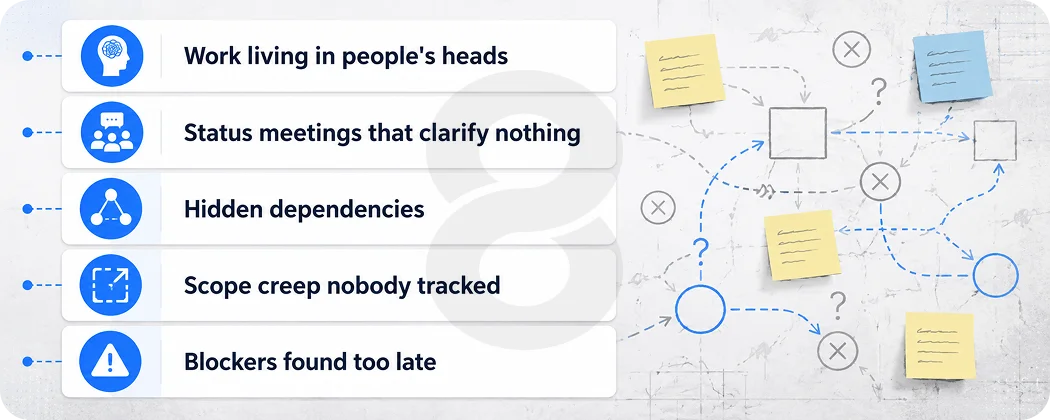
What slips deadlines |
What it costs you |
What purpose built tooling does about it |
|---|---|---|
| Work living in people’s heads | Forgotten tasks, last minute scrambles | Puts every task on a shared board with an owner and a due date |
| Status meetings that clarify nothing | Hours lost, decisions delayed | Replaces the daily update with a board everyone can read in ten seconds |
| Hidden dependencies | Integration delays, broken handoffs | Maps what must finish before the next thing can start |
| Scope creep nobody tracked | Quiet overruns, missed launches | Logs every change so the timeline updates honestly |
| Blockers found too late | Days lost per stall | Flags stalled work the moment it stops moving |
The teams that get this right stop treating the software as a place to report work after the fact. They treat it as the place the work lives. That one mental flip, from “place to report work” to “the actual source of truth,” is the whole difference between a board that pulls its weight and a board that is just one more thing to keep updated. And when a team’s workflow is too particular for a generic template, that usually means going with software shaped around how the team already works rather than the other way around.
Read More: Offshore Software Development Guide: How to Find the Right Partner
The Features That Actually Move Deadlines
Not every feature matters. A lot of project tools are bloated with stuff that looks good in a demo and never gets used. Here is what actually pulls a deadline closer, drawn from how high performing teams use these systems.
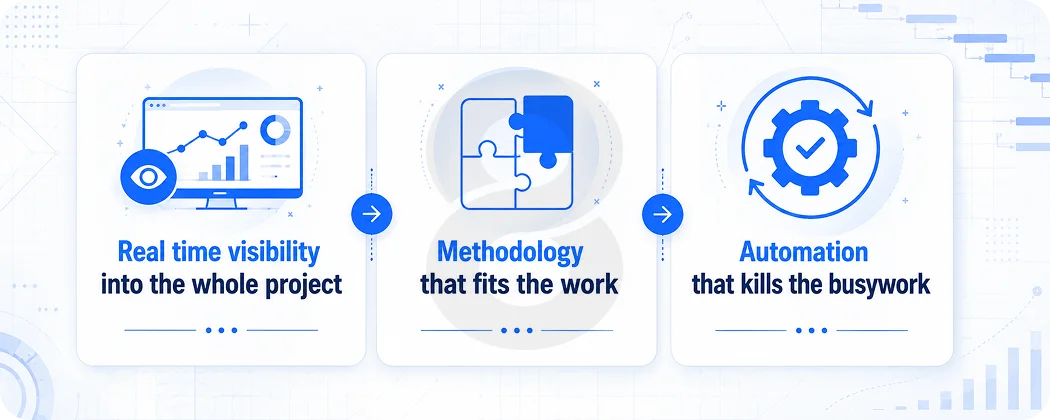
Real time visibility into the whole project
A live dashboard is the difference between knowing where you stand and hoping. When a project manager can see, in one glance, what is done, what is moving, and what is stuck, they can act on day two instead of day twelve.
The data backs this up. Strong project tooling shows up as a factor in 77 percent of successful projects, and teams report communication improving by more than 50% once everything sits in one shared space.
Methodology that fits the work
There is no single right way to run software work. The wrong move is forcing every project through the same playbook. Agile is the right fit when the requirements won’t sit still. Waterfall still pulls its weight in regulated worlds like healthcare or finance, where every step has to leave a paper trail.
Most teams these days end up somewhere in the middle, and about nine out of ten project managers now say they run some kind of hybrid setup.
Methodology |
When it fits |
How it helps you hit dates |
|---|---|---|
| Scrum | Evolving requirements, frequent shipping | Short sprints create real deadlines every two weeks instead of one far off date |
| Kanban | Priorities that shift week to week | A pull system keeps work flowing and exposes bottlenecks fast |
| Waterfall | Stable scope, heavy compliance needs | Sequential phases keep everything documented and audit friendly |
| Hybrid | Most real world software work | Plans at a high level with waterfall, executes day to day with agile |
Automation that kills the busywork
Think about every minute you lose dragging a card across a board, retyping a date somewhere else, or hunting someone down for a status update. That is time you could have spent actually building something. Automation just quietly takes all that repetitive work off your plate, so the timeline stays up to date on its own and nobody is stuck babysitting it.
The numbers add up too. The average manager claws back roughly 153 hours a year just by letting the software deal with the small recurring tasks, and that is nearly a full month of work.
How AI is Changing the Way Teams Hit Their Dates
This is the part that has genuinely shifted in the last year, so it is worth slowing down on.
For a long time, project software was passive. It held your data and showed it back to you. You still had to do all the thinking about what might go wrong. The newer wave of project tooling flips that. The system starts doing some of the watching for you.
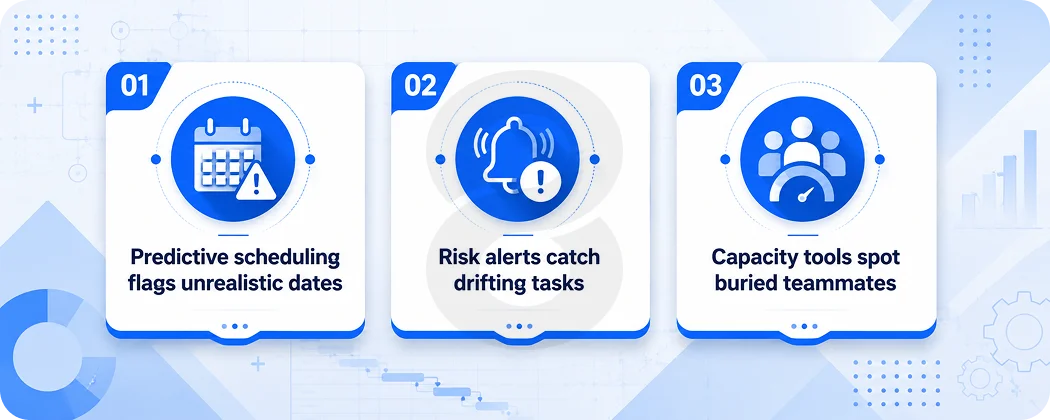
Predictive scheduling watches how your team actually works and tells you a date is wishful thinking before you go and promise it to someone. Risk alerts catch a task that is drifting late based on the pattern it is showing. And capacity tools tap you on the shoulder to say the person you just handed three tasks to is already drowning.
By 2026, roughly 80 percent of project management offices are expected to lean on AI for the calls they make, and more than 70 percent of project professionals say their companies are already using it or poking around with it.
However, Slapping AI on top of a broken process just lets the chaos pick up speed. McKinsey looked into this and found the companies pulling real value out of AI had one thing in common and it was not their toolkit.
They had gone back and fixed how the work actually moves. So the AI pays off when the system beneath it already knows who owns what and how the pieces connect. Give it a mess and you just get that mess, faster.
That is why the smartest teams treat AI as a layer on top of a solid foundation. The ones who get this build AI tools that flag a slipping timeline on top of a process that already works, instead of hoping the algorithm will paper over the gaps.
Read More: Time Tracking Software Development: Features, Tech Stack & Timeline
Buy Off the Shelf or Build Your Own
Here is the honest answer most agencies will not give you. For a lot of teams, an off the shelf tool is fine. If your process is fairly standard and your team is small, paying for an existing platform and moving on with your life is the right call. Do not build what you can rent.
The case for custom work shows up when your workflow stops fitting the box.
Maybe you run a manufacturing operation where project stages map to physical production lines. Or you are coordinating field crews who need a mobile app that keeps people in the field on the same board as the office, with patchy signal half the time.
Sometimes it comes down to an ecommerce build staring down a hard seasonal launch date, where the generic tool simply cannot model your release dependencies. At that point you are bending your team around the software, paying in lost hours every single day, and the math quietly tips toward building something that fits.
There is also the integration problem. A project tool that does not talk to your codebase, your billing, and your customer data becomes one more island people forget to update. A custom build can wire the board directly into the systems where work actually happens, so the timeline updates itself instead of waiting for someone to remember.
How 8ration Helps Teams Build Software That Hits the Date
8ration approaches project management software development a little differently from the usual “here is a template, good luck” model.
It starts with the dull part most vendors would rather skip. Before anyone designs a single screen, the team digs into how your projects really move, where things keep getting stuck, who actually owns what, and which handoffs keep breaking down. That diagnosis is where most of the deadline problem has been hiding all along.
Only then does 8ration build tooling around the way your team already works, instead of bending your process to fit somebody else’s idea of best practice.
That might be a dashboard that puts blockers in front of you the moment they appear, dependency mapping that flags an integration before it goes sideways, or predictive scheduling that calls a date fantasy before you promise it to a client.
And when a crunch hits and the team is stretched thin, it can mean doing staff augmentation for the push without slogging through a six month hiring cycle.
What ties it together is the refusal to treat the tool as the whole answer. The software is built to support a clear process. That is a less exciting pitch than “our AI will transform your delivery,” but it is the version that actually gets teams shipping on the date they committed to.
The global market for these tools keeps climbing, on track to grow from around $11.3 billion in 2026 to more than $23 billion by 2031, and the teams getting real value out of that spend are the ones who fixed the process first and bought the software second.