


A reviewed shortlist of the top AR app development companies in 2026, pulled from Clutch and GoodFirms, with what each one is actually good at and how to pick.
Most “top AR companies” lists have the same problem. They rank studios by a star rating that was earned building VR training modules or generic mobile apps, then file the whole thing under augmented reality and hope nobody checks. The rating is real. The AR experience behind it often is not.
The global augmented reality market was valued at around $140.34 billion last year and Fortune Business Insights projects it will go to $2.3 trillion by 2034 at a compound annual growth rate above 35%. Money like that pulls in every software agency that can spell ARKit so the filtering matters more than the ranking.
The list below leans on two directories that actually verify their reviews, Clutch and GoodFirms, and it favors companies with AR project history on file rather than a services page with the word “augmented” pasted near the top. Some picks come from Clutch, some from GoodFirms, and a few show up strong on both.
How We Evaluated These AR App Development Companies
Ranking AR app development companies is messier than a clean top-10 list makes it look, and any article pretending it ran structured interviews with every studio is lying to you. Nobody called all ten. That is not how these lists get built.
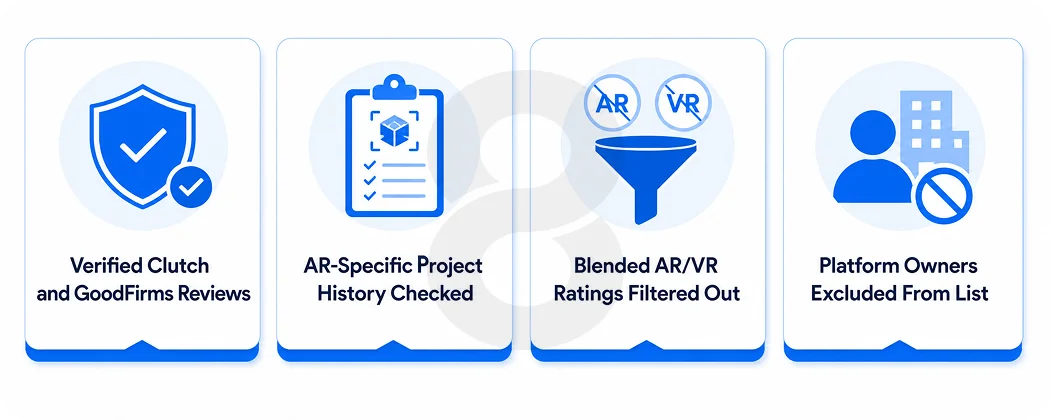
What actually happened is a pull from Clutch’s live AR and VR directory and GoodFirms’ AR and VR development category, both current as of July 2026, cross-checked against the reviews each company earned on augmented reality projects specifically rather than its blended average.
That distinction does most of the work here. Both directories file AR and VR under one heading, so a studio can carry a 5.0 built almost entirely on VR training simulators and still appear at the top of an “AR company” search.
Clutch makes the check easy, because each profile breaks reviews down by service line and tags project highlights by type. GoodFirms does the same through its portfolio audits. Anyone shortlisting a vendor should be reading those tags before the first discovery call.
Location, team size, founding year, and starting budget came straight from each company’s directory profile. None of it is paid placement, and where a company’s own portfolio is the source rather than a verified review, that gets flagged in the writeup.
A few names that dominate other versions of this list got left out on purpose. Platform owners like Snap, Niantic, and Apple build the AR tooling everyone else builds on, which is a different business than developing custom AR apps for a client. Hardware vendors selling smart glasses with software attached got the same treatment.
The 10 Best AR App Development Companies in 2026
Ten companies made the cut. The bar was a strong verified rating, review depth, and documented augmented reality work rather than a generic immersive-tech pitch. Roughly half lead with Clutch data and half with GoodFirms, and several earned their spot on both.
 8ration
8ration runs its AR work out of its New York office as part of a wider practice that spans mobile apps, game development, AI, and blockchain, with delivery teams across North America, the Middle East, and South Asia.
On the immersive side, its wearable development group covers augmented reality, Apple Vision Pro, VR, and metaverse builds, and that placement matters. AR done well is rarely a standalone app; it is 3D content, computer vision, and a mobile product stitched into one thing, and 8ration keeps those disciplines under one roof.
8ration’s strengths include:
- AR built into real mobile products rather than as a demo, covering retail try-on, product visualization, spatial navigation, and training overlays on ARKit and ARCore
- In-house Unity, 3D art, and computer vision talent, so the 3D pipeline and object recognition are engineered rather than outsourced mid-project
- An engineering model that works as an extension of a client’s product team instead of a black-box vendor
- A support model that stays involved after launch, which matters more in AR than almost anywhere else because ARKit, ARCore, and visionOS ship breaking changes on their own schedule
- Apple Vision Pro and spatial computing capability for teams planning past the phone
Notable Work: A cross-industry portfolio of more than 2,500 organizations, with immersive and 3D work delivered through its wearable and game development practices. Prospective clients can request AR-specific case studies directly rather than relying on a directory tag.
Ideal For: Teams that want AR built as part of a shipping product with the mobile and computer vision work handled by one partner instead of three.
Founded: Operating since 2014, incorporated in 2024
Location: New York, NY
Employees: 50 to 249
Pricing: 100 to $149 per hour
Rating: ⭐⭐⭐⭐⭐ 4.9/5 Clutch | 5/5 GoodFirms
 YORD
YORD
Clutch’s global VR and AR ranking has one name at the top right now, and it is YORD. 43 verified reviews put it there. The Prague studio does almost nothing except immersive work, about 90% of its billings, and its clients keep describing the same experience in their reviews: YORD showed up at strategy, stayed through creative production, and was still around running the deployment on-site. Few studios this visible have kept that kind of focus.
YORD stands out for:
- A near-total focus on immersive work, so AR is the main business rather than a line item
- A delivery model that bundles strategy, 3D content, technical build, and post-launch support into one engagement
- Recognition from Deloitte and multiple XR awards, alongside a client list its portfolio names among global consumer brands
Notable Work: The portfolio names get attention first, and fairly: a mixed-reality configurator for Bentley, an AR game for L’Oréal wired with real-time analytics, and a Formula 1 experience built for Apple Vision Pro.
Those come from YORD’s own site, so treat them as claims. What Clutch has actually verified is different work but the same range, an interactive VR platform for a telecom client where YORD carried the whole thing, storyboard to character design to 3D modeling.
Ideal For: Global brands past the pilot stage. If the AR needs to move an engagement number, not just impress a boardroom, this is the tier.
Founded: 2016
Location: Prague, Czech Republic
Employees: 10 to 49
Pricing: 100 to $149 per hour
Rating: ⭐⭐⭐⭐⭐ 4.9/5 Clutch (43 reviews)
 Treeview
GoodFirms ranks Treeview first in its entire AR and VR category. Here is the interesting part. Almost everyone else on that list pads the immersive practice with web work, staff augmentation, whatever pays. Treeview does not. 100% AR and VR, nearly all of it in Unity, and the client list reads like proof: Microsoft, Medtronic, ULTA Beauty, Transfr.
The projects skew heavy too. Guided workflows, digital twins, interactive data visualization. You will not find a one-off Instagram filter carrying this portfolio.
Treeview brings:
- Total specialization in immersive development, with no generalist services diluting the bench
- Deep Unity engineering aimed at production-ready enterprise AR across headsets, glasses, and mobile
- A documented pattern of long-term client relationships rather than single-project engagements
Notable Work: Custom AR and VR built from scratch in Unity for a manufacturing company, an AR mobile app developed with a mechanical engineering school, and an Instagram AR filter for a marketing agency, per its verified Clutch reviews.
Ideal For: Enterprises where the AR has a job. Workflow guidance, live data on a factory floor, systems integration. Decoration budgets should shop elsewhere.
Founded: 2016
Location: Montevideo, Uruguay (studio) / New York, NY (registered)
Employees: 10 to 49
Pricing: 100 to $149 per hour
Rating: ⭐⭐⭐⭐⭐ 5/5 Clutch (15 reviews)
 Saritasa
Very few companies rank near the top of Clutch and GoodFirms at the same time. Saritasa does, and the numbers underneath hold up under a closer look. 106 Clutch reviews overall, and within those, every single one of the 15 tagged to AR/VR work is five stars. Fifteen for fifteen.
The Newport Beach team is not a pure immersive shop, though, and in this case that is an asset. Custom software makes up a large share of the practice, so when an AR feature has to pull from a sensor, a legacy platform, or a piece of physical machinery, the integration muscle is already in the building.
Saritasa is worth a look for:
- A services mix that pairs a strong AR and VR practice with 40% custom software, so immersive features connect to the rest of the system instead of floating beside it
- A track record with industrial and hardware-adjacent clients, where AR usually has to integrate with sensors, machinery, or field data
- Enough scale to staff a multi-year build without scrambling, at 50 to 249 employees
Notable Work: An AR and 3D educational tool built for a liquid bulk chemicals company, translating technical concepts into interactive multimedia, per its verified Clutch reviews.
Ideal For: Industrial and medical device teams, or anyone whose AR has to talk to hardware. The software integration depth is the reason to call.
Founded: 2005
Location: Newport Beach / Irvine, CA
Employees: 50 to 249
Pricing: 100 to $149 per hour
Rating: ⭐⭐⭐⭐⭐ 4.8/5 Clutch (106 reviews) | 5/5 GoodFirms (13 reviews)
 Lucid Reality Labs
A perfect 5.0 over 41 Clutch reviews would be enough to earn a spot here on its own. What actually makes Lucid Reality Labs interesting is where those reviews come from. Most AR studios stay far away from healthcare, because the tolerances are brutal, and this Miami team went there anyway and built a practice around clinical-grade medical simulation.
About three-quarters of its work is immersive. Read through the reviews and one compliment keeps repeating: the storytelling. Making a branded activation emotionally engaging is one skill. Doing it with a medical procedure as the subject is another one entirely, and apparently they pull it off.
Lucid Reality Labs brings:
- A healthcare and life sciences depth that most generalist AR studios cannot match, alongside education and advertising work
- Delivery discipline that shows in the numbers, since more than 90% of reviewers mention hitting the timeline and the budget
- Range beyond the clinical work, including AR portals and interactive branded activations built to hold attention
Notable Work: A set of immersive experiences its recent reviews single out, including AR portal work and an AI-driven interactive character experience, plus medical simulations used for training and patient safety.
Ideal For: Healthcare and pharma above all. Any project where “mostly works” is a lawsuit rather than a bug report belongs with a team like this.
Founded: 2014
Location: Miami, FL
Employees: 10 to 49
Pricing: 100 to $149 per hour
Rating: ⭐⭐⭐⭐⭐ 5/5 Clutch (41 reviews)
 FFFACE.ME
FFFACE.ME does one thing: social AR built to spread. TikTok filters, Snapchat lenses, virtual try-on, and physical AR installations that anchor a campaign. That narrow lane might look like a limitation next to the enterprise studios above. It is not.
Filter work at this level, deep Lens Studio craft where the effect itself becomes the marketing, is something most full-service agencies attempt once and quietly stop offering. The 5.0 across 33 Clutch reviews backs it up, and the studio appears on GoodFirms as well.
FFFACE.ME stands out for:
- A creative-technology focus on face-based AR, filters, and interactive effects built for reach rather than internal use
- A blend of AR development with the marketing strategy around it, so the experience is designed to be distributed
- A low entry point, with an entry price under many enterprise studios and fast turnaround on filter project.
Notable Work: The standout in its verified reviews is a beauty brand launch where an interactive AR installation announced a new mascara and a companion filter let users try it on virtually. Filter work for creative agencies fills out the rest of the record.
Ideal For: Brands and agencies chasing shares, saves, and try-ons. If distribution is the whole point of the AR, start here.
Founded: 2020
Location: London, England / Kyiv, Ukraine
Employees: 10 to 49
Pricing: 100 to $149 per hour
Rating: ⭐⭐⭐⭐⭐ 5/5 Clutch (33 reviews)
 Cubix
Cubix
Eighteen years. More than 1,300 shipped projects. A game development practice that predates most of this list’s existence. Cubix brings the kind of mileage the AR field is short on, and the GoodFirms record, 4.9 across 33 reviews, says the quality held up over that distance.
That game background is not a footnote for AR. The same 3D pipeline, real-time rendering, and Unity muscle that ships a mobile game is what makes an AR app run smoothly on a mid-range phone, and Cubix has both.
Cubix brings:
- A long delivery history and large project count, so the team has seen the failure modes before your project hits them
- Game-grade 3D and real-time rendering capability that carries directly into AR performance
- A mid-market rate that undercuts the specialist US and European studios without dropping to freelancer territory
Notable Work: A cross-industry portfolio spanning AR and VR apps alongside games for major entertainment clients, per its GoodFirms profile and case studies.
Ideal For: Brands that want AR with game-quality 3D on a mid-market budget.
Founded: 2008
Location: West Palm Beach, FL
Employees: 50 to 249
Pricing: 49 per hour
Rating: ⭐⭐⭐⭐⭐ 4.9/5 GoodFirms (33 reviews) | 4.8/5 Clutch (56 Reviews)
 Groove Jones
Look at who writes the reviews for Groove Jones and you learn more than the 5.0 GoodFirms score tells you. They come from marketing and communications people, not IT departments. That is the whole story of this Dallas studio.
The work happens where AR is most exposed. An event floor. A retail install. A campaign moment with an audience standing right there.
In that setting there is no patch cycle, no “known issue,” no second attempt, and Groove Jones has made a career of shipping into exactly that pressure. The trophy shelf filled up along the way, and the studio’s range now covers AI, AR, VR, and XR.
Groove Jones offers:
- A creative team and an engineering team that are actually the same team, so the concept and the build never fall out of sync
- Brand activation experience that has survived the highest-visibility test there is, a live audience
- Campaign work for large consumer and automotive names, alongside a quieter enterprise training practice
Notable Work: Its GoodFirms profile documents AR and immersive activations across advertising, automotive marketing, and enterprise training.
Ideal For: Marketing teams with a launch date and a crowd. When the activation gets one chance to work, pedigree like this is what you are paying for.
Founded: 2015
Location: Dallas, TX
Employees: 50 to 249
Pricing: Project-based (listed under $25 per hour on GoodFirms, though engagements are typically scoped per project)
Rating: ⭐⭐⭐⭐⭐ 5/5 GoodFirms (6 reviews) | 4.9/5 Clutch (23 Reviews)
 Queppelin
Queppelin has been in AR and VR since before it was fashionable, going back to a Red Herring Asia award in 2011, and it carries a 5.0 on GoodFirms. The Gurgaon team covers AR, VR, metaverse, web3, and 3D, with a clear strength in virtual try-on and consumer-facing AR, and it has shown that work at Mobile World Congress.
For teams that want a broad AR feature set on a lean budget, this is one of the more affordable serious options on the list.
Queppelin offers:
- A wide AR and VR service range covering try-on, metaverse, 3D, and web-based AR
- A long tenure in immersive tech, with client work that has reached large consumer platforms
- An entry rate under $25 an hour, which makes ambitious scopes viable for smaller budgets
Notable Work: AR and virtual try-on plus metaverse product development, with past work its profile ties to major media and entertainment platforms.
Ideal For: Retail, try-on, and metaverse projects that need range without a US or European price tag.
Founded: 2010
Location: Gurgaon, India
Employees: 50 to 249
Pricing: Under $25 per hour
Rating: ⭐⭐⭐⭐⭐ 5/5 GoodFirms (5 reviews) | 4.8/5 Clutch (30 Reviews)
 HQSoftware
HQSoftware rounds out the list with a 4.8 on GoodFirms and something rare in this space: it has been building software since 2001, and immersive work has been part of that for years.
The Tallinn team develops AR and VR for education, healthcare, entertainment, manufacturing, and marketing, and it pairs that with IoT engineering, which is a useful combination when an AR app has to read from connected devices on a factory floor or in a clinic.
HQSoftware brings:
- Two decades of software delivery behind its AR and VR practice, so the engineering fundamentals are settled
- A cross-industry AR portfolio weighted toward training, education, and industrial use
- IoT capability that pairs naturally with AR built to display live data from connected hardware
Notable Work: AR and VR training, education, and industrial applications across small and mid-sized clients, per its GoodFirms profile.
Ideal For: Training and education AR, and industrial projects where AR needs to connect to live device data.
Founded: 2001
Location: Tallinn, Estonia
Employees: 50 to 249
Pricing: 49 per hour
Rating: ⭐⭐⭐⭐⭐ 4.8/5 GoodFirms (16 reviews) | 4.9/5 Clutch (24 Reviews)
Here is how all ten compare at a glance.
Here is how all ten compare at a glance
| Company | Rating | Headquarters | Team Size | Typical Starting Budget |
|---|---|---|---|---|
| 8ration | 4.9 Clutch / 5.0 GoodFirms | New York, NY | 50–249 | $25,000+ |
| YORD | 4.9 Clutch (43 reviews) | Prague, Czech Republic | 10–49 | $10,000+ |
| Treeview | 5.0 Clutch / Top GoodFirms | Montevideo, Uruguay | 10–49 | $25,000+ |
| Saritasa | 4.8 Clutch / 5.0 GoodFirms | Newport Beach, CA | 50–249 | $50,000+ |
| Lucid Reality Labs | 5.0 Clutch (41 reviews) | Miami, FL | 10–49 | $10,000+ |
| FFFACE.ME | 5.0 Clutch (33 reviews) | London / Kyiv | 10–49 | $5,000+ |
| Cubix | 4.9 GoodFirms (33 reviews) | West Palm Beach, FL | 50–249 | $49/hr |
| Groove Jones | 5.0 GoodFirms (6 reviews) | Dallas, TX | 50–249 | Project-based |
| Queppelin | 5.0 GoodFirms (5 reviews) | Gurgaon, India | 50–249 | Under $25/hr |
| HQSoftware | 4.8 GoodFirms (16 reviews) | Tallinn, Estonia | 50–249 | $49/hr |
How to Choose an AR App Development Company (What Actually Matters)
Every company on this list will tell you it does augmented reality. The rating confirms they do good work. Neither tells you whether they can build the specific AR thing you need, and the gap between those is where projects quietly go wrong.
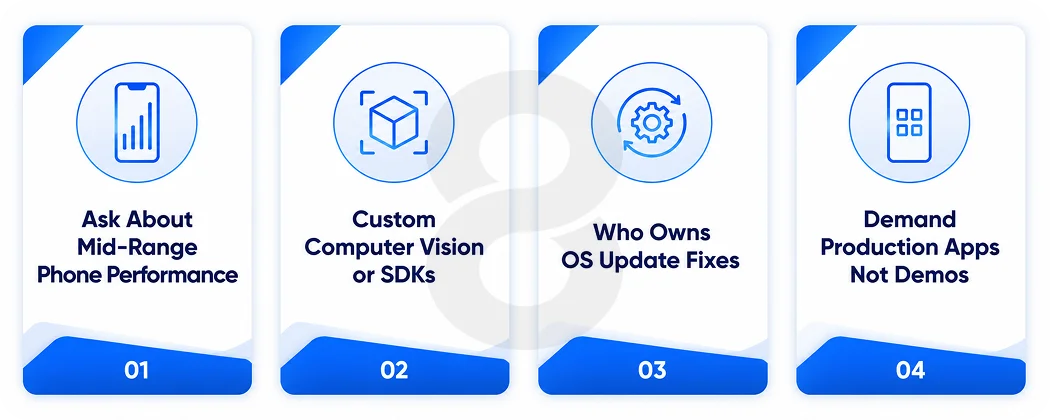
Ask how they optimize 3D for mid-range phones
The 3D content pipeline comes first, because nothing kills more AR apps in the wild. Here is the pattern. The studio demos on a brand-new flagship phone. Everything glides. Then a real user opens the app on a two-year-old handset and within four minutes the phone is hot, the frame rate is gone, and the battery indicator is visibly falling.
The 3D assets were never optimized for anything below the top of the market. So put the question to any vendor you shortlist: how do you handle meshes, textures, and draw calls on mid-range hardware? Teams that have shipped answer in specifics before you finish asking. Teams that have only demoed start talking about “performance best practices” and change the subject.
Check whether they build computer vision or just wire up SDKs
There is a line between building AR and assembling it, and buyers cross it without noticing. Placing a 3D object on a flat surface? ARKit and ARCore basically hand that to you. Any decent mobile shop can wire it up in a week.
But the moment the spec says reliable object recognition, accurate real-world measurement, or placement that stays anchored while the user walks a full circle around the room, the stock SDKs stop carrying the load and someone has to write actual computer vision. If that someone has never done it before, congratulations, your budget just became their tuition.
Confirm who owns compatibility when the OS updates
And then the problem nobody prices in: the app you launch is not the app you will be running in a year, because Apple and Google will not leave the ground alone underneath it. ARKit, ARCore, and visionOS all ship breaking changes on their own schedules. Working today means nothing about working after the next OS update.
One question settles who carries that risk, and it needs to be asked before anything gets signed: when the platform changes and the app breaks, who pays for the fix? Vendors have a way of going quiet right there. Silence in that moment means the answer is you.
AR App Development Cost in 2026 (With Timelines by Project Type)
AR pricing swings hard, because “an AR app” covers everything from a throwaway social filter to a spatial computing platform for Vision Pro.
Four variables do most of the damage to a budget: how many platforms the app targets, how much 3D content it needs and how complex that content is, whether custom computer vision enters the picture, and how much support the thing demands after launch. Everything else is rounding error next to those.
AR app development cost by project type
The directory data gives a starting point. Most AR and VR projects on Clutch and GoodFirms land somewhere between $10,000 and $50,000. Offshore rates cluster at $25 to $49 an hour. The specialist US and European studios sit at $100 to $149.
Useful, but an average across a category this wide flattens the picture, so the table below splits it out by what you are actually building.
| Project Type | Typical Cost Range | Typical Timeline |
| WebAR or social filter (Snapchat, TikTok, Instagram) | 20,000 | 3 to 6 weeks |
| AR product viewer or virtual try-on | 60,000 | 2 to 4 months |
| Markerless AR mobile app (ARKit / ARCore) | 120,000 | 3 to 6 months |
| Enterprise AR (guided workflows, training, digital twin) | 250,000 | 5 to 9 months |
| Apple Vision Pro or spatial computing app | 400,000 or more | 6 to 12 months |
Ranges only go so far. Anyone who wants a real number instead of a guess can run the specifics through an app development cost calculator before booking a single call.
Read More: AR App Development Cost in 2026: Full Breakdown
Why the cheapest hourly rate costs more in AR
The rate spread deserves a warning. A $25 hourly rate on a team that has never optimized a 3D scene for thermal throttling costs more in the end than a $120 rate on a team that gets it right the first time, because the cheap build comes back for a rewrite after the first round of one-star reviews about the phone overheating. The cheapest quote and the cheapest project are almost never the same thing in AR.
Read More: Top 8 Augmented Reality Frameworks to Power Your Next Spatial App
Mistakes to Avoid When Hiring an AR Development Company
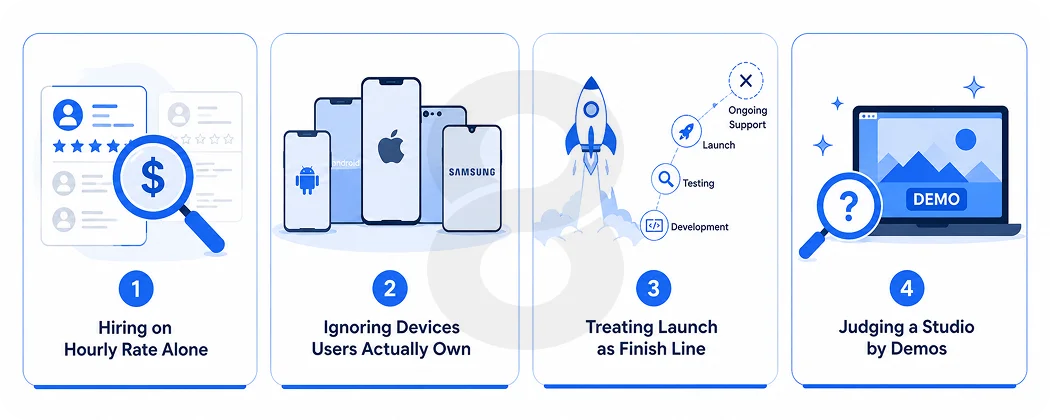
Hiring on hourly rate alone
The project that fails is rarely the one with the weakest pitch. It is usually the one where the buyer picked the lowest hourly rate on a list like this without checking whether that studio had ever shipped AR that survived contact with real devices. AR is not the place to fund a vendor’s first lesson in 3D optimization.
Ignoring the devices your users actually own
Teams scope an app for the newest iPhone, then discover half their users are on hardware that cannot hold 30 frames per second with the 3D scene they designed. Decide which devices matter before design starts, not after the first build lands and runs hot.
Treating launch day as the finish line
It is not. The moment Apple or Google updates its AR framework, an app with no maintenance owner starts drifting toward broken, and nobody notices until a user does. Whichever studio makes the final shortlist, the support model after go-live deserves as much scrutiny as the build itself.
Judging a studio by its demo
A polished demo proves a studio can build the happy path once, in controlled conditions. What the demo cannot tell you: how the app copes with a dim room, a cluttered table, or a user holding the phone at an angle nobody tested, three rooms from anywhere the studio ever ran it. Skip the reel. Ask for something live, in a store, right now, and go open it yourself.
Why 8ration Tops This AR Development Company List
A few paragraphs above a comparison table is not much room, so here is the fuller picture of what 8ration actually does with augmented reality.
There is a gap in this market that most of the list above does not serve. On one side sit the boutique XR studios, brilliant at activations and priced like it. On the other, the enterprise vendors, capable but wrapped in procurement cycles that eat quarters. In between sits the company that wants AR inside a real, shipping product without either of those tolls, and that is where 8ration does most of its AR work.
Concretely: AR features engineered into mobile apps people open more than once, built by in-house Unity, 3D, and computer vision teams rather than subcontractors, so the immersive layer grows out of the product instead of being stapled to it.
It also means planning past the phone where it makes sense, with Apple Vision Pro and spatial computing capability for teams whose roadmap runs into wearables, and a support model that treats OS-update compatibility as part of the deal rather than a surprise invoice a year later.
Behind the directory ratings sits more than a decade of software delivery and a client base of over 2,500 organizations across industries, which is the kind of general engineering depth AR quietly depends on.