



Marketplace app development cost runs from about $300,000 or more for an enterprise platform, with most funded startups landing between $150,000 for a version real users will actually transact on.
The spread is that wide for one reason: a marketplace isn’t one app. It’s three. A buyer app, seller dashboard, and admin panel that keeps the two from colliding. Anyone quoting you a flat number before they know your transaction model is guessing.
So let’s get specific. What each piece costs in 2026, which decisions move the number, and where budgets quietly bleed out after launch day.
What Does Marketplace App Development Cost in 2026?
No sugarcoating or lowball teaser rates. This is what the market actually charges right now across product, service, and rental marketplaces.
Two apps can both be called “MVPs” and sit $50,000 apart. The number that matters isn’t the tier label. It’s the scope underneath it, which is what the rest of this guide is about.
One warning before you set a budget: most first-time founders underestimate their total spend by 40 to 60 percent. Not because agencies lie, but because they budget for the build and forget everything that comes after it.
Why Marketplace Apps Cost More Than Regular Apps
A standard app has one user and one job. A marketplace has to serve buyers, sellers, and your own operations team at the same time, and each group needs its own interface with its own logic.
There’s no cheap shortcut around this. Skip the admin panel and your operations team runs the business out of a database. Skip the seller tools and nobody wants to list.
The other cost multiplier is money movement. The moment your platform holds funds between two strangers, you inherit escrow logic, commission splitting, delayed payouts, refunds, and fraud handling.
That’s custom workflow engineering, not a plugin. It’s also why a simple product marketplace costs a fraction of a booking platform with time-based pricing and identity checks.
Read More: eCommerce App Development Guide: Everything You Need to Know
What Factors Drive Marketplace App Development Cost?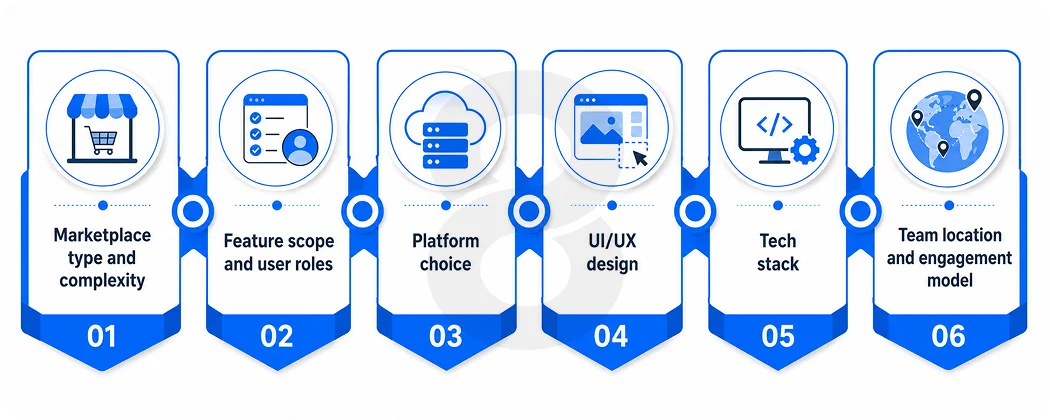
Six decisions set your budget and most of them get made before a single line of code is written.
Marketplace type and complexity
The transaction model dictates the build. A product marketplace where people buy and sell goods needs listings, cart, and shipping. A service marketplace needs scheduling, availability, and provider matching.
A rental or booking platform adds calendar logic, dynamic pricing, and escrow. The more dynamic the transaction, the more logic you’re paying for. Product marketplaces sit at the low end. Multi-service booking platforms sit at the top.
Feature scope and user roles
Every feature you add gets built three times, once for each portal, then tested and maintained. This is why feature discipline is the single biggest lever on cost. The founders who blow their budget aren’t the ones who picked an expensive agency.
They’re the ones who insisted on social login, AI recommendations, and an in app wallet before a single user had signed up. Cram all that into V1 and you can watch the initial build swell by 30 to 60 percent, most of it for things nobody actually requested.
Platform choice
First question: iOS, Android, web, or some mix. Building native, with Swift for iOS and Kotlin for Android, gives you the best performance. It also gives you two separate codebases to write, maintain, and pay for.
Go cross platform with React Native or Flutter instead and one codebase serves both stores, trimming your build hours by 20 to 40 percent. For nearly every marketplace MVP, that’s the call. Reach for native only when your app truly leans on device-specific muscle.
Store fees barely register next to what you’ll spend building, but for the record: Google Play takes a one-time $25 to list, and an Apple Developer Program membership sets you back $99 a year.
UI/UX design
Design isn’t decoration on a marketplace. It’s the difference between a buyer who checks out and one who bounces at the cart. A template-based interface runs 15,000. Fully custom design can pass $30,000. Expect quality design to add 10 to 20 percent to your total, and expect it to pay that back in conversion.
Tech stack
What you build on follows you around. Running costs, maintenance headaches, and how fast you can replace a developer who walks… all of it traces back to this decision.
In 2026, the stack that causes the least regret is React or Next.js on the frontend, Node.js or Django on the backend, and PostgreSQL for the data. For payments, Stripe Connect handles split payouts and commission logic without you having to engineer it from scratch.
Start with a monolith. Microservices sound impressive and cost extra. You don’t need them until specific parts of the platform are genuinely buckling under load, which most MVPs never reach. And whichever payment layer you pick, make sure it can actually handle marketplace flows. Getting that wrong is the mistake that forces a full rebuild a year in.
Read More: Best Scalable Ecommerce Technology Stack for Enterprise
Team location and engagement model
Where your team sits changes the bill more than almost anything else.
| Region / Model | Typical Hourly Rate |
| Asia (India, Pakistan, Southeast Asia) | 40 |
| Eastern Europe | 80 |
| Offshore agency (blended) | 60 |
| Freelance (Western) | 120 |
| North American / Western European agency | 180 |
| In-house team (annual salaries) | 300,000 |
Lower rates save real money. They also raise real risk if the team has never shipped a marketplace before. A cheap developer who doesn’t understand escrow will cost you far more in rework than a competent one at double the rate. Vet for marketplace experience first, price second.
How Much Do Marketplace App Features Cost?
Individual features carry rough price tags you can plan around. These are 2026 build estimates, and they move with your developer’s rate.
| Feature | Estimated Cost |
| Payment gateway integration | 7,000 |
| Payment splitting (Stripe Connect, full payout logic) | 20,000 |
| Order management | 8,000 |
| Vendor / seller dashboard | 12,000 |
| Ratings and reviews | 6,000 |
| Real-time chat / messaging | 15,000 |
| Geolocation and maps | 12,000 |
| Push notifications | 4,000 |
| AI recommendations | 15,000 |
| Multi-language / multi-currency | 5,000 |
The expensive rows share a secret. Chat, payment splitting, and geolocation all depend on someone else’s API, and that someone sends an invoice every month. Twilio wants money per message. Google wants money per map call. Stripe takes its slice of every sale. So treat the table’s figure as the down payment.
Read More: eCommerce App Development Cost: Your Ultimate Guide for 2026
Marketplace App Development Cost by Type (Etsy, Airbnb, Fiverr Models)
Want a shortcut? Find the platform your idea most resembles and start from its price bracket.
- Etsy or eBay-style product marketplace ($25,000–$80,000). People list goods, people buy them. About as simple as the transaction gets.
- Poshmark-style social commerce ($35,000–$100,000). Same buy-and-sell core, now with feeds, follows, and user posts layered over it.
- Fiverr or Upwork-style freelance marketplace ($50,000–$130,000). The cost lives in the work orders, milestone payments, dispute handling, and talent search.
- Airbnb-style rental and booking ($60,000–$150,000). You’re paying for calendars, dynamic pricing, escrow, ID checks, and reviews that cut both ways.
- TaskRabbit-style on-demand service marketplace ($60,000–$180,000). The pricey stuff is real-time matching and background checks.
Worth remembering: none of these companies launched with what they run today. Airbnb’s first version was thin. So was Stripe’s. Your job is the version that proves people will transact. Not the one that impresses investors.
Read More: How Much Does Shopify Cost: Pricing, Plans & Features Explained
Marketplace App Development Cost: Breakdown by Phase
Breaking the budget down by phase shows you where to spend and where you can defer.
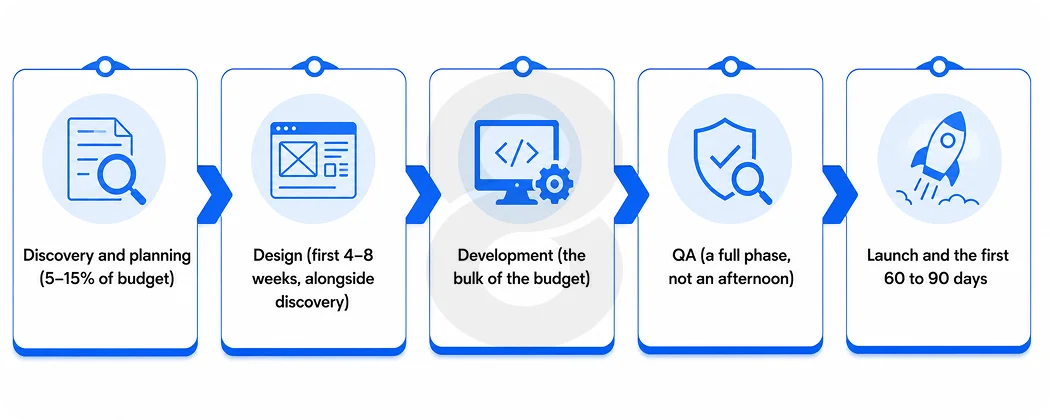
Discovery and planning (5–15% of budget)
Competitor research, journey maps for all three user roles, architecture calls, and a feature list that’s actually locked. Everyone wants to skip this phase. Nobody should. Teams that rush past discovery end up spending 40 to 60 percent more fixing things mid-build.
Design (first 4–8 weeks, alongside discovery)
Wireframes and prototypes in Figma before anyone codes. Cheaper to change a screen here than a database later.
Development (the bulk of the budget)
Backend is usually the largest single line item because it holds payments, authentication, the admin system, and every API connection. Frontend and the three portals build out in two-week sprints.
QA (a full phase, not an afternoon)
Testing buyer, seller, and admin paths in isolation, then together, catches most critical bugs before real money is involved. On a marketplace, a payment bug isn’t an inconvenience. It’s a lawsuit.
Launch and the first 60 to 90 days
Getting into the stores is the easy part. What follows is a humbling few weeks where real users ignore the features you agonized over and get stuck on things you never considered. Listen to that. The roadmap was a guess and behavior is data.
How Long Does It Take to Build a Marketplace App?
Timelines follow scope. Not headcount. Past a certain point, adding developers just adds meetings.
- Lean MVP: 10 to 16 weeks
- Growth-stage app: 4 to 6 months
- Enterprise-grade platform: 9 to 18 months
If someone quotes you a full-featured marketplace launching in eight weeks, read the fine print. Either the scope is tiny or QA got thrown overboard. Neither is what you want when payments are involved.
Read More: How to Build Apps Like Temu and Shein: Strategies for Success
Hidden Costs of Marketplace App Development After Launch
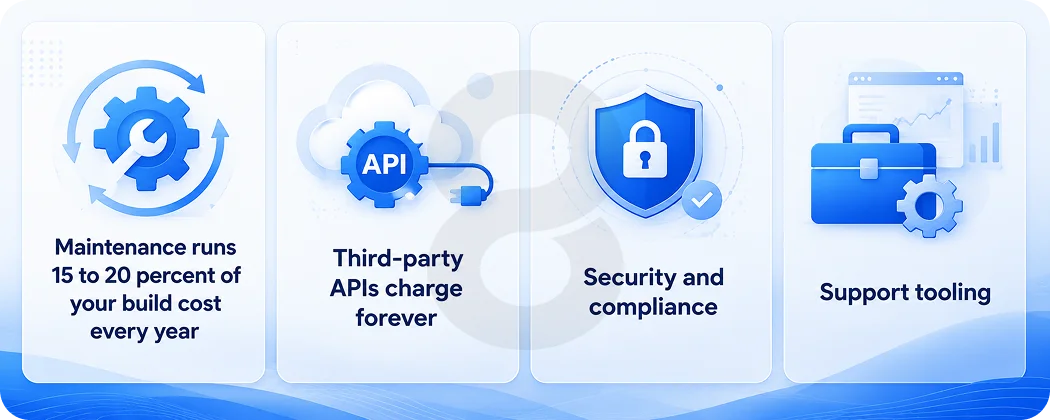
The build number is the headline. The operating bill is what actually kills marketplaces, and almost nobody budgets for it.
Maintenance runs 15 to 20 percent of your build cost every year
Spent $100K on the build? There’s no opting out of this one. Code nobody maintains turns into code nobody can maintain, usually within 18 months.
Third-party APIs charge forever
Stripe takes a cut of every transaction. Twilio charges per message. Google Maps charges per call. We’ve seen marketplaces lose money on every single transaction because nobody modeled the API costs against the commission before launch
Security and compliance
Budget 20,000 a year for penetration testing and audits once you’re handling payments and personal data. Not negotiable for a platform holding other people’s money.
Support tooling
It climbs to 3,000 a month once you hit around 1,000 active users, between the software and the humans answering tickets.
Here’s the rule worth tattooing on the budget: take your build cost and double it for year-one operations. If you spent everything getting to launch with nothing left for hosting, support, and the marketing that brings users, you didn’t build a business. You built a graveyard.
That last point deserves its own line. A marketplace with no users on either side is worthless no matter how good the code is. As a16z’s Andrew Chen says, your tech budget is only half the battle, the rest is liquidity. Plan to spend at least as much acquiring your first sellers and buyers as you spent building the thing they log into.
How to Reduce Marketplace App Development Cost Without Cutting Corners
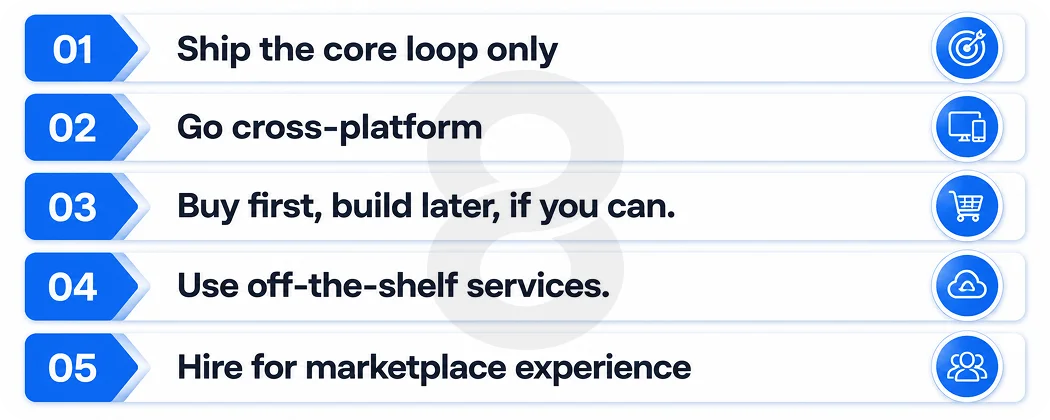
Cheaper doesn’t have to mean worse. Smarter scope does most of the work.
Ship the core loop only
For any marketplace, the loop is: find item, pay for item, receive item. Everything else is decoration you can add once real users prove they want it. Manual seller approval and manual dispute handling are perfectly fine at launch. Manual payment reconciliation is not.
Go cross-platform
A single cross-platform app built in React Native or Flutter covers both app stores from one codebase and cuts your build hours nearly in half. For an MVP, there’s rarely a reason not to.
Buy first, build later, if you can.
Before you sink six figures into a custom software build, a white-label platform or no-code builder can put a real, working product in front of users for a few thousand dollars and tell you whether anyone actually wants it.
A lot of founders do exactly this… launch on something like Sharetribe, watch the numbers, and only move to custom once the demand is real.
Use off-the-shelf services
Lean on Firebase for the backend basics, Stripe for payments, and Twilio for messaging. Rebuilding any of these yourself just sets money on fire for no payoff.
Hire for marketplace experience
A team that has shipped escrow and split payouts before will save you more in avoided rework than you’d save on a cheaper team learning on your budget.
Read More: How Much Does it Cost to Build an App Like Amazon
How Much Should You Budget for a Marketplace App?
There’s no single marketplace app development cost, and any agency that gives you one before understanding your transaction model is selling you a number. Set aside $30,000 to $70,000 for an MVP you’ve kept disciplined, then assume you’ll spend that again getting through year one.
Pour your effort into holding the scope line instead of finding whoever quotes cheapest. Because the winners here were never the biggest spenders. They shipped the smallest thing that let real buyers and sellers actually transact, then put their money back into whatever the numbers told them was working.
And if what you actually want is a number mapped to your features and your transaction model, not a range pulled from an article, that scoping conversation is where 8ration starts every marketplace project. Before anyone writes a line of code.
Read More: 7 eCommerce Giants Winning the Mobile App Game (and How They Do It)