



Most people think they understand how an app development agency works until they actually start working with one. From the outside, it looks simple. You have an idea, you hire a team, they build your app, and then you launch it. That is how it is usually imagined.
But once you are inside the process, you realize that is not even half of what is actually happening. Because when you really break down what does an app development agency do, you start seeing that it is less about “building an app” and more about figuring out what should be built in the first place, how it should work, and whether it will still make sense once people actually start using it.
And that gap between expectation and reality is where most things either go right or start falling apart quietly.
It Never Starts With Code, Even Though People Think It Does
This is usually the first misunderstanding.
People assume development starts with building something. It does not. It starts with figuring things out.
A good team is not rushing to open tools or start writing code. They are asking questions that might even feel unnecessary at first.
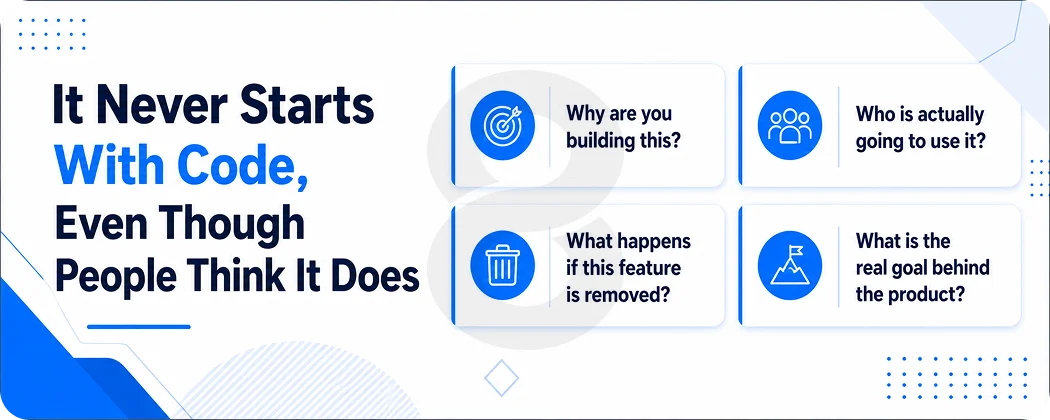
- Why are you building this?
- Who is actually going to use it?
- What happens if this feature is removed?
- What is the real goal behind the product?
Because if those answers are unclear, the entire product becomes a guess.
That is where strong software development thinking comes in early, because it is not about coding first, it is about understanding before anything gets built.
When people ask what does an app development agency do, this is the part they usually never see, but it is also the part that decides everything later.
Then Comes Product Thinking, Not Just Feature Planning
Once things start making sense, the focus shifts to shaping the product properly. And this is where a lot of businesses still think in the wrong direction.
They come in with a list of features, but a good agency is thinking in flows, behavior, and structure instead. Because features alone do not make a product usable. At this stage, things start getting clearer:
This is where proper mobile app development planning starts becoming visible, because the goal is not to build everything, it is to build what actually matters first.
Design Is Where Things Either Start Making Sense or Start Getting Confusing
A lot of people still think design is about making things look good. That is honestly one of the biggest misconceptions. Design is about how the product behaves when someone touches it for the first time without instructions. If they hesitate, something is wrong. what if they get confused, something is wrong. If they need to think too much, something is wrong. That is the level design operates on.
And this part directly affects what does an app development agency do, because a poorly designed product can technically work and still fail completely in real usage.
Read More: Mobile App Development Process – From Idea to Launch
Development Is Where Most People Think the Work Starts, But It Is Actually Midway
This is the part everyone focuses on, but it is not the beginning, it is the middle. Now the ideas, structure, and design start turning into an actual system. But again, it is not just about writing code. It is about building something that will not collapse the moment real users show up.
That means:
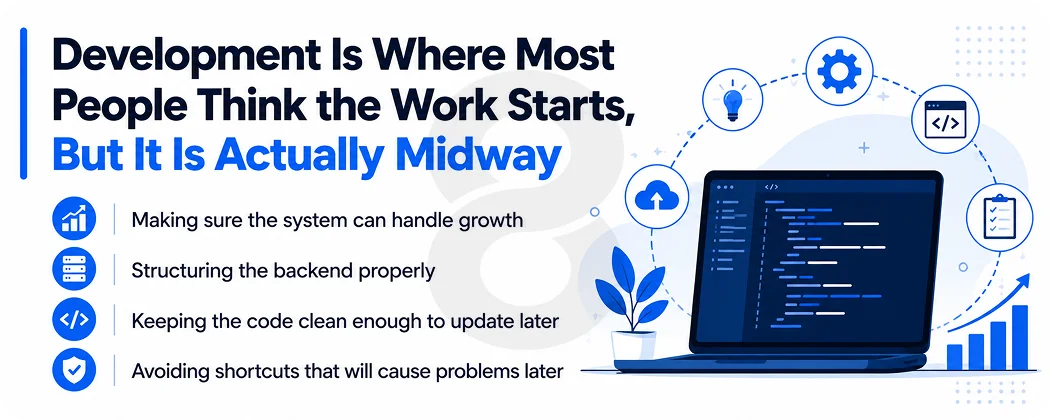
- Making sure the system can handle growth
- Structuring the backend properly
- Keeping the code clean enough to update later
- Avoiding shortcuts that will cause problems later
This is where both software development and enterprise app development start overlapping, especially when the system needs to support real business operations instead of just looking good in a demo.
Read More: How to Create an App: 8 Steps to Build an App
Integration Is Where Things Quietly Get Complicated
This is the part nobody really talks about before the project starts. Your app is not sitting alone. It needs to connect with other tools, systems, and platforms. Payments, dashboards, APIs, internal tools, third-party services, all of it needs to work together.
And if that part is not handled properly, everything becomes slower, messier, and harder to manage. That is where proper AI integration and system-level thinking start making a difference, because disconnected systems are one of the biggest hidden problems in most apps.
AI Is Not a feature anymore; it is becoming part of the System
A lot of people still think AI is something you “add later.” That is not how it works anymore. If used properly, it becomes part of how the system behaves from the start.
Through structured AI development, things like automation, recommendations, and smarter workflows start becoming natural instead of forced.
And this is another layer of what does an app development agency do that most businesses are only starting to understand now.
Read More: 50+ AI App Ideas Generating Millions in Revenue
Testing Happens Way More Than You Think
Testing is not a final step. It is happening all the time. Because things that look fine during development often behave differently when real conditions come in. More users, different devices, unexpected behavior, all of that changes how the system performs. So testing keeps happening alongside development, not after it. And skipping this is one of the fastest ways to reduce quality without realizing it.
Read More: Why 80% of Apps Fail: A Founder’s Guide to Success
Launch Is Not the Finish Line, It Is Where Things Get Real
This is another big misconception. People treat launch like the end. But in reality, it is where the real version of the product starts.
Because now:
- Users behave differently than expected
- Small issues become visible
- Performance patterns change
- New requirements show up
And that is completely normal. Which is why agencies do not disappear after launch. They stay involved because the product is still evolving.
Read More: Mobile App Development Timeline
Maintenance Is Where Long-Term Value Is Decided
Apps are not one-time builds. They are ongoing systems. They need updates, improvements, fixes, and sometimes changes that were not even considered at the start.
This is where enterprise app development thinking becomes important again, because systems need to stay stable while still evolving.
And this is where long-term success is actually decided.
Read More: The Real Cost of App Maintenance
What Actually Happens Behind the Scenes
Stage |
What Is Really Happening |
Why It Matters |
| Discovery | Understanding the real problem | Prevents wrong direction |
| Planning | Structuring the product | Avoids unnecessary work |
| Design | Shaping user interaction | Drives usability |
| Development | Building the system | Enables functionality |
| Integration | Connecting everything | Keeps systems efficient |
| Testing | Catching issues early | Reduces future costs |
| Launch | Releasing to real users | Starts real feedback |
| Maintenance | Improving continuously | Sustains long-term value |
Where Most Businesses Get It Wrong
The biggest mistake is thinking this whole process is shorter and simpler than it actually is. They expect fast results without giving enough time to thinking, planning, and structuring. And that usually leads to:
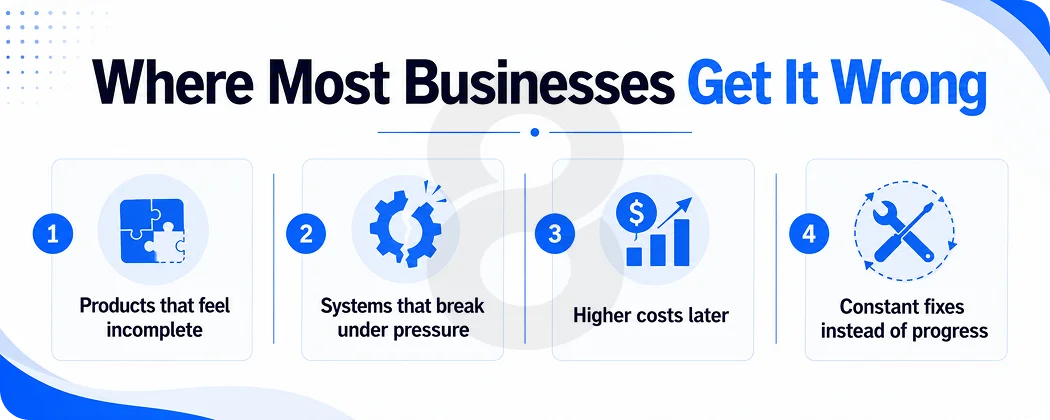
- Products that feel incomplete
- Systems that break under pressure
- Higher costs later
- Constant fixes instead of progress
Because rushing early always slows things down later.
Read More: Maximizing ROI: How App Development Services Save You Money Long-Term
If You Think It Is Just About Building an App, You Are Missing the Point
If your expectation from an agency is just to build what you ask for, then you are not really using them properly. The real value is in how they think, how they challenge ideas, and how they structure the system before anything is built.
Because that is what decides whether your product actually works or just exists. And that difference shows up very quickly once real users get involved.
Final Thoughts
So when you ask what does an app development agency do, the honest answer is not simple. They are not just building apps. They are helping define the product, structure the system, and make sure everything works beyond the launch phase.
And once you understand that, it becomes a lot easier to work with the right expectations instead of guessing how things should go. Because the difference is not in what they build. It is in how they think about what they are building.