


Most enterprise software failures do not happen because of missing features. They happen because the system never truly fits how the business operates once real pressure starts building. The demo looks polished, the roadmap feels structured, and everything seems aligned until actual usage begins and the gaps start showing.
That is exactly where the difference shows up. Not between companies that build apps and companies that do not. But between teams that understand enterprise systems and teams that only understand development. That is why large organizations consistently work with a specialized enterprise app development firm instead of trying to handle everything internally or through generalist vendors.
Because at scale, software is not just a digital product. It becomes infrastructure. And infrastructure cannot afford to break quietly.
Why Enterprise Software Is a Different Game Altogether
Enterprise products operate in environments where complexity is not optional. You are dealing with multiple departments, layered approvals, legacy systems, integrations, compliance requirements, and real operational pressure that does not pause for development cycles.
This is where most generic teams struggle. They build for the idea of the product, not the reality of how it will function. A specialized enterprise app development firm approaches things differently.
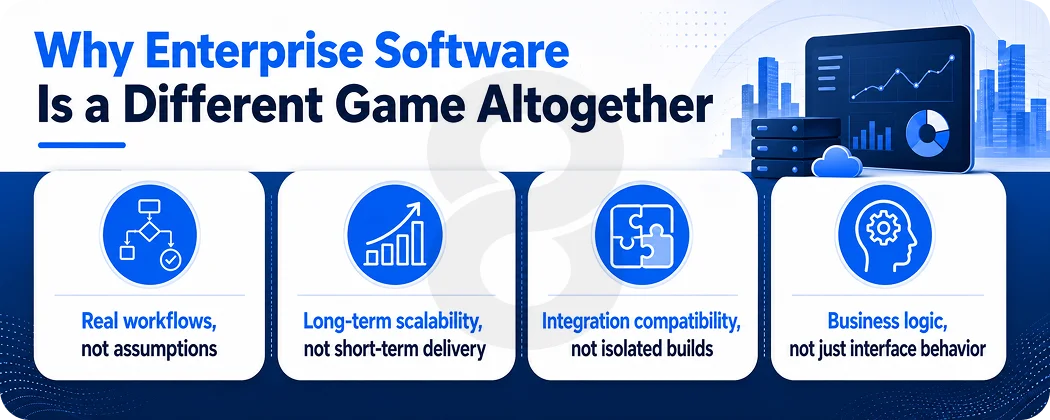
They design systems based on:
- Real workflows, not assumptions
- Long-term scalability, not short-term delivery
- Integration compatibility, not isolated builds
- Business logic, not just interface behavior
At 8ration, this thinking shapes how systems are designed from the beginning. Instead of starting with features, teams map operational workflows first, then build technology around them using structured AI development approaches where automation actually reduces workload instead of complicating it.
The Real Reason Fortune 500 Companies Avoid Generalist Vendors
On paper, most development companies look similar. They all mention scalability, performance, and innovation. But execution tells a different story.
Large organizations cannot afford:
- Systems that break under scale
- Delayed decision-making due to unclear architecture
- Poor integration with existing platforms
- Products that teams struggle to use daily
A specialized enterprise app development firm reduces these risks by bringing experience in handling complex environments where failure has real consequences.
Because enterprise products are not judged at launch. They are judged six months later when usage becomes real.
Where Specialized Firms Actually Add Value
The value is not in writing code. That is expected. The value is in how the system is structured before development even begins.
A strong enterprise app development firm focuses on:
- System architecture that supports long-term growth
- Clear data flow between different business units
- Scalable backend systems that do not collapse under load
- Interfaces that people can actually use without frustration
This becomes even more important in projects involving software development at scale, where multiple systems need to work together without creating operational bottlenecks.
At 8ration, the UI and UX process focuses heavily on reducing friction. Instead of designing for aesthetics alone, the team studies how users behave inside systems and builds interfaces that feel natural even in complex workflows.
The Role of AI in Enterprise App Development
AI is no longer optional in enterprise environments. But it is often misunderstood. The goal is not to add intelligence everywhere. The goal is to remove unnecessary decision-making pressure.
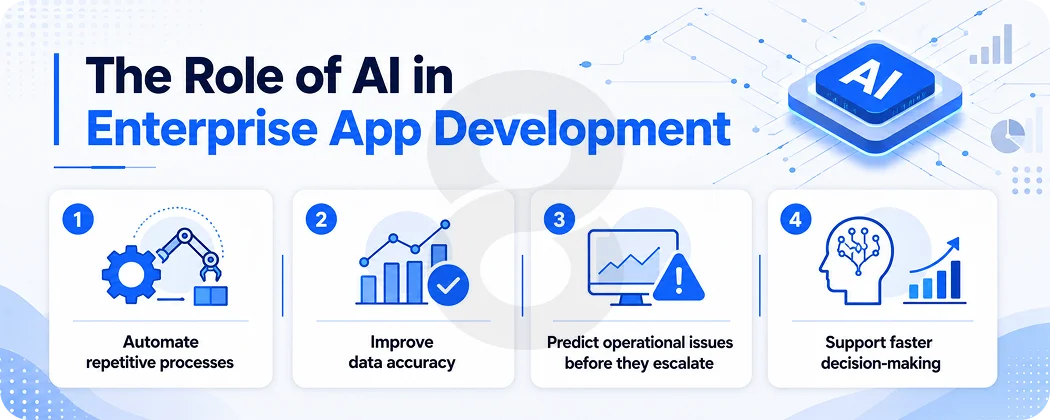
A specialized enterprise app development firm uses AI integration carefully to:
- Automate repetitive processes
- Improve data accuracy
- Predict operational issues before they escalate
- Support faster decision-making
This is where proper AI development matters. At 8ration, AI features are introduced only where they add measurable value, especially in enterprise mobile environments where performance and clarity directly impact usability.
Why Mobile and Cross-Platform Strategy Matters at Scale
Enterprise users are no longer tied to desks. Operations happen across devices, locations, and environments. This makes mobile app development and enterprise app development tightly connected.
A strong enterprise app development firm ensures:
- Consistent experience across devices
- Real-time access to data
- Secure communication between systems
- Smooth performance under different usage conditions
At 8ration, cross-platform systems are built to maintain consistency across environments without compromising performance, ensuring that users can switch between devices without losing context.
Generalist Vendor vs Specialized Enterprise Firm
Factor |
Generalist Vendor |
Specialized Enterprise App Development Firm |
| System Understanding | Surface-level | Deep operational alignment |
| Scalability | Often reactive | Built from the start |
| Integration | Limited | Structured and flexible |
| User Experience | Generic | Workflow-focused |
| Long-Term Value | Uncertain | Predictable and scalable |
What Happens When Companies Choose the Wrong Partner
This is where things usually go wrong. The system launches successfully.
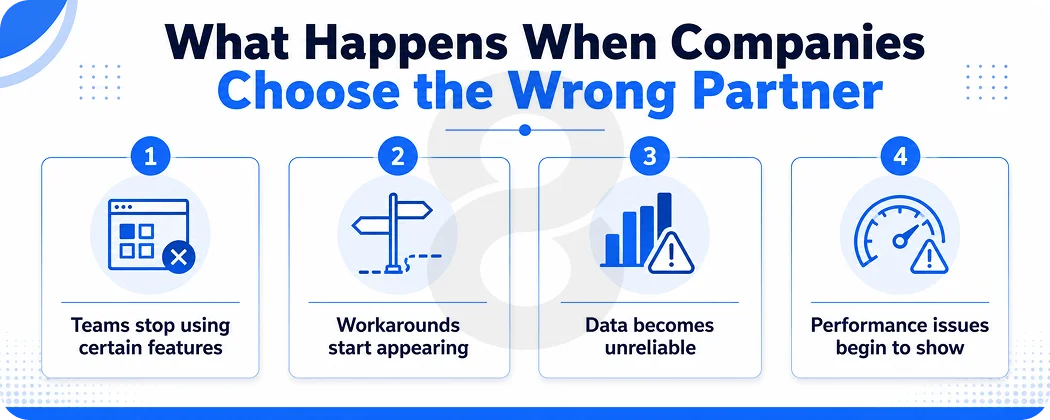
Then slowly:
- Teams stop using certain features
- Workarounds start appearing
- Data becomes unreliable
- Performance issues begin to show
None of these problems appears immediately. But they compound over time.
That is why choosing a specialized enterprise app development firm is not about avoiding failure at launch. It is about avoiding failure after adoption.
The Importance of Backend Strength
Most enterprise discussions focus too much on front-end experience. But backend systems decide whether the product survives.
A strong enterprise app development firm builds backend architecture that:
- Handles large-scale data processing
- Supports real-time updates
- Maintains system stability under pressure
- Allows future expansion without rebuilding everything
At 8ration, backend systems are designed alongside frontend workflows to ensure both layers support each other instead of creating bottlenecks.
Read More: CRM on Android: How to Build a Custom CRM App for Your Business
How Integration Defines Enterprise Success
Enterprise systems rarely operate in isolation. They connect with CRM tools, ERP systems, analytics platforms, and internal tools. Poor integration creates friction.
A specialized enterprise app development firm ensures:
- Seamless communication between systems
- Consistent data flow across platforms
- Reduced manual intervention
- Better operational visibility
This becomes critical in large-scale software development environments where multiple systems must function as a single ecosystem.
Where Specialized Firms Create Real Impact
Area |
Improvement |
Business Outcome |
| Operations | Streamlined workflows | Faster execution |
| Data | Improved accuracy | Better decisions |
| Integration | Connected systems | Reduced manual work |
| Performance | Stable systems | Higher reliability |
| Scalability | Flexible growth | Long-term sustainability |
Why This Decision Should Not Be Delayed
If your current systems feel slow, disconnected, or difficult to scale, the issue is already affecting your business performance. It may not be obvious yet. But it is there. Working with a specialized enterprise app development firm is not just about building new software. It is about fixing structural inefficiencies that limit growth. The longer those inefficiencies remain, the harder they become to resolve.
The Difference Between Building Software and Building Systems
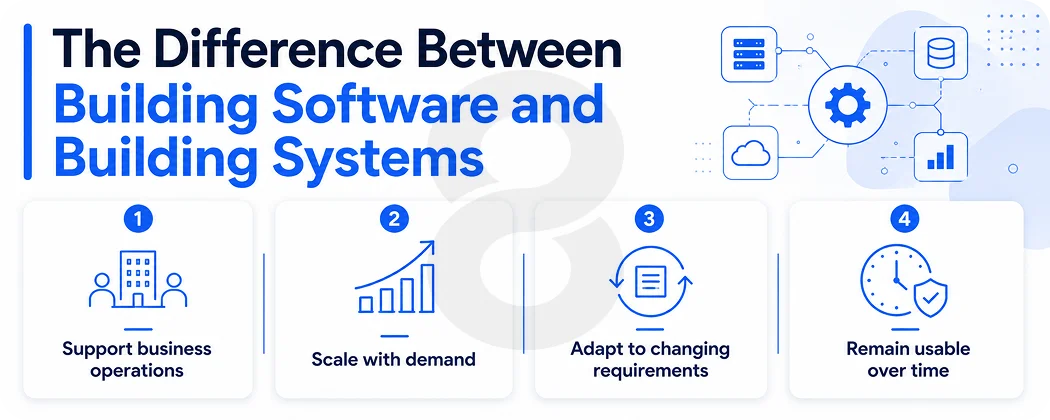
Most companies build software. Very few build systems. Software can function. Systems need to perform under pressure. That difference defines enterprise success. A specialized enterprise app development firm focuses on building systems that:
- Support business operations
- Scale with demand
- Adapt to changing requirements
- Remain usable over time
Final Thoughts
Fortune 500 companies do not choose specialized firms by accident. They do it because the cost of failure is too high. They need systems that work beyond the launch phase. Partners who understand complexity, not just development. They need solutions that support real business operations. That is why working with a specialized enterprise app development firm becomes less of an option and more of a necessity.