




Imagine If you have got a game-changing idea, you have the vision, perhaps even the funding, but you are lacking the most important element in the puzzle, the right technical team. As a startup founder and you are looking to hire developers for startup, you already understand how daunting the process can be. Where do you look? What do you do to screen candidates? How much do you pay them? The thing is that the process of recruitment by startups that employ software engineers is in no way similar to the practice used by large businesses. Your HR department is nonexistent. Months are not within your time. Each poor recruitment hurts you in terms of time, money, and momentum. And any big hire can 10x your growth.
This guide provides 10 easy, specific steps to hire developers for startup, vet them, and bring them on in a way you can spend time building your idea, not conducting interviews. Let us get into it.
According to a report, the global software development service market size is anticipated to be worth USD 571.7 billion in 2026 and is expected to reach USD 1935.28 billion by 2035 at a CAGR of 14.51% during the forecast from 2026 to 2035.
Step 1: Define Exactly What You Need Before You Hire
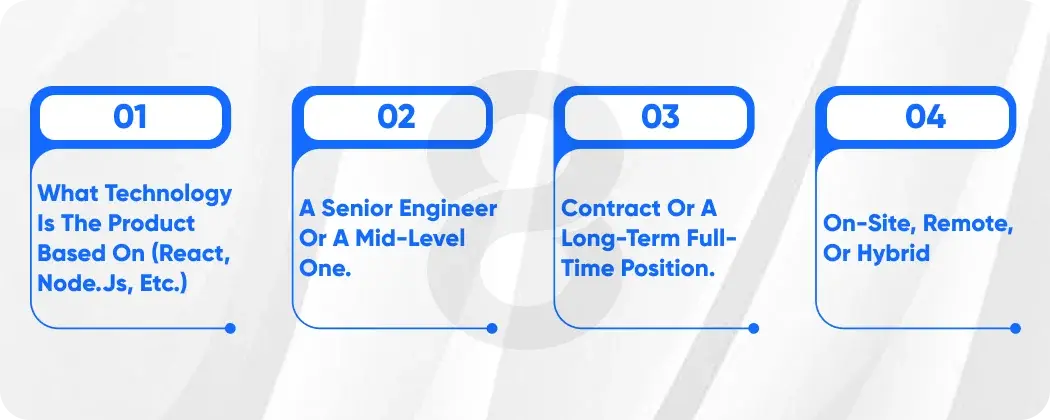
You have to be all too unsparingly honest as to what it is that you are constructing and what technical skill that requires before you can put one job advertisement in the paper, or even make a single phone call to one of your prospective workers. Question: Would you employ a web developer for your SaaS start-up? Do you require a mobile applications developer? A backend engineer? An all-purpose developer, possibly with multiple hats? The answer will alter everything: where to seek, the amount paid, and so on. You are about to embark on recruiting, so note the following:
- What technology is the product based on (React, Node.js, Python, Swift, etc.)
- A senior engineer or a mid-level one.
- It would be a short-term contract or a long-term full-time position.
- On-site, remote, or hybrid
Several founders post vague job descriptions, such as “We need a developer,” when seeking developers on the startup side. That brings the wrong contenders and wastes the time of everybody. Be specific. The easier and quicker you are, the better the role you define.
Step 2: Selecting Freelancer, Agency, or In-House Developer
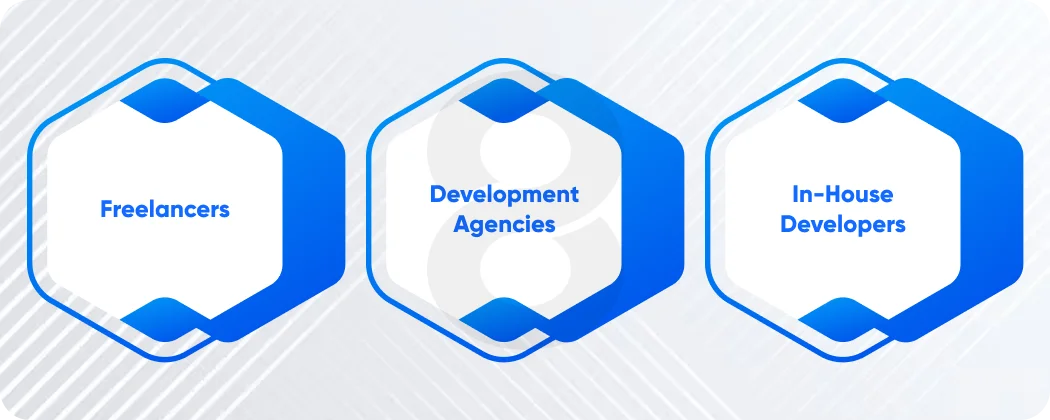
One of the most significant choices that you will make when recruiting programmers to your startup is the type of engagement to pursue. They both have real trade-offs, and making a bad decision will cost you months of wasted work.
Freelancers
They are best suited to early-stage startups that have a small budget. When looking for the app developers of your startup, you may refer to such platforms as Upwork, Toptal, or Freelancer.com. They are versatile, quick to have on board, and you only pay for what you require. The downside is that they might be taking on several customers, and this will interfere with their focus and availability.
Development Agencies
They provide a complete team of designers, developers, and project managers under one roof. In case you require a web developer to develop your SaaS business in a short period and desire a management-driven process, an agency will be a rigorous option. Nevertheless, agencies are pricier, and you might have less control over who works on your product, specifically.
In-House Developers
They are the correct choice when building long-term. Full-time software engineers provide startups with more attention and a better understanding of the product, as well as a higher level of team culture. The difficulty lies in the fact that full-time developers require much more resources and time to recruit, onboard, and maintain. No one size fits. The majority of startups at the pre-raise stage begin by outsourcing to a freelancer or small agency to develop an MVP but switch to in-house hiring as they grow.
Step 3: Establish a Realistic Budget and Compensation Plan
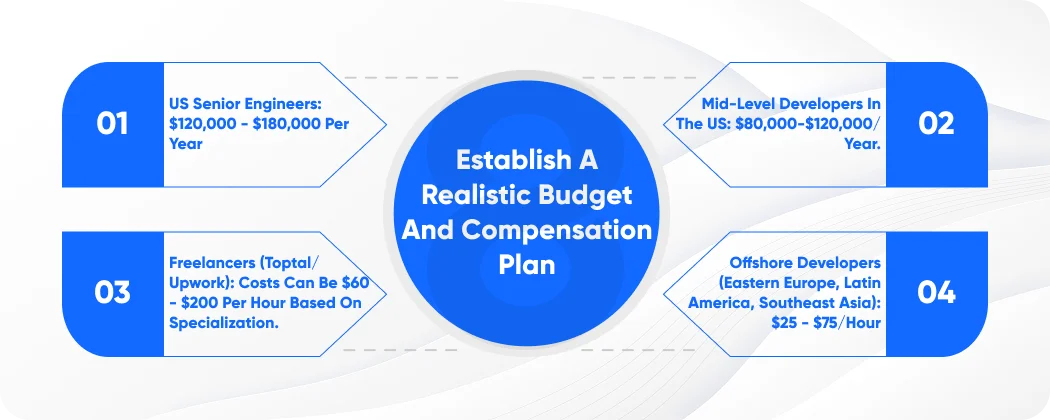
When you want to recruit startup developers who are not bad, you have to pay competitively. This is one of the quickest methods of getting the wrong individuals and sending signals that you do not value talent at all.
The following is a crude estimate of the prices you will likely spend, based on your model:
- US Senior Engineers: $120,000 – $180,000 per year
- Mid-Level Developers in the US: $80,000-$120,000/year.
- Freelancers (Toptal/Upwork): costs can be $60 – $200 per hour based on specialization.
- Offshore Developers (Eastern Europe, Latin America, Southeast Asia): $25 – $75/hour
In addition to the base salary, startups that employ software engineers will have to consider equity. Early-stage startups usually offer stock options to their developers. That is how you can compete with large technology businesses, which may afford higher wages. Your best-selling points as a startup are equity, mission, and the thrill of creating something out of nothing.
Step 4: Write a Job Description That Actually Attracts Top Talent
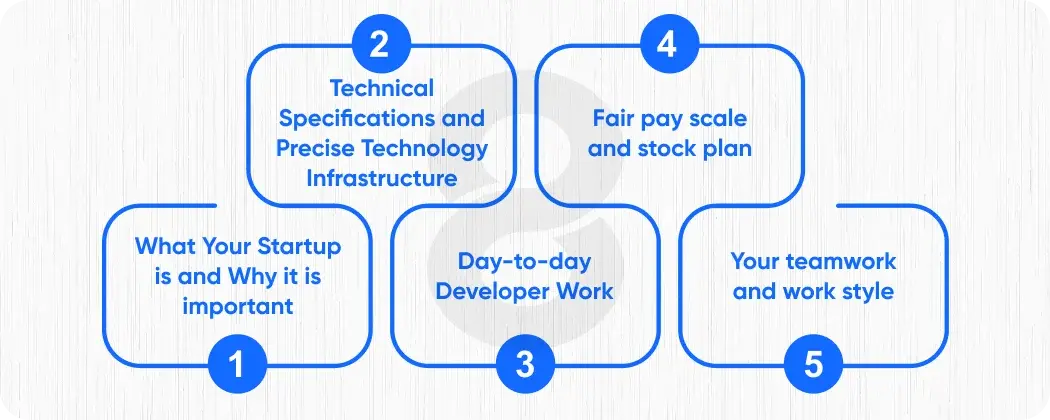
Your job description is your initial sales pitch to a developer. In case it is generic, dull, or loaded with buzzwords, then the top candidates will scroll past it. In the process of finding people to develop your startup, your job advertisement must accomplish multiple functions simultaneously.
Any good job description must always have:
- An explanation of what your startup is and why it is important
- Certain technical specifications and the precise technology infrastructure
- The developer can and will work on the day-to-day
- Fair pay scale and stock plan
- Your teamwork and work style, as well as your culture
Keep off such terms as “rockstar developer” or “ninja coder.” These are off-putting to the great developers. Be rather straightforward, concrete, and human. When attempting to recruit a programmer to work in a startup, in order to be memorable, demonstrate an interest in what you are creating. Developers prefer to work on issues of interest and products of relevance. Pay the students a genuine reason to apply.
Step 5: Find Developers with the Right Platforms
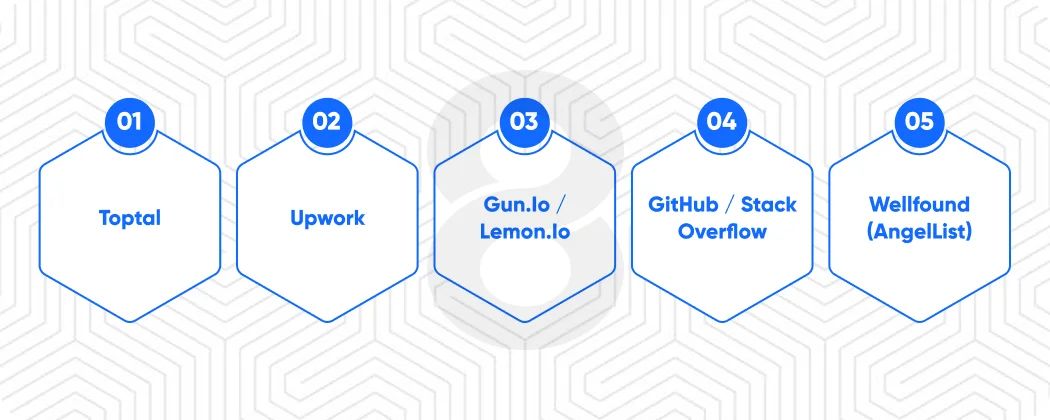
The battle half is knowing where to look when you are out to get coders in your startup. Various platforms appeal to different categories of developers, and by identifying and using the correct platforms you will dramatically boost your outcome.
In the case of full-time in-house recruitment, LinkedIn will still be the most effective source. You are able to filter by skills, location, and level of experience and contact passive candidates who do not actively seek employment. AngelList (since renamed Wellfound) is startup-specific and one of the best locations to experience developers who are actually keen to work at early-stage firms.
In the case of freelance and contract work, the following are the most optimal sources to identify app developers to your startup:
- Toptal: Pre-vets the top 3% of applicants. Best quality, higher cost
- Upwork: Wide talent pool of different levels of quality
- Gun.io / Lemon.io: Vetted freelance developers having start-up experience
- GitHub / Stack Overflow: Best in finding developers for real work
- Wellfound (AngelList): Hiring startups on purpose
Communities such as Reddit communities (r/forhire) or Discord servers and filters to custom Slack communities are also worth considering, particularly when seeking niche or emerging technology developers.
Step 6: Interview Candidates in a Time-Saving Manner
Once you begin receiving applications, you must have a well-organized screening. And without one, you will waste dozens of hours in interviews that lead nowhere. A common error many startups seeking developers make is to take an applicant directly to long technical interviews with everyone; this is a time-killer.
Begin with an asynchronous screening procedure. Ask short questions on the experience, the tech stack, and how they have tackled particular technical problems in the past to the candidates. This, on its own, will weed out a big percentage of candidates who do not fit.
This can be followed by a 30-45 minute technical screening call check of:
- Effective communication and comprehension of technical ideas
- Basic expertise on the needed tech stack
- Roll calls regarding attitude, ownership or work style
- True desire to know more about your product/start-up mission
At this point, you are not having a rigorous technical interview. You are merely verifying that the candidate is what his/her resume indicates he/she is and determining whether it is worth taking the time.
Step 7: Conduct a Technical Assessment Which is Real Work
It is during the technical interview that most startups either get it right or spend colossal sums of money on the non-performers on paper but are unable to perform in reality. The best practice when you are hire developers for startup will be to assign them a take-home assignment or a trial project with a payment that closely resembles the real work.
As an example, when you are recruiting programmers to work on your startup to create a REST API, assign them a small task: create a simple API endpoint that has authentication and error handling. When seeking the services of a web developer to work on your SaaS startup, request that they develop a small UI component with your technology stack. In going through submissions, look beyond the simple workingness:
- Code readability, code quality, and structure
- The manner in which the candidate describes and presents their decisions in writing
- Examples of edge cases that they thought about and addressed
- It can be either production-ready or barely functional
Maintain the assessment for two to four work hours. In case you are demanding something beyond that, pay the candidate to spend his time. It is an indicator that you have due respect for developers, and it instantly makes you stand out among dozens of other startups that they might be interviewing with.
Step 8: Check Culture Fit and Communication Skills
It is possible to teach and develop technical skills. It is much more difficult to change communication style, work ethic, and attitude. Never undervalue cultural fit in hiring software developers that join your startup because a small team means that each individual has excessive influence on speed and spirit.
Developers in a startup should be okay with ambiguity. Requirements change. Priorities shift. The roadmap is developed on a weekly basis. You have to have individuals who are quick adaptors, ownership seekers, and workers who do not have to be held by the hand at all times.
These are green flags to be considered during end interviews:
- When discussing the mistakes made in the past, they own up instead of laying the blame on others
- They are intelligent and inquisitive, inquiring about your product and users
- They can present complicated technical ideas in a clear way to non-technical individuals
- They appear to be revitalized by the thought of creating something new
Step 9: Make a Powerful Offer and Seal the Deal
The top developers are not always long-term in the market. Once you have the right individual to recruit to develop your startup, act fast. One of the primary factors that startups lose top candidates to other, more organized companies is the slow hiring process.
In your offer, the following needs to be clearly included:
- Competitive wages pegged to market rates
- Equity package that has a definite vesting schedule (usually four years, including a one-year cliff)
- Flexibility in working where feasible
- An established growth direction in the company
- Genuine account of the position of the startup and its future path
Be open about the position of your start-up, the obstacles you are about to face, and what success should be. The best developers never want to be sold or told the truth. Hurrying and being quick are indications of you having a tight, professional operation. When a candidate is made to wait two weeks between job-hiring aspects, he or she will lose trust in your capacity for performance as a company.
Step 10: Onboard Properly and Set Your Developer Up for Success
Hiring is only half the job. The way you introduce a new developer either plays or breaks them: they either come out of the gate swinging or they spend the first month of their life in your company with their head spinning and wondering why they accepted your offer.
Get the preparations made before the first day. That is access to the codebase, detailed documentation, an explanation of the architecture, and a prioritized list of tasks to complete within the first 30, 60, and 90 days. Have a mentor/buddy. Even in a small team, having a single person assigned to answer questions can greatly vary the ramp-up time.
A powerful onboarding procedure includes:
- Before anticipating production code, product and user settings are supplied
- Architecture, conventions and workflow documentation
- One-on-ones (day one through surface blockers) every day
- Be honest and provide on-time feedback to be able to calibrate fast
- A friendly team atmosphere that makes them feel that they are part of the team
The developers who feel encouraged and listened to during their first 90 days will stay longer, work better, and be your best recruiters, as they refer their talented friends and former colleagues to your team. Retention starts on day one.
According to statistical data, the global software development tools market was valued at USD 7.47 billion in 2025 and is projected to reach USD 8.78 billion in 2026, further increasing to USD 10.31 billion in 2027. Over the long-term forecast period, the market is expected to expand rapidly, reaching USD 37.38 billion by 2035, registering a strong compound annual growth rate (CAGR) of 17.47% from 2026 to 2035.
Stop Struggling to Hire Developers – Let 8ration Build Your Dream Team
You might be attempting to discover a developer for your brand new enterprise or expand the team that currently includes a handful of engineers; either way, it can be a time-consuming, expensive, and exasperating endeavor, especially when you are already carrying the full ten pounds of a founder. The ten steps will provide you with the outline, but how to do them correctly will demand time, the right kind of connections, and a profound knowledge of what an excellent technical talent truly looks like.
And that is precisely where 8ration.com fits in. When you need a web application, a SaaS, or a custom software solution developed from the ground up, 8ration will match you with startup-ready developers who will be ready to work on the first day. No endless job postings. No wasted interviews. No bad hires. Fast, just the right developers, the right developers. Quit wasting time hiring developers for startup independently. Go to 8ration.com today, describe what you are building, and leave it to us to find the right development team to build your startup. The faster you can put the right people in the right place, the faster your product will begin shipping, scaling, and winning.