


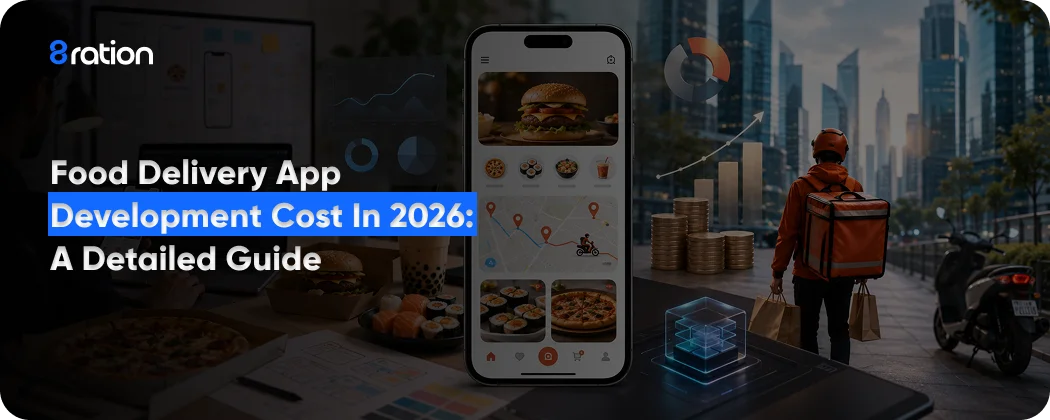
Before you jump in, one question comes up every single time: what is the food delivery app development cost in 2026? The answer, as you will find in this guide, is not a single number. It depends on your feature set, the platform you target, the development team you hire, and the complexity of the business model you want to support.
The food delivery industry is no longer just a convenience. It has become a $1.51 trillion global market in 2026, according to Statista, and that number keeps climbing. With over 2.6 billion users expected in the meal delivery segment by 2031, the window of opportunity for entrepreneurs and restaurant owners to build a powerful food ordering platform has never been wider.
This guide breaks down everything you need to know, from the core components of a delivery app to hidden post-launch expenses, so you can plan your budget confidently and make decisions that actually move the needle. Whether you are a startup founder, a restaurant chain, or an investor, this is the most complete cost breakdown you will find for 2026.
Why Is the Food Delivery Market Worth Entering Right Now?
Before diving into numbers, it helps to understand the scale of the opportunity. According to Statista, the United States alone is projected to generate $473.49 billion in online food delivery revenue in 2026, with a compound annual growth rate (CAGR) of 6.83% through 2031. Globally, the market is on course to reach $2.05 trillion by 2031.
Furthermore, over 40% of adults in the US order food delivery 3 to 5 times a month, and 57% of millennials actively prefer home delivery over dining out. These behavioral trends signal a sustained, long-term demand shift, not just a pandemic-era spike.
The bottom line is that the market is massive, the user habit is sticky, and there is still room for differentiated players. If you are serious about building a platform in this space, understanding the cost to build a food delivery app is your very first step.
Read More: Why Your On-Demand App Failed and How to Fix It Before Launch
What Does Food Delivery App Development Cost in 2026?
The food delivery app development cost in 2026 typically ranges from $20,000 to $300,000+, depending on the scope, complexity, and region of development. Here is the top-level overview:
App Type |
Estimated Cost |
Timeline |
What You Get |
| Basic MVP | $20,000 – $40,000 | 2 – 4 months | Single-restaurant ordering, basic payments, status tracking |
| Mid-Range Platform | $40,000 – $120,000 | 4 – 7 months | Multi-restaurant, real-time GPS, driver app, push notifications, ratings |
| Enterprise Platform | $120,000 – $300,000+ | 8 – 12 months | Full 4-panel ecosystem, AI features, multi-city, advanced analytics |
For more context on how these numbers compare across the broader industry, check out this detailed overview of app development cost in 2026.
The Four Core Components of a Food Delivery App
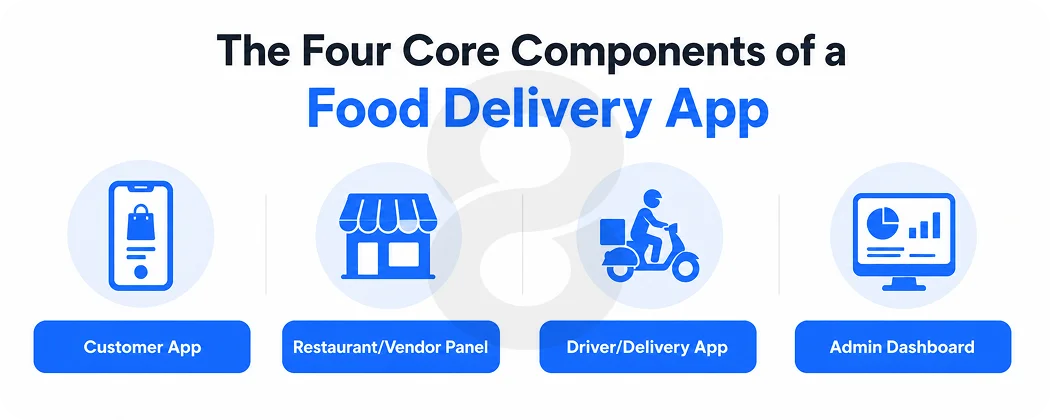
A food delivery app is not a single product. It is a connected ecosystem of four distinct applications, each serving a different user group. Understanding each component helps you understand where the budget actually goes.
Component |
Purpose |
Cost Range |
Timeline |
| Customer App | Browse, order, pay, and track deliveries | $25,000 – $60,000 | 4 – 6 months |
| Restaurant/Vendor Panel | Manage menus, accept orders, view analytics | $20,000 – $50,000 | 3 – 5 months |
| Driver/Delivery App | Accept pickups, navigate routes, update status | $18,000 – $45,000 | 3 – 5 months |
| Admin Dashboard | Manage all users, commissions, disputes, analytics | $10,000 – $25,000 | 2 – 3 months |
When combined, a full-stack food delivery platform costs between $73,000 and $180,000 on average. Most startups build in phases, starting with the customer app and restaurant panel, then adding the driver module after validating demand. To understand the nuances of building the delivery-side experience, read more about apps for delivery drivers.
Read More: 10 Best Delivery Driver Apps to Inspire Your Next App
Factors Influencing Food Delivery App Development Costs in 2026
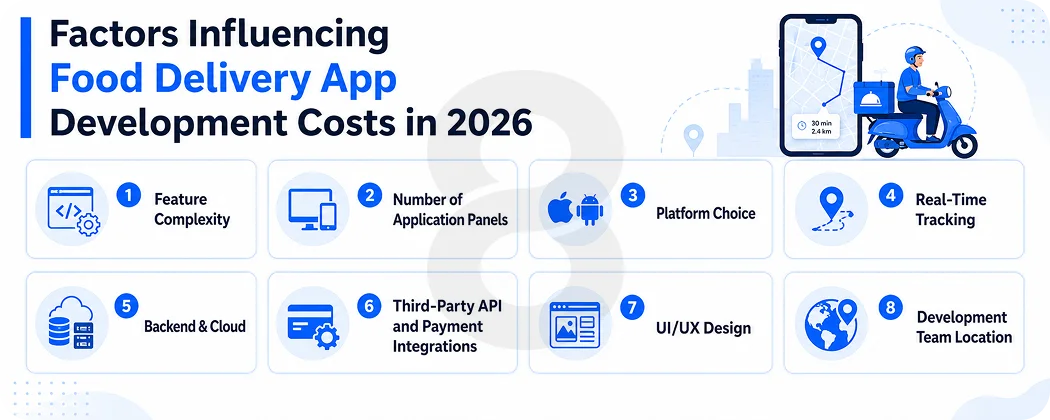
The food delivery app development cost in 2026 is influenced by technical architecture, feature complexity, infrastructure requirements, and development resources. Understanding these cost-driving factors helps businesses estimate budgets accurately, reduce unnecessary spending, and build scalable delivery platforms aligned with long-term growth objectives.
Feature Complexity
The overall feature architecture significantly affects development cost. A basic MVP with ordering, payments, and tracking may cost between $20,000 and $40,000, while AI-powered enterprise ecosystems with recommendation engines, loyalty systems, subscriptions, and analytics can exceed $250,000 in total development expenses.
Number of Application Panels
Food delivery ecosystems typically include customer apps, restaurant dashboards, delivery driver apps, and admin panels. Each additional module requires separate frontend development, APIs, authentication systems, and database workflows. Developing all four panels together can increase project costs by $50,000 to $120,000+.
Platform Choice
Native iOS and Android development require separate codebases, increasing both engineering hours and maintenance costs. Cross-platform frameworks like Flutter or React Native reduce development expenses by nearly 30% to 40%, making them ideal for startups targeting faster deployment and lower operational budgets.
Real-Time Tracking
Implementing real-time driver tracking requires technologies like WebSockets, Firebase Realtime Database, Socket.io, and Google Maps APIs. These systems demand scalable backend infrastructure and continuous data synchronization, adding approximately $8,000 to $20,000 to the overall development cost depending on tracking complexity.
Backend & Cloud
A scalable backend built with Node.js, Django, PostgreSQL, Redis, AWS, or Google Cloud directly impacts application performance and operational reliability. Enterprise-grade cloud architecture with auto-scaling, caching, CDN integration, and load balancing can add $10,000 to $35,000 during development and deployment stages.
Third-Party API and Payment Integrations
Food delivery applications rely heavily on integrations like Stripe, PayPal, Twilio, Firebase, and Google Maps. API implementation, security configuration, and testing increase initial development costs. Additionally, recurring monthly API expenses may range from $500 to $5,000+ depending on platform usage volume.
UI/UX Design
Custom UI/UX design involving motion animations, intuitive checkout flows, dark mode support, accessibility optimization, and responsive layouts increases frontend engineering efforts. High-end user experience design typically costs between $5,000 and $25,000 but substantially improves customer retention and platform engagement rates.
Development Team Location
Development costs vary significantly by region. North American agencies charge around $100–$150/hour, while South Asian teams typically range between $20–$50/hour. Hiring experienced developers may increase upfront investment but reduces technical debt, scalability issues, and long-term maintenance expenses after launch.
Read More: iOS App Development Cost in 2026: A Detailed Guide
Feature-by-Feature Cost Breakdown
Not all features carry the same cost weight. Knowing which features belong in your MVP and which ones can wait for phase two is one of the most effective ways to manage your food delivery app development budget without sacrificing user experience.
Feature |
MVP Version |
Advanced Version |
Additional Cost |
| User Auth | Email/phone login | Social login, biometric | +$2,000 – $5,000 |
| Restaurant Discovery | Search, filters by cuisine | AI recommendations, personalized feed | +$8,000 – $15,000 |
| Order Tracking | Basic status updates | Live GPS, driver ETA, photo proof | +$6,000 – $12,000 |
| Payment Processing | Card payments, cash on delivery | Digital wallets, BNPL, loyalty points | +$3,000 – $8,000 |
| Notifications | Push notifications | In-app chat, AI chatbot support | +$5,000 – $12,000 |
| Loyalty & Rewards | Basic points system | Gamification, tier-based rewards | +$4,000 – $10,000 |
| Analytics (Admin) | Basic order/revenue reports | Predictive analytics, heatmaps | +$8,000 – $20,000 |
| Grocery Delivery Module | N/A | Inventory sync, slot scheduling, substitutions | +$15,000 – $30,000 |
If you are building a grocery delivery app, note that the grocery delivery app development cost is generally higher due to inventory management complexity, substitution logic, and time-slot scheduling. Budget an additional $15,000 to $30,000 on top of your base platform for a fully functional grocery module.
Platform Choice: iOS, Android, or Cross-Platform?
Your choice of platform directly affects your food delivery app development cost. Here is a clear comparison to help you decide:
Platform |
Basic App |
Mid-Range |
Enterprise |
Best For |
| iOS Only | $25,000 – $50,000 | $70,000 – $110,000 | $130,000 – $200,000 | US urban market testing |
| Android Only | $30,000 – $55,000 | $80,000 – $125,000 | $150,000 – $230,000 | Emerging markets, global reach |
| Cross-Platform (React Native/Flutter) | $35,000 – $60,000 | $85,000 – $130,000 | $140,000 – $220,000 | Budget-conscious startups, best ROI |
| Native iOS + Android | $55,000 – $105,000 | $150,000 – $235,000 | $280,000 – $430,000 | Funded startups needing peak performance |
Cross-platform development using React Native or Flutter reduces costs by 30 to 50% compared to building separate native apps, making it the recommended approach for most startups. For a deeper comparison of Android app development cost, that breakdown can help you decide whether native Android is worth the premium for your specific target market.
Regional Development Costs: Where Your Team Is Based Matters
The geographic location of your development team is one of the most significant cost variables in custom food delivery application development. Here is what the numbers look like across regions in 2026:
Region |
Hourly Rate |
Basic App |
Mid-Range App |
Enterprise App |
| North America (US/Canada) | $100 – $150/hr | $50,000 – $80,000 | $120,000 – $180,000 | $200,000 – $300,000+ |
| Western Europe (UK/Germany) | $80 – $120/hr | $45,000 – $70,000 | $100,000 – $150,000 | $180,000 – $250,000+ |
| Eastern Europe (Poland/Ukraine) | $40 – $70/hr | $30,000 – $50,000 | $70,000 – $100,000 | $120,000 – $180,000 |
| South Asia (India/Pakistan) | $20 – $50/hr | $18,000 – $40,000 | $30,000 – $60,000 | $60,000 – $110,000 |
| Latin America (Argentina/Mexico) | $30 – $60/hr | $25,000 – $45,000 | $60,000 – $90,000 | $100,000 – $160,000 |
A hybrid model, where you have US-based product ownership and offshore development execution, typically delivers the best outcome: enterprise-quality results at 40 to 50% less than an all-US team. The key is thorough vetting and a clearly scoped project before development starts.
Read More: Local vs Remote App Development: Does Location Matter?
Technology Stack for a Scalable Food Delivery App
Choosing the right technology stack is foundational to building scalable mobile app solutions that can handle thousands of concurrent orders. Here is what production-grade food delivery platforms use in 2026:
Layer |
Technology |
Why It Matters |
| Frontend (Mobile) | React Native or Flutter | Cross-platform efficiency, 40% faster deployment |
| Backend | Node.js + Express or Python + Django | Scalable, event-driven, large ecosystem |
| Database | PostgreSQL + Redis (caching) | ACID compliance for transactions, low-latency reads |
| Real-Time Engine | Socket.io or Firebase Realtime DB | Live GPS tracking, instant order updates |
| Cloud Hosting | AWS or Google Cloud Platform | Auto-scaling, managed services, 99.9% uptime SLA |
| Payment Gateway | Stripe or PayPal | PCI DSS-compliant, straightforward API integration |
| Maps & Navigation | Google Maps API or Mapbox | Reliable geocoding, route optimization, global coverage |
| Push Notifications | Firebase Cloud Messaging (FCM) | Free up to 10M messages/month, cross-platform delivery |
Read More: 40 Best Technology Stacks for Mobile App Development in 2026
Hidden Costs Most Agencies Do Not Tell You About
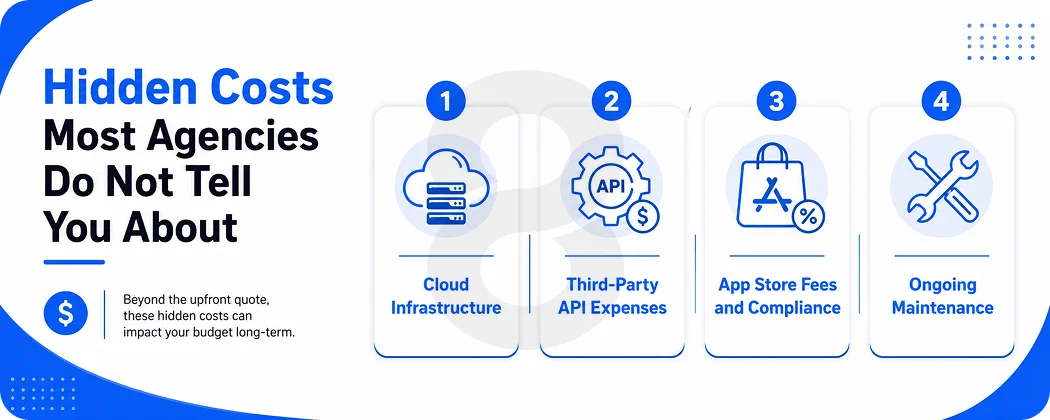
The development quote you receive is rarely the complete picture. Once your food delivery app launches, several ongoing costs kick in, and they add up faster than most founders expect. Planning for these from day one protects your runway.
1. Cloud Infrastructure
Your cloud hosting costs scale directly with your user volume:
- Startup phase (under 1,000 orders/month): $200 to $500/month
- Growth phase (1,000 to 10,000 orders/month): $500 to $2,000/month
- Scale phase (10,000+ orders/month): $2,000 to $10,000+/month
2. Third-Party API Expenses
Google Maps API alone costs $300 to $1,500 per month at scale (50,000+ monthly active users). Payment processing through Stripe adds 2.9% + $0.30 per transaction. On $100,000 in monthly GMV, that is roughly $2,900 in processing fees alone. SMS notifications via Twilio run about $79 per 10,000 messages.
3. App Store Fees and Compliance
- Apple Developer Program: $99/year
- Google Play Console: $25 one-time fee
- PCI DSS compliance (quarterly scans, annual penetration testing): $5,000 to $15,000/year
- GDPR/CCPA legal review (if applicable): $5,000 to $15,000 one-time
4. Ongoing Maintenance
Budget 15 to 20% of your initial development cost per year for maintenance. A $60,000 app means approximately $9,000 to $12,000 annually for bug fixes, OS updates, security patches, and performance improvements.
Food Delivery App Development Service: Build vs Buy vs White-Label
Before committing to custom food delivery application development, it is worth understanding your three strategic options:
Option |
Cost |
Flexibility |
Best For |
| White-Label Solution | $5,000 – $20,000 | Low (limited customization) | Market validation, single restaurant |
| SaaS Platform (Sharetribe, etc.) | $200 – $1,000/month | Medium (template-based) | Early-stage testing, no technical team |
| Custom Food App Development | $20,000 – $300,000+ | Full (unlimited) | Scalable startups, serious market players |
White-label solutions make sense for market validation. However, once you exceed 500 orders per week or want to differentiate on user experience, custom food app development is the only path to meaningful competitive advantage. Heavy customization of a white-label platform often ends up costing more than building custom from scratch, so plan the migration early if you go that route.
Partnering with a dedicated food delivery app development company like 8ration gives you access to on-demand app development services built around your specific business model, target geography, and scale goals.
Read More: The Complete Guide to White Label App Development for Agencies
How to Reduce Food Delivery App Development Cost Without Sacrificing Quality
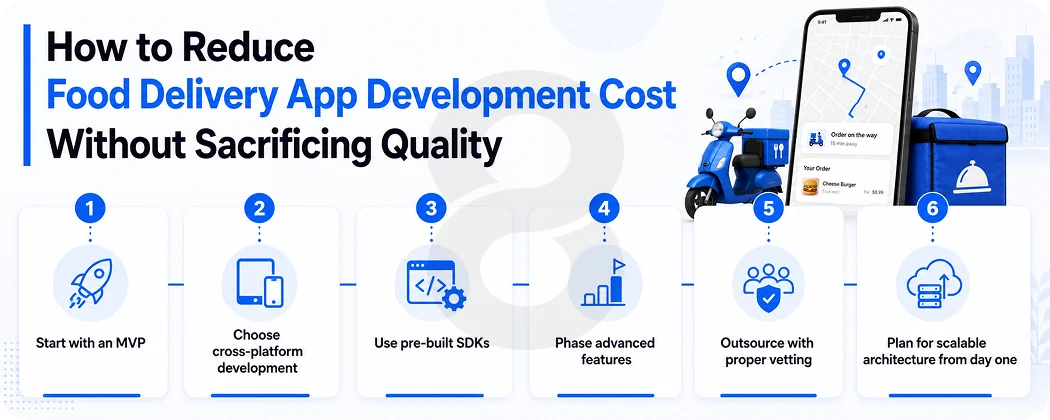
Smart planning and phased execution can reduce your budget by 30 to 50% while maintaining a competitive product. Here are the most effective strategies:
- Start with an MVP: A focused MVP reduces initial cost by 40 to 60%. Build one restaurant’s workflow first, validate demand, then expand.
- Choose cross-platform development: React Native or Flutter cuts costs by 30 to 40% compared to separate native builds.
- Use pre-built SDKs: Stripe for payments, Google Maps SDK for navigation, and Firebase for notifications each save weeks of custom development time.
- Phase advanced features: AI recommendations, loyalty programs, and voice ordering can each wait until you have usage data. Each deferred feature saves $5,000 to $20,000 at launch.
- Outsource with proper vetting: Eastern European or South Asian teams at $30 to $70/hr can deliver enterprise-quality results if you vet for live app portfolios, US client references, and clear IP ownership contracts.
- Plan for scalable architecture from day one: Cutting backend corners to save $10,000 upfront often results in $50,000+ in rewrites at 10,000 users.
Read More: The Real Cost of App Maintenance: What Budget Percentage Should You Allocate?
Food Delivery App Development: Timeline Overview
Development Phase |
Basic MVP |
Mid-Range Platform |
Enterprise Platform |
| Discovery & Planning | 1 – 2 weeks | 2 – 3 weeks | 3 – 4 weeks |
| UI/UX Design | 2 – 3 weeks | 3 – 5 weeks | 5 – 8 weeks |
| Development | 8 – 12 weeks | 12 – 20 weeks | 20 – 36 weeks |
| QA & Testing | 2 – 3 weeks | 3 – 4 weeks | 4 – 8 weeks |
| Deployment & Launch | 1 – 2 weeks | 2 – 3 weeks | 2 – 4 weeks |
| Total | 3 – 4 months | 5 – 7 months | 8 – 12 months |
Note that app store review processes, payment gateway approvals (typically 2 to 4 weeks), and compliance reviews can add time beyond the development timeline itself. Factor these into your go-to-market planning.
Read More: Mobile App Development Timeline: 2026 Guide
What Makes Delivery App Development More Complex Than Other Apps?
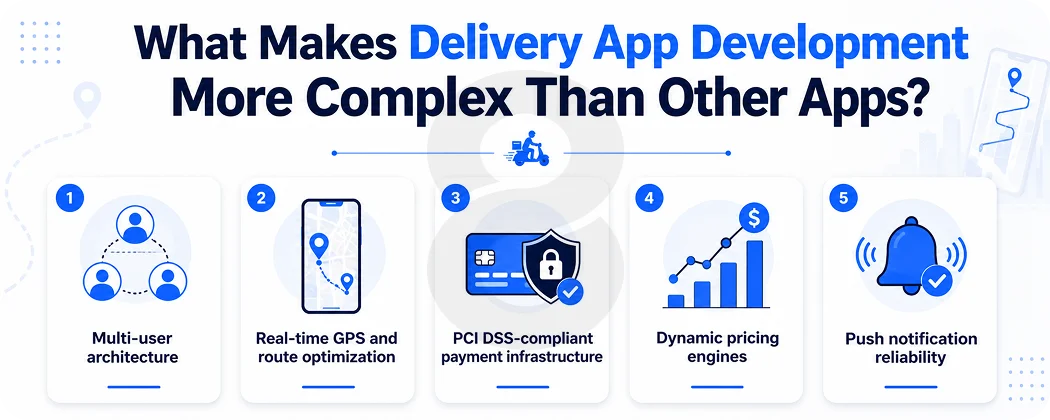
Delivery app development sits at a uniquely high level of technical complexity compared to standard mobile applications. Here is why:
- Multi-user architecture: Four interconnected panels (customer, restaurant, driver, admin) must communicate in real time without latency.
- Real-time GPS and route optimization: Live location tracking with sub-second updates requires persistent WebSocket connections and efficient map rendering.
- PCI DSS-compliant payment infrastructure: Handling financial transactions demands tokenization, encryption, and regular audits.
- Dynamic pricing engines: Surge pricing, promotional logic, and commission calculations require complex backend business logic.
- Push notification reliability: Order confirmations, driver updates, and promotions must be delivered reliably across iOS and Android at scale.
These complexities are exactly why partnering with a specialized food delivery app development service provider makes a material difference in both speed and quality of delivery.
Read More: How to Build a Successful Mobile Application Deployment Strategy
Why Choose 8ration for Your Food Delivery App Development?
8ration is a digital transformation company with 10+ years of experience delivering scalable mobile app solutions for clients across the US, Canada, UAE, and beyond. Here is what sets our food delivery app development approach apart:
- End-to-end ownership: From discovery and UI/UX to deployment and post-launch support, your project stays in one capable team.
- Transparent scoping: Every estimate clearly defines what is included. No surprise charges after the contract is signed.
- Cross-platform specialization: React Native and Flutter expertise reduces your time-to-market by up to 40%.
- Agile delivery: Bi-weekly sprints with working deliverables at every checkpoint keep your project on track and on budget.
- Scalable architecture: Apps built to handle 100,000+ users from day one, because rebuilding a broken foundation later costs far more than doing it right the first time.
Whether you are building a regional multi-restaurant marketplace, a grocery delivery app, or a direct ordering platform for your restaurant chain, 8ration has the expertise to bring your vision to market efficiently. Reach out through our website to get a transparent estimate based on your specific requirements.
Conclusion
Food delivery app development cost in 2026 varies widely based on features, platform choice, and development complexity. An MVP typically ranges from $20,000 to $40,000, while a full production-ready platform can cost $50,000 to $120,000, and enterprise-level systems may exceed $300,000.
With the global market nearing $2 trillion by 2031, success depends on timing and execution. The best approach is to start lean, validate quickly, and scale strategically with a strong technical and product-focused team.