
Being a lawyer is a multi-faceted role that encompasses lawyer, advisor, negotiator, and somewhere in the middle, an accountant. One of the most important, but time-consuming, pieces of a legal practice is billing. From small solo practices to medium-sized law firms, having the right law firm billing software is essential and not a luxury.
However, the question most law firms face is whether they should choose an off-the-shelf legal billing software or opt for a customized software platform designed to fit the needs of their specific law firm. This blog will go into detail about both options, why it is often better to go with a custom solution in the long run, and how to determine which option is right for your practice, whether you are a large company or searching for the best legal billing software for small companies.
Why Billing Is So Complex for Law Firms
It’s important to note that legal billing is a unique billing situation compared to other industries before deciding on software options.
Law firms manage various billing models concurrently: hourly, flat-fee, contingency, retainer, and hybrid. The billing agreement may vary per client, and each individual case within the client account can have a different agreement. Then there are trust accounting, IOLTA compliance, expenses, court filing costs, and multi-attorney cases. And that’s just a few of the challenges involved in billing. It’s an environment that is unlike nearly any other profession.
Moreover, attorneys have a legal and ethical responsibility to keep up with precise and detailed billing records. Errors could not only compromise your finances but also your relationship with your clients or result in bar complaints or malpractice claims. That is the reason why, in a legal context, standard small business invoicing software is simply not enough.
That’s where custom law firm accounting software and lawyer timekeeping and billing software can come into play.
Read More: Hire CRM Developer vs. Buy Ready-Made CRM Software: What’s Right for Your Business?
The Off-the-Shelf Version: Common But Flawed
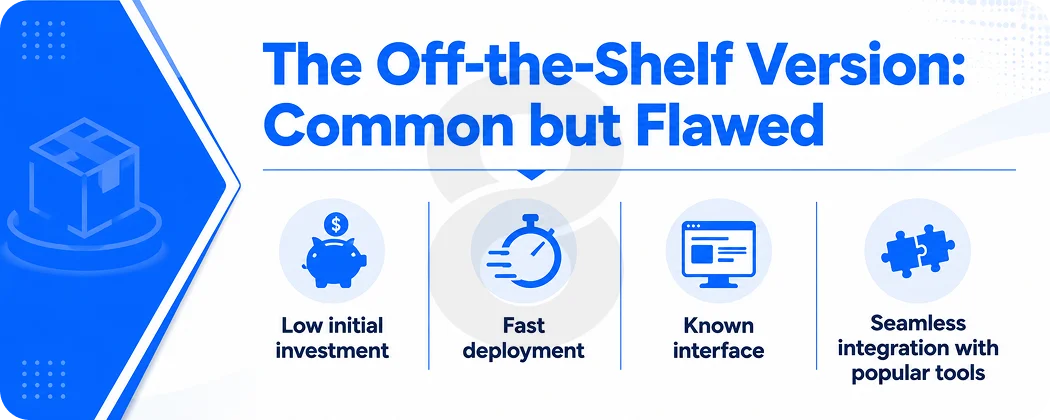
Most companies begin to use common software when they first start. Common initial options include QuickBooks or FreshBooks, or even simple practice management software with billing features. These are tools that are inexpensive, well-known, and relatively easy to install.
The benefits of an off-the-shelf legal billing software are enormous.
- Low initial investment: Many of the billing solutions available at SaaS are monthly subscription-based, which can be easily managed for a small business.
- Fast deployment: Businesses can be on the ramp-up in days, not weeks, without having to wait for lengthy development cycles.
- Known interface: Staff are likely to be comfortable using the mainstream accounting software.
- Seamless integration with popular tools: Integration with various popular tools, such as Google Calendar, Microsoft Office, or payment processors like Stripe.
The benefits outweigh the drawbacks for these reasons, and this is why off-the-shelf tools are popular, particularly among newer, smaller companies that are getting their first taste of digital billing.
Read More: What is a Proof of Concept in Software Development
The Restrictions That Begin to Prime
The problems with a one-size-fits-all approach do become evident, however, in a hurry, typically at the last minute.
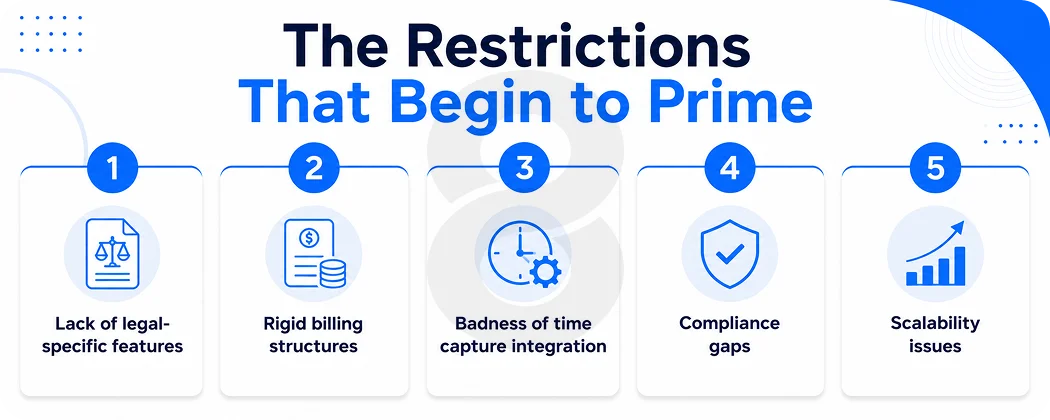
1. Lack of legal-specific features
Generic billing software is not capable of distinguishing between billable and non-billable time, does not comply with IOLTA trust accounting rules, and fails to provide matter-based billing, which is required by legal work. Lawyers find themselves needing to develop workarounds (which negates the need for software, of course).
2. Rigid billing structures
For firms that charge by the hour, flat fee, and contingency basis, most standard options will not allow you to seamlessly integrate all three types of pricing. You might end up with several systems, which can be a recipe for billing mistakes.
3. Badness of time capture integration
In law, time is money. Even a few minutes per day per attorney lost adds up to a substantial loss of revenue in a year. The majority of general billing tools do not have the depth of timekeeping and billing software for attorneys that is found in many other tools, such as time timers, mobile time entry, and email and document time capture.
4. Compliance gaps
Legal billing needs to follow state bar rules, outside counsel guidelines (also called corporate guidelines), and specific trust accounting rules. It’s hard to find off-the-shelf software that can accommodate the unique, jurisdiction-specific needs.
5. Scalability issues
Things that work well for a two-attorney firm don’t always work well for a ten-attorney firm. The problems with standard software get more painful as your company expands, and the expense and disruption of switching to another system halfway through growth are significant.
Custom Law Firm Billing Software: Built for How You Actually Work
Custom legal billing software is software that has been created to fit your law firm, your processes, your rules, your clients, and your reports. It’s not just a template with your logo in it; it’s a system designed for your purpose. The benefits of using custom solutions are clear. The advantages of custom solutions are evident.
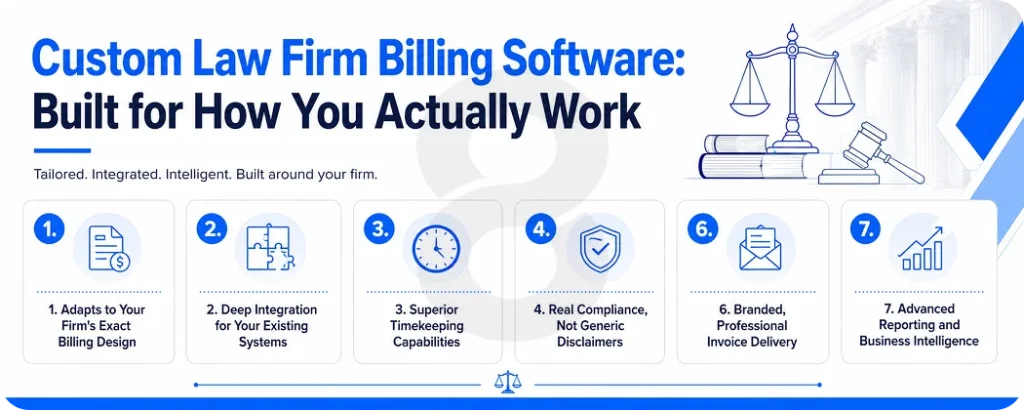
1. Adapts to Your Firm’s Exact Billing Design
Each law firm has a billing culture of its own. Some companies charge in increments of six minutes, others charge in increments of 15 minutes. A few partners have different pricing models based on their clients. Some companies charge a fee for some types of matters based on volume discounts. You don’t have to make any compromises with custom law firm billing software. A custom software solution for law firms allows you to set the rules. The software fits your firm, rather than the other way around.
2. Deep Integration for Your Existing Systems
Often, off-the-shelf solutions include third-party connectors that may have limited functionality, be costly, and be unreliable. Custom solutions seamlessly and fully connect to your current case management, document management, email, court e-file, and payment processor. This involves a single, seamless process from opening of matter through to sending of the invoice, and no duplication of data entry and no disconnected systems leading to recon issues.
3. Superior Timekeeping Capabilities
Attorneys use the time in the manner they use it, and the ideal timekeeping and billing software for attorneys captures time accordingly, not in the way a software product manager thought they’d use it. Time suggestions from email threads, calendar billing integration, a voice-to-time feature, and intelligent rounding rules are just some of the features that can be built into a custom platform. If there aren’t any barriers to timekeeping, lawyers use it. When attorneys employ it, your firm gets more billable time.
4. Real Compliance, Not Generic Disclaimers
Custom software can be programmed to meet your jurisdiction’s trust accounting rules, highlight any trust accounting entries that do not comply with outside counsel billing rules, and provide audit trails that meet bar oversight requirements. Your system doesn’t just accept a default checklist to determine whether you are compliant; it prevents you from billing anything that isn’t compliant in the first place.
6. Branded, Professional Invoice Delivery
Your invoices are a client interaction point. Custom software can create an invoice that reflects your company’s brand, include a matter-specific narrative summary, be sent to your client via the client portal with online payment options, and be formatted in the style of your client, such as LEDES (Legal Electronic Data Exchange Standard), which is required by many corporate clients.
7. Advanced Reporting and Business Intelligence
The best law firm accounting software can be tailored to include reporting dashboards that answer the questions that your firm’s leadership asks: Which practice groups are most profitable? What are the realization rates of the partners? Are there any clients who pay late regularly? Unbilled time is where? Generic Software provides you with generic business reports. Custom software provides you with the intelligence to run your particular firm better.
Read More: How to Build a Contract Management System for Law Firms
Simple Legal Billing Software for Small Firms: Does Custom Still Apply?
One argument against custom solutions is that it’s a topic for big companies with big budgets. This is an outdated concept, however, that is becoming rarer. Simple legal billing software designed specifically for small practices is more in demand than ever, and custom-developed legal billing tools are now much more affordable thanks to today’s cloud-based development platforms and modular software designs.
What Small Firms Really Need?
In the case of solo practitioners and small firms, priorities are a little different:
- Easy to operate: Above all else, small firm attorneys don’t have a billing department or employees. The lawyer(s) themselves or one administrator takes care of everything. The software should be truly user-friendly.
- But not the same price as the enterprise: the best legal billing software for small businesses won’t come with enterprise pricing, but it won’t leave out features that are important, such as mobile time entry or trust accounting, either, just to stay on budget.
- Fast invoicing: Small businesses are cash flow-constrained. Promptly getting invoices out and collecting payment effectively is essential for survival.
- Client portal with online payments: More and more clients are wishing to pay online. This is a feature that small firm billing software does not support.
- Simple trust accounting: Even a solo practitioner needs to manage his/her trust accounts properly. This is non-negotiable.
All these needs can be met by custom or extremely customizable legal billing software for small businesses, without all the bloat of large enterprise solutions, or even the undesirable feature set of generic small business products.
Read More: How to Hire a Software Development Team: A Step-by-Step Guide
Key Features to Look For in Any Law Firm Billing Software
When considering custom or off-the-shelf solutions, the following features should be on your list:
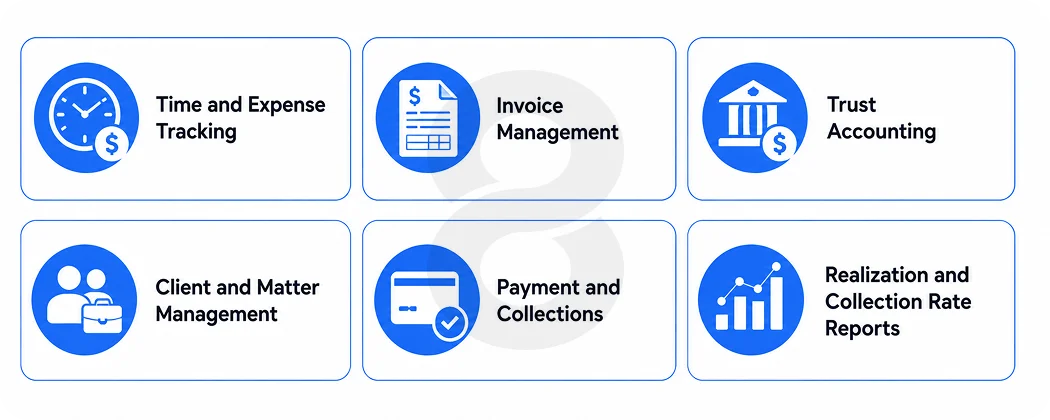
- Time and Expense Tracking: Multiple timer support, mobile time entry, automatic time rounding, and expense entry with receipt capture support non-billable time for internal reporting.
- Invoice Management: Customizable invoice templates, support for LEDES billing format, pre-bill review and editing workflow, automated invoice reminders, and bulk invoice generation.
- Trust Accounting: Three-way reconciliation between trust ledger, bank statement, and client ledger; IOLTA compliance tracking; automated retainer replenishment requests; and no commingling of funds.
- Client and Matter Management: Matter-specific billing rates, client billing preferences per account, conflict check integration, and matter budgets and billing caps.
- Payment and Collections: Integration with payment processors, payment plan support, online payment portal, credit card and ACH processing, automated collections workflows.
- Realization and Collection Rate Reports: attorney productivity reports, aged receivables report, matter profitability analysis, and revenue forecasting.
Read More: Intellectual Property in Software: How to Protect Your App Idea Before You Build
The Hidden Costs of the Wrong Software
However, many companies only consider the price of the bill software and don’t consider the real cost of a misfit.
Delaying time entries, not remembering them or undervaluing time by attorneys: When the timekeeping system is cumbersome, attorneys tend to delay time entries, forget them or undervalue their time. Timekeepers have repeatedly been found to waste 10–15% of billable time per year because they lack an efficient timekeeping system. It is tens of thousands of dollars per year when their firm charges $300 an hour and it has five lawyers.
- Write-offs due to billing errors: When billing systems aren’t aligned with your workflow, errors occur: duplicate entries, surcharges, and incorrect matter allocations. These mistakes result in lost time, lost clients and lost trust.
- Staff time on workarounds: If your billing software can’t do everything you need it to do, such as export to Excel, reconcile trust accounts and reformat invoices before sending, you are paying staff to fill in the gaps in your software.
- Trust accounting error: Not only is it an accounting issue, but it’s an accounting problem that’s a bar complaint waiting to happen. A disciplinary action, despite having no finding, can be a devastating time and reputation loss.
- Migration costs: Changing billing systems is very painful and costly. Each year you remain on the wrong platform represents another year of data that needs to be moved, reconciled and validated.
Read More: Pricing Models for Software Services: Fixed vs. Hourly Rates Explained
How to Choose: A Decision Framework
To effectively move forward, you should use a decision framework to help you choose the right solution.
Step 1: Review the Issues with your Payments
Write down each point of irritation, workaround, and mistake that you make in your present billing process. Be specific. These are your needs list.
Step 2: Classify your Requirements
Break down your needs into Musts, Shoulds, and Nice-to-Haves. This way, you won’t get dazzled by the functions that you will never use and fail to notice the functions that you will use.
Step 3: Take a Realistic Look at Available Products
Demonstrate at least three legal billing platforms that are off-the-shelf, not accounting programs. Look at how many of the items you want they are providing, not just the ones you think they are providing.
Step 4: Get a custom development consultation
Don’t assume that it’s too expensive until you get an actual quote. A common issue endured by various companies is that they have no idea that a well-defined custom solution will cost less over 5 years than an inadequate off-the-shelf solution in terms of licensing fees, workaround costs, and lost productivity.
Step 5: Think about a blended solution
Other companies have been successful in taking a legal-specific platform and modifying it extensively to fit their needs. This can give the best of both worlds: the speed of off-the-shelf deployment combined with much of the flexibility of custom development.
The Future of Legal Billing Software
The legal billing environment is changing at a fast pace. AI is now starting to make a meaningful difference, whether it’s AI to build up time from calendar, email, and document activity to create billable entries or predictive billing analytics that enable firms to price matters before work even starts.
In corporate legal, blockchain-based billing verification is a promising solution to audit the billing records for higher transparency. Bills are increasingly coming to be viewed in real-time, as in a real-time matter dashboard, and client expectations are growing around the same thing, seeing what they owe before an invoice arrives, are driving firms towards billing software with robust client-facing portals.
Custom law firm billing software is more likely to implement and incorporate these innovations as they become more developed, as it’s composed for your firm’s particular needs, not the widest possible market.
Read More: How to Hire a Software Engineer: The 2026 Checklist
Final Thoughts
The legal billing software that is most popular, cheapest, or most feature-packed doesn’t necessarily make it the best. It is the one that works the way your law firm operates, doesn’t create friction for your attorneys, helps maintain billing compliance, and helps you make sure you get paid for all that you’ve earned.
There are some tools out there that are available off the shelf that have a role to play, especially for small companies that are just beginning or with very basic billing requirements. As your practice expands and your clients become more sophisticated, however, the drawbacks of using generic software will become more apparent.
Highly customized or configured law firm billing software is an investment in the operational foundation of your firm. If constructed properly, it will recoup itself in the form of billable time, quicker collections, reduced write-offs, and the right kind of billing intelligence to make better business decisions.
If you are a solo practitioner who needs easy and efficient billing software, a growing law firm that is looking for billing software for small firms, or a multi-practice law firm seeking the best law firm billing software, it all begins with understanding your workflow and engaging software that addresses all of your workflow needs. Your billing system must be beneficial for you. Not the other way round.