



Adoption of online dating in the US has been flat for seven years. Pew Research Center has had the share of adults who have ever used a dating site or app sitting at 30% since 2019, and a January 2026 SSRS poll of 2,012 adults found only 6% were currently using one. Everyone who was going to download Tinder already did.
Which sounds like a bad market to enter, and is exactly the opposite. A saturated general market is where niche products win, because the people leaving the big apps are not leaving dating. They are leaving apps that feel like a slot machine full of strangers. That is the gap a focused platform can occupy.
This is a walkthrough of building one, based on the work behind Circle Track Connections, a dating app for the motorsport community. Architecture, matching, trust and safety, pricing, and the order to do them in.
The Dating App Build Order
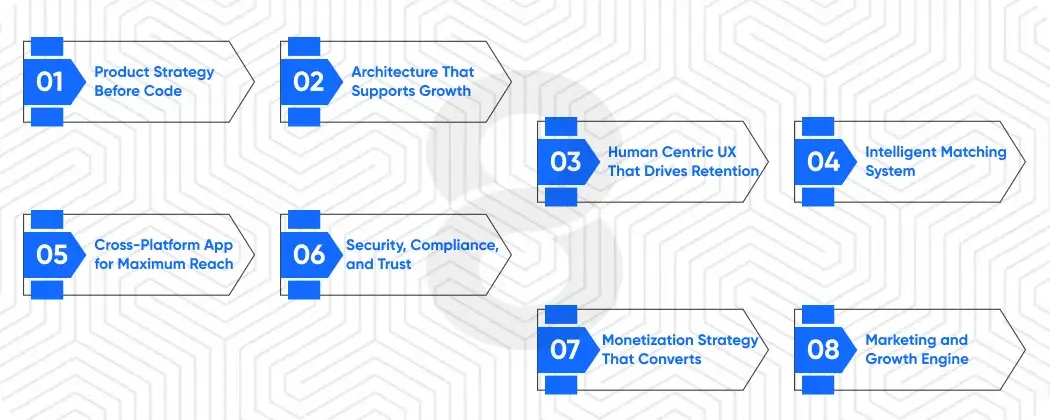
The eight sections that follow run in the order you would actually build them. Each stage produces something the next one depends on, so teams that reorder them tend to redo work.
- Positioning and audience
- Backend architecture
- Onboarding and UX
- Matching engine
- Platform choice
- Trust and safety
- Monetization and pricing
- Launch and growth
Dating App Strategy Starts With Positioning
Most dating app projects begin with a feature list. That is the wrong end. The feature list for a dating app is almost fixed, since profiles, matching, chat, and payments appear in every one of them. What differs is who the app is for, and that decision changes the architecture underneath.
Why niche beats general
A general dating app has to solve cold-start on both sides of a marketplace in every city it launches. A niche app inherits an existing community with its own events, vocabulary, and reasons to talk. Circle Track Connections works because motorsport fans already have something to say to each other before either person has to be charming.
Shared identity also does something measurable to conversation rates. Two strangers with a common interest have an opening line built in, and conversation rate is the metric that predicts retention in dating apps far better than match rate does.
The audience segments worth separating
The original research on Circle Track Connections identified users looking for a long-term relationship inside the motorsport world, users who wanted the community more than the dating, and users who were driven by events and race weekends. Those three want different things from the same app, and treating them as one audience produces an app that suits none of them.
What to decide before writing code
Market validation, the audience segments, the feature priority order, how money is made, and whether the technical approach is feasible on your budget. This is also the stage where MVP development scoping happens, because the honest version of a first release is much smaller than the deck version.
Architecture That Holds Up as Your Dating App Grows
Dating apps fail on infrastructure more often than on product. The load profile is unusual, because messaging is real-time and bursty, media uploads are heavy, and the matching workload grows faster than the user count does.
What the system has to handle at once
High-concurrency messaging, real-time notifications, media uploads and processing, geo-based filtering, the matching engine, and subscription billing. Each of those scales on a different axis, which is why a single monolith becomes painful at exactly the moment you are trying to grow. Splitting them into separate services means backend development effort goes into the parts under pressure rather than redeploying everything.
| Service | Scaling Pressure | Why It Gets Its Own Service |
| Identity and verification | Spikes at signup and during growth pushes | Security-sensitive and needs independent deploy cadence |
| Messaging and WebSocket | Persistent connections, bursty at peak hours | Connection count scales differently from request count |
| Matching and recommendations | Grows faster than user count | Compute-heavy, benefits from separate scaling and caching |
| Media processing | Heavy uploads, unpredictable file sizes | Long-running jobs that should not block the API |
| Subscription and billing | Low volume, high consequence | Isolating it limits the blast radius of a bad deploy |
The infrastructure decisions that matter
Load balancing and automatic scaling triggers, so a spike in signups after a press mention does not take messaging down with it. A well-defined API layer matters more here than in most apps, because the mobile clients, the moderation tools, and any future web surface all consume the same data. Getting the API design right early saves a rewrite later.
Onboarding and UX That Survives the First Week
Dating apps lose most users in the first session. The profile is empty, the matches are thin, and nothing has happened yet. Every design decision in the first ten minutes is a retention decision.
Progressive profiles instead of long forms
A full profile improves match quality, and a long signup form kills signups. The way out is to ask for the minimum up front and prompt for the rest later, tied to a visible benefit. Users who complete more of their profile get better matches, which is worth saying out loud in the prompt rather than leaving implied.
Signals that build trust between strangers
Verified profile indicators and community badges do more for conversation rates than any amount of interface polish. In a niche app, a badge that proves someone actually attends events carries real weight. This is where app design work overlaps with trust engineering, because the badge is only meaningful if the verification behind it is.
Designing for connection rather than swiping
Swipe mechanics optimise for session length. Conversation optimises for retention and for the outcome users actually came for. Circle Track Connections leaned toward shared-interest signals, event context, and profile depth rather than pure swipe volume, which suits an audience that wants to meet people at a track rather than collect matches.
How to Build a Matchmaking Algorithm That Works
Location filtering is where matching starts, not where it ends. A distance-sorted list of everyone nearby is a directory, and users work out quickly that it is not doing anything for them.
What a matching engine actually weighs
Behavioural signals from how someone uses the app, preference clustering across users who behave similarly, activity scoring so dormant profiles stop surfacing, and mutual interest weighting so a match reflects both sides rather than one. Dormant profile suppression is the least glamorous item on that list and often the one that moves conversation rate most.
The cold-start problem
A learning system needs data it does not have on day one. The workaround is to start with explicit signals, which are stated preferences, interests, and event attendance, then layer behavioural weighting once there is enough usage to learn from. Teams that ship a machine learning matcher into an empty database usually end up debugging the model when the real problem is the sample size. This is where AI development experience matters more for the sequencing than for the algorithm.
Native or Cross-Platform for a Dating App
This decision gets made on ideology more often than on requirements, which is how teams end up rewriting a year later. For dating apps specifically, a few requirements should drive it.
What pushes toward native
Heavy camera and media work, background location, tight push notification behaviour, and platform-specific privacy APIs all get easier in native code. If verification involves live selfie capture or the product depends on precise background location, iOS and Android builds usually pay for themselves.
What pushes toward cross-platform
A single team, a tight runway, and a feature set dominated by lists, profiles, and chat. Cross-platform development cuts time to market and maintenance cost, and a well-optimised cross-platform app is indistinguishable from native for most of a dating app surface. The performance risk sits in the media-heavy screens, so budget optimisation time for those specifically rather than assuming parity.
The decision in practice
Most teams should pick based on which of the two lists above contains their hardest requirement, then plan for the possibility of moving one surface to native later. Chat and profiles rarely need it. Camera-based verification often does.
Dating App Trust and Safety You Cannot Retrofit
This is the section founders postpone and the one that decides whether a dating app survives contact with real users. It is also a competitive argument, not just a cost.
Where the fraud actually happens
The FTC reported in April 2026 that nearly 60% of people who lost money to a romance scam in 2025 said it started on a social media platform, with Facebook named most often. Social platforms have no verification requirement, no dating-specific moderation, and no incentive to police it. A dating app that does verification properly is offering something those platforms structurally cannot, which is worth saying in your marketing rather than burying in a trust and safety page.
What has to ship in version one
End-to-end encrypted messaging, secure authentication with multi-factor available, privacy-compliant data storage for the regions you operate in, automated content moderation on images and text, and user-controlled reporting and blocking. Reporting and blocking in particular cannot wait, because the first bad actor arrives long before the growth budget does.
Why retrofitting is so expensive
Adding verification to a live user base means asking existing users to re-verify, which costs you some of them. Adding moderation after a community norm has formed means enforcing rules people did not agree to. Both are survivable and both are far cheaper before launch, which is a good reason to include safety flows in the QA and testing scope from the start rather than treating them as edge cases.
Monetization That Does Not Cost You the Network
Dating apps have a structural pricing problem. The product only works if enough people are active, and the paywall reduces how many are active. Where you put it decides whether the network survives.
Gate reach, not function
Tiered subscriptions, profile boosts, event promotion, and premium messaging access all work as revenue lines. What breaks the product is gating basic messaging entirely, because a free user who cannot reply is a dead end for a paying user. Gating volume, visibility, and priority keeps the network liquid while still giving people a reason to pay.
Freemium as an onboarding decision
The free tier exists to reduce signup friction and to let someone experience a match before they are asked for money. Time-based feature unlocks, personalised tier bundles, and social proof at the point of decision all lift conversion, and all of them should be A/B tested rather than assumed, since pricing sensitivity varies enormously by niche.
Event revenue in a niche app
A community app has revenue options a general dating app does not. Event promotion, sponsored community placements, and partnerships with organisers in the niche can carry meaningful revenue without touching the core dating experience, which matters when subscription conversion is still finding its level.
Launch and Growth for a Niche Dating App
Marketing a niche dating app looks nothing like marketing a general one, and the budget goes much further because the audience is already gathered somewhere.
Go where the community already is
Motorsport events, existing forums, and creators inside the niche reach the target audience at a fraction of broad performance marketing cost. Community-driven campaigns and referral incentives work here because the audience overlaps with itself, which is the whole point of choosing a niche.
App store optimisation and landing pages
Store listings and landing pages should describe the outcome rather than the action. “Meet people who actually understand your weekends” does more than “Join now,” and this is one of the few places where copy testing produces reliable, repeatable gains.
What to measure in the first ninety days
Signup completion rate, day seven and day thirty retention, match-to-conversation rate, and conversation-to-meeting rate if you can capture it. Download counts flatter a launch and predict nothing. Conversation rate is the number that tells you whether the matching system is doing its job.
What It Costs to Build a Dating App
Cost tracks scope rather than category. A single-platform MVP with profiles, matching, and chat sits at one end. A two-platform build with live verification, encrypted messaging, an AI matching engine, moderation tooling, and subscription billing sits well above it.
The variables that move the number most are platform count, whether verification is automated or manual, and how much moderation tooling you build rather than buy. Mobile app development scoping should price those three separately, because they are the ones that expand mid-project.
Dating App Tech Stack Considerations
Stack choices matter less than architecture, with three exceptions. These are the ones that are painful to change once you have users, so they are worth deciding deliberately rather than inheriting from whatever the first developer was comfortable with.
Persistent connections rather than polling
Chat built on polling looks fine in testing and falls apart under load, because every idle client is still generating requests. WebSocket connections cost you connection management and a stickier infrastructure setup, and they are the difference between messaging that feels instant and messaging that feels like email. Notifications ride on the same decision.
A media pipeline that runs outside the request cycle
Profile photos and verification selfies arrive at unpredictable sizes and need resizing, format conversion, and moderation before they are visible. Doing that inside the upload request blocks the API and gives users a spinner. Queue the work, return immediately, and show the image once processing finishes. This is also where cloud infrastructure choices start to bite, since storage and processing costs scale with photo volume rather than user count.
Deployment speed as a safety requirement
Most teams treat CI/CD as engineering hygiene. On a dating app it is part of trust and safety, because when a moderation gap or an abuse pattern appears you need a fix live in hours rather than at the next release. Automated pipelines, monitoring, and analytics instrumentation all belong in the first release for that reason rather than as a later cleanup.
Circle Track Connections in Practice
Circle Track Connections set out to serve the motorsport community rather than compete with Tinder or Bumble on their terms. It shipped on both the App Store and Google Play with profile discovery, real-time messaging, intelligent matching, and event-driven interaction, and the full build is documented in the Circle Track Connections case study.
The pattern worth taking from it is the order of operations. Positioning came before the feature list, the architecture assumed growth before there was any, and trust systems shipped with the product rather than after the first incident.
Mistakes Teams Make When Building a Dating App
These come up on almost every project, and none of them are technology problems. They are sequencing problems.
- Building for everyone. A general dating app has to win a marketplace fight in every city it launches, against companies with far larger budgets.
- Shipping a machine learning matcher on day one. There is no behavioural data yet, so it performs worse than explicit preference matching and takes longer to build.
- Treating verification as a version two feature. The first fake profile arrives before the first thousand real users.
- Gating messaging entirely behind the paywall. Free users who cannot reply make the app worse for the people who paid.
- Measuring downloads. Retention and conversation rate tell you whether the product works. Downloads tell you whether the campaign ran.
- Running the monolith too long. The rewrite always lands during the growth push, which is the worst possible time for it.
Building Dating and Community Apps With 8ration
8ration builds community and matchmaking platforms across iOS, Android, and cross-platform, with the backend, matching, and moderation work handled by the same teams rather than split across vendors. That matters on this product category, because trust and safety cuts across the app, the API, and the admin tooling at once. The wider on-demand and community app practice covers adjacent products with the same real-time and marketplace pressures.
If you are early, the first conversation is usually about scope rather than stack. Who is this for, what has to ship in release one, and which safety systems are non-negotiable at launch? Those three answers set the budget and the timeline more than any technology choice does.