


The digital revolution is transforming the world of finance, and accounting is changing at a rapid pace. Firms are no longer using spreadsheets and manual audits only. Rather, they have resorted to using augmented reality in accounting to enhance accuracy, reduce errors, and speed up financial operations.
Augmented reality in accounting converts complex information into interactive visual experiences by superimposing real-time digital information on physical settings for the auditors and finance teams.
The guide divides the implementation steps, real-world application use cases, and smart AR app development plans into parts. Regardless of whether you are a CFO or the head of the audit, learn how to transform auditing and realize quantifiable performance improvements.
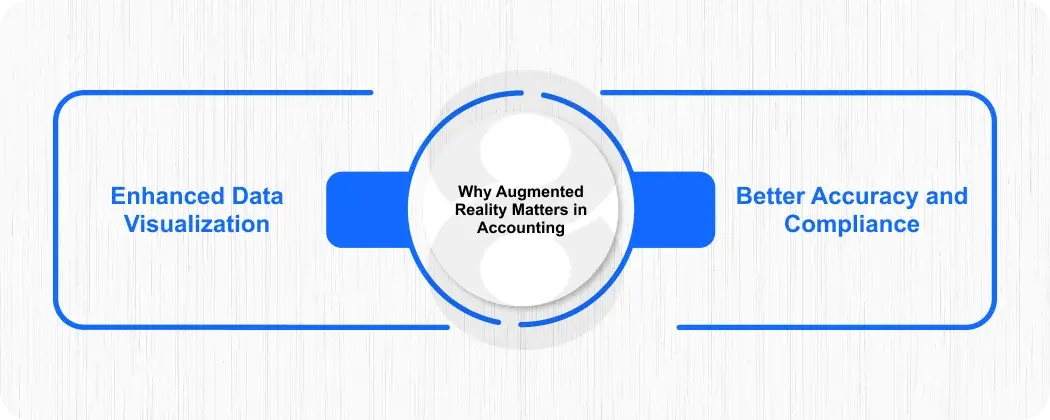
Why Augmented Reality Matters in Accounting
AR is not a technological innovation. It is an instrument that is gradually growing and is acquiring practical enterprise applications in industries. The opportunities are compelling in accounting and audit, as the work is data-intensive and time-consuming, and is therefore likely to be subject to manual error.
The following are three reasons why augmented reality in accounting will transform the profession:
Enhanced Data Visualization
Conventional spreadsheets and dashboards may overpower the non-technical stakeholders. AR enables one to see financial data in 3D and contextual overlays on actual objects, allowing complex information to be interpreted more easily whenever taking a closer look.
Faster Audit Cycles
Physical verification of assets, inventory, and documentation is usually an aspect of audit tasks. In AR, auditors are able to connect digital audit trails on objects in the real world, thereby saving time in travelling and shortening the verification process.
Better Accuracy and Compliance
A report by IBM has estimated the cost of human errors in accounting to be 7 trillion USD for businesses around the world each year. Although this amount is general, it brings to focus the expense of inaccuracies. AR would allow minimizing mistakes through guided inspections and real-time verification.
Indeed, by 2025, the worldwide market of augmented reality is likely to grow to USD 60.55 billion, with its expansion being partly contributed to by the use of AR in the enterprises of finance and professional services. These trends are indicative that the use of AR in accounting is not an experiment. It is a strategic step to higher operational efficiency and competitive advantage.
Step 1: Understand Your Business Use Cases
The use of augmented reality in accounting should be introduced by pinpointing particular issues that you wish to address. In a broad sense, AR is most effective in those cases that entail:
- Physical asset cross verification
- Complicated financial number visualization
- Live reporting and audit compliance
- Remote work between auditors and clients
Questions to be asked to be able to define your use cases include:
- Are auditors investing excessive working time at locations?
- Is it a challenge to convey complicated financial knowledge to customers?
- Are delays in audit due to mistakes in inventory valuation?
Whether you will require AR solutions to check inventory, audit walkthrough, or even financial visualization of your business will depend on your answers.
In one of the projects, we assisted a medium-sized manufacturing company in simplifying the inventory audits. The conventional auditors were required to physically visit the inventory and count it against the digital records.
We were able to cut the audit time by 40 percent with the implementation of an AR application showing the count of inventory and discrepancies in real time on mobile devices and shift to more accurate data with the ability to do real-time validation. The direct benefits of augmented reality in accounting processes can be seen in this use case.
Step 2: Assess Technical and Operational Readiness
After clearly defined use cases, the next thing that you can do is to evaluate your preparedness on the technical and operational fronts. This involves:
- Infrastructure Evaluation: Do you own the hardware required to experience AR, e.g., tablets, AR glasses, or compatible smartphones?
- Data Availability and Accessibility: Good AR experiences are reliant on clear and unhindered financial and asset information.
- Skill Assessment: Does the team have developers, or are you going to collaborate with an established AR app developer?
This evaluation will provide a good idea of the loopholes that need filling before implementation. The need to have robust backend systems is underestimated by many companies.
The use of AR apps demands real-time data streams, meaning that first, the legacy systems that rely on manual processes need to be updated. To accounting departments, which will be dealing with data that is in non-integrated systems, it is prudent to look at enterprise system integration as one of the first items in your implementation plan.
Step 3: Choose the Right AR Technology and Tools
Selection of the appropriate technology is a critical move. The usual tools used in augmented reality in accounting are
- AR headsets or hands-free immersion glasses
- Mobile-based AR tablets and smartphones
- Marker-based AR, where specific tags or codes are scanned to trigger overlays
- AR without a marker and based on data and spatial mapping
These two are dependent on your audit environment. As an example, in auditing warehouse assets, the AR based on markers can be effective since each item can be labeled. Spatial mapping of markerless AR can be the most useful in terms of the financial visualization experience.
In case you are thinking about the development of an AR app, you should work with a team that is aware of accounting processes and technical implementation. To achieve your objectives in terms of target devices and user experience, a good development partner will assist you in choosing platforms like Unity, ARCore, or ARKit.
Step 4: Build a Prototype for Rapid Testing
A prototype can be built before a full-scale solution is developed. The following is what a prototype does:
- Affirms the suppositions in your case
- Helps collect the early end-user feedback
- Shows worthiness before higher investment
As an example, a prototype may enable the auditors to scan an inventory item and view financial information overlaid. It does not have to be entirely connected with your ERP in the first place. This is aimed at testing the basic functionality and improving it according to actual user feedback.
The accountants, auditors, and financial teams should be engaged in prototyping. They will influence the development of the UI and workflows in such a way that the completed AR solution will reflect day-to-day tasks.
Step 5: Integrate AR with Your Accounting Systems
The seamlessness of the AR system with your current accounting and audit software is paramount to the successful implementation of AR in accounting. Integration ensures that:
- Financial records are updated in real time
- Audit trails remain intact
- The process of data verification is automatic
An integration architecture would contain:
- Data Layer: Links AR applications to your ERP, financial database, and asset management systems.
- API Layer: API makes it possible to exchange data between AR software and backend systems safely.
- User Interface Layer: AR displays that are used by accountants and auditors.
There are also strict security and compliance checks in integration. The accounting data is delicate, and therefore encryption and authentication are necessary, together with access controls.
Middleware that eases integration is one such practice. This enables the AR application to retrieve real-time financial information to ensure that security and performance are not compromised.
Step 6: Train Your Team for Adoption
The most advanced technology cannot work without adoption by the user. One of the most important processes in the realization of augmented reality in accounting is training.
You should include in your training program:
- Hands-On Workshops: Give users the chance to work with real financial data in AR environments.
- Step-by-Step Tutorials: Decompose complicated work processes into simple guided directions.
- Support Channels: Support either internal help desks or external consultants.
Most accountants are not very experienced with AR, and thus, your training should be very straightforward, tolerant, and involving. Present actual cases on how accounting audits can be quickened and simplified with AR. The user becomes an advocate of AR when he/she realizes the time- and accuracy-saving qualities of the technology.
Step 7: Measure Success With Key Metrics
Once it is implemented, it should be measured. Key performance indicators (KPIs) will help you to show the value of your AR initiative.
Some KPIs to track include:
- Time Spent per Audit Task: Compare the time taken in carrying out tasks prior to and after the implementation of AR.
- Error Rates in Financial Records: Accentuate the differences in data over time.
- User Adoption Rate: Track the number of auditors and accountants using the AR tool.
- Client Satisfaction Scores: Receive feedback from clients who have experienced better reporting and transparency.
Through the measurement of these metrics, you are able to have justifications to make further investments and identify areas that might need improvement.
PwC conducted a survey that showed that 77 percent of business leaders said that the use of technology enhanced transparency in the audit process and client confidence. This demonstrates that audit practices that are tech-driven are becoming more appreciated by the stakeholders.
Common Challenges and How to Overcome Them

Even though the advantages of augmented reality in accounting are actual, the process does not occur without problems. The most typical barriers and their ways to solve them are
Resistance to Change
Several accountants are used to the traditional ways. To overcome resistance:
- Demonstrate clear use cases
- Engage employees at the initial stages
- Emphasize efficiency gains
Technical Complexity
AR may be difficult to develop and support. Best practices include:
- Collaborate with established AR application developers
- Use proven AR platforms
- Begin small and grow in a step-by-step manner
Integration Barriers
The old accounting systems can be unproductive in terms of APIs or real-time. If this is the case:
- Modernize core systems
- Use middleware solutions
- Align finance and IT to enhance integration
These obstacles can be anticipated and help you prevent work delays and present a successful AR program.
Future Trends in AR for Accounting
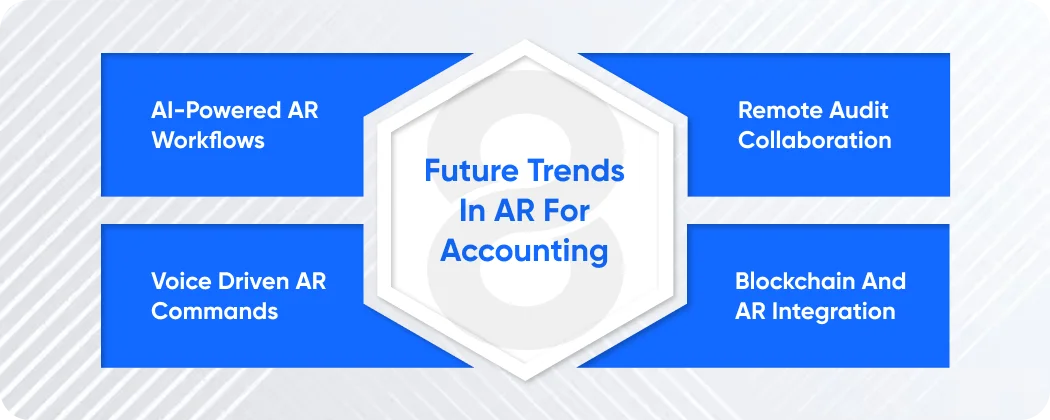
The use of augmented reality in accounting has only recently begun to take off, but there is a high level of growth in future trends. Some trends to watch include:
AI-Powered AR Workflows
With the use of artificial intelligence and AR, forecasting analytics, anomaly-detecting algorithms, and risk scoring will be superimposed on the financial data, allowing accountants to discover inconsistencies more quickly and make decisions based on data.
Remote Audit Collaboration
Social ARs will enable auditors and clients to work remotely by meeting in real time and allow them to check the assets remotely, looking at financial overlays, as well as decreasing the costs of traveling and enhancing the transparency and communication of audits.
Voice Driven AR Commands
AR systems with voice capabilities will enable accountants to access reports, approve entries, and navigate financial dashboards without using their hands, and enhance their multitasking performance in complex audits and inspections.
Blockchain and AR Integration
By integrating blockchain and AR, it will be possible to visualize the audit trail with tamper-proof characteristics and visualize it on a single physical asset, enhancing trust, achieving compliance, and offering real-time verification of the financial transactions and ownership history.
These tendencies demonstrate the way AR is going to develop and become a part of financial activities.
Key Business Benefits of Implementing AR in Accounting
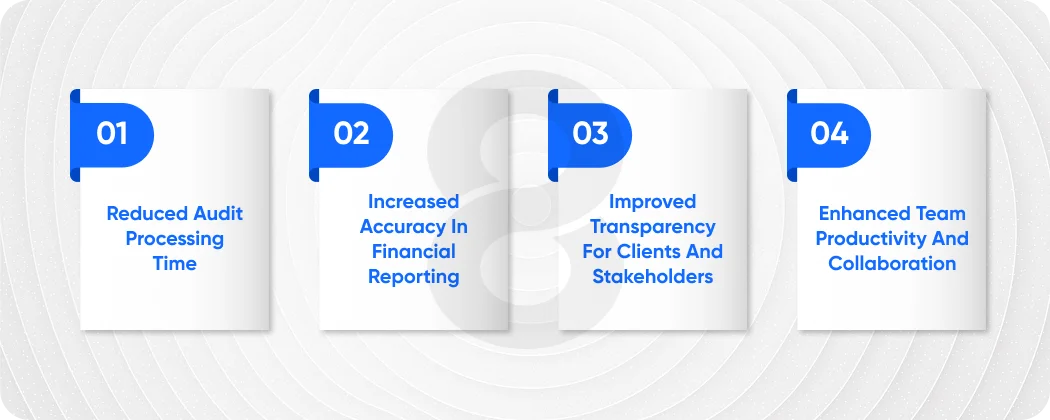
You do not simply modernize processes when you introduce the use of augmented reality in the accounting process. You produce quicker audits, wiser decisions, better compliance, and a more assured finance team that is ready to develop sustainably in the digital space.
Reduced Audit Processing Time
AR superimposes real-time financial information on the physical assets, enabling the auditors to validate records immediately. This saves on the manual cross-checking, minimizes repeated visits to the site, and reduces audit cycles without affecting the regulatory standards.
Increased Accuracy in Financial Reporting
AR solutions can minimize human error based on guided validation and synchronized data systems. The accountants will be able to spot discrepancies, enhance compliance controls, and make sure the reporting is accurate without the need for fewer post-audit adjustments.
Improved Transparency for Clients and Stakeholders
AR visualizations provide financial information in a coherent and comprehensible way. This improves communication, gains the confidence of the stakeholders, and provides informed decision-making by allowing structured and transparent reporting.
Enhanced Team Productivity and Collaboration
AR makes coordination with others as distant as possible, visual workflow sharing, and real-time updates possible. Consequently, accounting teams work more efficiently in interdepartmental and inter-location settings and have a high level of governance and operational efficiency.
Final Thoughts!
Accounting is already seeing augmented reality enhancing efficiency in the audit, as well as accuracy and engagement with clients. The findings indicate that by establishing the use cases, determining the readiness, selecting the appropriate technology, and monitoring the performance, the firms can effectively deploy AR solutions that are specific to them.
The first to adopt digital transformation will have a competitive advantage. The future of accounting is interactive and data-driven, and by adopting AR at present, it is possible to make the audit processes better in response to the emerging demands of businesses in the future.