



Homes are changing fast because devices now communicate through software platforms. Lights, locks, cameras, and thermostats respond instantly through connected mobile interfaces. People want more control without complicated hardware installation or configuration steps. That expectation drives demand for intelligent platforms and connected automation ecosystems. A smart system for home connects physical devices through applications, cloud platforms, and sensors.
The goal is simple: control automation and real-time monitoring everywhere. Businesses build these platforms through strategic software development and infrastructure planning. They combine hardware, communication, mobile applications, and cloud-based intelligence. The result becomes a flexible ecosystem that adapts to user behavior patterns. This article explains the technology architecture strategy and implementation path clearly. It focuses on user experience, scalability, automation, and long-term platform growth.
Defining a Smart System for the Home
A smart system for the home connects household devices through intelligent automation platforms. Sensors, devices, and cloud services coordinate actions across the living environment. Users manage everything through centralized dashboards or mobile applications. Lights, security cameras, thermostats, and appliances respond to commands instantly.
Automation also triggers actions when sensors detect activity or environmental changes. Motion sensors might activate hallway lighting during nighttime movement automatically. Temperature sensors adjust heating when outdoor weather conditions change rapidly. Door sensors alert homeowners whenever an unexpected entry occurs.
Modern systems also rely on artificial intelligence to improve daily automation decisions. That intelligence usually appears through AI integration within analytics engines. The system studies device activity and gradually learns household behavior patterns. Over time, automation becomes predictive instead of manual rule-based routines.
Developers usually begin projects through structured software development lifecycle planning phases. Architecture must support device communication, real-time analytics, and mobile connectivity. Cloud infrastructure processes automation rules and device data continuously. Without these foundations, the platform becomes unstable and unreliable quickly.
Why Smart Homes Matter Now
Connected homes solve real problems across security, efficiency, and daily convenience. Homeowners want simplified control over multiple devices and automation scenarios. Energy management also becomes easier through connected thermostats and monitoring systems. Smart lighting reduces electricity waste by adjusting brightness and schedules automatically.
Another reason for adoption involves safety monitoring and real-time alerts. Security cameras and sensors notify users immediately after suspicious activity appears. Parents appreciate monitoring tools that track children entering or leaving rooms.
A well-designed smart system for the home centralizes these capabilities within one platform. Instead of separate applications, users manage everything from a single dashboard. This unified experience improves usability and long-term engagement.
Companies building these platforms prioritize strong mobile app development strategies early. The mobile interface becomes the main interaction point for everyday control. Users expect real-time notifications, voice commands, and automation configuration tools. Artificial intelligence also improves system capabilities across automation and analytics. Through advanced AI integration platforms, detect patterns and optimize routines automatically.
The global smart home automation market size is estimated to be valued at USD 444.98 billion by 2030, with a CAGR of 27.3% from 2023 to 2030, based on the latest report by Grand View Research, Inc.
Read More: How to Hire a Software Development Team – A Step-by-Step Guide
Core Components of a Smart Home Platform
Building an intelligent home platform requires several integrated technical layers. Hardware sensors and controllers form the physical infrastructure layer. Software services coordinate device communication, automation logic, and data analytics. Cloud platforms manage scalability, performance monitoring, and data storage operations.
Below is a simplified overview of core system layers
# |
System Layer |
Purpose |
Key Technologies |
| 1 | Device Layer | Sensors, cameras, thermostats, locks, and appliances | Zigbee, WiFi, Bluetooth |
| 2 | Platform Layer | Device communication, automation, and event processing | Cloud APIs, microservices |
| 3 | Application Layer | User control dashboards and notifications | Mobile app development |
| 4 | Intelligence Layer | Data analysis automation optimization | AI integration |
Each layer requires careful design and testing during development phases. Poor architecture often creates latency issues or unstable device communication. Another essential component involves automation rule management engines. These engines trigger actions when defined conditions become true. For example, door sensors might activate security cameras automatically. Advanced systems include AI workflow automation to manage complex behavior patterns. Artificial intelligence processes sensor data and improves routines gradually.
Read More: Coding for Cars – Custom Software Solutions for Modern Vehicles
Planning the Architecture
Architecture planning determines system scalability, performance, and reliability. Developers evaluate device categories, automation complexity, and expected user demand. They also design backend services managing device commands and automation events. The architecture typically includes microservices responsible for specific platform functions. These services process sensor signals, device commands, and notification events. Cloud infrastructure scales automatically when device traffic increases significantly.
Developers also design data pipelines storing sensor events and device analytics. Historical data improves system intelligence and automation recommendations. Artificial intelligence models analyze that data to identify behavioral patterns.
The planning phase also evaluates third-party integrations and external APIs. Voice assistants, smart speakers, and monitoring services may require compatibility. Strong AI integration often connects these systems through unified automation workflows.
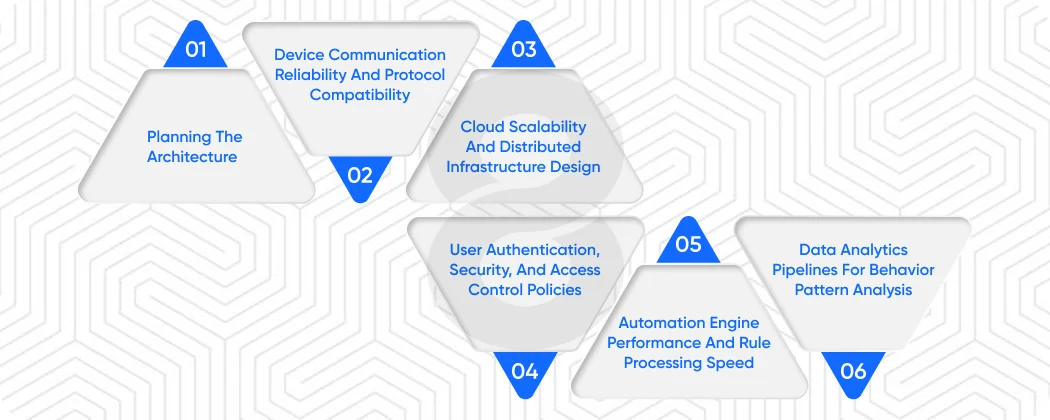
Key architectural priorities usually include the following considerations
- Device communication reliability and protocol compatibility
- Cloud scalability and distributed infrastructure design
- User authentication, security, and access control policies
- Automation engine performance and rule processing speed
- Data analytics pipelines for behavior pattern analysis
These decisions influence platform performance for many years after launch.
Read More: How to Build a “Digital Workforce” of Specialized AI Agents for Supply Chain Automation
Building the Mobile Control Application
The mobile application becomes the primary control interface for connected homes. Users rely on it to monitor devices, adjust automation rules, and receive alerts. A confusing interface quickly reduces user satisfaction and long-term adoption.
Teams, therefore, invest heavily in user-centered mobile app development strategies. Designers create dashboards showing device status notifications and quick actions clearly. Users should understand the system status immediately after opening the application.
The mobile app typically supports several important user features
- Device onboarding and network connection setup
- Real-time monitoring of device status and sensor activity
- Automation rule creation and scheduling configuration
- Security alerts and notification management
- Remote control for lighting, locks, cameras, and thermostats
Another important capability involves natural voice interaction and commands. Users prefer speaking simple commands instead of navigating complex menus. This interaction often relies on AI chatbot development and voice assistants. Conversational interfaces reduce friction when controlling devices across daily routines. Users can simply ask questions about temperature, lighting, or security status.
Read More: Implementing AR in Accounting: A Step-by-Step Guide to Audit Efficiency
Device Connectivity and Integration
Connectivity determines how efficiently a smart home platform performs daily tasks. Stable device communication prevents automation failures and delayed system responses. Different communication standards offer advantages depending on device categories.
# |
Protocol |
Strength |
Typical Devices |
| 1 | WiFi | High bandwidth and common home compatibility | Cameras, hubs, and smart speakers |
| 2 | Zigbee | Low energy consumption and mesh networking | Sensors lighting |
| 3 | Bluetooth | Short-range communication and easy pairing | Locks wearable devices |
Developers often implement hybrid communication architectures supporting multiple protocols. This approach improves compatibility across different manufacturers and devices. Integration also requires message brokers coordinating communication traffic efficiently. These brokers route commands between devices, applications, and cloud servers.
Important integration tasks typically include the following steps
- Device authentication and identity verification processes
- Secure API connections between devices and cloud services
- Firmware compatibility testing across multiple device manufacturers
- Network optimization for real-time command delivery
Strong connectivity ensures responsive automation and reliable monitoring features. Through AI integration the system also studies device activity patterns continuously. Artificial intelligence identifies relationships between devices during daily routines. These insights help optimize automation rules and system recommendations.
The smart home automation market is expected to grow from $132 billion in 2025 to over $1.35 trillion by 2035, showing massive long-term expansion.
Automation and Intelligence
Automation defines the real power of modern smart home platforms. Basic automation triggers actions based on schedules or simple sensor signals. Advanced automation responds dynamically to context and user behavior patterns. For example, lighting systems may respond to sunset times and room occupancy. Heating systems may adjust automatically during colder nighttime conditions. Security systems might activate monitoring whenever users leave the house.
Artificial intelligence dramatically expands these capabilities across connected environments. Developers implement workflow automation engines for complex automation scenarios. Machine learning algorithms analyze historical device activity patterns continuously. The system may then suggest new routines improving comfort, efficiency, and safety. Users can accept suggestions and deploy them instantly within automation settings.
# |
Step |
Action |
Outcome |
| 1 | Sensor Event | Motion sensor detects activity | System receives a signal |
| 2 | Context Analysis | AI checks time, location, and user status | Determine automation rule |
| 3 | Automation Trigger | The lighting routine activates automatically | Room illumination improves |
| 4 | Feedback Loop | System records user response | Improve future predictions |
Automation also integrates with conversational systems through AI chatbot development. Chatbots allow homeowners to ask questions about system activity instantly. They may ask whether doors remain locked or alarms remain active. Conversational interaction makes automation platforms easier for non-technical users.
Read More: Transitioning from Human-Led Detection to Autonomous AI Threat Response
Security and Privacy Considerations
Security remains critical when deploying connected home technology platforms. Devices collect sensitive data about routines occupancy and daily household activity. Unauthorized access could compromise privacy and physical safety easily. Developers, therefore, enforce strict safeguards across the entire software development lifecycle. Encryption protects communication between devices, mobile applications, and cloud services. Authentication systems verify user identities before allowing remote device control.
Other essential security practices often include these strategies
- Multi-factor authentication for remote platform access
- Secure firmware updates distributed through trusted servers
- Role-based permissions controlling device management privileges
- Continuous monitoring for unusual login or device behavior
Data privacy policies also determine how sensor information is stored and processed. Users should maintain full transparency regarding data collection practices. Security monitoring tools may detect suspicious activity across the platform network. For example, repeated login failures may trigger temporary account restrictions. These measures protect both homeowners and platform providers effectively.
Read More: What is Spatial Intelligence? Examples, Uses, and Improvement Tips
Real World Applications
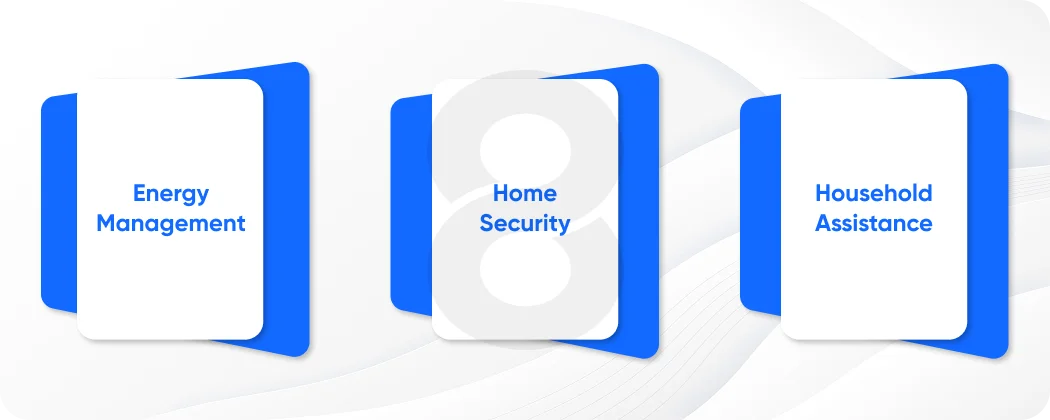
Smart home technology improves everyday living across multiple practical scenarios. Automation enhances comfort, security, and energy efficiency simultaneously. A smart system for the home becomes the central control hub for these activities.
Energy Management
Energy monitoring tools track electricity consumption across different appliances. Smart thermostats automatically adjust heating during unoccupied daytime hours. Lighting automation reduces waste by switching lights off automatically. Artificial intelligence improves energy efficiency through predictive analytics. Using AI integration platforms, study usage patterns and optimize schedules.
Home Security
Security systems combine cameras, sensors, alarms, and mobile monitoring dashboards. Motion detection instantly alerts homeowners whenever unusual activity occurs. Smart locks allow remote control over entry permissions and visitor access.
Security platforms increasingly integrate AI chatbot development for monitoring assistance. Users ask chatbots about camera activity, door status, or alarm conditions.
Household Assistance
Automation routines simplify everyday household tasks and repetitive activities. Morning routines might activate lights, open curtains, and start coffee machines. Evening routines might lock doors, dim lights, and activate security monitoring.
These routines rely heavily on AI workflow automation, managing multiple device actions. The system performs tasks automatically without requiring manual commands.
Challenges During Implementation
Smart home platforms still present technical and operational challenges today. Device fragmentation remains one of the most complicated development obstacles. Different manufacturers implement inconsistent communication standards and protocols. Testing across many device models requires extensive engineering effort.
Quality assurance teams must validate compatibility before releasing updates publicly. Scalability also challenges backend infrastructure when thousands of households connect simultaneously. Cloud systems must process massive volumes of sensor data continuously. Another challenge involves designing clear onboarding experiences for new users. Many homeowners feel unfamiliar with automation configuration procedures initially.
Developers must balance automation intelligence with manual control flexibility. Users should always override automation when preferences change temporarily. Strategic product planning helps overcome these limitations gradually over time.
Read More: 8 Industries Being Redefined by Computer Vision in 2026
The Future of Smart Home Systems

Smart homes will become more autonomous as artificial intelligence improves rapidly. Future platforms will interpret environmental data and behavioral signals continuously. Homes may anticipate needs before users manually request specific actions.
Voice assistants and conversational interfaces will continue evolving quickly. Natural language interactions will replace complicated application menus gradually. This evolution increases demand for advanced AI chatbot development capabilities. Edge computing may also expand intelligence directly inside home automation hubs.
Local processing reduces cloud dependency and improves response speed significantly. Energy systems will integrate solar panels, batteries, and electric vehicles automatically. Homes may coordinate energy usage based on weather conditions and electricity pricing. As these technologies mature, developers will refine the smart system for the home ecosystem further. Advanced software development strategies will continue shaping intelligent residential environments.
Read More: 10 Best AI Development Companies In The US
Conclusion
Developers integrate device automation engines, cloud infrastructure, and mobile interfaces carefully. The final result becomes a powerful smart system for managing everyday tasks in the home.
Successful platforms rely on scalable software development and a reliable device communication architecture. Strong mobile app development ensures users maintain simple control over automation features.
Companies investing in these technologies today will shape the future connected household ecosystem. Smart homes will evolve into responsive digital environments, improving safety, comfort, and efficiency.