


The contemporary supply chains do not follow a linear course. These are sprawling, interrelated ecosystems, including dozens of suppliers, real-time logistics information, demand variability, customs compliance, warehouse processes, and last-mile delivery, all concurrently across multiple geographies and time zones.
Conventional software manages this complexity with an inflexible workflow and rule-based automation. However, when the conditions do not match, as they never do in the supply chain, such systems break down. A port strike, a demand spike that happens, a supplier who has gone dark, these are not edge cases.
This is precisely why the AI agents in supply chain management are gaining momentum from being experimental to being essential. At the cutting edge of this change is a so-called Multi-Agent System (MAS), coordinated networks of specialized AI agents that can perceive, reason, and act all the way up, down, and around the supply chain in real time.
This blog disaggregates to create a clear understanding of what MAS is and how it functions within a supply chain setting and how one can begin to generate their own digital workforce of specialized agents.
What Is Multi-agent Orchestration?
A Multi-Agent System (MAS) uses multiple AI agents, each with a specific role, specialized knowledge, and a set of tools, to collaborate on complex tasks. An orchestrator coordinates these agents to achieve the desired outcomes efficiently.
Imagine it as having a properly organized operations team. There is a demand planner, a procurement lead, a logistics coordinator, a compliance officer, and a warehouse manager. Every individual is very knowledgeable in his or her field. The team lead (the orchestrator) assigns tasks, packages their results, resolves conflicts, and ensures that everything is heading to a common cause.
AI agents are playing those specialized roles in a digital workforce constructed on MAS. The orchestrator, which is also an AI model, channels tasks, handles dependencies, consolidates outputs, and acts.
Specialization and parallelism are what define MAS as opposed to a single large AI implementation doing it all. Single agents can be customized or suggested on particular domains, run concurrently, and updated or replaced manually. This renders MAS much more scalable, precise, and serviceable compared to monolithic AI solutions.
According to a research report published by Spherical Insights & Consulting, the global artificial intelligence in supply chain market size is expected to grow from USD 6.5 billion in 2024 to USD 238.5 billion by 2035, at a CAGR of 38.75% during the forecast period 2025-2035.
Why Supply Chain: The Ideal Application of Supply Chain AI Agents
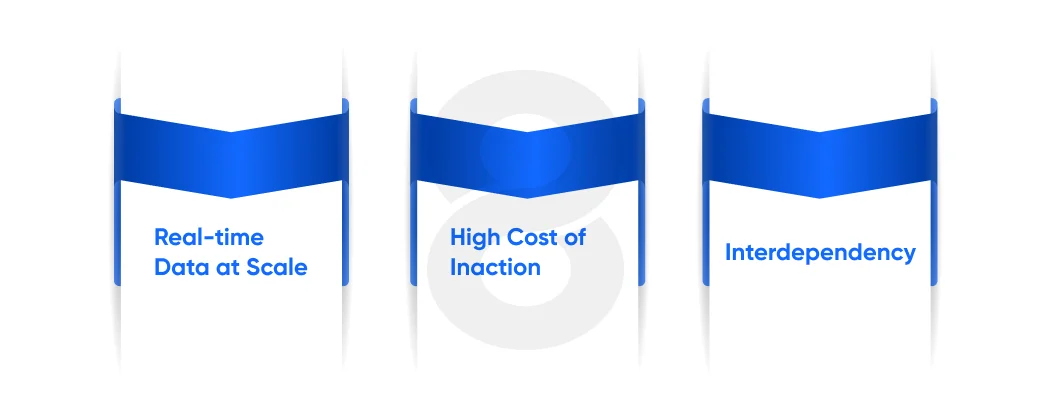
The supply chains are particularly well adapted to MAS for several reasons:
Decomposition of tasks is inherent.
Each supply chain has its own functions, which are a natural extension of the other one, namely, demand forecasting, procurement, inventory management, logistics, compliance, and customer service. All these areas can be mapped to a specialized agent.
Real-time Data at Scale
Supply chains produce vast amounts of structured and unstructured information: ERP logs, IoT sensor feeds, supplier messages, shipping sheets, weather information, and political warnings. This cannot be done in real time by a single human or traditional system. Supply chain AI agents can.
High Cost of Inaction
Delays get compounded in supply chains. A late shipment alert that is not received at 2 am can lead to the production halting by the morning. Agents never sleep, they never feel overwhelmed, and they never miss alerts.
Interdependency
The decisions in supply chains made on one aspect tend to impact others. When a procurement agent is renegotiating a supplier contract, he or she must liaise with an inventory agent and the logistics agent. This type of cross-functional coordination is the reason why MAS architectures exist.
The Architecture: Constructing Your Digital Workforce

The following is the design of a realistic MAS architecture of the supply chain automation:
1. The Orchestrator Agent
The brain of the system is the orchestrator. It gets high-level aims, such as minimum stockout risk of SKU group A within 30 days, and divides them into tasks it delegates to special agents. It monitors the accomplishment of tasks, manages exceptions, or resolves interagent conflicts and creates a final product or action.
The planner does not have to be familiar with all the fields. It is its role to coordinate, prioritize, and synthesize decisions. Modern large language models, such as Claude or GPT-4–class models, handle this role effectively because they use powerful reasoning and strong instruction-following abilities.
2. Specialist Agents
A given domain is assigned to each specialist agent, and access to it is available to the available tools and sources of data applicable within the domain. You may leverage a digital workforce in a supply chain by deploying:
Demand Forecasting Agent
Oversees and manages previous sales, trends, market conditions, and promotional cycles to produce and constantly update demand forecasts. It alerts about aberrations and informs the inventory and procurement agents in cases of material forecast changes.
Procurement Agent
Responsible for tracking supplier performance, monitoring the terms of a contract, finding alternative sources of supply, and initiating purchases when inventory limits are reached. Moreover, it negotiates at least via email or vendor portals with predefined parameters and escalates edge cases to human buyers.
Inventory Optimization Agent
Moreover, this agent oversees inventory levels in warehouses, computes reorder points, and dynamically adjusts safety stock based on supply variability signals. Feeds from warehouse video surveillance give the agent an added layer of visual confirmation, helping it catch discrepancies between recorded stock and what’s actually sitting on the shelves. It interacts directly with logistics and procurement agents to prevent both stockouts and overstocking.
Logistics & Carrier Agent
Tracks delivery tracking information, carrier performance, and external disruption indicators (weather, port congestion, and geopolitical events). It automatically reroutes deliveries, chooses new carriers, and changes ETAs on the networked systems.
Compliance and Trade Agent
Deals with the regulatory aspect: tariff codes, customs papers, import/export prohibitions, and sanctions screening. They are very costly in terms of compliance failures, and a committed agent here is self-paying in a short time.
Supplier Risk Agent
Ongoing tracking of supplier financial health, supplier news, ESG risk rating, and geopolitical risk. It evaluates suppliers in real time and warns the procurement agent when risk levels exceed thresholds, enabling the agent to diversify suppliers before disruptions occur.
Customer Service/Fulfillment Agent
Responds to order status calls and exception calls and, when there is a problem in fulfillment, calls out to the customer proactively. Additionally, it retrieves the information of all other agents in order to give real-time responses.
3. The Tool Layer
Agents are not as powerful as the tools they have access to. The tool layer of a supply chain MAS deployment normally contains:
- Integrations with ERP and WMS (SAP, Oracle, NetSuite)
- Freight forwarding platforms and carrier APIs (FedEx, UPS)
- Transactions with suppliers
- Warehouse and in-transit sensor feeds
- Outside data sources: weather API, news feeds, commodity price information
- Internal data warehouses and databases
- Areas of communication: email, Slack, ERP workflows
The key principle is that agents should be able to read, write, and act, not just analyze. A logistics agent that can only report a shipment delay is far less valuable than one that can reroute the shipment and update the customer in the same workflow.
Key Design Principles for Building Supply Chain AI Solutions with MAS
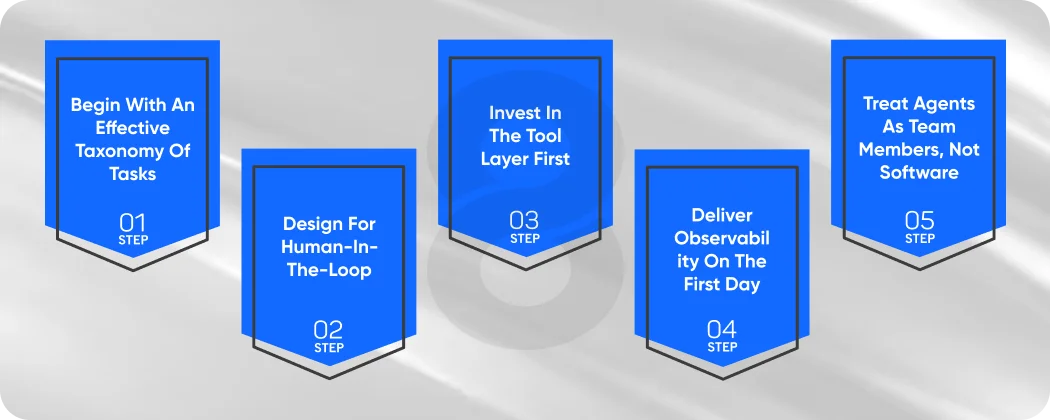
Begin With An Effective Taxonomy Of Tasks
Before you construct agents, identify all repetitive activities in your supply chain operations and classify them by domain, frequency, and data dependency. This step creates your agent design blueprint.
Design for Human-in-the-Loop
Not everything ought to be unconditionally independent. Establish explicit limits of escalation in your MAS; agents operate within some set parameters and are exposed to human exceptions. Building trust is a gradual process.
Invest in the Tool Layer First
The quality of agents is merely defined by the capabilities of accessing data and taking action. Clean, real-time, and bidirectional integrations are something to be concerned about before worrying about model selection.</p>
Deliver Observability on the First Day
Each agent action is to be recorded together with its reasoning, inputs, and outputs. This is necessary in debugging, auditing, compliance, and continuous improvement.
Treat Agents as Team Members, Not Software
Establish the scope, responsibilities, and the lines of escalation of each agent, just like you would with a new employee. There are conflicts, duplications, and gaps arising out of ambiguity in the role of the agents.
The Agentic AI In The Supply Chain And Logistics Market size is estimated at USD 8.67 billion in 2025, and is expected to reach USD 16.84 billion by 2030, at a CAGR of 14.20% during the forecast period (2025-2030).
The Competitive Advantage Is Compounding
Companies with AI agents in supply chain do not merely automate tasks; they are creating a compounding capacity. Each agent uses data to make decisions. It leverages this information to enhance forecasting models, improve risk scores, and refine procurement strategies. The digital workforce is becoming smart with each cycle.
Some of the initial adopters of MAS-driven automation of the supply chain are already reporting lower stockout rates, better on-time delivery, a drastic reduction of time spent in manually handling exceptions, as well as quicker supplier risk response. These are not marginal benefits, but a systemic change in the way supply chains are working.
Conclusion: The Smartest Supply Chains Won’t Be Run by Humans Alone
MAS has chased the greatest change in supply chain technology since ERP was implemented. Whether or not to deploy supply chain AI solutions is no longer a question that the supply chain leaders need to address, and how fast and how intelligible it is to implement those solutions is the question.
Creation of a digital workforce of highly specialized AI agents is not a moonshot project. It begins with finding your most frustrating, most frequented tasks, putting specialized agents into use that have access to the tools, and expanding outwards. The organizations that succeed in doing this in the next 18 to 24 months would be at an advantage in terms of operationalization, which will be extremely hard to bridge by competitors.
The future chain is 24/7, real-time, and daily smarter. It is that future which is being constructed now, one agent at a time.