It is no longer about treating patients. It is regarding the administration of intelligent data systems that drive faster decision-making, safer treatment, and worry-free care experiences. Efficient healthcare management now requires the right EHR features to facilitate automation, interoperability, and patient-centered workflow.
The field of healthcare is facing one of the greatest technological changes in history. The shift to digital transformation in healthcare is characterized by using unified and intelligent solutions instead of fragmented ones in hospitals, clinics, and healthcare providers.
It has been estimated that the global electronic medical record market is USD 19.92 billion in 2024 and is expected to be USD 36.39 billion in 2034 with a CAGR of 6.21% between the years 2024 and 2034.
This article discusses the 13 essential EHR functionalities required by healthcare organizations in 2026 to provide effective and patient-centered care to patients and enhance operational efficiency.
Why Modern EHR Systems Matter More Than Ever
Currently, healthcare professionals have to deal with several challenges at the same time:
- Increasing patient volumes
- Accomplicated regulatory requirements
- Information fragmentation among the departments
- Rising operational costs
- Request for individual patient care
Hence, current electronic health record capabilities should not just consist of holding patient history. They should be proactive to assist clinicians, administrators, and patients using smart automation and live insights.
Companies that have invested in modern EHR systems enjoy:
- Less administrative burden
- Quickened diagnosis and treatment decision-making
- Better patient satisfaction
- Greater compliance and accuracy of reporting
Now, we are going to discuss the capabilities of next-generation systems.
The Most Important Features of EHR Platforms in 2026
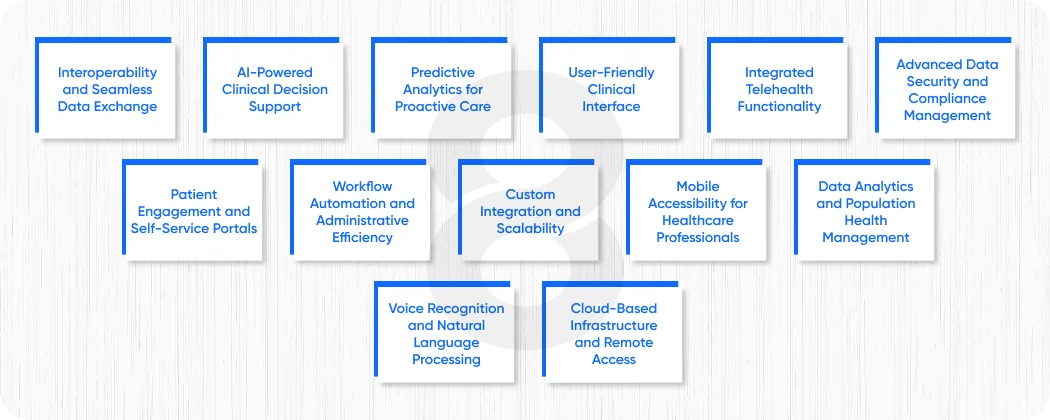
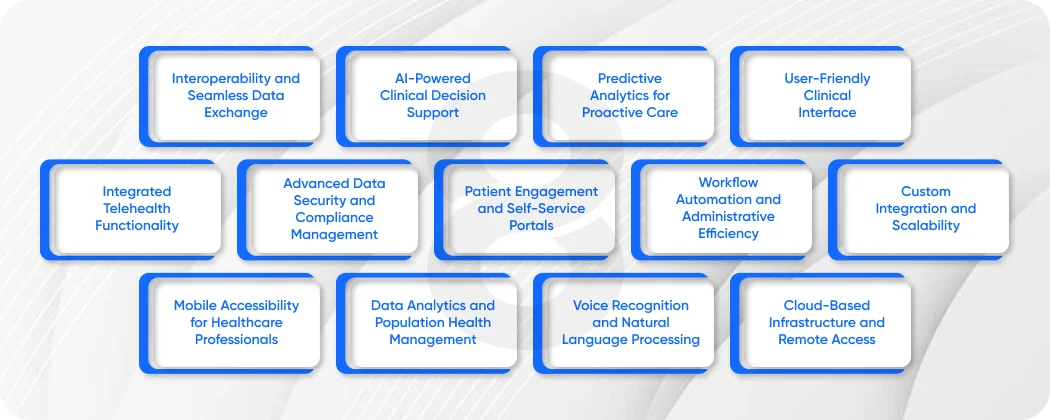
The contemporary healthcare organizations are in need of smart, interconnected systems that will increase efficiency, enhance clinical care, and simplify operations. The subsequent EHR attributes constitute the fundamental functions of providing smarter and data-driven care in 2026.
1. Interoperability and Seamless Data Exchange
To begin with, interoperability is the key to effective healthcare systems.
The current EHR should be able to communicate with:
- Laboratory systems
- Pharmacy databases
- Insurance platforms
- Wearable health devices
- Telehealth solutions
Lack of interoperability means that healthcare providers live with duplicated records and delayed treatment.
FHIR and HL7 standards now enable an exchange of information between institutions safely and thus provide coordinated care and better clinical accuracy. Interoperability is no longer a superior offering in 2026. It is a requirement.
2. AI-Powered Clinical Decision Support
The role of artificial intelligence in healthcare is becoming more popular to facilitate diagnosis and treatment planning.
The development of advanced clinical decision support technologies takes patient data, past medical history, and population health trends to recommend the following:
- Treatment pathways
- Risk alerts
- Drug interaction warnings
- Prevention measure recommendations
Such EHR functions minimize human error and enable clinicians to take action.
3. Predictive Analytics for Proactive Care
Medicine is changing to preventive health care versus rehabilitative health care. Such a transition relies on the importance of data intelligence.
The EHR systems are being incorporated into modern platforms using predictive analytics to detect risks before the conditions deteriorate. For example:
- Anticipating hospital readmissions
- Determining chronic disease risks
- Predicting patient degradation
Consequently, medical organizations will be able to intervene sooner and save in the long run.
4. User-Friendly Clinical Interface
Even the most sophisticated system will not work if clinicians cannot adopt it in day-to-day activities. An easy-to-use interface design is one of the least recognized aspects of EHR platforms.
Some of the key usability points would include:
- Minimal navigation steps
- Voice documentation
- Smart templates
- Role-based dashboards
An easier interface not only decreases the burnout among physicians, which is an increasing issue in the world, but also enhances the rate of documentation, clinical precision, and general satisfaction among healthcare personnel.
5. Integrated Telehealth Functionality
The adoption of telemedicine gained momentum following the pandemic and is still expanding at a very high rate as patients grow to demand the convenience of virtual care solutions as part of their daily healthcare service experiences.
The modern EHR software capabilities should be equipped with the built-in telehealth features, including:
- Virtual consultations
- Secure video conferencing
- Remote patient monitoring
- Automated documentation
In cases where telehealth is directly linked with patient records, the providers get a full picture of patient history without system switching, enhancing continuity of care, efficiency, and accuracy of clinical decision-making.
6. Advanced Data Security and Compliance Management
The healthcare data is still one of the most sensitive types of digital information in the world. Security is thus one of the most significant EHR characteristics that organizations should consider in ensuring the privacy of the patients.
The fundamental security factors are:
- End-to-end encryption
- Multi-factor authentication
- Role-based access controls
- Audit trails
- Automation of compliance (HIPAA, GDPR equivalents)
Effective cybersecurity protects the trust of the patients and deters the expensive breaches and guarantees compliance with regulations, organizational reputation, and continuity of the healthcare processes in a more interconnected digital landscape.
7. Patient Engagement and Self-Service Portals
The healthcare industry is growing more patient-centered as people require transparency, availability, and active involvement in their healthcare processes via new digital healthcare systems and services.
The modern systems enable patients to:
- Access medical records
- Schedule appointments
- View prescriptions
- Make communication with physicians
- Track treatment progress
Patient portals enhance accountability and decrease the burden on administration at the same time. Additionally, involved patients will adhere to treatment plans more easily, leading to increased adherence, treatment outcomes, and future long-term health management.
8. Workflow Automation and Administrative Efficiency
The administrative responsibilities in healthcare consume close to one-third of the time spent by healthcare professionals, which results in inefficiencies that affect productivity, operational expenses, and overall quality of providing care to patients in healthcare organizations.
Automation will assist in removing repetitive procedures like the following:
- Appointment reminders
- Billing workflows
- Insurance verification
- Documentation updates
Electronic health records driven by automation are highly efficient in operations, with clinicians being able to concentrate on treatment and reducing burnout, errors, and wastage of healthcare resources.
9. Custom Integration and Scalability
Healthcare organizations do not operate with only one system, but, on the contrary, there are many specialized platforms collaborating with each other. At this point, it is necessary to have custom software development for the integration of EHR.
Custom integrations will enable organizations to:
- Connect legacy systems
- Scale operations easily
- Add specialized modules
- Keep the working process flowing
Scalable architecture makes sure that the EHR system expands with the organizational demands, promotes innovation, smooth expansion, changing compliance demands, and long-term operational predictability in various healthcare settings.
10. Mobile Accessibility for Healthcare Professionals
Healthcare facilities and departments are in constant motion. Thus, mobile accessibility has turned into one of the most sought-after features of EHR systems in contemporary settings in the realm of healthcare.
Mobile secure access allows the following:
- Real-time patient updates
- Bedside documentation
- Instant alerts
- Remote approvals
Moreover, there are hospitals that are investing more in custom healthcare mobile applications, which can be integrated with EHRs and provide quicker real-time communication and better coordination among care teams.
11. Data Analytics and Population Health Management
To enhance the quality of community health, clinical performance, and proactive and preventive healthcare strategies, healthcare organizations need to be capable of analyzing large datasets effectively.
Further analytics dashboard aids providers:
- Track disease patterns
- Evaluate the efficacy of the treatment
- Observing the allocation of resources
- Determine high-risk populations
The analytics will aid strategic decision-making and long-term healthcare planning, which enable providers to allocate resources effectively, improve care delivery models, and detect emerging trends in public health in early stages.
12. Voice Recognition and Natural Language Processing
Documentation is still considered one of the largest time wasters among clinicians, and it usually takes away the time during meaningful discussions with patients and causes a lot of administrative burnout in contemporary healthcare settings.
Modern EHR platforms now use the following:
- Voice recognition
- Natural language processing (NLP)
- Automated transcription
As such, clinicians are able to communicate with the patient rather than the computer user, enhancing their daily clinical workflows and documentation processes, and patient satisfaction, in addition to enhancing the quality of communication.
13. Cloud-Based Infrastructure and Remote Access
Lastly, next-generation healthcare systems are characterized by the utilization of the cloud, which provides large-scale flexibility and deployment schemes, as well as constant availability of healthcare information throughout dispersed clinical settings and care units.
The cloud-based EHR software includes
- Real-time updates
- Lower costs of IT infrastructure
- Automatic backups
- Disaster recovery
- Remote accessibility
Clouds also facilitate wider digital transformation in healthcare to allow quicker innovation, better collaboration, more data accessibility, and scalable system performance to meet the changing healthcare needs.
Case Study: Matrix Health and Wellness App
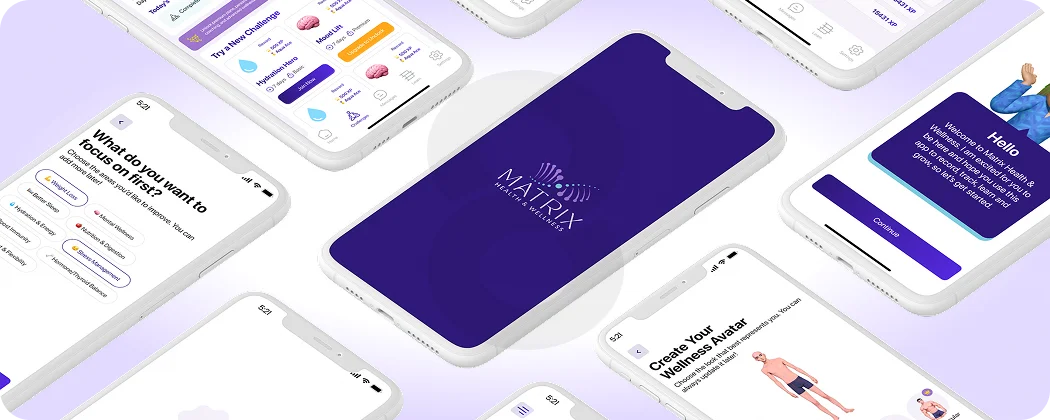
In order to see how the EHR innovation is developed in practice, we will take the example of our collaboration with Matrix Health and Wellness.
The Challenge
To effectively supervise patient wellness journeys, appointments, and clinical data, Matrix Health required a single digital ecosystem. Their current work processes were disjointed, restricting scale and interaction with patients.
Our Solution
We created and developed a unified healthcare platform that incorporated:
- CPOE patient data management
- Patient interaction by mobile
- Uninterrupted appointment procedures
- Secure data architecture
- Elastic application infrastructure
The Results
- Better efficiency in operation
- Improved patient interaction
- Automated clinical processes
- Quick access to data among healthcare experts
This project has shown that nowadays, EHR functions, along with custom healthcare software, can change the way services are delivered and the experiences of patients.
Read More: 10 Benefits of Artificial Intelligence in Healthcare
How to Choose the Right EHR System in 2026
Before the adoption of an EHR solution, healthcare organizations must consider the following:
- Scalability and integration facilities
- Compliance readiness
- Clinician user experience
- Analytics and AI functions
- Support of vendors and customization
- Access to mobile and cloud
Moreover, systems that are focused on actual clinical practices instead of templates ought to be emphasized in organizations.
Read More: Artificial Intelligence in Medicine- Transforming Healthcare with Smart Technology
Helping Clinics and Hospitals Upgrade to Next-Gen EHR Systems
At 8ration, we learn that good healthcare technology is beyond implementation. We assist organizations in designing, developing, and streamlining EHR systems to match actual clinical processes, regulatory demands, and patient expectations.
Our team is capable of providing tailored EHR solutions by integrating scalable architecture, intelligent automation, and smooth integrations to enhance operational efficiency, patient engagement, and digital healthcare innovation in the long term.
Final Thoughts!
In 2026, digital infrastructure should be reconsidered in healthcare organizations because the correct implementation of EHR features is an efficient and patient satisfaction rate and a long-term growth point.
Interoperability with cloud access characteristics of modern electronic health records provides quicker and more customized care. Finally, successful healthcare is reliant on systems that enable clinicians, as they assist organizations in performing better, improving their outcomes, and remaining agile to changing industry requirements.