


The artificial intelligence market is no longer dominated by tech giants only. Startups in healthcare, logistics companies, and financial entities are scrambling to integrate intelligent systems as part of their business.
However, there is a single bottleneck that continues to slow down the growth, that of discovering the appropriate talent. The choice of how to hire AI developers who will deliver and not merely talk about it is one of the most significant choices that a business will make in 2026.
This guide strategically distills that very process, so you will no longer waste time on the wrong candidates and start developing the right team instead.
Why Hiring AI Developers Has Become So Competitive
The AI talent has hit a point of crisis. Statista says that the number of AI-related job advertisements has increased by more than 75% in the USA over the past few years, and the trend is not declining.
At the same time, supply is limited. Institutions are churning out graduates, but it is a process that can only be acquired in the real world after several years, when it comes to the skills of application required by businesses.
What is even more complicated is the fact that the range of skills needed is different. A developer of AI predictive analytics at a retail brand works in a different way than a developer who develops natural language processing systems at a legal technology company.
Specializations in machine learning engineers, data scientists, MLOps engineers, computer vision specialists, and large language model fine-tuners have come to be encompassed under the term AI developer. Knowledge of this landscape preceding your posting of a job description is the first action toward smart hiring.
 What AI Skills Do You Need Before Hiring?
An effective business problem to start with is to have a clear business problem before you embark on your search to hire AI developers. It is the biggest mistake that most companies commit in recruiting talent without having defined the scope of their project technically.
The following are the underlying questions:
- Do you develop a product on your own, or do you use AI in a system?
- Are you automating your workflow to eliminate manual processes, or are you creating predictive models to support decision-making?
- Is it a single project or a continuous project that will need a complete in-house team?
- What data infrastructure are you currently using?
The responses will help decide on whether you require a single engineer, a small team, or a collaboration with an AI development company capable of delivering a complete technical stack to the table.
Read More: 8 Industries Being Redefined by Computer Vision in 2026
 Know the Core Technical Skills to Look For
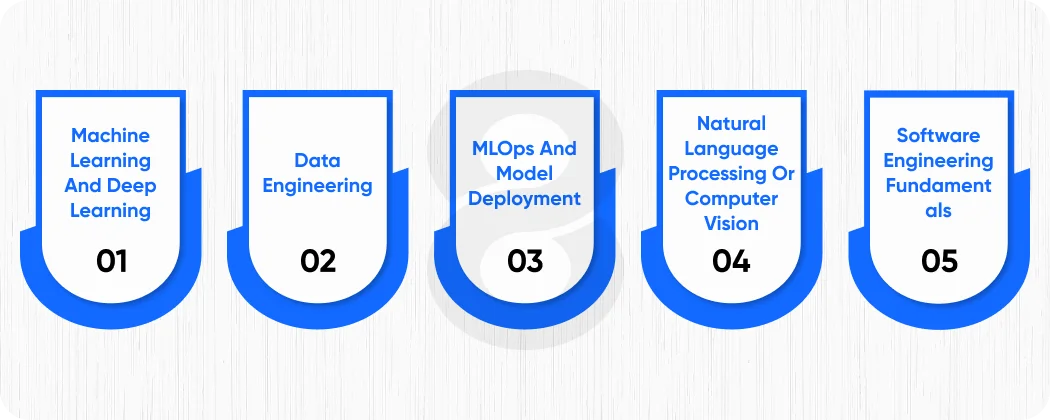
Not every AI developer is created alike. When it comes to employing artificial intelligence developers, it is necessary to assess the level of technical proficiency. The following is what to be evaluated:
Machine Learning and Deep Learning
Find practical work with such frameworks as TensorFlow, PyTorch, and Scikit-learn. In addition to familiarity, the candidate ought to be capable of explaining model selection choices and trade-offs.
Data Engineering
The artificial intelligence is as good as the information it feeds. Good applicants know data pipelines, ETL processes, and the operation of cleaning, labeling, and versioning training data sets.
MLOps and Model Deployment
The creation of a model is one thing. Another is deploying it into a production environment with monitoring, retraining triggers, and version control. It is becoming more expected that experience with tools such as MLflow, Kubeflow, or AWS SageMaker is used.
Natural Language Processing or Computer Vision
Domain-specific expertise is immensely important depending on the use case. Both an NLP specialist and a vision engineer can refer to themselves as AI developers, but their set of skills is very different.
Software Engineering Fundamentals
Good Python experience is a minimum, but also seek information about knowledge of REST API architecture, Docker containerization, and cloud computing with AWS, GCP, or Azure.
Read More: 10 Open-Source Small Language Models for Your Next Project
 Which AI Developer Hiring Model Is Right for Your Business?
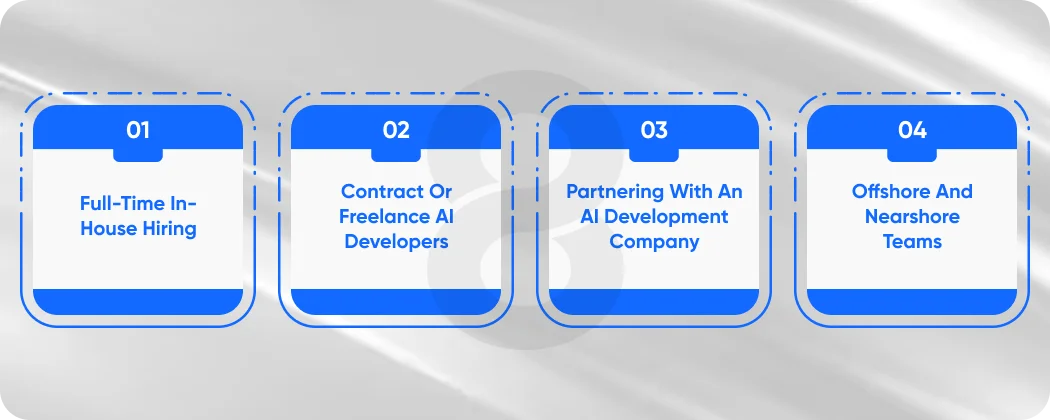
Among the least considered issues related to knowing how to hire AI developers, the choice of the engagement model should be mentioned. The flexibility of businesses is greater than ever before, and so is the need to make decisions consciously.
Full-Time In-House Hiring
Most suitable in cases of long-term AI development of companies. It provides complete control, team spirit, and knowledge retention within an institution. It, however, costs more and has longer ramp-up times. Statista indicates that the median annual earnings of AI workers in the US are more than 120,000 USD, so it is among the most expensive technical recruits in the market.
Contract or Freelance AI Developers
Appropriate for short and project-based jobs. Toptal, Upwork, and Turing are among the platforms that have developed pools of vetted AI developers that can be employed. The trade-off is reduced continuity and the possibility of being inconsistent with the company culture.
Partnering with an AI Development Company
In the case of companies that require end-to-end custom AI development, it may be the most prudent path to collaborate with a specific company. An excellent AI development firm not only introduces developers but also data architects, product managers, and domain consultants, who are able to shorten time-to-value. The model is particularly successful in firms that do not have an AI infrastructure internally.
Offshore and Nearshore Teams
Affordable to scale AI teams rapidly. There are increasing sources of AI talent in Eastern Europe, India, and Latin America. The time zone alignment, clarity of communication, and IP protection, however, should be controlled carefully.
Read More: 10 Best AI Development Companies In The US
 Structure Your Technical Evaluation Process
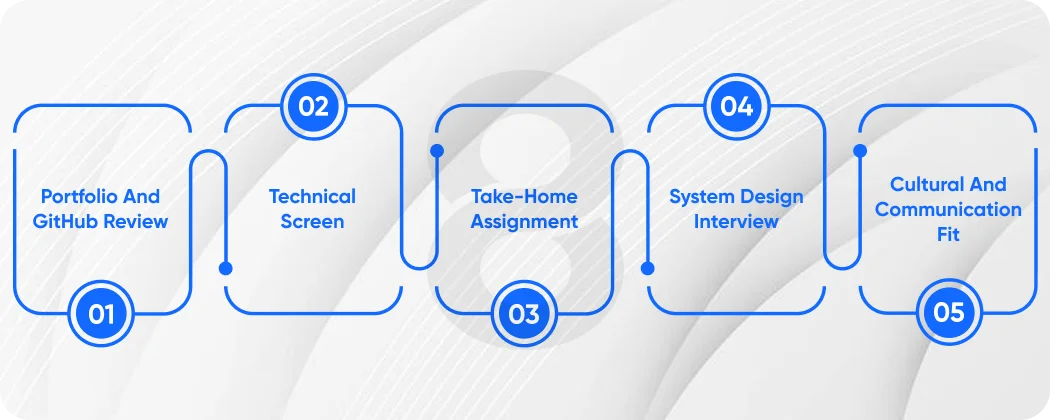
When businesses recruit AI developers, they are over-reliant on resumes. The resume can tell you what the individual has worked with. It does not know how they reason out their problems. The following is an assessment plan:
Portfolio and GitHub Review
Analyze real project code, model notebooks, and contributions to open source. Find documentation quality, code structure, and problem-solving decisions.
Technical Screen
Begin with a 30-minute live coding or conceptual discussion. Ask the candidates to step through a process of solving a real business problem, like the construction of a churn prediction model or an AI-driven recommendation engine.
Take-Home Assignment
In case of the senior position, a structured take-home task where you have a real dataset can be used to test your end-to-end thinking, including data exploration, model assessment, and results communication.
System Design Interview
To test the capability to create scalable AI systems at lead or architect-level jobs, their capability to design scalable systems must be tested. Inquire about the way they would design a production-grade pipeline for AI predictive analytics under certain business constraints.
Cultural and Communication Fit
The developers of AI are commonly cross-functional with product managers, business analysts, and non-technical stakeholders. Their capacity to transform complex model outputs into a form that is understandable by the business is a point of difference.
Read More: 10 Types of Machine Learning Models for Smarter Decision Making
 Where Can You Find Qualified AI Developers for Hire in the USA?
Place is important, but so is the platform that you use to pull candidates. The following is the place to look:
- LinkedIn Talent Solutions is the most popular professional AI hiring service in the US. The keywords such as machine learning engineer, MLOps, or LLM fine-tuning can be used as a Boolean search query to filter through a large pool of candidates and get those who are qualified.
- AI talent platforms focused on specialized AI-specific talent communities, such as Toptal, talent networks within Scale AI, and AI-specific job boards such as AI Jobs and MLJobs.com, consist of candidates who have self-identified with the space.
- Some of the most technical talent in AI is generated by university research labs in places such as MIT, Stanford, Carnegie Mellon, and UC Berkeley. An early talent pipeline can be established by establishing a relationship with such programs through sponsorships, hackathons, or research partnerships.
- Open-source communities such as Hugging Face, Kaggle, and GitHub are a good place to find developers who have demonstrated themselves by contributing to open source.
- Staffing agencies and AI development companies that specialize in technical talent can save you a tremendous amount of time-to-hire if you require AI developers to be hired fast and on a mass basis.
 Evaluate Cultural Alignment and Long-Term Potential
Technical skills are something that you can acquire, whereas congruence with your company values, work culture, and long-term vision is more challenging to alter. In consideration of candidates, look at:
- What is their approach to ambiguity? Clean requirements with AI projects are unusual.
- Do they ask questions and learn independently? The sphere is developing rapidly, and stagnation is a genuine threat.
- What is their reaction to failure? The process of developing AI involves failed experiments.
- Is it possible to mentor junior developers or help construct team standards?
These lesser indicators with high technical validation give you a far better picture of the hire you are making.
Read More: 20 Best AI Apps for Android to Build Profitable Products
 Build the Right Onboarding and Retention Infrastructure
Recruiting is not the whole story. Statista shows that turnover in AI and data science jobs is also much higher than in conventional software engineering. After recruiting artificial intelligence developers, it will take deliberate investment to maintain their engagement.
Get access to compute facilities, proprietary data sets, and experimentation. Attendance of support conference and further learning using such platforms as Coursera, fast.ai, or DeepLearning.AI.
Design a technical leadership channel, as most AI developers give up as they cease to develop. Also, get their work visible so that their models and systems can have a real business impact, as meaningful work is one of the most powerful retention levers at their disposal.
Read More: 50+ AI App Ideas Generating Millions in Revenue
When to Work With an AI Development Company Instead
It does not always turn out to be the most tactical step to create an in-house team immediately. When your organization is new in its AI journey, an established company in AI development may prove beneficial since it will assist you in accelerating, minimizing risk, and setting up the technical base before scaling internally.
An established AI vendor can guide you on how to scope and validate your AI applications, construct and launch your first operational models, execute workflow automation systems to generate initial ROI, and hand over knowledge to your internal staff in the long run.
This is a hybrid model, which begins with an outside partner and develops inside competence over time, which is becoming more and more popular with mid-market-based companies in the year 2026.
Final Thoughts!
The time to achieve a competitive advantage in AI is now, and it will not last forever. Strategic hiring of AI developers would involve knowing how to define your technical requirements and the appropriate engagement model, and investing in retention at the outset.
It does not matter whether you create an in-house team, hire AI experts, or contract an experienced AI development firm to develop custom AI: be decisive. In the year 2026, the businesses that will be correct in implementing AI will determine how industries implement AI.