


The moment when months of planning, design, and development are compensated is the launch of an app, which seems like the most difficult step. But what most businesses fail to understand is that the opening day does not denote an ending point but the beginning of responsibility.
The actual adventure starts when the actual users start tapping, swiping, and demanding perfection all day and all night. Bugs show up, systems get modified, devices get modified, and user expectations multiply at a pace faster than expected. All of a sudden, the app requires continuous attention.
The maintenance of applications is not a side-note or unnoticeable expense; it is the lifeblood that can either keep your product alive, it can grow with usage, or it can be killed by the slow death.
Why App Maintenance Is Always More Important Than People Expect
The weird thing about maintenance is that it rarely feels urgent until something breaks. And by then, it’s already annoying.
Apps don’t fail all at once. They slowly drift into issues.
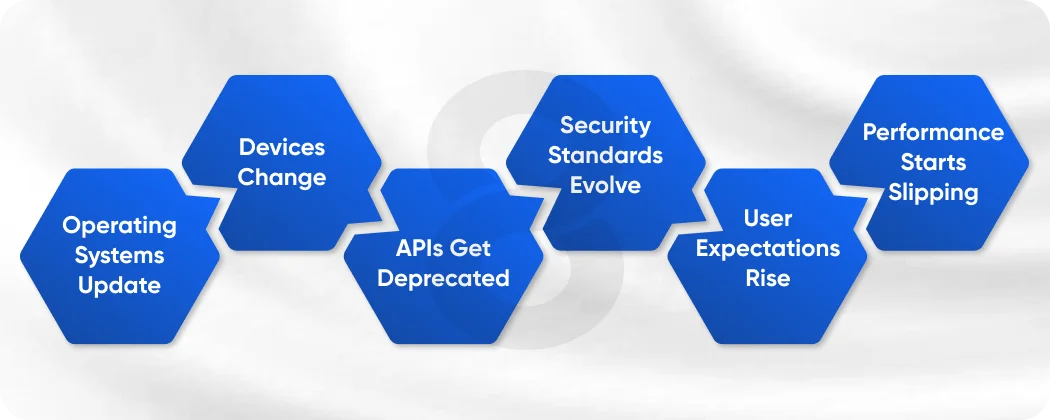
- Operating systems update
- Devices change
- APIs get deprecated
- Security standards evolve
- User expectations rise
- Performance starts slipping
And the worst part is, users don’t care why something broke. They just know your app feels off now. That’s enough.
A lot of businesses put all their excitement and budget into mobile app development, but then treat maintenance like a leftover task. That’s backwards. Because the build gives you a product, but maintenance is what keeps that product usable, relevant, and safe over time.
This is why the cost of app maintenance is not really a side budget. It’s part of the actual product lifecycle. If the app matters to the business, maintenance matters too.
Most apps do not become bad because they were built badly. They become bad because nobody kept improving what users were already depending on.
What App Maintenance Actually Includes
People hear “maintenance” and think bug fixes. That’s only one small part of it. Real app maintenance is way broader than that, and honestly, that’s why the budget gets underestimated so often.
Maintenance usually includes:
Core Maintenance Areas
- Bug fixing
- Performance optimization
- Security patches
- Server and backend upkeep
- Third-party service updates
- OS compatibility adjustments
- Database optimization
- UI improvements
- Feature enhancements
- Analytics and monitoring
- User support fixes
- Crash investigation
That’s a lot already, and that’s before the app starts growing or integrating with more systems.
If you’re trying to estimate the cost of app maintenance, you have to stop thinking only in terms of “fixing problems” and start thinking in terms of “keeping a live product healthy.”
Because healthy products require active work, not occasional rescue missions.
Allocate around 15% to 25% of your original development cost annually for maintenance.
That’s the usual range where things stay realistic.
So if your app costs:
- $20,000 to build: maintenance may cost $3,000 to $5,000 per year
- $50,000 to build: maintenance may cost $7,500 to $12,500 per year
- $100,000+ to build: annual maintenance can climb much higher depending on complexity
But that’s just the starting logic. The real answer depends on what kind of app you have, how active it is, how fast it changes, and how many systems it depends on.
This is why the cost of app maintenance can feel “reasonable” for one app and ridiculously expensive for another, even if both launched around the same time.
Because maintenance is not just tied to app size. It’s tied to app behavior.
Read More: Autonomous Procurement – AI Agents for Vendor Contracts
What Actually Affects App Maintenance Cost
This is where the budget gets real. Not all apps age the same way. Some are simple and stable. Others are basically needy little monsters that need attention every month.
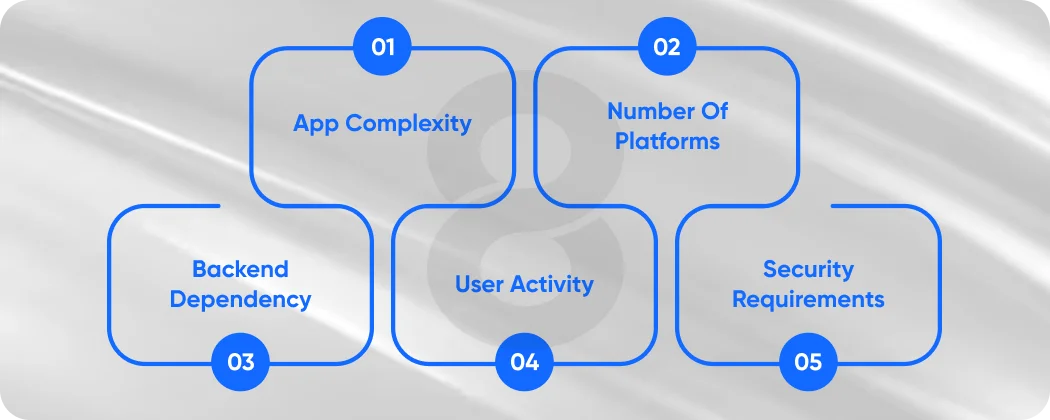
Here’s what usually affects maintenance cost the most:
1. App Complexity
A basic informational app is easier to maintain than a multi-user product with dashboards, notifications, payments, integrations, and admin controls.
More moving parts = more things to watch.
2. Number of Platforms
If your app runs on:
- iOS
- Android
- Tablet layouts
- Web admin panel
then yes, maintenance gets heavier. Every platform introduces more testing, more compatibility work, and more edge cases.
3. Backend Dependency
Apps with APIs, cloud systems, user accounts, file storage, payment gateways, and analytics tools always need more upkeep than standalone apps.
4. User Activity
If thousands of people use the app regularly, small issues become visible much faster and more painfully.
5. Security Requirements
Apps handling payments, personal data, or business-sensitive information need stronger maintenance routines and tighter monitoring.
This becomes even more serious in fintech app development, where one overlooked issue can turn from “bug” into “compliance problem” very fast.
That’s why the cost of app maintenance rises quickly when reliability is not just nice to have, but mandatory.
The Biggest Maintenance Cost Categories
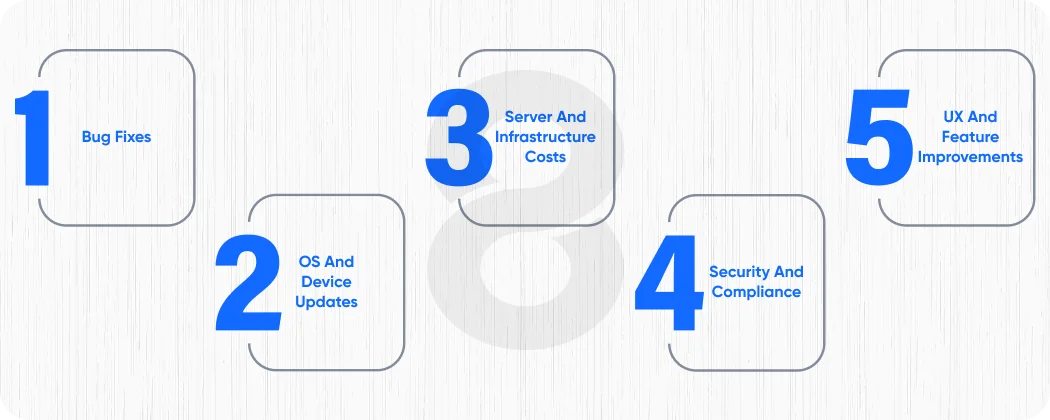
Now let’s break this down into actual buckets, because a lot of businesses know they need a budget but still don’t know where it actually goes.
1. Bug Fixes
This one’s obvious, but it’s still not always predictable.
Apps break in weird ways:
- Certain devices
- Certain screen sizes
- Certain user flows
- Certain network conditions
And bugs don’t always show up during testing. Some only appear once real users start doing weird human things.
2. OS and Device Updates
Apple updates iOS. Google updates Android. Devices change. App permissions change. Notifications behave differently. Background tasks break. Suddenly, your previously “stable” app starts feeling weird.
That maintenance never really ends.
3. Server and Infrastructure Costs
If your app has a backend, then maintenance includes:
- Server upkeep
- Uptime checks
- Performance monitoring
- Scaling issues
- Hosting optimization
This is often forgotten when estimating the cost of app maintenance, but backend care quietly eats budget over time.
4. Security and Compliance
If your app stores data, handles payments, or logs sensitive user activity, then security is not optional maintenance. It’s required maintenance.
5. UX and Feature Improvements
Users don’t just want your app to keep working. They want it to keep getting better.
That means:
- Small design improvements
- User journey refinements
- Onboarding updates
- Better retention mechanics
Maintenance is not just survival. Sometimes it’s evolution too.
Hidden Maintenance Costs Most Teams Forget
Now let’s talk about the sneaky costs. The ones that don’t show up clearly in the original budget but still happen anyway.
Common Hidden Costs
- Third-party subscription renewals
- Analytics tool upgrades
- Push notification service limits
- Cloud scaling charges
- Emergency bug support
- App store policy changes
- Payment gateway issues
- User support overhead
These things rarely look huge individually, but together they quietly raise the cost of app maintenance more than people expect.
And honestly, this is where bad budgeting usually starts. Not with one giant failure, just lots of little ignored costs piling up slowly.
Read More: 10 Real-World Flutter App Examples That Will Inspire Your Next Build
How Maintenance Changes as the App Grows
This part matters a lot.
An app in month one and an app in year two are not the same product anymore. The maintenance needs change because the product itself changes.
Early Stage Maintenance
Usually includes:
- Bug cleanup after launch
- Crash fixes
- User feedback improvements
- Small UX adjustments
Growth Stage Maintenance
Now you’re dealing with:
- Feature expansion
- Scaling backend load
- Performance optimization
- Team process alignment
Mature Product Maintenance
This becomes more strategic:
- Infrastructure optimization
- Security hardening
- Retention improvements
- Long-term technical debt cleanup
This is why the cost of app maintenance usually increases with product maturity, even if the app looks “stable” from the outside.
Stable does not mean maintenance-free. Stable usually means someone is actively doing the invisible work.
When Low Maintenance Budget Becomes a Business Risk
This is the part people usually ignore until something embarrassing happens.
A low-maintenance budget doesn’t just slow improvements. It can create actual business damage.
What happens when maintenance is underfunded
- User trust drops
- App ratings decline
- Crashes stay unresolved longer
- Support requests increase
- Security issues linger
- Revenue leaks start quietly
And if your app is tied to transactions, subscriptions, onboarding, support, or customer retention, then these problems don’t stay “technical.” They become business problems.
This gets especially sensitive in industries connected to fintech app development, where maintenance failures can affect trust almost instantly.
That’s why the cost of app maintenance should never be treated like a luxury line item. It’s product protection.
App Maintenance Budget by App Type
Different apps need different maintenance expectations. So here’s a cleaner way to think about it.
Simple Utility or Informational Apps
- Estimated maintenance: 10% to 15% annually
- Usually lower complexity, fewer moving parts, and limited backend dependency.
Business or Operational Apps
- Estimated maintenance: 15% to 20% annually
- More logic, user roles, backend interaction, and process-specific functionality.
Consumer Marketplace or SaaS Apps
- Estimated maintenance: 20% to 25%+ annually
- Heavy user interaction, feature evolution, retention improvements, payment systems, and scaling issues.
Finance, Healthcare, or High-Risk Apps
- Estimated maintenance: 25% to 30%+ annually
- Because stability, security, and compliance are way more serious here.
This is where software development choices made early also affect maintenance later. Clean architecture, modular systems, and good documentation reduce long-term pain a lot more than people realize.
Read More: Top 10 Flutter App Development Companies in 2026
Maintenance vs New Features: Where Should the Budget Go?
A lot of teams get stuck here because they want growth, but they also need stability.
And honestly, if you’re not careful, you can end up spending so much energy building new things that the existing product starts quietly rotting underneath.
A healthier split usually looks like this
- 60% to 70% on maintenance and stability work
- 30% to 40% on new improvements and feature expansion
Obviously, this changes by product stage, but the bigger point is this:
If the core product is unstable, adding more features just creates more expensive instability.
That’s why the cost of app maintenance should never be seen as “money not spent on growth.” In many cases, maintenance is what makes growth sustainable.
Practical Budget Planning
# |
App Build Cost |
Suggested Annual Maintenance Budget |
Monthly Maintenance Estimate |
| 1 | $10,000 | $1,500 – $2,500 | $125 – $210 |
| 2 | $25,000 | $3,750 – $6,250 | $312 – $520 |
| 3 | $50,000 | $7,500 – $12,500 | $625 – $1,040 |
| 4 | $100,000 | $15,000 – $25,000 | $1,250 – $2,080 |
| 5 | $250,000+ | $37,500 – $62,500+ | $3,125 – $5,200+ |
This won’t fit every app perfectly, but it gives you a much healthier starting point than pretending maintenance is just “occasional fixes.”
And again, the cost of app maintenance goes up fast when complexity, user activity, or system dependency grows.
Why Maintenance Is Really About Product Longevity
At the end of the day, maintenance is not just a technical responsibility. It is a product strategy decision.
Because every app eventually enters one of two paths:
- Path 1: It keeps improving, adapting, staying relevant, and becoming more useful over time.
- Path 2: It slowly becomes frustrating, outdated, harder to trust, and more expensive to rescue later.
That choice is usually made through maintenance, not launch.
This is why the cost of app maintenance should be treated like product insurance mixed with product evolution. Because that’s basically what it is.
And honestly, once you start seeing it that way, the budget starts making way more sense.
Build for Longevity, Not Just Launch Hype
If your app matters to your business, then maintaining it properly is not optional anymore. Budget for the updates, fixes, support, and technical care before problems start stacking up quietly. A healthy product needs long-term attention, not just a nice launch. The businesses that win are usually the ones that treat maintenance like growth support, not emergency cleanup after things start going weird.
Conclusion
The truth is, app maintenance feels invisible when it’s working properly, and painfully obvious when it’s not. That’s why so many teams underestimate it. Nothing dramatic happens at first. The app still opens. The users still log in. Things seem mostly fine. But underneath that surface, updates are piling up, dependencies are aging, little bugs are getting ignored, and technical decisions from months ago are starting to demand attention.
That’s why budgeting for maintenance is not really about “extra cost.” It’s about whether you want the product to stay useful, stable, and trustworthy after launch. Because launch is not the finish line, it’s just the point where the app becomes real enough to start needing care.