




Mobile applications have become a determining factor in the growth, competition, and accessibility of a business to customers. However, creating high-performance apps often poses a challenge to many companies as they need to increase the cost of development on both platforms. This is where Flutter comes in to save the game.
Google has an open-source UI toolkit called Flutter, which allows developers to write natively compiled applications in iOS, Android, web, and desktop applications based on the same codebase, saving time-to-market and allowing almost native performance. It keeps growing in popularity with 46% of developers all over the world utilizing Flutter, according to Statista.
Consequently, companies are taking the lead to research actual Flutter app examples to learn about effective success techniques. This guide discusses ten inspirational examples and lessons that can be learned when building your next app.
Why Businesses Are Choosing Flutter for App Development
It is necessary to comprehend why Flutter adoption is growing faster and faster before delving into the examples.
Flutter enables:
- One platform codebase across multiple platforms
- EMFUI architecture based on widgets
- Hot reload through faster development
- High-performance rendering engine (Skia)
- Lower maintenance expenses in the long run
Moreover, Flutter has the advantage of unified design systems and scaled architecture patterns such as BLoC, Provider, and Riverpod. Furthermore, the study indicates that mobile applications dominate digital interaction, which consumes more than 85% of the digital time in the world, which supports the need to appreciate effective app development systems more than ever before.
It is time to dive into the real Flutter app examples now to see the actual business impact.
 Google Pay
Industry: Fintech
An example of how Flutter can be used to support secure high-performance fintech apps on a global scale can be seen in Google Pay. Google made an in-house decision to use Flutter that demonstrated that cross-platform frameworks can provide reliability, integrated transactions, and coherent user experiences across markets and devices.
Key Highlights
- Implementation of security at an enterprise-grade level
- Cross-device user interface fluidity
- Manages complicated payment processes effectively
- Cohesive global experience
 Alibaba’s Xianyu App
Industry: E-commerce Marketplace
The Xianyu marketplace of Alibaba demonstrates the capability of Flutter to serve huge user bases and allow the creation of user interfaces in a short period of time. Flutter is an application that enables quicker feature releases, better experimentation, and identical functionality across multiple platforms without reconstructing applications, which have millions of active users.
Key Highlights
- Supports over 50 million users
- Faster UI iteration cycles
- The platform shared business logic
- Scalability of marketplace performance
 BMW Companion App
Industry: Automotive Technology
The companion app created by BMW shows how Flutter can be used to make connected mobility experiences more significant through the provision of uniform interfaces on both vehicles and smartphones. The architecture assisted in facilitating the streamlining of updates and, at the same time, upholding top design standards that would be expected in current automotive ecosystems.
Key Highlights
- On-the-fly vehicle tracking capabilities
- Remote service management
- Uniformity of UI between platforms
- Quickening of rollout cycles of features
 eBay Motors
Industry: Marketplace / Automotive Commerce
eBay Motors partnered with Flutter to update the shopping experience and enhance the performance of automotive customers. The platform has improved usability, as its system of widgets allows one to navigate faster and filter and perform interactions more easily, which has a direct impact on engagement and conversion rates.
Key Highlights
- Online listing performance
- Advanced filtering facilities
- High-quality scrolling
- Improved buyer engagement
 Toyota Connected Apps
Industry: Mobility & IoT
One of the best flutter app examples is Toyota connected apps. The applications interrelated with Toyota show the capabilities of Flutter beyond the consumer application, driving mobility and IoT systems. Flutter facilitated the smooth connectivity among car systems and mobile interfaces, which assisted in providing data-oriented insights and linked experiences to the drivers and fleet operators.
Key Highlights
- Fleet monitoring solutions
- Dashboard analytics in vehicles
- Driver interaction systems
- Efficient API integrations
 Google Ads Mobile App
Industry: Marketing Technology
Even the mobile version of Google Ads makes it clear that Flutter is a successful enterprise SaaS tool. The interface redesign with Flutter made Google easier to use and more responsive and productive for advertisers who run campaigns via mobile processes.
Key Highlights
- Better user satisfaction rates
- Quick response interface
- Efficient campaign management processes
- Enterprise-level scalability
 Groupon
Industry: Local Commerce
Groupon used Flutter to enable it to have a consistent cross-platform user experience, as well as to increase the pace of development. The framework facilitated quicker promotional updates, diminished duplication in engineering, and ensured uniform performances, which assisted the firm in adopting swiftly to alterations in customer engagement trends.
Key Highlights
- Similar design on different platforms
- Quickened feature testing
- Minimized development overhead
- Greater strength of promotional agility
 Reflectly
Industry: Health & Wellness
Reflectly is one of the first successful consumer Flutter apps and can be seen as the representation of rich design and personal experiences. The capabilities of Flutter to create animations allowed making transitions and interesting interfaces to create applications that relate to wellbeing on an emotional level.
Key Highlights
- Artificial intelligence-powered journaling
- Fluid motion and effects
- Highly customized UI design
- Good user engagement orientation
 Nubank
Industry: Digital Banking
Nubank is an app that leverages Flutter elements to scale the digital banking experiences in foreign markets. The framework facilitated quick growth, stable onboarding processes, and stable operation, which allowed the fintech giant to preserve user trust and increase its customer base worldwide.
Key Highlights
- Extensible fintech infrastructure
- Consistent cross-market UX
- More rapid onboarding processes
- Predictable performance scales
 Hamilton Musical App
Industry: Entertainment & Media
The Hamilton musical application shows that Flutter is stronger in its ability to provide immersive, content-rich entertainment services. With the integration of multimedia experiences and interaction possibilities, Flutter was able to create an organic fan engagement setting that was optimized to promote storytelling and interaction with the digital audience.
Key Highlights
- Dynamic multimedia timelines
- Multimedia video case study
- Improved fan activation applications
- Smooth content navigation
Read More: Flutter App Development Cost – A Detailed Guide
Common Patterns Across Successful Flutter Apps
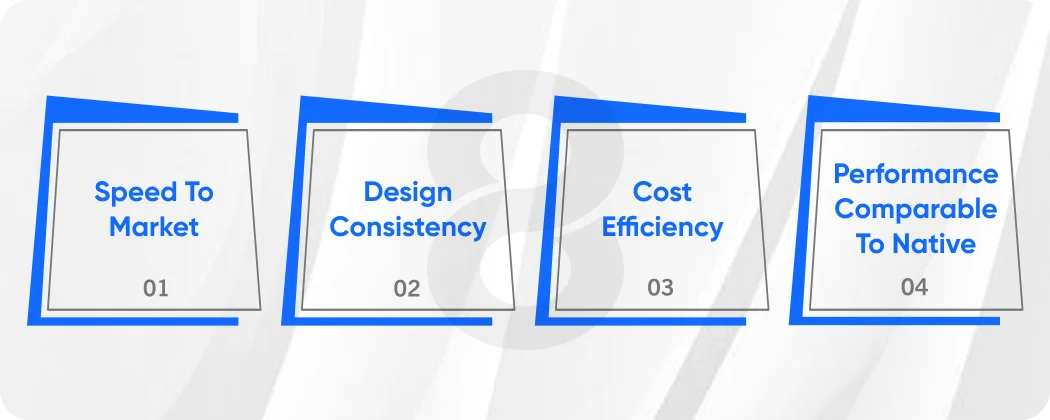
Effective Flutter apps have strategic benefits that aid enterprises in building quicker, staying consistent, lowering the cost of Flutter apps, and providing high-performance experiences meeting contemporary user demands.
1. Speed to Market
Flutter helps developers to create and deploy applications within a short time frame using one set of code. This means that businesses will launch features more quickly, verify concepts sooner, and adapt to market shifts effectively.
2. Design Consistency
The architecture that uses widgets in Flutter provides platform consistency in UI and UX. This means that the users will get the same layouts, animations, and interactions across devices, which enhances usability and brand perception.
3. Cost Efficiency
Flutter saves the engineering hours and complexity of maintenance by removing independent native development. Enterprises reduce the long-term expenses and still retain quality, scalability, and constantly updated features.
4. Performance Comparable to Native
Flutter is offered as native ARM code, which provides smooth animation and responsive interactions. This guarantees the performance of apps, which are reliable and offer quick loading systems and easy use across devices.
Read More: Flutter vs React Native – Which Is Better for Business Apps in 2026?
When Should You Choose Flutter for Your App?
Flutter is ideal when your product needs:
- Cross-platform deployment
- Rapid MVP development
- High UI customization
- Frequent updates
- Start-up or scaling environments
Moreover, Flutter can be used when the business is planning to develop Flutter apps on a long-term basis and not as an experiment.
Key Technical Advantages Behind Flutter’s Success

Knowledge of the technical underpinning of Flutter can assist businesses in creating faster, scalable, and more aesthetically similar applications and enhance the efficiency of their development process, performance consistency, and long-term cross-platform ability of their products.
Reactive Framework Architecture
Flutter has a reactive programming model in which the updates of the UI are automatically provided in response to changes in data. This will enhance responsiveness, decrease manual updates, and provide smoother and real-time user experiences across devices.
Skia Rendering Engine
Flutter uses the Skia engine to render each pixel without using native UI components. Consequently, applications have a consistent image, animation, and operation across the different operating systems.
Hot Reload
Hot reload enables a programmer to see the changes in the code immediately without reloading the program. As a result, teams work through more iterations, have efficient test cycles, and reduce the development cycles without impacting productivity and accuracy.
Modular Architecture
Flutter is based on modular and clean architecture principles and supports scalable app structures. The APIs, microservices, and backend systems can be seamlessly integrated by developers and are flexible since applications can grow and change.
Read More: 8 Steps to Build an App in 2026
Business Benefits of Flutter from a Conversion Perspective
Regarding marketing and growth, Flutter is part of something measurable:
- It will launch faster; hence, revenue will be generated earlier
- Uniform UX retains
- Fewer bugs enhance the ratings of the apps
- This increases customer satisfaction because of quicker updates
Flutter enables a business to constantly streamline onboarding processes, payment experiences, and engagement funnels because it enables teams to release updates as quickly as possible.
Read More: Top 10 Flutter App Development Companies
The Future of Flutter App Development
The use of Flutter is still increasing in the world.
Industry data shows:
- The most utilized cross-platform framework globally is still Flutter
- There are more than half a million Flutter applications in the Google Play Store alone
- Flutter is actively developed by millions of developers
- Flutter is therefore developing past mobile into web, desktop, embedded systems, and AI-driven applications.
- Flutter is a technology stack of the future for any business intending to implement a long-term digital ecosystem.
Read More: Mobile App Development Timeline – 2026 Guide
How to Use These Flutter App Examples for Your Next Build
These apps are being analyzed strategically instead of imitating the features:
- Determine user experience trends
- Work on the optimization of performance
- Put more emphasis on scalable architecture
- Test concepts through MVP releases
- Iterate based on analytics
Technology is no longer sufficient to create successful apps. They are being constructed through the integration of user knowledge and the appropriate development model.
Final Thoughts!
Flutter has ceased being experimental. Whether it is the fintech giants or startups and entertainment solutions, it drives scalable applications across millions of users all over the world. These are examples of Flutter applications that demonstrate how companies can attain native performance, develop applications faster, and achieve cross-platform scalability.
More to the point, Flutter enables organizations to focus on user experience and innovation. The business can learn something through every successful example of a Flutter app and become smarter in their architecture and growth choices, creating more modern applications to be launched faster and be able to compete.