


The slowness of enterprise operations was due to procurement, which was full of RFPs, negotiations, compliance inspections, and contract complexity. That is rapidly changing. The multi-agent AI systems can now autonomously administer the entire lifecycle of vendors, including sourcing and negotiation, validation, performance tracking, and execution.
This change is already being implemented. McKinsey claims that procurement using AI can accelerate the process as much as 40%, with a lower operating cost.
In the meantime, Globality also writes that Global 2000 companies that apply autonomous sourcing reduce procurement expenses by a fifth and augment productivity by 70%. Those companies that fail to embrace this change will become victims of more agile and AI-powered competitors.
What Is Autonomous Procurement And Why Does It Matter?
Autonomous procurement represents AI-based multi-agent systems that allow autonomous procurement to control the overall procurement cycle. It does not transform the physical processes of traditional automation by digitizing the manual processes but repurposes procurement, in which the agents reason, interact, negotiate, and make decisions without human oversight.
Adoption is accelerating. According to an EY Global CPO Survey (2025), 8 out of every ten Chief Procurement Officers are intending to implement generative AI in three years, particularly in contract management. Regardless of this momentum, 37 percent of organizations have adopted or tested such systems, with a significant opportunity for those that adopt them early.
From Automation to Autonomy: A Critical Distinction
Conventional procurement automation is similar to cruise control; it is the same speed. However, there is still a human behind the wheel. Automated procurement is the self-driving car: it can drive along complicated paths, react to new circumstances, and change the course in real-time without the human operator having to press a button.
Fundamentally, it is based on a coordinated system of specialized AI agents, each with its assigned role, sourcing, negotiation, compliance validation, contract execution, and performance monitoring communication in real time, sharing of data, and avoiding conflicts with a set of preset rules and patterns training.
The Multi-Agent Architecture: Who Does What?
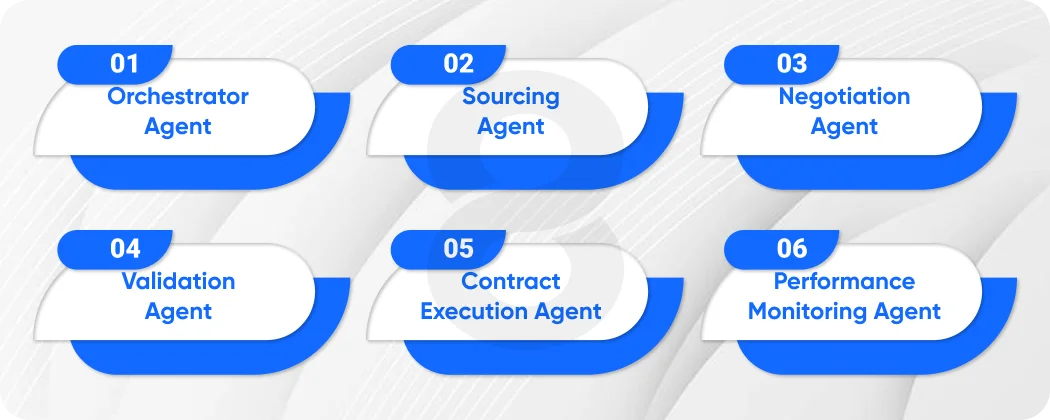
To understand the mechanism of autonomous procurement, it would be necessary to peek under the hood. A properly designed multi-agent procurement platform would normally have the following special agents operating in unison:
Orchestrator Agent
The master controller is the Orchestrator Agent. It gets a procurement goal, such as sourcing 10,000 units of Component X in 60 days at a market rate or less, and assigns subtasks to each of the specialized agents.
It tracks the real-time developments, manages inter-agent conflicts, redeploys resources where there might be a change in the timelines, and prevents the entire mission from being derailed.
Sourcing Agent
The Sourcing Agent will scan vendors’ databases, procurement markets, past purchases, and live supply chain feeds to determine and rank qualified suppliers. It compares every candidate based on price, lead time, quality score, geographic risk and ESG compliance metrics producing a shortlist in minutes, not days, without the need for manual research.
Negotiation Agent
The Negotiation Agent conducts the communication with vendors using the organized digital channels. The system suggests terms, counters offers, applies sophisticated strategies such as anchoring, concession sequencing, and BATNA modeling, and uses fine-tuned large language models to converge on the best pricing and delivery terms.
Most importantly, it is able to run multiple negotiations with dozens of vendors simultaneously, reducing the process that took weeks before into hours. It does not feel tired, emotionally strained, or biased in cognition, as is the case with human negotiators.
Validation Agent
The Validation Agent will conduct a cross-check of proposed contract terms prior to proceeding with the agreement with internal policies, regulatory requirements, supplier financial health indicators, and risk scoring models.
It raises red flags on anomalies, unusual payment window times, non-normative liability terms, and matches in the sanctions list and auto-rejects or escalates, depending on pre-defined severity levels.
Contract Execution Agent
When successfully validated, the agent prepares the final contract by using ready-made legal templates, modifies the terms according to negotiation conditions, issues digital signatures via built-in e-signature APIs, and initiates back-office processes: purchase order creation, ERP updates, payment processing, and so on, without any human intervention
Performance Monitoring Agent
After execution, this agent monitors the performance of the vendors on a regular basis against the contracted SLAs: timeliness of delivery, rate of defects, invoice accuracy, and compliance reporting. Deviations will cause an automatic notification and calculation of penalties or re-sourcing based on the level of deviation.
Read More: How to Predict and Manage the “Token Tax” in High-Scale Generative AI Applications
How AI Negotiation Actually Works
Most objections take place during the negotiation phase. Can AI really negotiate? Yes, it is the response more, under certain circumstances, and more efficiently than human beings.
Multi-agent negotiation relies on game theory, reinforcement learning, and natural language generation. The agents minimize cost, reliability, and risk based on vendor history, market performance, and the reservation price of the organization.
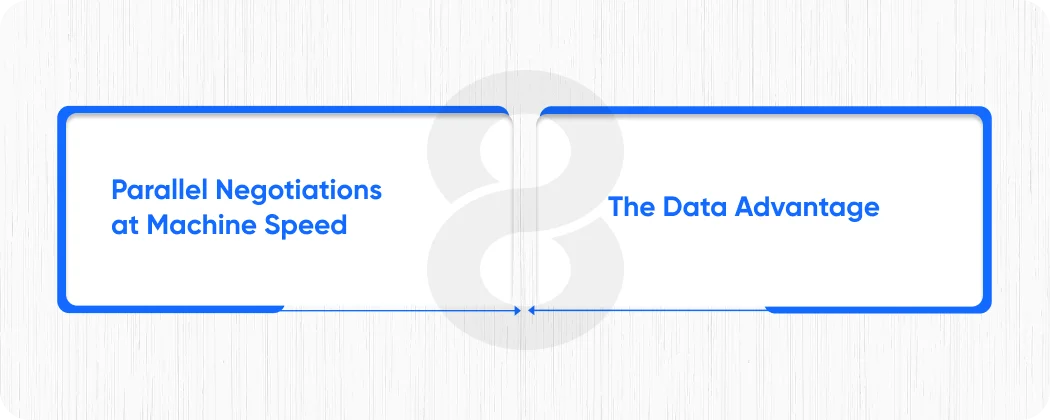
Parallel Negotiations at Machine Speed
A weak negotiator agent can negotiate with 50 or more vendors at the same time and customize strategies based on the relationships, position in the market, and category trends. It adapts strategies and concessions and moves out where necessary. As an illustration, it can underprice, make flexible deals, and have a fully auditable record of all dealings.
The Data Advantage
Autonomous negotiation quality is directly related to the quality of the underlying data. Companies that have been investing in clean, structured procurement data as the basis of an agent system have always performed better compared to those that have implemented agents based on disjointed or non-congruent data sources.
The inputs are not historical vendor behavior, category benchmarks, and spend analytics; these are the fuel that intelligent negotiation works with.
Validation: Protecting the Organization at Every Step
Lack of an automated procurement system that is thoroughly verified is a weakness. The validation agent works on various dimensions at the same time. Legal compliance checks are made to ascertain that the contract is not contravening the applicable law in the jurisdiction of both the seller and buyer.
Financial risk scoring is used to evaluate the financial viability of a vendor through real-time credit information and publicly disclosed financial information. Sanctions screening compares the vendor entities to the list of restricted parties set by the OFAC, UN, and EU. Policy alignment makes sure that the payment terms, IP ownership clauses, and data processing agreements will be in line with internal governance rules.
More importantly, validation agents are not supposed to act blindly on ambiguity. In the case of non-standard contract clauses that are not technically forbidden, the agent does not simply reject them.
It scores the risk, offers an alternative clause based on a pre-approved library, and has the negotiation agent re-engaged to make term substitutions without escalating to a human until the risk score has exceeded a specified limit.
Read More: 10 Open-Source Small Language Models for Your Next Project
Execution and Smart Contract Integration
Upon validation, smart contracts realized through blockchain can be used in the execution of contracts to generate self-enforcing contractual agreements. This model uses executable logic instead of law to encode the terms of the contract, payment events, milestones in the delivery process, and penalty provisions.
When a seller verifies receipt of a shipment through an integrated logistics API, the smart contract automatically releases payment. If delivery arrives late, the system automatically calculates the penalty, deducts it, and applies it to the subsequent invoice.
This removes the manual process of invoice approval, missing SLA disagreements, and delay of payments, long-time thorns of traditional procurement. The contract in itself is not merely a legal document, but it is already an operational system.
Read More: Leveraging Model Context Protocol to Connect AI Agents Across Salesforce, Slack, and SAP
Risk Management: Autonomous Doesn’t Mean Unaccountable
Developers build state-of-the-art multi-agent procurement systems with clear risk guardrails that keep autonomous operations within defined boundaries. Teams set spend limits to define the maximum contract value an agent can execute without escalation.
Categories inhibit agents from going out of strategy sourcing that needs human intervention, like the sole-source supplier relationship or acquisition beyond certain limits. Unchangeable audit trails record all agent activities, all negotiations, and all validation choices, providing complete visibility to compliance and finance departments.
The anomaly detection models can constantly track the behavior of agents. When a negotiation agent initiates the acceptance of terms that do not align closely with past trends, an alarm goes off, and this prevents the organization from the possibility of vendor manipulation or model drift. It is intended to have supervised autonomy: agents work independently within guardrails, and human beings control the guardrails.
Read More: The ‘Decision Trace’ Protocol – Building Audit-Ready AI Agents for Regulated Industries
The Business Case: Why Organizations Are Moving Fast
CPOs are reacting: now organizations are spending about a fifth of their technology budget on procurement AI, which is almost twice their spend on procurement AI in 2023.
Procurement teams already demonstrate the practical benefits: they reduce maverick spend incidents, accelerate contract turnaround, increase supplier compliance, and shift their focus from transactional execution to strategic supplier relationships and category intelligence.
Read More: How to Build a “Digital Workforce” of Specialized AI Agents for Supply Chain Automation
What Comes Next: The Road to Fully Autonomous Procurement
The trend of the industry is evident. AI co-pilot systems and intelligence augmentation have been the 2024-2025 window. 2025-2026 is the period of increased agentic AI adoption. Since 2026, the fully autonomous procurement will become the operating model of digital enterprises.
Gartner estimates that in the year 2028, around one-third of enterprise applications will contain agentic AI capabilities, which will enable the enterprise to make around 15 percent of daily work decisions without manual human intervention.
To procurement, this implies that the digital operating model is changing more quickly than most of the organizations are ready for. A slow approach to adoption leaves those teams falling behind those that already adopted the use of intelligent systems to reduce cycle time, sharpen vendor insights, and create more resilient supply chains at scale.
Building the Future of Procurement
Businesses now use AI in a fundamentally different way as they shift to intelligent autonomous systems and transform manual procurement. Instead of relying on humans to request and receive assistance, organizations deploy AI as a self-operating layer that runs independently within defined limits.
Questions to organizations prepared to adopt the new paradigm are not whether or not to automate procurement, but how to architect agent systems that are fast, compliant, and aligned to the strategic objectives of the business.
Technology firms, ERP vendors, and specialized AI firms are today constructing the multi-agent procurement stack. The businesses that invest in know-how and integrate these systems today will establish procurement standards for the coming ten years.