



Money does not have to wait in lines and paperwork, but it is transferred immediately by apps, APIs, and digital ecosystems. The secret to all smooth transactions is a single important element: experienced fintech developers.
With the digitization of financial services spreading rapidly in the United States, the need to recruit fintech developers has never been as high as ever. As the fintech revenues around the world are expected to reach over $188 billion by 2024 and increase at a 16.8% CAGR through 2028, the competition for top talent is getting heavier.
Whether you are a startup that is starting with a payments platform or a corporation that is modernizing the banking infrastructure. This guide has all the information to build a high-performing fintech engineering team.
What Does a Fintech Developer Actually Do?
It is necessary to know what you are hiring before you go into the how of hiring fintech developers. A financial company is not just any software engineer who works as a fintech developer. They occupy a special nexus of technical engineering and regulatory financial expertise.
They are usually required to perform their day-to-day duties, which are:
- Developing and sustaining pipelines of payment processing based on such protocols as ISO 8583 or SWIFT MT messages.
- Developing APIs that integrate with banking systems, card networks, and digital wallets such as Stripe, Plaid, or Visa Direct.
- Installing fraud detection software based on machine learning models, which are trained on transactional data.
- Maintaining adherence to PCI-DSS, SOC 2, AML standards, and SEC rules.
- Incorporating blockchain technology into DeFi protocols, tokenization, or smart contracts.
- Development of mobile and web applications on consumer-facing financial products.
In short, these highly specialized engineers directly impact revenue, regulatory compliance, and user trust. This is precisely the reason why the process of hiring should be systematic and calculated.
The State of Fintech Talent in the USA: Why It Is So Competitive
The United States is the largest fintech hub in the world with more than 10,000 fintech startups so far. The talent supply has, however, not been in line with demand. The U.S. Bureau of Labor Statistics estimates that the number of software developers will increase by 25 percent over the next decade, 2022-2032, which is much higher than for other jobs.
When you further refine that to developers who have fintech-specific knowledge, blockchain knowledge, or experience with open banking standards, such as PCI-DSS, the list becomes much shorter.
More so, a Statista report on worldwide digital payment indicates that the total transaction value within the digital payment segment will grow to $14.78 trillion, which supports the idea that all companies, including neobanks and insurance technology platforms, are fighting over the same niche competencies.
The implication of this to you as a hiring manager or founder is simply that you have to have a clear, well-thought-out hiring strategy. Otherwise, you are losing the best candidates to other companies, or you are compromising with talent that is just unable to satisfy your technical needs.
Read More: Average Timeline and Budget for a FinTech App with Real-Time AI Fraud Detection
Core Technical Skills to Look for When You Hire Fintech Developers
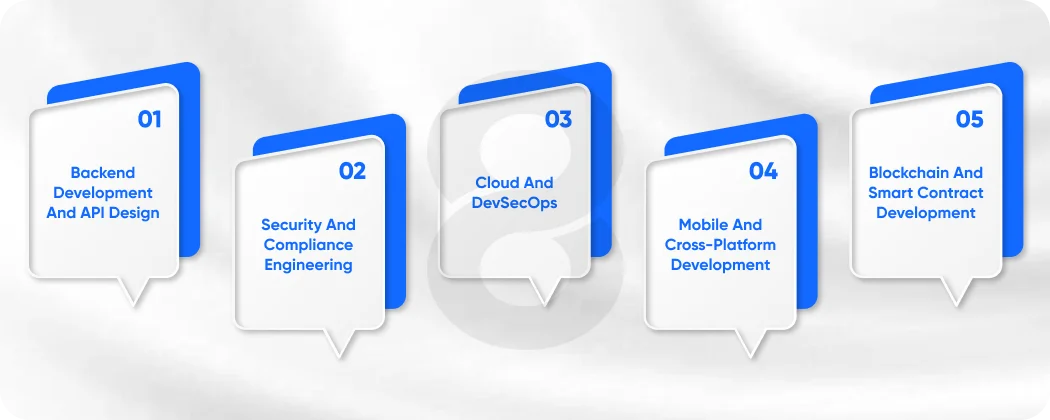
Not all fintech developers are built the same. The technical stack and domain knowledge will vary widely depending on whether you are constructing a robo-advisor, a lending platform, or a crypto exchange. That being said, there are fundamental competencies to be exhibited by any qualified fintech developer.
1. Backend Development and API Design
Look for candidates experienced in Java, Python, Go, or Node.js, as these languages excel in fintech backends due to their performance, concurrency handling, and mature ecosystems.
Ensure they design robust REST and GraphQL APIs, especially for integrating with banking systems or third-party financial data providers like Plaid and Yodlee.
2. Security and Compliance Engineering
In fintech, there is no bargain when it comes to security. Your candidates must be skilled and knowledgeable in encryption standards (AES-256, RSA), OAuth 2.0 and OpenID Connect protocols, tokenization and data masking.
Also, having previous experience in operating within regulatory standards such as PCI-DSS Level 1, GDPR, CCPA, SOX, or FinCEN compliance is a significant point of distinction.
3. Cloud and DevSecOps
The current fintech architecture is cloud-based. The ability to work with AWS, the Google Cloud platform, or Microsoft Azure, along with experience in Kubernetes, Docker, or CI/CD pipelines, is becoming standard even in middle-level positions.
The implementation of DevSecOps (adding security into the delivery pipeline) is particularly essential to any platform that deals with real money transactions.
4. Mobile and Cross-Platform Development
If your product includes a consumer-facing mobile application, hire developers skilled in React Native, Flutter, or Swift/Kotlin to build native iOS and Android apps.
Collaboration with a cross-platform app development firm can be a great advantage in this matter, as the company can create a single codebase that will run on both platforms without the need to compromise on performance or user experience.
5. Blockchain and Smart Contract Development
Solidity programming, Ethereum Virtual Machine (EVM) expertise, and knowledge of Layer 2 scaling solutions are growing in importance due to those companies working in DeFi, digital assets, or cross-border settlements. Although this is a narrower niche, it can become a strong advantage if your product roadmap includes tokenized assets or programmable money.
Read More: 15 Fintech Industry Trends for Innovative App Development 2026
How to Hire Fintech Developers: A Step-by-Step Process

Now that you have a clue of what you are seeking, we will take a stroll through the real hiring workflow. This part describes a systematic procedure that is effective in both startups that develop rapidly and in businesses with a hierarchical authority system.
 Define Your Technical Requirements Clearly
Before you put up an advertisement for a job description, outline what exactly your product architecture requires. Which programming languages are on your stack? Do you require a person who can create a distributed ledger system, or are you mainly doing ACH payments? The clearer you are at the outset, the less time you will be wasting on vetting the wrong candidates.
 Choose the Right Hiring Channel
Fintech talent in the USA takes several routes. Both are associated with particular trade-offs:
- Recruit local US-based developers directly through LinkedIn, AngelList, or Dice for long-term, embedded team roles.
- Hire fintech developers on a project or short-term basis through freelance platforms such as Toptal or Gun.io.
- Collaborating with an app development company in the fintech sector offers a complete team of architects, QA engineers, and project managers without the additional cost of each being hired separately.
- The Latin American, Eastern, or South Asian nearshore or offshore talent pools can save a lot of money without compromising technical quality.
 Design a Rigorous Technical Interview Process
Fintech jobs do not require generic coding problems. In your interview process, you must include:
- One system design round centered on financial applications, like creating a fraud detection engine in real-time or a multi-currency ledger.
- Security-oriented code tests that evaluate knowledge of secure data management, input validation, and authentication paths.
- Compliance situation questions to evaluate the thoughts of candidates regarding regulatory limits in product choice.
- A homework task that uses a real-world problem in your field, e.g., an initial KYC verification system or a transaction reconciliation system.
 Evaluate Soft Skills and Domain Mindset
Technical skills cannot do it. Fintech is one of the fields where the price of errors can be directly converted into a fine by a regulator, data breach, or customer distrust. Thus, seek out developers with an attitude of risk awareness, the ability to communicate well with non-technical stakeholders, and an actual appreciation of the financial requirements of the end user.
 Verify Past Work and References Thoroughly
Request to provide tangible examples of fintech products or features that they have delivered. Did they develop a payment reconciliation system? Have they been incorporated into main banking platforms such as Temenos or Mambu? The check of references in fintech is particularly relevant due to the fact that the sphere is in need of a track record of reliability, rather than theoretical knowledge.
In-House Team vs Fintech App Development Company: What Works Best?
The choice of either developing a team internally or hiring a fintech app development company is one of the largest decisions companies have to make. Both strategies will be beneficial based on the product objectives and stage of growth.
In-house construction gives more control over culture and intellectual property and long-term technical knowledge, and it is ideal in companies that have already determined product-market fit. Nonetheless, cooperating with an external team allows quicker development, reduced initial investment, and expert knowledge. The mature partners offer formalized QA, security practices, and DevOps that can speed up delivery.
In the case of mobile-first, cross-platform development enables a single codebase to support both iOS and Android. Without requiring more maintenance and without limiting scalability as regulatory and market requirements change.
Read More: 30 Top Apps Like MoneyLion to Inspire Your Next Fintech Startup
Hire Fintech Developers in USA: Cost Benchmarks and Compensation Trends
One of the most typical areas of contention during fintech recruitment is compensation. When you are thinking of recruiting fintech developers in the USA, it is important to know the existing market rates to recruit talent without stretching your finances.
As of 2024: Glassdoor and Levels. FYI, data show that:
- In the USA, junior fintech developers usually have salaries ranging between $85,000 and $110,000 annually.
- Mid-level development fintech professionals with three-six years of experience will earn salaries ranging between $120,000 and $160,000.
- Top fintech companies can pay senior and principal engineers with security, blockchain, or payments infrastructure experience between $180,000 and $250,000 or higher.
- Companies typically pay between $120 and $250 per hour to hire a fintech developer contractor or freelancer, depending on their specialization.
Other than the base salary, the finest candidates will demand equity, extensive benefits, flexible working schedules, and professional growth funds. Fintech engineers are also starting to consider the technical complexity of your stack when making their decision. So investing in modern tooling is also dividend-paying in recruiting.
Read More: List of Best Mobile Banking Apps to Inspire Your Fintech Solution
Common Mistakes to Avoid When Hiring Fintech Developers
Even financially endowed firms commit errors that are preventable during fintech recruitment. Knowledge of such pitfalls can save you months of wasted efforts.
- Bringing in general software engineers and asking them to learn the ropes of fintech within a few months without any domain-specific training is an invitation to expensive delays.
- The application of a general technical interview that does not investigate regulatory expertise or security profundity will reveal those who appear good on paper but fail in fintech production settings.
- Concentrating on US-based talent and not looking at remote or nearshore fintech developers as a talent source is an unnecessarily narrow talent pool, particularly in specialized positions.
- Another fatal mistake is underestimating the time required to recruit: the mean time to replace a top fintech engineer in the USA is more than 60 to 90 days, which is why it is necessary to plan.
- Even the most technically qualified hires can fail if you neglect cultural and communication fit, especially in distributed teams.
Read More: Best Cash Advance Apps – Build a Custom Fintech App
Key Questions to Ask Before Engaging a Fintech Development Partner
In case you choose to outsource the development of a fintech application to an external company instead of using or in addition to the internal team, due diligence is also significant. These are the questions that you need to ask prospective partners:
- Have you developed and delivered regulated financial products, and would you please present some particular references of those clients?
- How do you deal with PCI-DSS compliance, data encryption, and penetration testing?
- Do you support cross-platform development of apps, and what frameworks do you support?
- What is your policy regarding IP ownership, data security agreements, and NDAs?
- How do you organize your team, and who will be your main technical point of contact during the engagement?
- What about regulatory changes that may occur in the middle of the product development?
Final Thoughts!
Finding fintech developers is not only a decision to recruit but also an investment in the future of your product. The right engineers determine the level of security of your platform. Its ability to comply with the regulatory requirements, and the level of trust users have in your financial services.
With the rapid expansion of fintech, organizations that recruit intelligently and intentionally will have a sustainable competitive advantage. Define your technical requirements, evaluate both skills and domain expertise, and prioritize a security-first approach.
A proficient fintech team is not just building features; it is the stable base your platform will need to grow and prosper.