Modern farming has come a long way from manual record-keeping and guesswork-driven decisions. Today, the fields are smarter, the data flows in real time, and the farmer who once relied solely on intuition now has predictive analytics, IoT sensors, and cloud-connected dashboards at their fingertips.
Yet, for all this progress, many farms and agribusinesses are still leaving enormous value on the table simply because they have not adopted the right agriculture software solutions.
This guide breaks down what these solutions are, why they matter, what specific features to look for, and how they are reshaping the way the world grows food. Whether you manage a smallholding or run a large-scale agribusiness, this is the complete picture you need.
The Numbers Tell the Story: Why Agricultural Software Is Booming
The rapid growth of agriculture software solutions highlights their increasing importance in modern farming. According to Grand View Research, the farm management software market was valued at USD 4.18 billion in 2024 and is expected to reach USD 10.58 billion by 2030, growing at a CAGR of 17.3%.
Similarly, Market Research Future estimates the broader agriculture software market will grow from USD 2.71 billion in 2024 to USD 10 billion by 2035.
This growth reflects rising global food demand, climate challenges, and labor shortages pushing farms toward digital solutions. Notably, Mordor Intelligence reports precision farming accounts for nearly 91% of the market, proving data-driven agriculture is already mainstream.
What Are Agriculture Software Solutions?
Agriculture software solutions are digital platforms and applications that help farmers, agribusinesses, and supply chain stakeholders manage and optimize every stage of the agricultural lifecycle. These solutions support activities such as crop monitoring, irrigation, livestock management, financial tracking, supply chain visibility, and weather analysis.
Unlike traditional ERP systems, agribusiness software is built to handle farming complexities like soil variability, seasonal cycles, and real-time weather integration. It also supports data collection from drones, satellites, and IoT sensors through specialized, field-friendly interfaces.
Modern ag management solutions go beyond basic data organization. They convert raw field data into actionable insights, enabling smarter decisions, reduced resource waste, improved efficiency, and higher crop yields across farming operations.
Read More: How to Hire a Full Stack Developer in 2026
Core Types of Agriculture Software You Need to Know
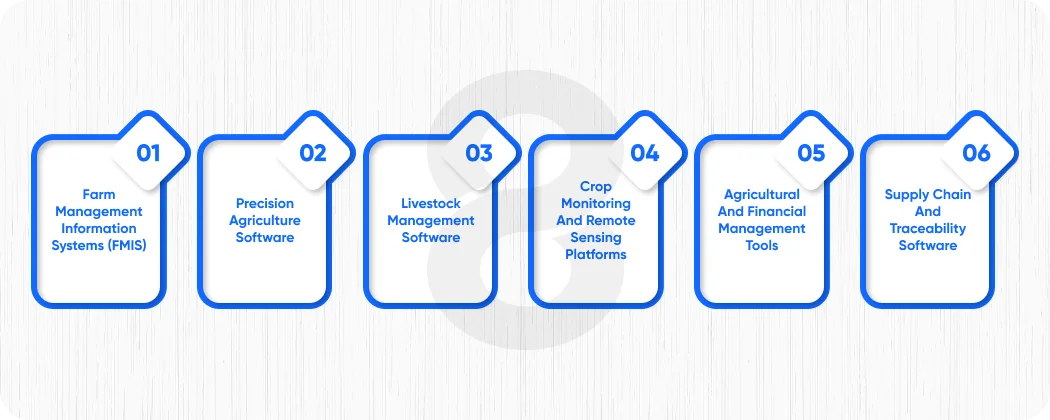
Farm Management Information Systems (FMIS)
A farm management information system centralizes crop planning, input tracking, labor scheduling, equipment maintenance, and financial reporting into one platform. It helps farmers monitor operations, track costs, and ensure compliance. For small farms, it improves visibility, while large enterprises benefit from integration with ERP systems, combining field-level operations with strategic financial insights.
Precision Agriculture Software
Precision agriculture software enables site-specific farming using GPS, sensors, and AI-driven analytics. It identifies variations within fields to optimize inputs like water and fertilizers. By combining drone imagery, satellite data, and soil sensors, these tools detect crop stress early, reduce waste, improve yields, and support sustainable, data-driven farming practices.
Livestock Management Software
Livestock management software tracks animal health, breeding, feeding, and performance across herds. Advanced systems integrate RFID tags and biometric sensors for real-time monitoring, enabling early disease detection and better herd management. This improves productivity, reduces losses, and streamlines operations, making livestock farming more efficient, data-driven, and easier to manage at scale.
Crop Monitoring and Remote Sensing Platforms
Crop monitoring tools pull data from satellites, unmanned aerial vehicles (UAVs), and ground-based sensors to deliver normalized difference vegetation index (NDVI) maps, canopy coverage analysis, and chlorophyll content readings. These platforms give agronomists a bird’s-eye and ground-level view of crop health simultaneously, enabling precision interventions and harvest timing optimization.
Agricultural Accounting Software and Financial Management Tools
Agricultural accounting software helps farmers manage finances with tools for budgeting, cash flow forecasting, tax preparation, and profit analysis. It integrates commodity pricing, loan tracking, and subsidy compliance, improving financial clarity. These solutions enable farmers to make informed decisions, maintain accurate records, and run their operations with greater business efficiency and stability.
Supply Chain and Traceability Software
Consumers and regulators alike are demanding greater transparency in the food supply chain. Transparent farming supply chain solutions use digital traceability tools, often blockchain-powered, to log every touchpoint from seed to shelf. Farmers can document input applications, harvest batches, storage conditions, and logistics handoffs, giving buyers verifiable provenance data that supports premium pricing and consumer trust.
How IoT and Connectivity Are Transforming Ag Software
The rise of connected devices has significantly expanded the capabilities of agriculture software. Modern farms now rely on soil sensors, weather stations, smart irrigation systems, GPS-enabled machinery, and drones that continuously feed real-time data into centralized platforms.
IoT in agriculture enables precise, data-driven decisions. For example, soil sensors can optimize irrigation by monitoring moisture at multiple depths, while storage sensors prevent spoilage and wearable devices track livestock health.
Cloud infrastructure plays a key role, enabling scalable data integration and real-time insights across systems. As farms become more connected, software and hardware work together as a unified ecosystem, increasing efficiency, reducing waste, and improving overall farm productivity.
Read More: Best 45+ Internet of Things Examples Across Different Industries
Mobile-First Farming: The Role of Apps in Modern Agriculture
Farmers work in fields, barns, and remote areas, not at desks, which has driven the rise of mobile apps designed for real-world farming conditions. Modern agricultural apps offer offline access, voice input, barcode scanning, GPS mapping, crop disease detection, and real-time alerts for weather and tasks.
Beyond farm operations, these apps serve as essential tools for smallholder farmers, providing access to advisory services, market prices, weather updates, and even financial support. Initiatives like India’s Digital Agriculture Mission highlight this mobile-first shift by connecting millions of farmers to digital ecosystems.
Additionally, cross-platform compatibility ensures seamless data sharing between field workers using mobile devices and managers using desktop systems, reducing data silos, improving communication, and enabling more efficient, data-driven decision-making across agricultural operations.
Read More: How to Choose the Right Supply Chain Management Software Solutions (Complete Guide)
Key Features to Look For in Ag Software Solutions
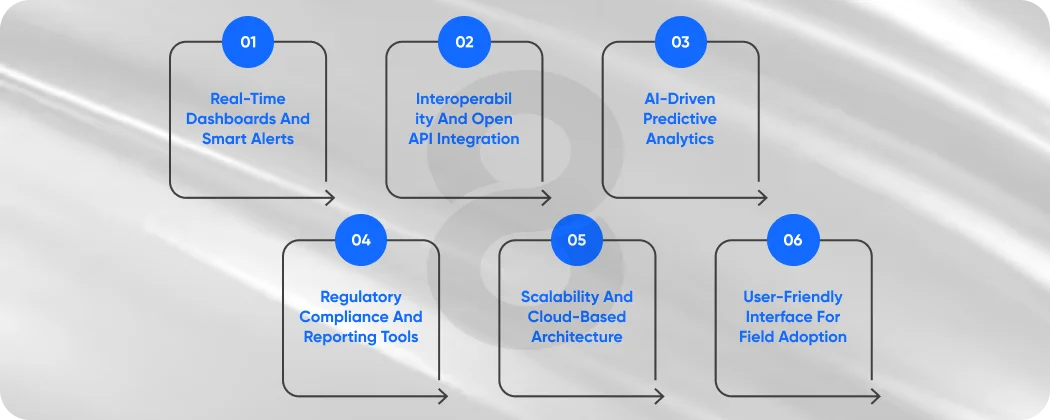
When evaluating ag software solutions for your operation, the feature checklist should go beyond basic crop logging. Here is what truly separates capable platforms from excellent ones:
Real-Time Dashboards and Smart Alerts
Real-time dashboards provide instant insights into crop health, weather conditions, and equipment performance, while customizable alerts ensure farmers respond quickly to critical changes without being overwhelmed by unnecessary notifications.
Interoperability and Open API Integration
Interoperability allows seamless integration with existing machinery, IoT devices, and third-party tools, while open APIs ensure flexibility, preventing data silos and enabling a unified, efficient digital farming ecosystem.
AI-Driven Predictive Analytics
AI-powered analytics transform historical and real-time data into actionable insights, helping farmers forecast yields, detect diseases early, optimize resource usage, and make proactive decisions that enhance productivity and reduce risks.
Regulatory Compliance and Reporting Tools
Built-in compliance features simplify adherence to agricultural regulations by tracking pesticide usage, maintaining audit trails, and generating reports required for certifications like organic farming and GlobalGAP standards.
Scalability and Cloud-Based Architecture
Scalable cloud infrastructure ensures agriculture software solutions can handle increasing data volumes, expanding farm operations, and multi-location management without performance issues, supporting long-term growth and operational efficiency.
User-Friendly Interface for Field Adoption
An intuitive interface designed for non-technical users ensures farmers and field workers can easily adopt the software, reducing training time while improving daily usage, accuracy, and overall operational effectiveness.
Why Custom Agriculture Software Development Matters
Off-the-shelf agriculture software solutions work for standard workflows, but many agribusinesses have unique operational needs that generic platforms cannot address effectively.
Custom development allows businesses to build purpose-driven solutions tailored to their specific processes, crop types, and equipment ecosystems. By partnering with experts like 8ration, farms can integrate IoT devices, AI-driven analytics, and cloud systems into a unified platform that aligns perfectly with their operations.
Custom software also creates a competitive advantage, as workflows and efficiencies cannot be easily replicated. Additionally, it supports continuous scalability, enabling farms to adapt, innovate, and grow as market demands and technologies evolve.
The ROI Case for Investing in Agriculture Software
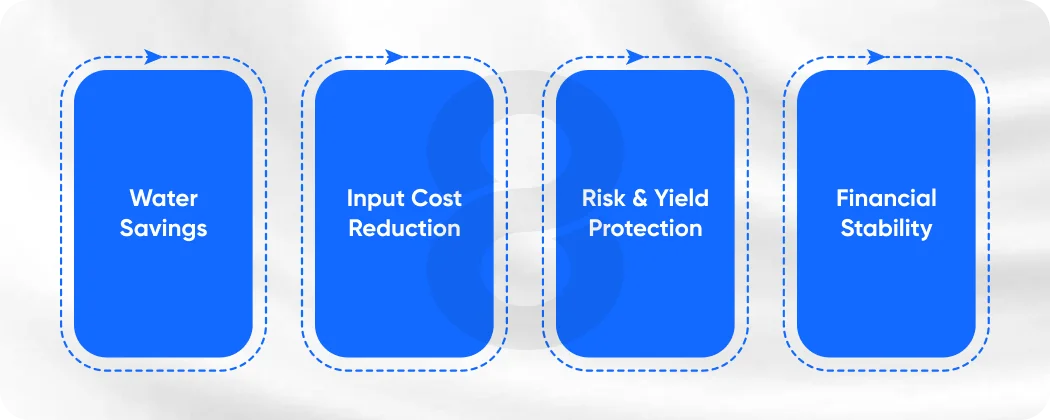
Investing in agriculture software solutions delivers measurable ROI by reducing costs, improving efficiency, increasing yields, and strengthening financial stability across modern farming operations.
Water Savings
Smart irrigation systems using sensors and weather data reduce water consumption by 30-40% while ensuring precise irrigation, improving efficiency, conserving resources, and supporting healthier crop growth across seasons.
Input Cost Reduction
Precision farming reduces fertilizer and pesticide overuse by targeting only affected areas. This lowers operational costs, improves soil quality, and increases productivity while minimizing waste across agricultural processes and cycles.
Risk & Yield Protection
Predictive analytics and early disease detection help farmers identify threats early. This proactive approach reduces crop losses, stabilizes yields, and minimizes financial risks caused by unpredictable environmental and biological factors.
Financial Stability
Agriculture-focused accounting tools improve cash flow tracking, insurance accuracy, and financial reporting. Better data management enables easier access to credit, stronger budgeting, and long-term business growth for farmers.
Read More: Top 10 CRM Software Platforms of 2026
Real-World Results: How 8ration Builds Agriculture Software That Works
Theory is useful. Proof is better. Two of 8ration’s agricultural development projects illustrate exactly what becomes possible when the right technology is applied to real farming challenges with genuine user understanding behind every design decision.
Case Study 1: Digital Crop – AI-Powered Crop Disease Detection at Your Fingertips

The Challenge
Crop diseases cause major global agricultural losses, especially for smallholder farmers lacking timely expert diagnosis. Delays in identification often lead to irreversible damage. Digital Crop was created to provide instant, accessible crop diagnostics directly through smartphones, reducing dependency on slow traditional support systems.
What Was Built
An AI-powered mobile app for iOS and Android was developed to diagnose 200+ crop diseases using image recognition. It provides results in seconds, includes symptom-based diagnostics, and works offline. The system uses agricultural data and is optimized for field conditions and usability.
The Results
The app was launched within eight months and reached 15,000 farmers across eight regions. It reduced diagnosis time from five days to under two minutes and improved crop protection by 34%. Expert validation confirmed high diagnostic accuracy, demonstrating strong real-world agricultural impact.
Case Study 2: Munitora – Where Tradition Meets Smart Livestock Management

The Challenge
Livestock farming blends tradition with increasing operational complexity. Farmers manage health records, breeding cycles, feeding, and finances manually, leading to inefficiencies and errors. Munitora was designed to bridge traditional farming practices with modern digital tools for improved productivity and animal welfare outcomes.
What 8ration Built
Munitora is a multi-device SaaS livestock management platform enabling real-time access across desktop, tablet, and mobile. It includes herd tracking, health monitoring, breeding optimization, financial integration, and analytics, all designed for intuitive use and minimal training requirements in field conditions.
Development Process
The platform was developed through close collaboration with farmers, veterinarians, and agricultural experts. Field-tested prototypes and iterative feedback cycles ensured every feature addressed real operational needs, resulting in a user-friendly system aligned with practical livestock farming workflows and challenges.
The Results
Munitora launched within seven months, achieving 92% positive feedback. Pilot farms managed over 5,000 cattle, while the administrative workload decreased by 40%. The platform improved efficiency, reduced manual effort, and demonstrated how digital tools enhance productivity without disrupting traditional farming practices.
Wrapping It Up!
Global agriculture is rapidly shifting from labor-intensive practices to precision, data-driven operations. Agriculture software solutions are driving this transformation, helping farms of all sizes improve efficiency, reduce waste, and increase productivity.
As the market grows at a strong pace, early adoption offers a clear competitive advantage. Whether it’s crop monitoring, livestock management, mobile apps, or supply chain tools, the right technology approach enables smarter decisions. The future of farming is digital, those who adopt it today will lead tomorrow.