



Many businesses only begin searching for new supply chain management software solutions after their existing systems start causing real damage. Orders slow down, inventory becomes chaotic, procurement turns messy, and team communication breaks down in costly ways.
In the resulting panic, companies rush into decisions based on flashy features, dashboards, and persuasive sales pitches. Months later, they’re left with expensive software that technically works but fails to address their actual operational problems.
Choosing the right platform isn’t about finding the most advanced tool, but about selecting a system that truly fits your workflow, team behavior, scale, and real-world complexity. Otherwise, even the best software becomes costly friction.
What Supply Chain Management Software Actually Does
A lot of companies think they need “better visibility,” but they have never properly defined what that means operationally. That creates problems immediately.
Before you choose a platform, you need to understand what the system is supposed to improve. At its core, supply chain software is meant to help businesses manage the movement of goods, information, inventory, suppliers, and fulfillment processes more clearly and more efficiently.
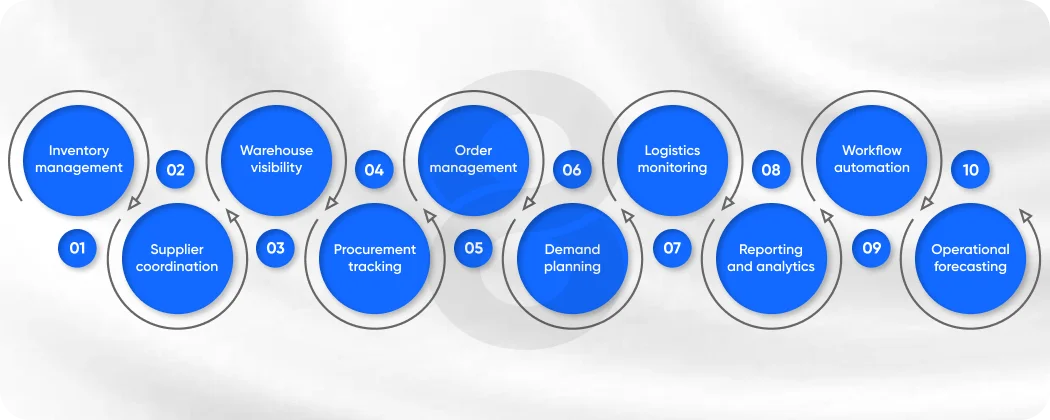
That includes areas like:
- Inventory management
- Supplier coordination
- Warehouse visibility
- Procurement tracking
- Order management
- Demand planning
- Logistics monitoring
- Reporting and analytics
- Workflow automation
- Operational forecasting
The problem is that many businesses need all of these things at different levels of complexity. A company managing regional wholesale inventory does not need the same structure as a multi-location manufacturing operation with layered procurement dependencies.
That is why choosing supply chain management software solutions should never begin with “What is the best platform?” and should always begin with “What operational problem are we trying to solve first?”
Why Businesses Are Rethinking Supply Chain Software in 2026
Supply chains are no longer simple enough to manage through disconnected spreadsheets, fragmented dashboards, and five different internal tools pretending to be “good enough.”
The pressure is higher now.
Businesses are dealing with:
- More suppliers
- Faster customer expectations
- Tighter delivery windows
- Greater inventory sensitivity
- Rising operational costs
- Stronger visibility demands
- More cross-team dependencies
That changes the role of software completely. What used to be a “back-office operations tool” is now something much bigger. The right platform influences planning, procurement, logistics, forecasting, communication, and executive decision-making all at once.
That is exactly why supply chain management software solutions are being treated much more seriously now by both mid-sized companies and larger enterprises.
This is also where businesses start realizing that the software itself is only one part of the decision. The other part is how intelligently the software is designed, integrated, and adapted around the business using it. That is where stronger software development thinking starts becoming far more valuable than people initially expect.
Read More: Top Banking Software Solutions to Modernize Your Financial Services
Start With the Operational Pain, Not the Product Demo
This is probably the most important part of the entire selection process. Most businesses approach software backward. They start with demos, sales calls, shiny dashboards, with AI features they barely understand. And then they try to force their workflow into whatever the product already does. That is not a strategy. That is procurement theater.
The smarter approach is to start by identifying where your supply chain is already leaking time, money, or clarity.
Look for problems like:
- Inventory discrepancies
- Delayed purchase approvals
- Vendor communication breakdowns
- Poor warehouse visibility
- Weak demand forecasting
- Manual reporting bottlenecks
- Shipment tracking blind spots
- Disconnected team workflows
- Fragmented procurement records
Once you identify those issues clearly, the software decision becomes much easier because now you are evaluating based on operational fit instead of presentation quality.
That is where good supply chain management software solutions start separating themselves from software that only looks impressive during onboarding.
Read More: Top 10 CRM Software Platforms of 2026
The Different Types of Supply Chain Software Businesses Usually Compare
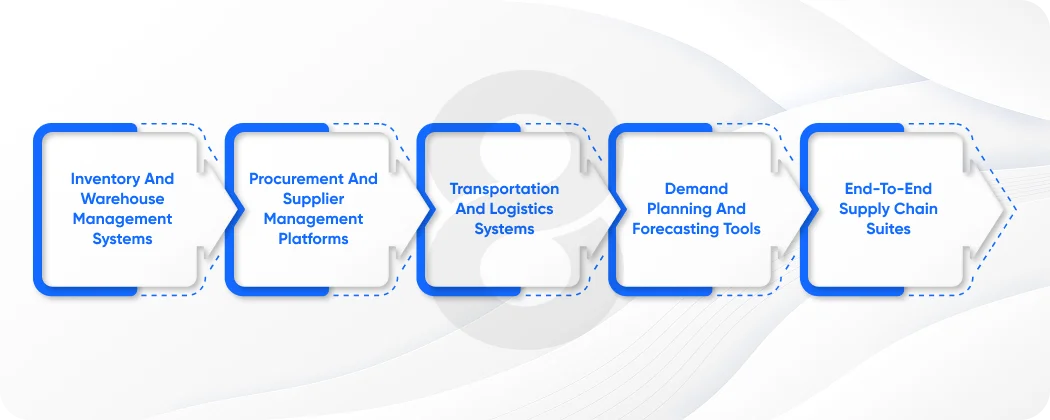
Not every platform is built for the same kind of business environment. That sounds obvious, but businesses ignore it constantly. Some platforms are broad and modular. Some are deeply specialized and are ERP-connected. Most are logistics-heavy. Some are built more around warehouse operations. Others are designed more for procurement or planning visibility. The main categories usually include:
1. Inventory and Warehouse Management Systems
These are strongest for businesses dealing with stock movement, storage accuracy, inventory counts, and fulfillment visibility. Companies with complex warehouse layouts often benefit from custom API development to sync stock data across multiple locations and sales channels in real time.
2. Procurement and Supplier Management Platforms
These are useful when the biggest problem is purchasing, approvals, supplier coordination, and procurement control. Businesses with layered approval chains or multiple vendor tiers often need software integration to connect procurement tools with existing finance and ERP systems.
3. Transportation and Logistics Systems
These are stronger for route visibility, shipment movement, delivery coordination, and logistics optimization. Companies scaling delivery operations across regions frequently pair these platforms with AI integration to power route optimization, delay prediction, and real-time exception alerts.
4. Demand Planning and Forecasting Tools
These are useful for businesses trying to reduce inventory mistakes and improve future planning accuracy. Forecasting accuracy improves significantly when these tools are supported by strong AI predictive analytics, turning historical sales data into more reliable future demand signals.
5. End-to-End Supply Chain Suites
These are broader systems that try to connect multiple operational layers into one ecosystem.
This is also where businesses sometimes realize they do not need one giant monolithic platform. In some cases, the better move is a more focused stack supported by stronger web development decisions and cleaner system architecture.
That depends entirely on operational maturity.
Read More: Pricing Models for Software Services – Fixed vs. Hourly Rates Explained
The Features That Actually Matter Most
A lot of software comparisons get derailed because teams spend too much time looking at features they will never meaningfully use. That is why it helps to focus on what actually creates value.
Here are the features that usually matter most:
- Real-time inventory visibility
- Supplier and vendor tracking
- Purchase order management
- Warehouse coordination
- Shipment and logistics monitoring
- Forecasting and planning support
- Reporting and dashboard clarity
- Role-based access control
- Workflow automation
- Integration with existing systems
The value of a feature does not come from whether it exists. The value comes from whether your team will actually use it consistently without friction.
Because a software product can technically include every capability in the world and still fail if nobody inside the company enjoys working with it.
That is why the best supply chain management software solutions are not just operationally powerful. They are also structurally usable.
Read More: What is a Proof of Concept in Software Development
How to Evaluate Software Fit Properly
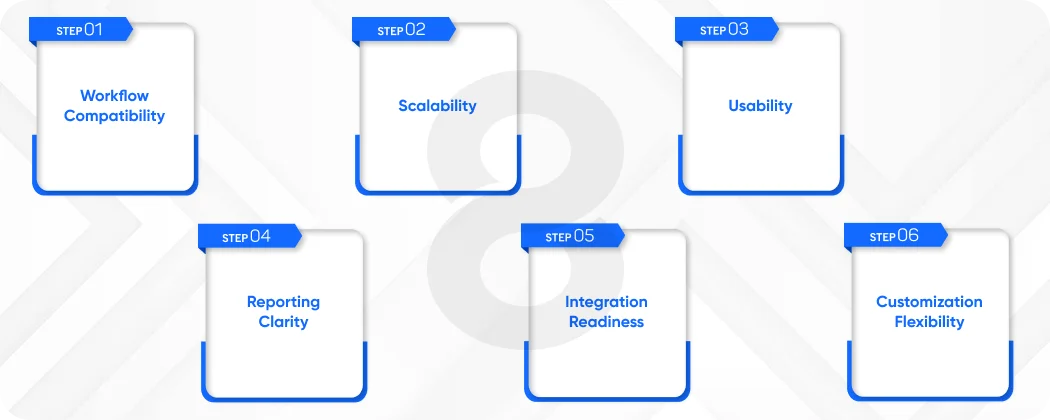
This is where businesses should slow down and get more honest. A platform can look strong on paper and still be a terrible fit for your actual operation. That is why software fit needs to be evaluated across multiple layers, not just one. You should assess every option across these areas:
1. Workflow Compatibility
Can the platform support how your team actually works without needing constant workaround behavior?
2. Scalability
Will it still make sense once order volume, locations, suppliers, or operational complexity increase?
3. Usability
Can non-technical teams use it comfortably without turning every workflow into a training dependency?
4. Reporting Clarity
Does it actually improve decision-making, or just generate more data nobody interprets properly?
5. Integration Readiness
Can it connect with your existing ERP, CRM, warehouse tools, procurement systems, or finance stack?
6. Customization Flexibility
Can it adapt to your process, or does your process have to adapt too aggressively to the platform?
Because sometimes the smartest move is not choosing a fully off-the-shelf tool. Sometimes it means adapting the implementation through stronger software development planning so the platform behaves more like your business actually needs it to.
Read More: How to Hire a Software Development Team: A Step-by-Step Guide
Off-the-Shelf vs Custom-Built: What Makes More Sense?
This is one of the biggest decision points businesses face. And the answer is not always obvious.
Off-the-shelf systems are usually better when:
- Your workflows are relatively standard
- Your timeline is shorter
- Your budget needs more control
- Your team wants faster implementation
- Your reporting and operational needs are not highly unusual
Custom or heavily tailored systems make more sense when:
- Your workflows are highly specific
- You have multi-step internal logic
- Your teams rely on non-standard approvals
- Your integrations are complex
- Your operational structure is too unique for generic tools
This is where supply chain management software solutions stop being just “products” and start becoming infrastructure decisions.
Because once software becomes central to procurement, movement, planning, and visibility, flexibility starts becoming a much bigger deal than people expect.
Why Integration Matters More Than Most Businesses Expect
A supply chain system does not operate in isolation. If the software cannot communicate properly with the rest of your business stack, you are not really solving fragmentation. You are just relocating it. That is why software integration should never be treated like a “nice extra” feature. It should be one of the first things evaluated.
The right system should ideally connect with:
- ERP systems
- Accounting software
- CRM platforms
- Warehouse management tools
- Logistics providers
- Procurement systems
- Inventory databases
- Reporting environments
- Internal admin workflows
This is also where AI integration is becoming more useful in practical ways. For example, stronger AI integration can support:
- Demand forecasting
- Exception alerts
- Supplier performance insights
- Inventory pattern detection
- Predictive reporting
- Workflow prioritization
That is where modern systems start becoming genuinely smarter instead of just more complicated.
Read More: Intellectual Property in Software – How to Protect Your App Idea Before You Build
Do Not Ignore Mobile Access and Team Behavior
This is another thing businesses underestimate until the software is already live. A supply chain system is only useful if the people closest to the operation can actually interact with it efficiently. That includes warehouse teams, managers, supervisors, procurement leads, delivery coordinators, and field-facing operational staff. If access is too desktop-dependent, too clunky, or too delayed, the system starts losing value immediately.
That is why stronger mobile access is becoming much more important in modern supply chain management software solutions. And yes, in some cases, this is exactly where custom mobile app development becomes valuable. Because not every team needs the full system interface, sometimes they just need fast, role-specific access to approvals, inventory checks, shipment updates, or operational alerts.
Questions You Should Ask Every Vendor Before Buying
This part matters a lot because the sales process is where businesses often get overwhelmed by polished language and not enough operational truth.
Ask questions like:
- How long does implementation usually take?
- What kind of businesses is this platform strongest for?
- What workflows usually require customization?
- What integrations are already supported?
- What reporting limitations should we know about?
- How difficult is adoption for non-technical teams?
- What happens if our process evolves after launch?
- What does support actually look like after onboarding?
- How flexible is the permission and access structure?
These questions reveal much more than feature sheets ever will. The goal is not to hear “yes” to everything. The goal is to understand where the system fits naturally and where it starts needing adaptation. That is how smarter software decisions are made.
Read More: How to Hire a Software Engineer – The 2026 Checklist
Common Mistakes Businesses Make When Choosing Supply Chain Software
This is where a lot of expensive regret starts.
The most common mistakes include:
- Choosing based on demos instead of workflows
- Overvaluing feature quantity
- Ignoring internal adoption behavior
- Underestimating implementation complexity
- Skipping integration planning
- Buying for “future possibilities” instead of current realities
- Failing to define success metrics before rollout
- Assuming one tool can fix bad process design
How to Build a Smarter Selection Process Internally
If you want to choose the right platform properly, do not let one department decide in isolation. That usually creates blind spots. The better approach is to evaluate software through the lens of everyone who will actually depend on it.
Your selection process should involve input from:
- Operations
- Procurement
- Warehouse teams
- Finance
- Logistics
- Reporting stakeholders
- IT or technical leadership
- Implementation owners
This does not mean letting 15 people derail the process with opinions. It means getting enough operational visibility to avoid choosing a platform based on one department’s comfort alone. That usually leads to much stronger decisions.
Read More: 15 Top Web App Examples for Startups in 2026 (With Business Models Explained)
What a Good Supply Chain Software Outcome Should Actually Look Like
This is important because many businesses launch a new system without ever defining what success should actually look like.
That is how “successful implementations” become quietly disappointing.
A strong outcome should create improvements like:
- Faster order and inventory visibility
- Fewer manual coordination gaps
- Cleaner procurement workflows
- More reliable reporting
- Lower dependency on spreadsheet workarounds
- Better team alignment
- Stronger forecasting confidence
- Less operational guesswork
That is what the right supply chain management software solutions should help create.
Not just software usage.
Operational clarity.
That is the real win.
Read More: 10 Web Application Frameworks – Selecting the Best Tech for Your ROI
How to Choose a Partner, Not Just a Platform
Sometimes, the real difference does not come from the software itself. It comes from who helps you implement, adapt, and scale it.
That is why businesses should not only think about the platform vendor. They should also think about the technical and strategic partner supporting the rollout.
Because implementation quality often determines whether the software becomes useful or frustrating. A strong technical partner can help with:
- System mapping
- Implementation planning
- Process alignment
- Custom extensions
- Adoption flow
- Integration logic
- Role-based usability
- Internal optimization
That is where operational strategy, product thinking, and delivery discipline become much more valuable than people initially assume.
Build a Smarter Supply Chain Before the Friction Gets More Expensive
If your current process already feels slow, fragmented, or harder to manage than it should, that is usually the signal to stop patching around the problem and start solving it properly. The right software should not just help your team work harder. It should help the business move cleaner, faster, and with less operational drag every single week.
If you are evaluating new systems, now is the right time to choose something that supports the way your business actually works instead of forcing your teams into more avoidable friction.
Read More: Native App vs Progressive Web App (PWA) – A Complete Technical & Strategic Comparison
Conclusion
Choosing the right supply chain platform is not about buying the most impressive product in the market. It is about understanding your operation clearly enough to choose a system that actually reduces friction instead of quietly adding more of it.
Because businesses do not struggle just because they lack software, they struggle because their workflows become harder to manage as complexity increases, visibility gets weaker, and coordination becomes more fragile under pressure.
The right supply chain management software solutions can improve planning, reduce waste, strengthen reporting, support team alignment, and make the entire operational environment feel much more manageable. But only if the platform fits the business properly.