




The financial technology sector has experienced its most disruptive period during the past decade, and 2026 will mark a pivotal moment in its development. Fintech app development cost in 2026 ranges from $30,000 to $300,000+, depending on features, security requirements, development team structure, and region. Today, financial systems rely on AI-powered robo-advisors and blockchain-based payment systems and fintech applications as essential components of their infrastructure. Companies of all sizes, including start-ups and established banks, are in a scramble to develop or modernize their digital financial offers, and the first question that can always arise is, “How much does it cost to develop a fintech app?”
The truth of the matter is that there is no one number. The cost of the fintech app development is influenced by a confusing meshing of factors: what kind of app you are creating, the functionality you would like to add, the security and compliance regulations you need to satisfy, the technology stack you want to use, and the location of your development team. The cost of a simple personal finance tracker is approximately 30,000 dollars, and a multi-currency, AI-based fraud detection, and advanced banking platform can be as expensive as $500,000.
This guide disaggregates all levels of that cost. You may be a founder checking your first fintech idea or a product manager looking to launch a full-scale project; with numbers, tables, and context, this article will provide you with the information necessary to make informed decisions on your budget in 2026.
Key Takeaways
- Fintech app development cost: $30K – $300K+
- Simple MVP: $30K – $80K
- Medium app: $80K – $180K
- Complex app: $180K – $500K+
- Security & compliance add $20K – $60K+
- Backend takes 40–70% of budget
- Team cost (mid-level app): $90K – $200K+
- US teams = highest cost, South Asia = lowest
- Hidden costs (APIs, cloud, legal) are significant
- Maintenance: 15–20% yearly
- MVP approach saves 40–60% cost
- AI & blockchain features increase cost
- Planning phase prevents expensive mistakes
- Fintech market to grow $1T+ by 2030 (~32.8% CAGR)
- Market size: $460B (2026) → $1.76T by 2034
Why Fintech App Development Costs More Than a Standard App
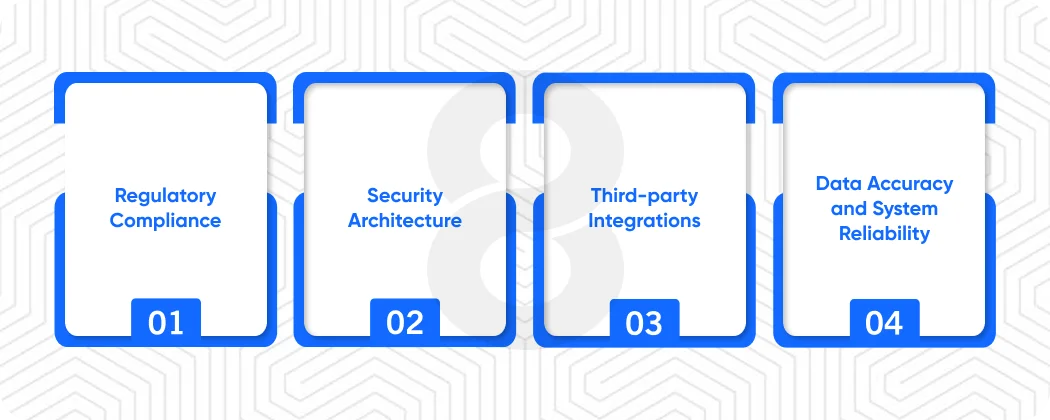
It is necessary to comprehend the reasons why the cost of the fintech app development is structurally greater than the cost of creating a regular consumer-focused app before delving into numbers. An e-commerce application or a social media platform must be operable, quick, and responsive, yet a fintech application must be all that and also be secure on an infrastructure level, meet financial regulations, be connected to banking systems, and can handle high transaction volumes.
Regulatory Compliance
Depending on your target market, your app should meet such frameworks as PCI DSS (Payment Card Industry Data Security Standard), GDPR (when used by European users), KYC (Know Your Customer), AML (Anti-Money-Laundering), and PSD2 (Payment Services Directive 2). To create compliance in your application all the way through, as opposed to gluing it on afterwards, requires specific development time, legal analysis, and external auditing. This alone can add $20,000 to $60,000 to your overall budget.
Security Architecture
One of the most sensitive types of information that a business can deal with is financial information. End-to-end encryption, biometric authentication, the use of secure API gateways, fraud detection systems, and frequent penetration testing are not optional but a minimum requirement. These characteristics demand hundreds of development hours and senior engineers with specialized knowledge.
Third-party Integrations
A fintech app does not often work in isolation. It must be integrated with banking APIs, payment gateways, such as Stripe or Plaid; credit bureaus; identity verification services, in most situations, blockchain networks. Every integration involves the creation of custom applications, error checks and maintenance.
Data Accuracy and System Reliability
In fintech,, it remains much higher in comparison to the other types of apps. Missed order may be a result of a bug in a food delivery app. An error in a payment application can lead to losing money or exposing the information of a user. This puts the quality assurance, testing and infrastructure redundancy a notch higher, which is more expensive in time and money.
Simple fintech apps are generally MVP (minimum viable product) applications that are created to test a concept or provide a small scope of functionality. The first example shows that digital wallets which allow users to keep funds and send money between accounts. The development team works with a small team at this complexity level which includes a project manager and two to three developers and a UI/UX designer and a QA engineer. The project requires three to five months for completion with a budget range of $30,000 to $80,000 based on team location and required features.
Fintech App Development Cost by Complexity Level
The median-complexity fintech apps fall into the sweet spot of most startups and mid-sized financial companies. These apps are not just simple applications; they have features that directly affect the business viability of KYC onboarding processes, card issuance, transaction analytics, and secure multi-factor authentication. Construction on this scale requires a bigger workforce and a greater timeframe, usually between six and nine months and a cost of between $80,000 and $180,000. This is the level at which compliance architecture takes center stage and cost of cutting corners comes into real sense.
Complexity Level |
Key Features Included |
Development Time |
Average Cost (2026) |
| Simple | Account balance, basic transfers, user profile, push notifications | 1,000 – 1,500 hours | $30,000 – $80,000 |
| Medium | Payments, KYC/AML, card management, analytics dashboard, multi-factor authentication | 2,000 – 3,000 hours | $80,000 – $180,000 |
| Complex | AI/ML fraud detection, investment portfolios, multi-currency, blockchain integration, robo-advisory | 3,500 – 6,000+ hours | $180,000 – $500,000+ |
Complex fintech applications are enterprise-level products that integrate more sophisticated technologies, such as artificial intelligence, machine learning, blockchain, and real-time financial data feeds. Consider apps such as Revolut, Robinhood, or a bespoke neobank designed by a big financial institution. These undertakings need cross-functional teams between 10 and 20+ experts and a timeframe of 12 to 24 months, and the development expense may be up to $180,000 to way over $500,000. The size of the market opportunity and the complexity of the product under construction justify the investment.
Read More: How to Build an App That Makes Money in 2026
Cost of App Development by Type of Apps
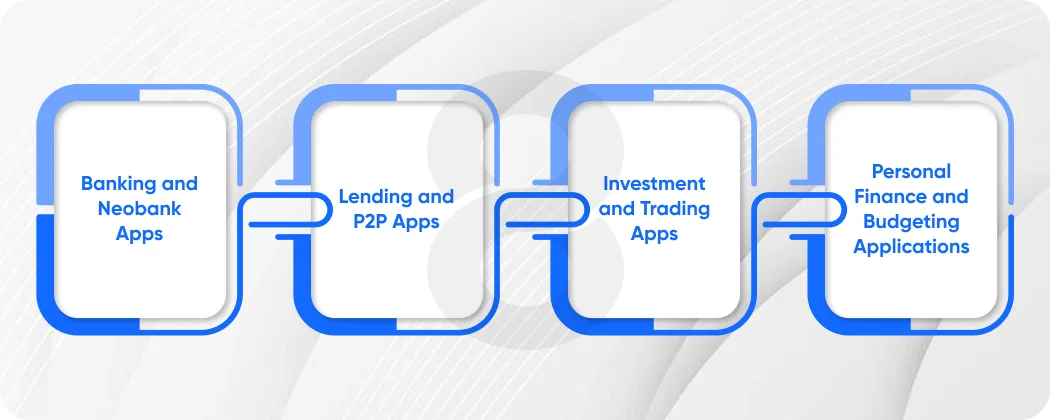
The type of application is another important aspect of knowing how much it will cost to create a fintech app. The feature needs, regulatory needs, and integration needs of different fintech verticals differ and are all factored in the final price.
App Type |
Core Features |
Development Hours (MVP) |
Average Cost Range |
| Banking / Neobank App | Accounts, transfers, card management, KYC, admin panel | 3,000 – 4,000 hours | $120,000 – $300,000 |
| Lending / P2P App | Loan application, credit scoring, repayments, KYC, admin | 2,000 – 2,800 hours | $90,000 – $160,000 |
| Investment / Trading App | Portfolio management, order management, analytics, KYC | 2,200 – 3,000 hours | $100,000 – $200,000 |
| Insurance App | Policy management, claims, quotes, payments, admin panel | 2,500 – 3,200 hours | $110,000 – $180,000 |
| Personal Finance / Budgeting App | Expense tracking, account aggregation, goals, analytics | 1,500 – 2,200 hours | $60,000 – $130,000 |
| Payments / Money Transfer App | Transfers, multi-currency, FX rates, notifications | 1,800 – 2,500 hours | $70,000 – $150,000 |
| Cryptocurrency / Blockchain App | Wallet, trading, blockchain integration, compliance | 3,000 – 4,500 hours | $130,000 – $280,000 |
| Robo-Advisory App | AI recommendations, portfolio automation, analytics | 2,800 – 4,000 hours | $120,000 – $250,000 |
Banking and Neobank Apps
Lending and P2P Apps
P2P lenders and consumer loan apps are cost-driven by a particular set of technical requirements. The main problem is to create an engine of credit scoring capable of estimating the risk of a borrower in the shortest possible time and without errors, very often based on AI and machine learning models trained on the information about the financial behavior. In addition to the scoring, these applications require smooth KYC and identity verification experiences, loan disbursement systems that are tied to payment rails, repayment schedules with automatic reminders, and an administrator dashboard with risk dashboards. The lending regulation is the most stringent, and most markets demand certain lending licenses and severe disclosure regulations. The minimum cost to develop a lending app MVP is between $90,000 and $160,000 on average.
Investment and Trading Apps
Investment applications are used by individuals who desire to purchase, sell and manage their financial resources e.g. stocks, ETFs, mutual funds, and bonds. The technical difficulty is in real-time data feeds of stock markets, order management systems capable of processing thousands of concurrent transactions, visualization of portfolio dashboards, and tax-reporting functionality. The most important is security since any breach of a trading platform can result in great loss to the users. Social trading-enabled and copy trading platforms provide additional complexity in engineering. Expect to invest between $100,000 and $200,000 for a solid investment app MVP in 2026.
Personal Finance and Budgeting Applications
The most affordable entry point to the development of fintech is generally personal finance apps, which nonetheless have significant technical needs. Account aggregation is the most common feature of the majority of budgeting apps: the possibility to tie to an existing bank. credit card, and investment accounts via APIs such as Plaid or Open Banking and automatically retrieve transaction data. Based on it, the app classifies expenditures, follows budgets, establishes savings plans, and offers financial insights. The engineering of these data pipelines should be done with due care in the background to ensure reliability and security. An MVP of a well-built personal finance app can be in the range of $60,000 to $130,000.
Read More: Best Cash Advance Apps – Build Your Own Fintech App
Feature-by-Feature Cost Breakdown
The most detailed perspective of where your budget is actually spent is to understand the cost to build a fintech app at the feature level. The features are broken down and their average development costs in 2026 are calculated at an average blended rate of 60-80/hour as shown below:
Feature |
Development Hours |
Estimated Cost |
| User Registration & Login | 80 – 120 hours | $4,800 – $9,600 |
| KYC / Identity Verification | 120 – 180 hours | $7,200 – $14,400 |
| Two-Factor Authentication (2FA) | 60 – 80 hours | $3,600 – $6,400 |
| Biometric Login (Face ID / Touch ID) | 80 – 120 hours | $4,800 – $9,600 |
| Dashboard & Account Overview | 100 – 150 hours | $6,000 – $12,000 |
| Bank Transfer / P2P Payments | 120 – 180 hours | $7,200 – $14,400 |
| Payment Gateway Integration | 100 – 160 hours | $6,000 – $12,800 |
| Card Management (Virtual / Physical) | 80 – 120 hours | $4,800 – $9,600 |
| Transaction History & Search | 60 – 100 hours | $3,600 – $8,000 |
| Push Notifications | 40 – 60 hours | $2,400 – $4,800 |
| Spending Analytics & Reports | 120 – 160 hours | $7,200 – $12,800 |
| AI-Based Fraud Detection | 200 – 320 hours | $12,000 – $25,600 |
| Credit Scoring Engine | 180 – 260 hours | $10,800 – $20,800 |
| Blockchain / Crypto Wallet | 250 – 400 hours | $15,000 – $32,000 |
| Multi-Currency Support | 100 – 150 hours | $6,000 – $12,000 |
| Admin Panel & CMS | 250 – 400 hours | $15,000 – $32,000 |
| Customer Support / Chat | 80 – 120 hours | $4,800 – $9,600 |
| Regulatory Compliance Module | 160 – 240 hours | $9,600 – $19,200 |
All these features are associated with their own backend logic, API integrations, database design, and testing requirements. To illustrate, KYC integration is not a form but the process of connecting to third-party identity verification providers such as Jumio, Onfido, or Persona; document scanning, liveness detection; watchlist screening; and fallback flows to failed verifications. On the same note, AI-powered fraud detection involves training models based on past transaction data, developing real-time scoring pipelines, and alerting systems on suspicious activity, which require senior engineering talent and significant time to develop.
The global fintech market is forecasted to grow by USD 1.02 trillion during 2025-2030, accelerating at a CAGR of 32.8% during the forecast period. The report on the global fintech market provides a holistic analysis, market size and forecast, trends, growth drivers, and challenges, as well as vendor analysis covering around 25 vendors.
Cost by Development Team Structure
The cost of the development of your fintech application is largely influenced by how your development team is organized. An average fintech project involves a cross-functional team and the roles are well-defined, and the team size depends on the complexity of the project.
Role |
Hourly Rate (CEE) |
Hourly Rate (US/UK) |
Typical Hours on Medium Project |
| Project Manager | $40 – $60 | $90 – $130 | 300 – 500 hours |
| Solution Architect | $70 – $90 | $130 – $180 | 150 – 250 hours |
| UI/UX Designer | $40 – $60 | $80 – $130 | 250 – 400 hours |
| Frontend Developer | $50 – $75 | $100 – $160 | 600 – 900 hours |
| Backend Developer | $55 – $80 | $110 – $170 | 700 – 1,000 hours |
| Mobile Developer (iOS/Android) | $55 – $80 | $110 – $170 | 600 – 900 hours |
| QA Engineer | $35 – $55 | $70 – $110 | 300 – 500 hours |
| DevOps Engineer | $55 – $75 | $100 – $160 | 150 – 250 hours |
| Security Specialist | $65 – $90 | $130 – $200 | 100 – 200 hours |
In the case of a medium-complexity fintech app, you can expect a team of six to ten experts to work within six to nine months. Such a team project may cost the organization between $90,000 and $200,000+ as a total cost of the team, based on the hourly rate of the team members and the number of hours spent on the project.
It is also significant to note that the various engagement models have various cost structures. By contracting an agency to provide a full development team, you have access to a complete pool of vetted professionals in the fintech industry, but usually at a higher price than staff augmentation or freelancers. Conversely, handling a team of freelancers is less expensive on paper but adds coordination overhead and risk to a project, which is especially problematic in a compliance-intensive industry such as fintech.
Fintech App Development Cost per Region
The geographical location of your development team is one of the strongest levers that you can exert on the cost of developing the app in fintech. The hourly rates of developers in some parts of the world are astronomical, and by selecting the appropriate outsourcing location, you can save up to 40-60% of the overall project price without necessarily sacrificing quality.
Region |
Average Developer Hourly Rate |
Estimated Cost – Medium App |
Notes |
| United States | $120 – $200/hr | $240,000 – $500,000+ | Highest rates, best for regulated markets needing local presence |
| Western Europe (UK, Germany) | $90 – $150/hr | $180,000 – $375,000+ | High quality, strong compliance expertise |
| Central & Eastern Europe (Poland, Ukraine, Romania) | $50 – $85/hr | $100,000 – $212,000 | Best balance of quality, cost, and timezone overlap |
| Latin America (Brazil, Colombia, Argentina) | $40 – $70/hr | $80,000 – $175,000 | Good quality, similar timezone to US clients |
| South Asia (India, Pakistan) | $25 – $50/hr | $50,000 – $125,000 | Lowest cost, large talent pool, timezone gap with Western clients |
| Southeast Asia (Vietnam, Philippines) | $30 – $55/hr | $60,000 – $137,000 | Growing talent pool, competitive rates |
| Africa (Nigeria, South Africa, Kenya) | $25 – $45/hr | $50,000 – $112,000 | Emerging tech hubs, growing fintech expertise |
Central and Eastern Europe (CEE)
They are now one of the most sought-after outsourcing locations to develop fintech in particular due to its attractive blend of technical chops, extensive experience with financial regulations such as GDPR and PSD2, and lower hourly rates (40-60) than the same talent would in the US or UK. Software engineering ecosystems in countries such as Poland, Romania, and Estonia are mature and have a robust pipeline of developers with fintech-specific experience.
South Asia
In South Asian nations such as India and Pakistan, the lowest hourly rates in the world are found, and there is truly outstanding engineering talent in these markets. The key factors are timezone management with Western clients and the significance of carefully picking and choosing agencies that have fintech-specific compliance expertise, as not every development shop has the experience to create regulated financial software.
Read More: Top Banking Software Solutions to Modernize Your Financial Services
Development Stage-by-Stage Cost Breakdown
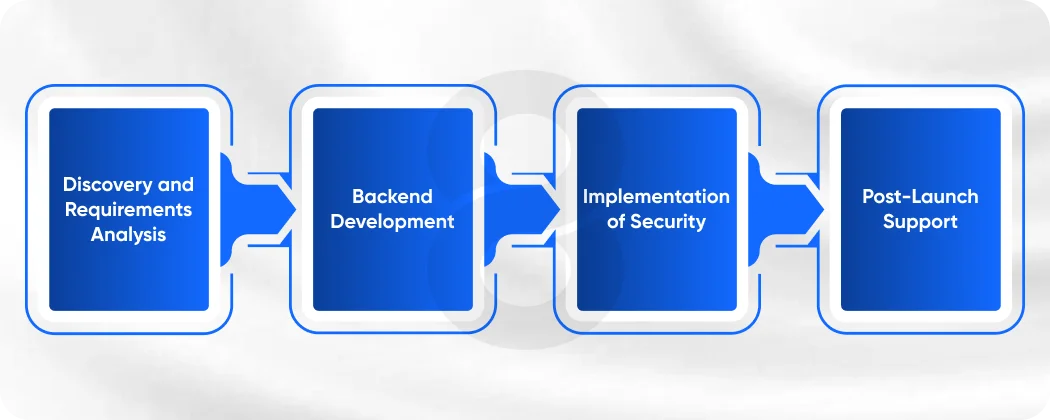
This is because by knowing the allocation cost of fintech app development at the various project stages, you are able to budget more accurately and make decisions regarding the areas in the project that you are going to invest more in and the areas that you are going to be more conservative with.
Discovery and Requirements Analysis
At this step, business analysts and solution architects collaborate with you to capture all functional and non-functional requirements, user journeys, third-party integrations, the technology stack, and a project roadmap. One of the most frequent and expensive errors in fintech development is skipping this step or hurrying through it, and the difference between changes during discovery and development costs a fraction of the development costs. Allocate between $8,000 and $20,000 in a comprehensive discovery phase.
Backend Development
The part of fintech development that is the most costly, and in many cases demands 40-70 percent of the overall development budget, is backend development. The reason is that the backend deals with all the functionality that a fintech app is actually doing, such as processing transactions, storing data, creating APIs to banking systems, compliance logic, fraud detection, and so on. Separating a fintech app that can serve 10 users to one with 10 million users is a scalable, secure, and well-architected backend. The cost of the backend development of a medium-complexity app is usually between 35,000 and 120,000.
Implementation of Security
It is not a one-time exercise but a process that is ongoing throughout the whole lifecycle of development. This involves the establishment of encrypted data storage at the very beginning, the application of secure code conventions, frequent review of the code to identify vulnerabilities, and penetration testing before launch. Security work generally costs between $15,000 to $60,000, based on the sensitivity of the data being processed and the regulatory nature of the environment in which the app will be used.
Post-Launch Support
A cost that most founders underestimate in computing the cost to develop a fintech app is post-launch maintenance. Once deployed, you must continue updating your app to resolve security vulnerabilities, respond to regulatory changes, resolve bugs raised by users, and expand infrastructure as your user base expands. Maintenance and support costs of a typical fintech app are between 5,000 and 20,000 a month, or about 15-20 percent of the initial development cost annually.
Read More: 15 Money Apps Like Dave That Generate Millions of Dollars
Hidden Costs That Impact Your Fintech Budget
In addition to the essential development expenses, other costs can easily surprise fintech founders. Knowing these ahead of time will enable you to create a more realistic budget and eliminate unpleasant surprises during the project.
Hidden Cost Category |
Estimated Annual Cost |
Notes |
| Cloud Infrastructure (AWS / Azure / GCP) | $12,000 – $60,000/year | Scales with user volume and data storage |
| Third-Party API Licenses | $6,000 – $36,000/year | KYC, payment gateways, data feeds |
| Security Audits & Penetration Testing | $10,000 – $30,000/year | Required for PCI DSS compliance |
| Legal & Compliance Consulting | $15,000 – $50,000/year | Varies significantly by market |
| App Store Fees | $99 – $299/year | Apple and Google developer accounts |
| SSL Certificates & Domain | $500 – $2,000/year | Depends on certificate tier |
| Customer Support Tools | $3,000 – $15,000/year | Intercom, Zendesk, etc. |
One of the least considered continuing fintech application costs is cloud infrastructure. Financial applications produce huge volumes of data and must be available most of the time, commonly 99.99% uptime, so you must have redundant server configurations, automatic detection and recovery, and planned data backups. Your cloud costs increase as your user base increases. A start-up of 10,000 users is likely to incur a cost of 1,000 per month on cloud infrastructure, but a platform with 500,000 active users may easily spend 15,000-30,000 a month.
The third-party API charges are also refunded within a short period. KYC verification services are usually per-user verified. Onfido and Jumio, among others, cost between 1 and 5 dollars per user verification. Assuming that you have 50,000 users onboard in your first year, then that is a KYC bill of 50,000-250,000, without even having a single transaction. Likewise, payment gateway vendors impose transaction fees, such as Stripe, which charges 2.9% plus $0.30 per transaction, which may be a major operating expense at a small scale but a big one at a larger scale.
Read More: How to Hire Fintech Developers in USA
How to Reduce Fintech App Development Cost Without Cutting Corners
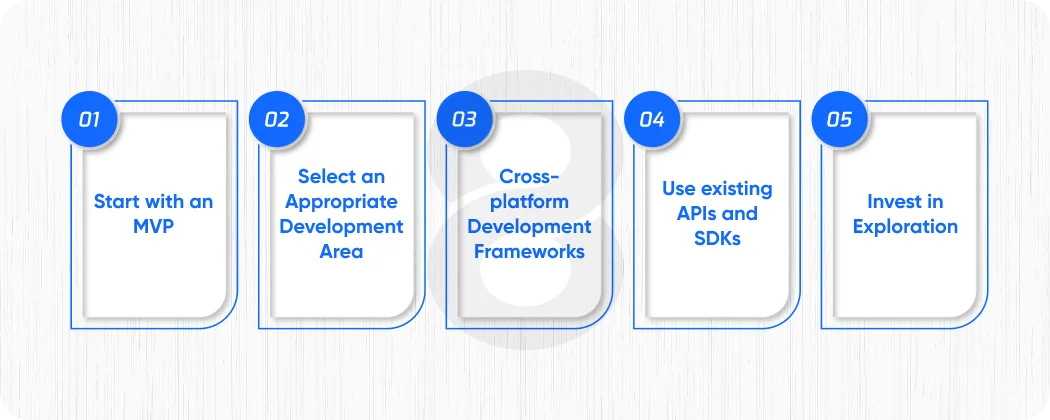
It does not necessarily mean compromising on the quality or compliance to reduce your fintech app development cost. You can use a number of strategic options to maximize your budget and still create a product that is secure, scalable, and market-ready.
Start with an MVP
Instead of creating all of the features that you had planned in the beginning, release a narrowly scoped MVP that contains only those features that are necessary to the core value proposition. This method will allow you to test your product on actual users, get feedback, and focus the second round of development on real data and not guesses. MVP strategy usually saves the
The initial cost of development is 40-60, compared to a full-feature build.
Select an Appropriate Development Area
As the table of regional costs above demonstrates, you can save 40-60% of the labor costs in a US-based agency and relocate it to a high-quality CEE team without any significant quality compromises. The trick here is to do due diligence: seek out agencies that have a record of successful fintech projects, are ISO certified, and have good recommendations by former customers.
Cross-platform Development Frameworks
Developing native apps on iOS and Android will cost you twice to build. Flutter and React Native frameworks enable you to have a single codebase across both platforms, which makes mobile development 30-50 percent cheaper and time-to-market much shorter. In the case of most fintech MVPs, cross-platform development is all that is needed.
Use existing APIs and SDKs
Instead of writing everything in-house, adopt third-party APIs that are tested by battle and that handle common fintech capabilities. Plaid takes care of aggregating bank accounts. Stripe is used to process payments. Onfido is used to authenticate identities. With these APIs, you can have a highly reliable, compliant, and well-documented functionality at the cost and risk of developing it.
Invest in Exploration
Investing between $10,000 and $20,000 in a detailed discovery and planning phase before writing a single line of code is one of the best ROI choices that you can make. An adequately documented project specification helps minimize scope creep, avoid costly architecture changes halfway through development, and provide a roadmap that your development team can easily follow to complete its tasks.
Read More: Average Timeline and Budget for a FinTech App with Real-Time AI Fraud Detection
Total Cost Summary: What to Expect in 2026
To bring everything together, here is a comprehensive summary of what different types of fintech businesses can expect to spend on app development in 2026.
Business Type |
App Complexity |
Team Location |
Estimated Total Cost |
Timeline |
| Early-stage startup | Simple MVP | South Asia / CEE | $30,000 – $80,000 | 3 – 5 months |
| Growth-stage startup | Medium complexity | CEE / Latin America | $80,000 – $180,000 | 6 – 9 months |
| Established fintech | Complex product | CEE / Western Europe | $180,000 – $350,000 | 10 – 16 months |
| Enterprise / Bank | Full-scale platform | US / Western Europe | $350,000 – $600,000+ | 14 – 24 months |
The total project expenses encompass all costs associated with design work and development work, quality assurance testing and security system deployment, and initial system launch. The costs do not cover ongoing system upkeep, cloud service expenses, third-party API charges, legal expenses, or compliance costs, which require separate budget allocation according to the previous sections of this guide.
The global fintech market was valued at USD 394.88 billion in 2025 and is projected to be worth USD 460.76 billion in 2026 and reach USD 1,760.18 billion by 2034, exhibiting a CAGR of 18.20% during the forecast period. North America dominated the global market with a share of 32.30% in 2025.
From Budget to Breakthrough: Making Your Fintech Vision a Reality
The fintech app development cost in 2026 spans a remarkably wide range, from $30,000 for a simple MVP to $600,000 or more for an enterprise-grade financial platform. The range exists because fintech does not function as a single unified category. The industry includes multiple product categories, which demand distinct feature sets and regulatory requirements and technical development challenges.
The most important takeaway from this guide is that understanding what drives cost is more valuable than knowing the average. You gain decision-making power when you know that security testing costs between $15000 to $60000 and AI fraud detection needs 200 to 320 development hours and US teams save 40 to 60 percent by moving to CEE and skipping the discovery phase, which shows businesses their most expensive error.
The businesses that build successful fintech products in 2026 are the ones that plan carefully, partner with experienced teams, invest in compliance and security from day one, and take an MVP-first approach to managing development cost while moving fast enough to stay competitive. Through strategic planning and effective partnership, organizations can develop a top-notch fintech application that meets financial requirements.