


Hiring an app development agency feels easy until you actually try to pick one properly. At the start, everything looks fine. Every agency says the same things. Scalable apps, clean UX, modern tech, strong teams. You go through a few websites, maybe hop on a couple of calls, and it starts to feel like you can just pick one and move on.
That’s usually where people mess up. Because the real difference doesn’t show in the pitch. It shows later, when things are not as clean anymore and decisions actually matter. And by then, you’re already committed.
If you’re hiring an app development agency, you’re not just picking someone to build something. You’re picking how your product is going to behave when real users start using it, when things break a little, and when plans change. That part is where most people underestimate the impact.
IT services outsourcing market was valued at $285.1 billion in 2025 and is projected to reach $626.7 billion by 2035, growing at a CAGR of 8.2% during the forecast period (2026-2035).
Key Takeaways
- Hiring an app development agency is a long-term product decision, not a short-term execution task
- The real risks don’t appear during sales; they show up during development and scaling
- Agencies that prioritize understanding over speed consistently deliver better products
- A flexible, product-driven process always outperforms a rigid, templated approach
- Post-launch readiness is what separates scalable apps from fragile ones
- Consistent communication is critical to maintaining speed, clarity, and execution quality
- A strong portfolio should reflect problem-solving depth, not just visual design quality
- Early-stage misalignment leads to higher costs, delays, and technical debt later
- The fastest-growing companies choose agencies based on expertise and long-term value, not just cost
- The right agency acts as a strategic product partner, not just a development vendor
Why This Decision Ends Up Affecting More Than You Think
This isn’t just about launching an app and moving on. The agency you pick affects how easy it is to update things later, how well your product handles growth, and how cleanly it connects with everything else you’re running. That gets even more important when your product ties into software development work that needs to stay aligned. A bad agency doesn’t always crash your project.
They just make things slower, messier, and harder to manage over time. You start noticing small issues first, then those turn into bigger ones that take more effort to fix than they should. That’s why hiring an app development agency is not something you treat casually.
The 5 Red Flags That Actually Matter
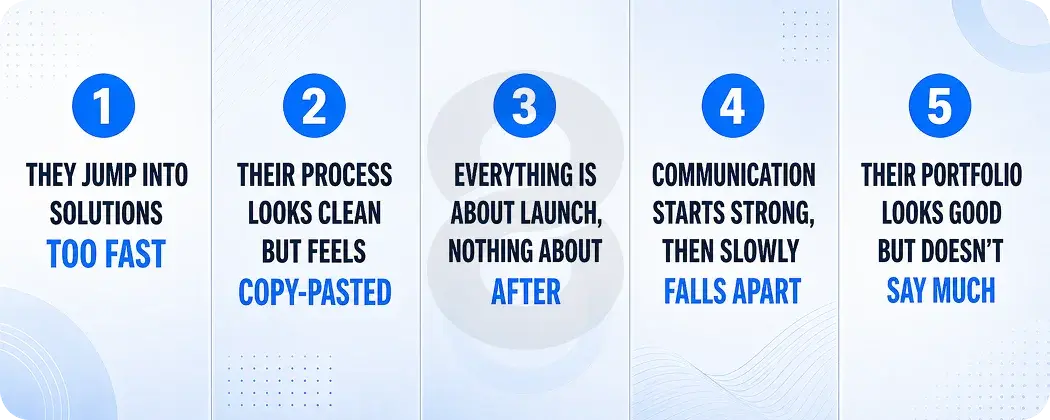
1. They Jump Into Solutions Too Fast
This one tricks a lot of people. You explain your idea, and they immediately start talking about features, timelines, and how they’d build it. It feels efficient. It feels like they know what they’re doing. But most of the time, it just means they didn’t really understand what you said.
Because if someone hasn’t taken the time to break down your product, your users, and your actual problem, then whatever they’re suggesting is just based on assumptions. And assumptions turn into problems later.
When you’re hiring a mobile app development agency, you want them to slow down early. You want them asking questions that feel a bit uncomfortable sometimes. You want them digging into things instead of rushing forward.
If they skip that part, you’ll feel it later when the product doesn’t behave the way you expected.
2. Their Process Looks Clean but Feels Copy-Pasted
Every agency has a process. That’s normal. The issue is when it feels like the same process is used for everything.
Some products need flexibility. Some need structure. Something tied to mobile app development moves differently compared to something heavy in enterprise app development. If an agency treats both the same way, things start getting awkward as the project moves forward. At first, you won’t notice it.
Then suddenly timelines feel off, decisions feel rushed, and the product doesn’t quite fit together the way it should. A good process adapts. A bad one stays fixed and expects you to adjust.
3. Everything Is About Launch, Nothing About After
This is a big one. A lot of agencies focus heavily on getting to launch. Timelines, milestones, and delivery. Everything sounds structured. But launch is not the hard part. What happens after launch is where things actually matter.
Users behave differently than expected. Some features don’t land properly. Performance issues show up. New requirements come in. If the system wasn’t built with that in mind, it starts feeling fragile. This gets even more important when your product involves AI integration, because those systems need to evolve, not just exist. If an agency doesn’t talk about what happens after launch, they’re only thinking halfway.
4. Communication Starts Strong, Then Slowly Falls Apart
At the beginning, communication is always great. Fast replies, clear answers, everything feels smooth. Then the project starts, and things shift.
Replies take longer. Updates get vague. You start following up more than you should. It becomes slightly harder to know what’s going on. That’s where things start slipping.
Because projects involving development rely heavily on clear communication. Once that weakens, mistakes increase, and fixing them later always costs more time. You don’t notice it all at once. It just slowly becomes annoying, then stressful.
5. Their Portfolio Looks Good but Doesn’t Say Much
Nice visuals don’t mean much on their own. Clean UI, smooth animations, modern layouts. That’s easy to show. What matters is what actually happened behind those projects.
A solid agency should be able to explain what went wrong, what they had to fix, what changed after launch, and how the product performed with real users. If they can’t explain that clearly, you’re just seeing the polished version. And that’s not enough to make a decision.
The global mobile apps development outsourcing solutions market is valued at USD 1.37 Billion in 2026 and steadily progressing to USD 3.5 Billion by 2035 with a CAGR of 11% from 2026 to 2035.
Read More: Hire Mobile App Developers: Expert Guide
Quick Reality Check
| Area | What You Want | What Usually Happens |
| Thinking | They understand first | They assume and move fast |
| Process | Adjusts to your product | Same flow every time |
| Scalability | Planned early | Ignored until later |
| Communication | Stays consistent | Drops after kickoff |
| Portfolio | Shows real depth | Looks nice only |
What Better Agencies Actually Feel Like
They’re not dramatically different at first. They just feel more thoughtful.
They don’t rush. They question things. They explain trade-offs instead of pretending everything is simple. They think about what happens when things go wrong, not just when everything works. They’re not trying to impress you. Because once things get complex, weak decisions don’t stay hidden.
If It Feels Off Early, Don’t Ignore It
Most people ignore early signs because nothing has gone wrong yet. That’s the mistake. If something feels rushed, unclear, or slightly off during early conversations, it usually doesn’t get better later. It gets worse. Once development starts, changing direction becomes harder, slower, and more expensive. The right agency makes things clearer as you move forward. The wrong one makes everything feel heavier than it should be.
Final Thoughts
There are a lot of agencies that can build apps. That part isn’t rare anymore. The real difference is finding one that understands what you’re building, how it should behave, and what happens once real users get involved. Hiring an app development agency is not just about getting something done. It’s about how that thing actually works in the real world. And that’s where most of the value sits.