


Most businesses think they are making smart decisions when they focus on reducing upfront costs. On paper, it looks logical. Lower budget, faster delivery, fewer resources. But once the product goes live and real usage starts putting pressure on the system, that decision often starts to fall apart quietly.
Because the real cost of an app is not what you spend building it. The real cost is what it takes to keep it working, scaling, and actually useful over time. That is where app development ROI becomes the conversation that actually matters. And that is also where most businesses realize they were optimizing the wrong thing from the beginning.
Why Most ROI Calculations Are Wrong From Day One
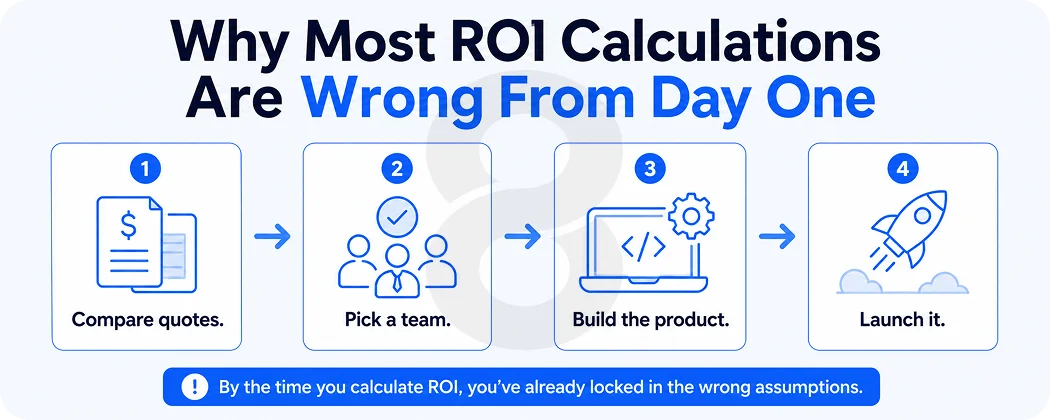
The typical approach to evaluating app development looks something like this.
- Compare quotes.
- Pick a team.
- Build the product.
- Launch it.
That is where most thinking stops. But what gets ignored are the parts that actually determine app development ROI in the long run. Things like system performance under real usage, how easily the product can scale, how expensive it becomes to maintain, and whether users actually want to keep using it.
At this stage, strong software development decisions early on usually determine whether the system becomes an asset or a long-term cost center.
The Hidden Cost Structure Nobody Talks About
Cheap development rarely stays cheap. It just delays where you pay the price.
Here is how those costs usually show up later:
- Systems that require constant bug fixes
- Performance issues when user load increases
- Expensive rework when scaling becomes necessary
- Poor integrations that slow down operations
All of these directly reduce app development ROI, even if the initial build looked cost-efficient. Because fixing problems later is always more expensive than preventing them early.
Read More: How 8ration Cut App Load Time by 60% Without Rewriting Core Logic
Where Professional Development Actually Changes the Equation
A professional development service does not just build what you ask for. It builds what your system actually needs to survive real-world usage.
That includes:
- Scalable architecture that grows with your business
- Clean and maintainable code that reduces future costs
- Proper system integration from the beginning
- Thoughtful product structure that supports long-term usage
This is where app development ROI starts improving instead of declining.
That mindset is what separates short-term delivery from long-term value.
Read More: 5 Red Flags to Watch for When Hiring an App Development Agency
Why Scalability Is Not Optional Anymore
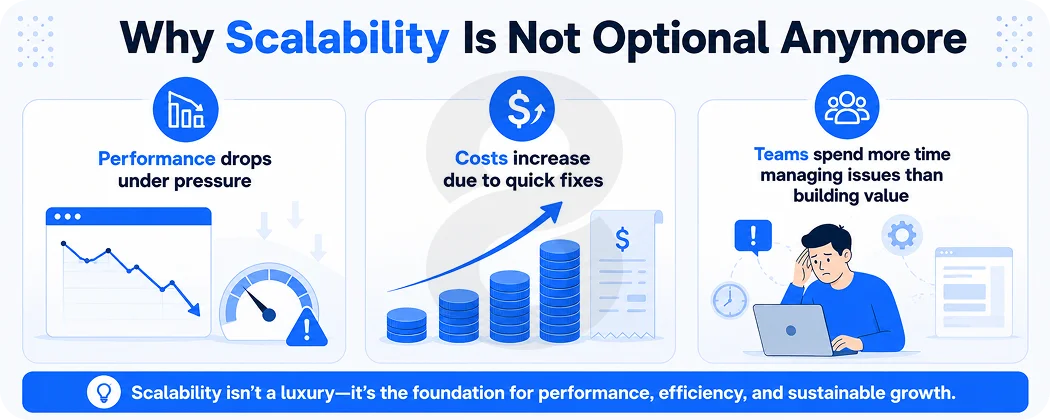
Every business wants growth. But very few systems are built to handle it properly.
When scalability is ignored:
- Performance drops under pressure
- Costs increase due to quick fixes
- Teams spend more time managing issues than building value
This is why enterprise app development plays a critical role in serious applications, because systems need to support expansion without constant rebuilding. A strong app development ROI depends heavily on whether your system can grow without breaking.
The Role of AI in Reducing Long-Term Costs
AI is often misunderstood as something complex or unnecessary. But when implemented correctly, it becomes one of the most effective ways to improve efficiency and reduce operational overhead.
With proper AI development, businesses can:
- Automate repetitive processes
- Reduce manual errors
- Improve decision-making speed
And through structured AI integration, these improvements happen without disrupting existing workflows. This directly contributes to stronger app development ROI by lowering ongoing operational costs.
Why User Experience Has a Direct Financial Impact
A system that is difficult to use becomes expensive very quickly. Not because of development cost, but because of lost efficiency.
If users struggle:
- Productivity drops
- Errors increase
- Adoption decreases
This is especially important in mobile app development, where usability directly affects engagement and retention.
Short-Term Savings vs Long-Term ROI
Factor |
Short-Term Focus |
Long-Term ROI Focus |
| Cost | Lower upfront | Optimized over time |
| Performance | Often unstable | Reliable under pressure |
| Scalability | Limited | Built for growth |
| Maintenance | Expensive later | Controlled and predictable |
| User Experience | Often ignored | Prioritized |
Integration: The Silent Factor That Impacts Everything
Most systems do not fail because they lack features. They fail because they do not connect properly.
Disconnected tools create:
- Manual workflows
- Delayed processes
- Data inconsistencies
A professional development approach ensures proper system connectivity, which significantly improves app development ROI. This becomes even more critical when dealing with larger ecosystems involving enterprise app development and multiple platforms.
Why Cross-Platform Strategy Matters More Than Before
Users no longer operate in one environment. They move between devices, platforms, and systems constantly. A strong mobile app development strategy ensures accessibility and flexibility, while solid backend software development keeps everything consistent across platforms.
That consistency directly impacts adoption, efficiency, and ultimately ROI.
Read More: 20 Popular Software Development Life Cycle Models You Should Know
Where ROI Actually Comes From
Area |
Impact on ROI |
Explanation |
| Performance | High | Reduces downtime and errors |
| UX | High | Improves user adoption |
| Scalability | Critical | Supports long-term growth |
| Automation | Medium to High | Reduces manual work |
| Integration | High | Improves operational efficiency |
If Your App Feels Expensive to Maintain, It Probably Is
If your system constantly needs fixes, struggles under load, or feels harder to manage over time, then the issue is not just technical. It is structural. A weak system increases costs gradually. A strong system reduces them.
Improving app development ROI is not about finding the cheapest option. It is about building something that continues delivering value without increasing complexity. That is where professional development becomes less of an expense and more of a long-term investment.
The Long-Term Thinking Most Businesses Skip
Apps are not static products. They evolve with the business. They need updates, integrations, and improvements over time. If the foundation is weak, every change becomes expensive. If the foundation is strong, growth becomes easier. That is why focusing on app development ROI from the beginning changes everything.
Final Thoughts
The difference between a cost-effective app and an expensive one is not the initial price. It is how the system performs over time. Businesses that focus only on saving money at the start usually end up spending more later. Businesses that focus on ROI build systems that keep delivering value long after launch. And that is what actually matters.