




Customer communication becomes inconsistent. Operational visibility slowly starts disappearing underneath disconnected tools and rushed processes. Then eventually, the business reaches a point where growth itself starts creating operational pressure instead of progress.
That is exactly why modern b2b software solutions became far more important in 2026 than they were even a few years ago. Because small businesses now operate inside environments where speed, efficiency, and system clarity directly affect competitiveness daily. And honestly, the businesses scaling successfully right now are usually not working harder than everyone else. Their systems are simply working better underneath the surface.
At 8ration, business-focused platforms are usually designed around operational simplicity first because complexity quietly slows growth much faster than most companies initially realize.
Why Small Businesses Are Investing More Into Software Systems Now
This shift is happening everywhere now. Earlier, many small businesses could survive using fragmented tools because operational pressure stayed manageable. That is no longer true.
Customers now expect:
- Faster responses
- Better communication
- Seamless digital experiences
- Real-time updates
- Consistent service quality
At the same time, businesses themselves are managing:
- Remote operations
- Growing customer data
- Multi-platform workflows
- Increasing operational complexity
That combination makes disconnected systems much more expensive operationally. This is exactly where stronger b2b software solutions start creating real value because the goal is no longer simply digitizing operations. The goal is creating operational consistency across the business.
Read More: Top 10 eCommerce Solution Providers for the B2B Industry
The Biggest Problem Is Usually Workflow Fragmentation
A lot of companies think they need more software. Usually, they need fewer disconnected systems instead.
This is where things quietly become inefficient:
- Sales uses one platform
- Marketing uses another
- Customer support tracks data separately
- Finance exports spreadsheets manually
- Teams constantly update information twice
That creates operational friction everywhere. And honestly, most businesses underestimate how much time gets wasted there every week. That is why a stronger software development strategy matters now because modern systems need to communicate naturally instead of functioning like isolated tools.
Disconnected Operations vs Connected Business Systems
Area |
Disconnected Systems |
Connected B2B Systems |
| Team Coordination | Manual communication required | Automated synchronization |
| Reporting | Delayed visibility | Real-time insights |
| Productivity | Repetitive tasks everywhere | Streamlined workflows |
| Scalability | Operational bottlenecks increase | Easier growth support |
| Customer Experience | Inconsistent interactions | Better service continuity |
CRM Systems Became Operational Hubs Instead of Contact Databases
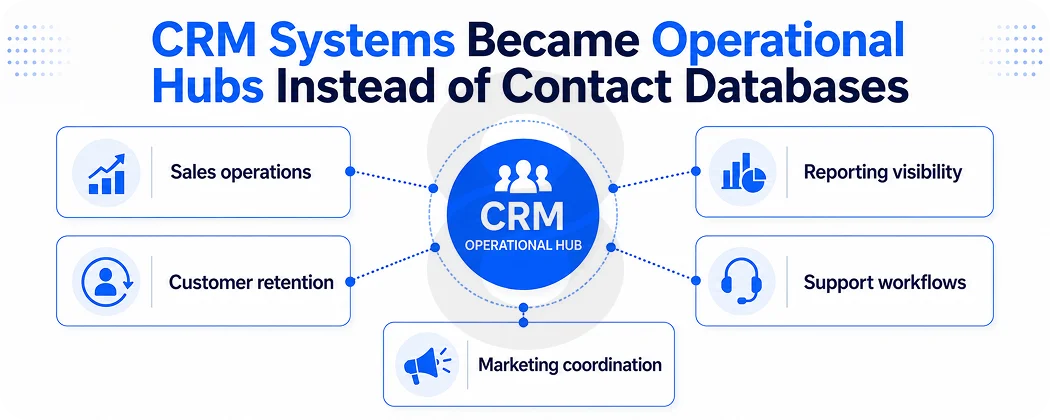
This is another major shift businesses are realizing now. Earlier, CRM systems mainly stored customer information.
Now they influence:
- Sales operations
- Customer retention
- Reporting visibility
- Support workflows
- Marketing coordination
That is why modern b2b software solutions increasingly center around connected CRM ecosystems instead of isolated management tools.
Because once operational visibility improves, businesses usually make faster and smarter decisions naturally. And honestly, that operational clarity becomes more valuable as companies grow.
AI Is Transforming Business Software Faster Than Expected
A lot of small businesses still think AI only matters for enterprise-level organizations. That assumption is becoming outdated very quickly.
Through proper AI development, businesses can already:
- Automate repetitive workflows
- Improve forecasting accuracy
- Predict customer behavior trends
- Reduce manual support pressure
- Improve operational visibility naturally
And through structured AI integration, these systems work quietly underneath operations without overwhelming employees or customers.
That matters because businesses now need systems capable of adapting faster than traditional workflows allow.
At 8ration, AI-supported systems are usually implemented gradually so operational improvements feel natural instead of disruptive for internal teams.
Read More: How to Make an Artificial Intelligence in 2026
Why Mobile Access Became Non-Negotiable
Business operations are no longer tied to offices consistently. Teams now work everywhere.
That includes:
- Remote work environments
- Hybrid business structures
- Sales teams are constantly traveling
- Managers operating across locations
- Real-time support coordination
That shift changed expectations completely.
This is exactly why a stronger mobile app development strategy now affects business productivity directly. Because if systems are difficult to access through mobile environments, workflows slow down almost immediately.
And honestly, employees notice poor usability much faster now because modern consumer apps have already trained people to expect smooth experiences everywhere.
Read More: Top 10 Mobile Apps for Businesses in 2026
Businesses Are Prioritizing Scalability Earlier Than Before
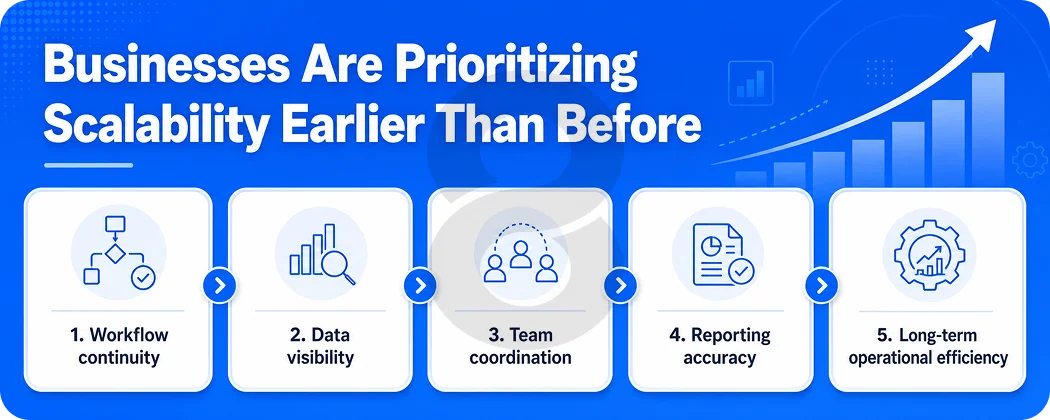
This is another important change happening now. Earlier, small businesses delayed infrastructure planning until growth became large enough to create problems.
Now businesses are preparing earlier because rebuilding systems later becomes extremely expensive operationally. A scalable b2b software solutions strategy usually improves:
- Workflow continuity
- Data visibility
- Team coordination
- Reporting accuracy
- Long-term operational efficiency
According to Salesforce research, businesses using connected digital systems report significantly stronger customer retention and operational visibility compared to fragmented workflows. That matters because operational clarity directly affects growth stability long term.
Read More: Hire CRM Developer vs. Buy Ready-Made CRM Software: What’s Right for Your Business?
What Strong Business Software Actually Improves
Business Area |
Improvement |
Why It Matters |
| Operations | Faster workflows | Better efficiency |
| Customer Support | Faster response times | Higher satisfaction |
| Reporting | Real-time visibility | Smarter decisions |
| Team Productivity | Reduced manual work | Better scalability |
| Customer Retention | Consistent experiences | Long-term revenue growth |
Why Generic Software Often Creates New Problems
This is where many small businesses struggle eventually. They purchase software quickly because the features sound impressive.
Then later they realize:
- The workflows do not fit properly
- Teams struggle adopting the system
- Integrations remain limited
- Reporting stays fragmented
- Operational flexibility becomes weaker
That is why custom-focused enterprise app development increasingly matters for growing businesses now. Because operational flexibility usually becomes more valuable as businesses scale and processes become more complex.
Forcing operations around rigid systems eventually creates frustration everywhere internally.
Read More: Top 10 CRM Software Platforms of 2026
Ecommerce and B2B Systems Are Connecting More Closely
This is another major shift happening now. Sales operations, inventory systems, customer support, and ecommerce environments are becoming increasingly connected operationally.
That means a stronger ecommerce app development strategy now directly affects backend business operations too. Because once customer orders, inventory updates, support requests, and reporting systems connect properly, operational efficiency improves naturally. And businesses that fail to connect those systems usually create unnecessary friction internally.
Read More: Pricing Models for Software Services: Fixed vs. Hourly Rates Explained
The Real Goal Is Operational Simplicity
A lot of businesses accidentally overcomplicate their systems while trying to modernize operations. That creates another type of problem entirely.
Good business software should:
- Reduce confusion
- Improve workflow clarity
- Make information easier to access
- Remove repetitive tasks
- Improve team coordination naturally
That is exactly where stronger b2b software solutions become valuable because the system should quietly support operations instead of constantly demanding attention from employees.
How the 8ration Team Approaches Business Software Systems
One thing our team focuses on heavily is operational realism. A lot of business systems look impressive during demonstrations but become frustrating during everyday usage. That usually happens because the system was designed around features instead of workflows. Instead, the focus generally stays centered around:
- Workflow simplification
- Scalable infrastructure planning
- Cross-platform usability
- Real-time operational visibility
- Integration-focused architecture
The goal is not simply building software. The goal is creating systems that quietly improve how businesses operate every single day without creating unnecessary friction underneath.
And that difference affects long-term adoption more than businesses initially expect.
If Your Team Still Depends on Manual Workarounds Constantly, The System Is Already Limiting Growth
A lot of operational inefficiencies feel normal because businesses adapt to them gradually over time.
- Manual updates become normal.
- Spreadsheet coordination becomes normal.
- Disconnected reporting becomes normal.
But those inefficiencies quietly slow growth much more than most businesses realize initially. Strong b2b software solutions create operational visibility, workflow automation, and scalability that businesses struggle to maintain manually long term.
And right now, that matters more than ever because customer expectations and operational complexity continue increasing every year.
Read More: How to Hire a Software Development Team: A Step-by-Step Guide
Final Thoughts
Most small businesses do not actually need more tools anymore. They need smarter systems. That is the real shift happening underneath modern business operations right now. Strong B2B software development and b2b software solutions improve visibility, reduce friction, simplify workflows, and help businesses scale without operations becoming chaotic underneath growth pressure.
And honestly, the businesses succeeding long term usually are not relying on harder manual work anymore. They are building systems capable of supporting growth properly. Because modern business efficiency is no longer only about effort. It is about how intelligently the systems underneath the business actually operate.