




Pricing sounds simple until you actually have to do it. Then suddenly everything gets weird. You’re not just putting a number on a project; you’re trying to predict effort, uncertainty, communication, revisions, hidden complexity, and the random stuff clients remember halfway through the work.
And that’s exactly why pricing models for software services become such a big deal. Because pricing is not just about money, it’s about expectations, risk, trust, delivery, and how much pain both sides are willing to absorb before someone gets frustrated.
A lot of businesses think pricing is just “what do you charge?” but that’s not really the question. The real question is, “What kind of working relationship are we building here?” Because fixed pricing creates one kind of relationship, hourly creates another, and both can go really well or really badly depending on the project.
If you’re trying to understand pricing models for software services properly, this is where things start making more sense.
Why Pricing in Software Always Gets Complicated
Software projects look clean on paper and chaotic in real life. That’s the problem.
A client says, “We just need a simple dashboard.” Then that dashboard needs roles, permissions, analytics, exports, notifications, third-party integrations, responsive design, admin control, maybe AI later, and now somehow that “simple dashboard” is a mini platform.
This is why pricing becomes difficult. Because software is not a static product, it’s moving parts pretending to be one task.
Here’s what usually makes software pricing messy:
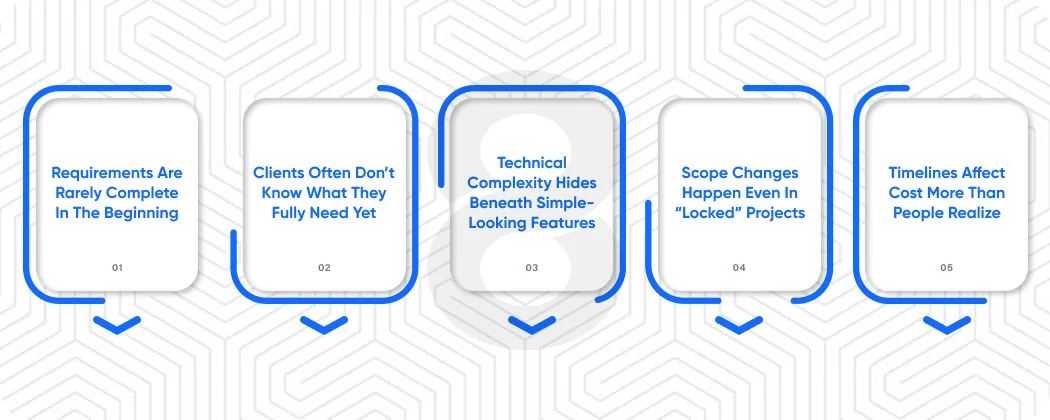
- Requirements are rarely complete in the beginning
- Clients often don’t know what they fully need yet
- Technical complexity hides beneath simple-looking features
- Scope changes happen even in “locked” projects
- Timelines affect cost more than people realize
That’s why pricing models for software services need more thought than just multiplying hours or throwing one big number at the proposal and hoping it survives.
What Are Pricing Models for Software Services?
At the simplest level, pricing models are just the structure you use to charge for work. But in practice, they define way more than payment. They define how scope is handled, how risk is shared, how flexibility works, and how expectations are managed.
The two most common options are:
- Fixed pricing
- Hourly pricing
Simple enough, right? Not really.
Because behind those two labels are totally different project behaviors. One prioritizes predictability. The other prioritizes adaptability. One works better when things are clear. The other works better when things are still moving.
Understanding pricing models for software services properly means understanding the psychology behind them, too, not just the invoice format.
Read More: What is a Proof of Concept in Software Development
Fixed Pricing: What It Really Means
Fixed pricing sounds comforting. One price, one project, one agreed scope. Everyone knows what they’re paying, everyone knows what’s being built, and everyone feels calm for at least the first few days.
And honestly, when a project is genuinely clear, fixed pricing can work beautifully. It’s simple, structured, and easier for clients to budget around.
But fixed pricing only works well when the scope is actually stable. Not “mostly clear.” Neither “we’ll figure out some details later.” Not “we have a rough idea.” It has to be really clear.
Fixed pricing usually works best when:
- The requirements are already documented properly
- The features are clearly defined
- The timeline is predictable
- There are fewer unknowns
- The client wants cost certainty
This is why many website builds, landing pages, dashboards, MVPs, and internal tools start under fixed contracts. But again, only when the project is actually stable.
Read More: How to Hire a Software Development Team
Pros of Fixed Pricing
Fixed pricing exists for a reason. It solves real problems when used correctly.
Benefits of fixed pricing:
- Easier budgeting for clients
- Clear upfront agreement
- Simpler proposal process
- Less billing confusion
- Better for shorter, defined projects
Clients usually like it because it removes uncertainty around cost. They know what they’re getting into financially, and that makes decision-making easier.
It also creates a nice sense of closure. There’s a beginning, a middle, and an end. That structure can be really useful when everyone is aligned.
And for teams, fixed pricing can be profitable too, but only if the scope is controlled and the estimation is actually realistic. Not optimistic. Realistic.
Read More: Intellectual Property in Software – How to Protect Your App Idea Before You Build
Cons of Fixed Pricing
Fixed pricing can go bad very quickly when people underestimate complexity or pretend unclear requirements are somehow “close enough.”
Here’s where things usually break:
- Scope creep becomes constant
- Revisions turn into mini rebuilds
- Hidden work eats profit
- Client assumptions don’t match the actual scope
- Teams rush to protect margins
That’s where fixed pricing gets toxic. Not because the model is bad, but because people force unstable projects into a rigid structure.
And once that happens, the relationship starts getting weird. A small request becomes a negotiation. Every revision feels loaded. Every extra feature turns into “is this included?” and suddenly nobody’s enjoying the project anymore.
That’s one of the biggest hidden truths in pricing models for software services. The wrong pricing model doesn’t just hurt margins; it hurts the whole working relationship.
Read More: How to Hire a Software Engineer – The 2026 Checklist
Hourly Pricing: What It Actually Solves
Hourly pricing is way more flexible, which is exactly why some clients hate it, and some teams love it.
Instead of charging for a promised final package, you charge for time spent. The client pays for actual effort, not estimated certainty.
This works really well when the project is evolving, unclear, experimental, or likely to change during development. Which, honestly, is a lot of software work.
Hourly pricing usually works best when:
- The scope is still evolving
- The client needs flexibility
- Discovery is part of the process
- The project has ongoing changes
- The work is maintenance-based or long-term
This is especially useful in software development, where technical decisions often evolve once implementation starts and hidden complexity finally shows itself.
Read More: What Is QA Testing in Software – Our Experts Insights
Pros of Hourly Pricing
Hourly billing gets a bad reputation sometimes, but honestly, it solves a lot of real project problems.
Benefits of hourly pricing:
- More flexible when requirements change
- Fairer for evolving work
- Better for long-term collaboration
- Easier to handle unexpected complexity
- Less pressure to overestimate upfront
It also creates more honesty. Instead of pretending the project is fully defined, hourly pricing accepts reality. Things change. New priorities show up. Technical surprises happen.
That doesn’t mean it’s chaotic by default. It just means the pricing model is designed for movement instead of pretending everything is frozen.
That can make projects healthier, especially when trust is strong and communication is good.
Read More: 20 Popular Software Development Life Cycle Models You Should Know
Cons of Hourly Pricing
Now obviously, hourly pricing is not perfect either. The biggest issue is uncertainty. Clients often feel uncomfortable not knowing exactly what the final cost will be. That’s understandable.
Common problems with hourly pricing:
- Budget predictability becomes harder
- Clients may feel anxious about efficiency
- Poor time tracking kills trust
- Endless projects can feel expensive
- Weak communication creates tension
And if the team is disorganized or vague about progress, hourly pricing can feel like a black hole. Money goes in, updates come out, and the client starts wondering where the actual progress is.
That’s why hourly only works well when the delivery process is transparent. Without trust and visibility, it gets uncomfortable fast.
Fixed vs Hourly: The Real Difference
A lot of people compare these two models as if it’s just one being better than the other. That’s not really how it works.
The real difference is this:
- Fixed pricing transfers more risk to the service provider
- Hourly pricing shares more uncertainty with the client
That’s the real trade-off.
If the provider underestimates a fixed project, they absorb the pain. If the project expands uourly, the client absorbs the cost.
That’s why choosing between them is really about risk allocation.
And that’s the part people ignore when discussing pricing models for software services. It’s not just billing style, it’s who carries the uncertainty when things inevitably get weird.
Read More: 50 Tech Startups Ideas to Inspire Your Next Venture
Fixed vs Hourly Rates
# |
Factor |
Fixed Pricing |
Hourly Pricing |
| 1 | Cost Predictability | High | Medium to Low |
| 2 | Flexibility | Low | High |
| 3 | Scope Control | Strict | Flexible |
| 4 | Best For | Clear projects | Evolving projects |
| 5 | Client Comfort | High initially | Depends on trust |
| 6 | Risk for Provider | High | Lower |
| 7 | Risk for Client | Lower upfront | Higher if the scope grows |
| 8 | Estimation Pressure | High | Lower |
| 9 | Revision Handling | Harder | Easier |
| 10 | Long-Term Collaboration | Less ideal | Stronger fit |
When Fixed Pricing Is the Better Choice
Let’s make this practical.
Fixed pricing is usually the better option when the project has structure, clarity, and limited moving parts. If the work can be broken into clearly defined deliverables, fixed can be great.
Good fixed-price project examples:
- Company websites
- Landing pages
- Small admin dashboards
- MVPs with tightly defined features
- Internal tools with known workflows
It can also work well when the client needs internal budget approval. A lot of businesses simply need a number they can present to management, and hourly billing makes that harder.
If the project has low ambiguity and clear outcomes, fixed pricing can feel cleaner for everyone involved.
When Hourly Pricing Is the Better Choice
Now let’s talk about the projects that look simple at first and then slowly mutate into something else entirely.
That’s where hourly pricing usually wins.
Good hourly project examples:
- Product discovery work
- Ongoing product iterations
- Technical consulting
- Bug fixing and maintenance
- Evolving startup products
This is especially common in mobile app development, where user feedback, feature testing, performance issues, and platform changes can reshape the project while it’s still being built.
If the product is still being figured out while building, hourly pricing often protects everyone better.
Why Clients Often Prefer the Wrong Model
This part matters a lot.
Clients often choose based on emotional comfort, not project reality.
Fixed feels safer because the number is stable. Hourly feels scary because it’s open-ended. But emotional comfort does not automatically mean operational fit.
Sometimes clients push for fixed pricing simply because they want control over the budget, even when the scope is clearly unstable. And that’s usually where problems begin.
What they really need is not fixed pricing. They need better planning, phased delivery, and transparency.
This is where educating the client matters. Good service providers don’t just quote. They guide.
That’s one of the biggest hidden skills in pricing models for software services. It’s not just choosing a structure; it’s helping the client understand why that structure fits.
Read More: 10 Open-Source Small Language Models for Your Next Project
Hybrid Pricing: The Smarter Middle Ground
Now here’s where things get interesting. Because honestly, the fixed vs hourly debate is useful, but real life is often somewhere in the middle.
A lot of the best service teams don’t use just one model. They combine them.
That’s where hybrid pricing comes in.
Common hybrid approaches:
- Fixed price for discovery, hourly for build
- Fixed core scope, hourly for extras
- Monthly retainer plus scoped tasks
- Milestone-based pricing with change request buffers
This works really well because it balances clarity with flexibility.
You’re not forcing everything into one rigid billing structure. You’re adapting the model to the project’s actual behavior. Which, honestly, is usually the smarter move.
A lot of modern teams doing AI development work already operate like this because early-stage technical uncertainty is hard to price cleanly in one rigid format.
Common Pricing Mistakes That Wreck Projects
Let’s be real. Most pricing mistakes are not dramatic. They’re subtle, slow, and expensive.
Mistakes that usually cause problems:
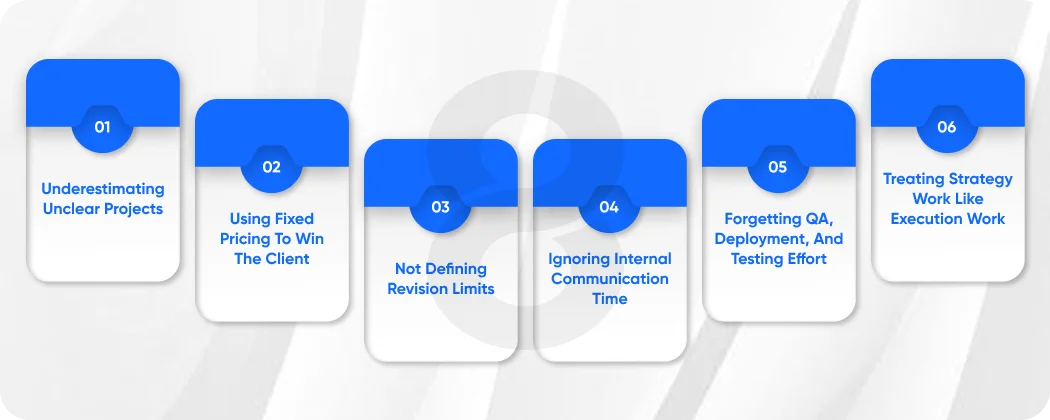
- Underestimating unclear projects
- Using fixed pricing to win the client
- Not defining revision limits
- Ignoring internal communication time
- Forgetting QA, deployment, and testing effort
- Treating strategy work like execution work
And one of the biggest ones?
Quoting based on what the client said instead of what the project actually requires. That one destroys margins quietly.
This gets even worse when the project includes things like workflow automation, because clients often underestimate the hidden process logic and backend complexity involved.
Read More: How to Build a “Digital Workforce” of Specialized AI Agents for Supply Chain Automation
How Different Services Usually Get Priced
Not all software services behave the same, so they shouldn’t always be priced the same way either.
Common patterns:
Fixed works well for:
- Landing pages
- Small dashboards
- Website redesigns
Hourly works well for:
- Product iteration
- Technical consulting
- Ongoing support
Hybrid works well for:
- MVPs
- Scaling startups
- Complex custom systems
For example, something like AI chatbot development often starts better under a discovery or hybrid model because use cases, flows, fallback behavior, and knowledge structure are rarely fully clear on day one.
What Clients Should Actually Ask Before Accepting a Quote
This section matters a lot because a lot of bad projects start with clients asking the wrong questions.
Instead of only asking “how much?” clients should ask:
- What assumptions is this price based on?
- How are revisions handled?
- What happens if priorities change?
- What risks are not visible yet?
- Is this model still safe if the scope grows?
Those questions save a lot of pain later.
And if a provider gets uncomfortable when asked these things, that’s already useful information.
Stop Buying Quotes and Start Choosing the Right Delivery Model

A cheap quote can still become an expensive mistake if the pricing structure doesn’t match the project. Focus less on the number and more on how the work will actually be delivered, changed, managed, and supported once things start moving. The right model doesn’t just protect the budget; it protects timelines, expectations, communication, and the overall sanity of everyone involved in the project.
Conclusion
At some point, software pricing stops being about numbers and starts being about fit. That’s the real thing people miss.
The best pricing model is not the one that sounds safest in the proposal; it’s the one that matches how the project will actually behave once real work starts. And that matters way more than people think. Because once development begins, the truth always shows up. Scope changes, hidden complexity appears, assumptions get tested, and the project becomes what it actually is, not what it looked like in the kickoff call.