
Hiring a CRM developer sounds easy until you actually try to do it.
You ask around. One freelancer says they can handle the setup for a small budget. An agency sends a proposal that looks like a full product build. A Salesforce specialist quotes a rate that makes you close the tab and rethink your life for a minute.
Then the real fun begins.
Licences are separate. Integrations are separate. Data migration is separate. Testing, training, support, cleanup, fixes after launch. Also separate.
And suddenly, the small CRM project you thought you were starting feels like another product inside your business.
Anyone who has worked in a startup knows this feeling. You begin with a simple request. “We just need a CRM.” Two weeks later, the “simple CRM setup” has somehow become a company-wide therapy session.
So yes, the cost to hire CRM developer talent in 2026 matters. But the number by itself doesn’t tell you much. A low quote can still become painful if the system creates more confusion than clarity. A higher quote can be worth it if the developer understands the business mess before touching the software.
For most businesses, CRM development can start with a basic setup and grow into a serious build with workflows, dashboards, user roles, integrations, and long term support. That’s why prices can move from a few thousand dollars to six figures, depending on how deep the system needs to go.
That sounds expensive because it is.
But the painful part is not always the price. The painful part is paying for the wrong thing. A CRM can work on paper and still make everyone avoid it like another unpaid invoice sitting in a browser tab.
What Does a CRM Developer Actually Do
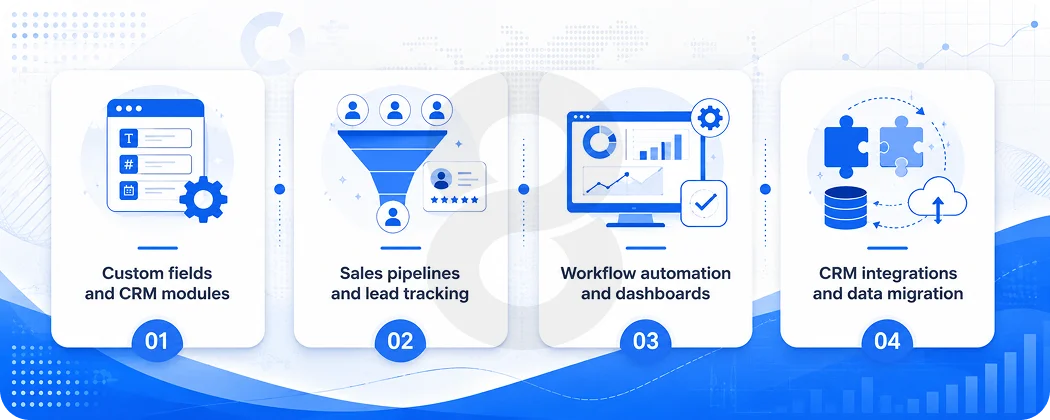
A CRM developer takes the mess your company has been avoiding and turns it into a system people are supposed to use every day.
That sounds simple. It isn’t.
They might work inside Salesforce, HubSpot, Zoho, Microsoft Dynamics 365, SugarCRM, Pipedrive, or they might build a custom CRM from scratch. On paper, that means configuration, custom fields, workflows, dashboards, integrations, and data migration.
In real life, it means sitting with all the broken little habits inside the business.
The sales team has one process. Marketing has another. Support keeps notes somewhere else. Finance wants clean customer data but usually gets half filled records. Founders want reports that show the truth, but nobody agrees on what the truth even means.
A good CRM developer has to make sense of that.
They don’t just write code. They figure out where leads come from, who owns them, when follow ups happen, what counts as a qualified opportunity, which customer details matter, and why the team keeps going back to spreadsheets even after paying for a CRM.
That last part is usually where the real problem is.
Because most CRM issues are not only technical. They’re process issues wearing a software costume.
A CRM developer builds the screens, automations, dashboards, user roles, reports, and data flows. But the better ones also notice when your workflow is confused before it becomes expensive to fix.
CRM Developer Hiring Cost in 2026
Here’s a realistic pricing view for 2026.
| Hiring Model | Typical Cost Range | Best For |
| Freelance CRM developer | $20 to $80 per hour | Small fixes, setup, light customisation |
| Senior CRM freelancer | $60 to $150 per hour | Platform specific work, integrations, automation |
| Dedicated CRM developer | $3,000 to $12,000 per month | Ongoing CRM product work |
| In house CRM developer | $90,000 to $160,000 plus per year in the US | Long term ownership and internal control |
| CRM development agency | $25,000 to $250,000 plus per project | Strategy, design, build, QA, deployment, support |
| CRM consultant | $75 to $250 per hour | Planning, architecture, platform selection, CRM audit |
If your CRM needs are small, a freelancer can work well. If your CRM is becoming a core business system, you’ll usually need more than one developer. You may need a business analyst, UI designer, backend developer, QA tester, project manager, and CRM architect.
That’s where agency pricing starts to make sense.
A single developer can build screens. A proper CRM team can question your process before bad logic gets baked into the system.
Read More: Hire CRM Developer vs. Buy Ready-Made CRM Software: What’s Right for Your Business?
Cost to Hire CRM Developer by Project Type
The cost to hire CRM developer talent depends on what you’re building. CRM projects usually fall into five pricing groups.
Basic CRM Setup
A basic setup usually means configuring an existing CRM platform.
This may include:
- Contact fields
- Sales stages
- Basic lead forms
- User roles
- Email templates
- Simple reports
- Importing clean customer data
Expected cost
$2,000 to $10,000
This is common for small businesses moving from spreadsheets to HubSpot, Zoho, Pipedrive, or Salesforce Starter.
CRM Customization
Customization means you already have a CRM, but it doesn’t match the way your team works.
This may include:
- Custom modules
- Sales pipeline changes
- Automated task assignment
- Approval flows
- Custom dashboards
- Custom email sequences
- User permission changes
Expected cost
$5,000 to $30,000
This is where many businesses start asking about the cost to hire CRM developer talent because they’ve outgrown the standard setup.
CRM Integration
CRM integration connects your CRM with other systems.
That could include:
- Website forms
- ERP software
- Accounting tools
- Ecommerce platforms
- Inventory systems
- Email marketing tools
- Customer support software
- Payment systems
- Call centre software
Expected cost
$10,000 to $75,000
The range is wide because integrations are unpredictable. A clean API makes life easier. A legacy system with poor documentation makes everything slower.
CRM Migration
Migration means moving customer data from one CRM, spreadsheet, or old database into a new system.
This may include:
- Data cleaning
- Duplicate removal
- Field mapping
- Migration scripts
- Test imports
- Historical activity transfer
- Validation
- User acceptance testing
Expected cost
$5,000 to $50,000
Migration gets expensive when data is messy. And let’s be honest, most customer data is messy. Duplicate names, missing emails, old deal stages, fake phone numbers, half filled fields. It happens.
Custom CRM Development
Custom CRM development means building a CRM around your exact business model instead of bending your company around a generic platform.
This may include:
- Custom contact management
- Lead management
- Sales pipeline
- Quote management
- Customer support tickets
- Team dashboards
- Admin panel
- Reporting
- Notifications
- Workflow automation
- API integrations
- Mobile CRM access
- Security controls
Expected cost
$50,000 to $300,000 plus
A smaller custom CRM MVP may stay near $50,000. A complex enterprise CRM can go far beyond $300,000.
Read More: CRM on Android: How to Build a Custom CRM App for Your Business
CRM Development Cost by Complexity
CRM Complexity |
Common Features |
Estimated Cost |
| Simple CRM | Contacts, leads, tasks, notes, basic reports | $10,000 to $30,000 |
| Mid level CRM | Workflows, dashboards, user roles, email sync, integrations | $30,000 to $100,000 |
| Advanced CRM | ERP sync, automation, analytics, custom permissions, mobile access | $100,000 to $250,000 |
| Enterprise CRM | Multi department workflows, AI features, complex reporting, security, compliance | $250,000 to $500,000 plus |
A simple CRM is mostly a database with a clean interface. A serious CRM becomes an operating system for sales and customer operations.
That’s why custom CRM development cost grows quickly when you add automation, integrations, analytics, and mobile access.
Read More: Top 10 CRM Software Platforms of 2026
CRM Developer Hourly Rate by Region
Location changes CRM development pricing.
| Region | Typical Hourly Range | Notes |
| United States and Canada | $80 to $180 per hour | Strong enterprise and Salesforce talent, higher cost |
| Western Europe | $70 to $150 per hour | Good for regulated projects and enterprise systems |
| Eastern Europe | $40 to $90 per hour | Strong engineering value for custom CRM builds |
| South Asia | $20 to $60 per hour | Cost effective for setup, development, and support |
| Latin America | $40 to $100 per hour | Good time zone overlap for US businesses |
| Middle East | $40 to $120 per hour | Pricing depends heavily on seniority and platform experience |
Lower hourly rates can help. Of course they can. Nobody wants to pay more than they need to, especially when the CRM budget is already fighting with every other budget in the company.
But cheap CRM work can become expensive very quickly. A developer with a lower rate is only a good deal if they understand the bones of a CRM.
A company hires someone cheap to “just set things up.” Everyone claps for about three days. Then the cracks appear.
So yes, the cost to hire CRM developer talent matters. But don’t judge it only by the hourly rate. Judge it by how much risk the developer removes from the project.
A senior developer who asks annoying questions early can save you from a painful rebuild later.
Read More: 10 Steps to Hire Developers for Startup: The Ultimate Guide
Cost by CRM Platform
Different CRM platforms need different skills.
Salesforce
Salesforce developers usually cost more because Salesforce is its own world.
It has its own tools, rules, certifications, architecture, limits, and strange little behaviours that only people who’ve been burned by them truly understand.
On paper, Salesforce looks like a CRM platform. In practice, it can become the operating system for your sales team, support team, marketing team, and management reports.
That’s why Salesforce work gets expensive.
You may start with a basic setup. Then someone needs custom objects, approvals, automation, integrations and better reporting. After that, someone asks why the license bill is climbing again, and everyone looks tired because they already know the answer. The CRM did not stay small because every broken process slowly got dumped into it.
Salesforce works well for growing companies, but it needs careful setup. If you rush it, you don’t get a powerful CRM. You get a very expensive place to store bad data.
Microsoft Dynamics
A Microsoft Dynamics CRM developer usually works with Dynamics 365 Sales, Power Platform, Dataverse, Power Automate, and the wider Microsoft stack.
If your company already lives inside Microsoft tools, Dynamics can make sense. Outlook, Teams, SharePoint, Excel, Power BI, and finance systems can all sit closer together.
That’s the good part.
The tiring part is that Dynamics projects can become heavy when they connect with ERP, finance, inventory, operations, or internal approval systems. And once different departments get involved, the CRM stops being “a sales tool” and becomes a business system everyone has opinions about.
That’s where the budget starts moving.
HubSpot
HubSpot is friendlier than most CRM platforms. That’s why startups and marketing teams like it. It feels cleaner. Less scary. Less like you need three consultants just to understand the menu.
A HubSpot CRM developer may work on workflows, custom objects, API integrations, reports, lifecycle stages, sales automation, and HubSpot CMS.
For simple teams, HubSpot can be quick to set up. But once you need custom reporting, advanced automation, lead scoring, complex lifecycle journeys, or deeper integrations, it stops being a “simple CRM” project.
That’s usually the moment someone says, “Wait, I thought HubSpot was supposed to be easy.” It is easy, until your process isn’t.
Zoho
Zoho can be a good option for small and mid sized businesses that want CRM features without the heavy enterprise bill.
A Zoho developer may handle custom modules, Deluge scripts, workflows, Zoho Creator, Zoho Books, Zoho Desk, and third party integrations.
The pricing can feel more comfortable compared with Salesforce or Dynamics. But don’t mistake affordable for automatic.
Zoho still needs proper setup. If your workflows are messy, Zoho will not magically fix them. It will just organise the mess into nicer looking screens.
For a business with clear processes, Zoho can work well. For a business still figuring out how sales, support, and finance should talk to each other, you’ll need a developer who can think beyond settings.
Custom CRM
A custom CRM gives you control.
Real control.
You’re not bending your process around Salesforce, HubSpot, Zoho, or Dynamics. You’re building the system around how your business actually works.
That sounds great. And sometimes it is.
A custom CRM developer may work with Laravel, Node.js, Django, React, Next.js, PostgreSQL, MySQL, MongoDB, AWS, Azure, or Google Cloud.
But here’s the part people forget when they’re tired of SaaS platforms. If you build a custom CRM, you own the product.
You get freedom, but freedom comes with invoices.
Custom CRM development makes sense when your workflows are too specific for standard platforms. Your license costs are getting out of hand. Or, your CRM needs to connect deeply with other internal systems.
But don’t build custom just because you’re annoyed with your current CRM. Everyone is annoyed with their CRM. Build custom when the business case is strong enough to justify owning the whole thing.
Read More: How to Hire a Software Development Team: A Step-by-Step Guide
What Top Ranking Websites Are Doing
The top ranking pages for CRM developer cost usually follow a few patterns.
Upwork focuses on freelancer hourly pricing. That helps users who want a quick market rate.
Software agencies focus on custom CRM development cost ranges by project complexity. That helps buyers understand why a basic CRM and an enterprise CRM can be worlds apart.
CRM implementation pages usually focus on data migration, integrations, training, and licences. That matters because the development quote is not the whole bill.
The best pages also explain hiring models, hidden costs, timelines, feature based pricing, and build versus buy decisions.
So this article takes the practical route. It gives you cost ranges, but it also shows what pushes pricing up or down.
Read More: Mobile App Development Team: Hiring Tips for 2026
Main Factors That Affect CRM Developer Cost
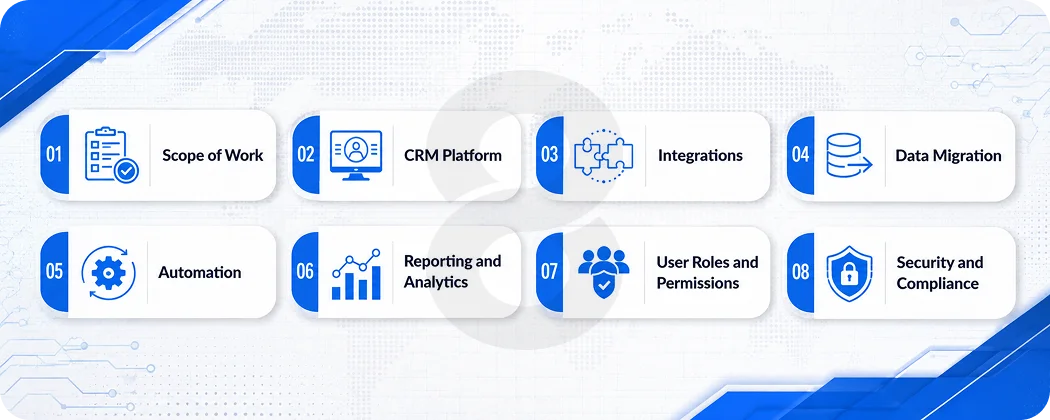
Scope of Work
A five screen CRM is not the same as a multi department platform.
Every extra workflow, role, report, trigger, and integration adds planning, development, testing, and training time.
Before hiring, write down:
- Which teams will use the CRM
- Which data they need
- Which steps they repeat daily
- Which reports managers need
- Which tools must connect
- Which tasks should be automated
This helps control the cost to hire CRM developer talent before the project starts.
CRM Platform
Some platforms are easier to customize than others.
Salesforce and Dynamics 365 are powerful, but they often require specialists. HubSpot and Zoho can be easier for smaller teams, but advanced use cases still need experienced developers.
A custom CRM gives flexibility, but you’ll need a full software development process.
Integrations
Integrations are one of the biggest cost drivers.
A CRM that only stores leads is simple. A CRM that talks to your website, email, billing tool, support desk, WhatsApp, ERP, and warehouse system is a different project.
Common integration cost range
$3,000 to $25,000 per integration
Complex systems can cost more.
Data Migration
CRM data migration sounds boring. It isn’t.
Bad migration can break reporting, confuse sales teams, and create duplicate customer records. A good developer or team will test migration before going live.
Typical CRM migration cost
$5,000 to $50,000
The cleaner your data, the lower the cost.
Automation
Automation can save time, but bad automation creates chaos.
Common automations include:
- Lead assignment
- Follow up reminders
- Deal stage updates
- Quote approvals
- Renewal alerts
- Customer onboarding tasks
- Ticket routing
Typical automation cost
$2,000 to $30,000 plus
Reporting and Analytics
Most teams don’t just want a CRM. They want answers.
Which sales rep is closing? Which lead source performs best? Where do deals stall? Which accounts are at risk?
Custom dashboards and analytics can add $5,000 to $40,000 depending on data complexity.
User Roles and Permissions
Small teams can work with basic access rules. Larger businesses need strict control.
Sales reps should not always see finance data. Support teams may not need pipeline values. Managers need department level access. Admins need full control.
Role based access can add $3,000 to $20,000 depending on complexity.
Security and Compliance
CRM systems hold sensitive customer data.
Security work may include:
- Role permissions
- Audit logs
- Data encryption
- Secure APIs
- Backup planning
- Login controls
- Compliance support
For healthcare, finance, insurance, or legal businesses, this cost can rise quickly.
Hidden Costs Most Businesses Miss
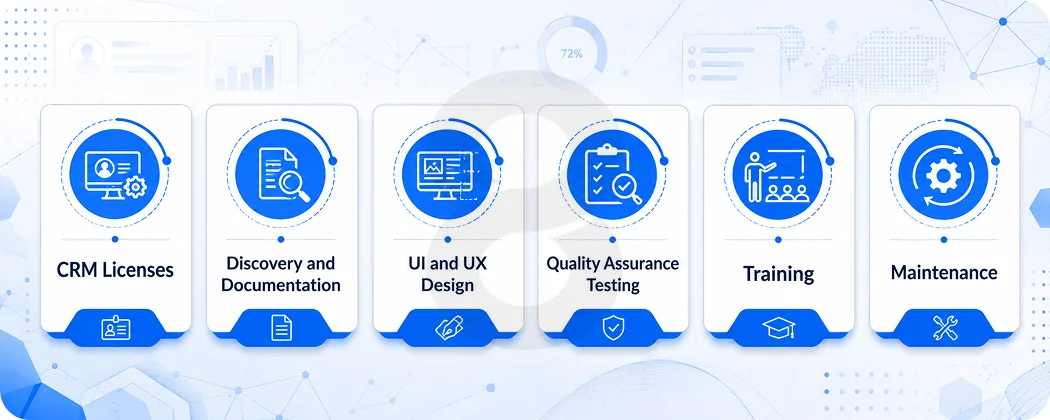
The first quote rarely shows the full cost.
Here are the items that often appear later.
CRM Licenses
If you use Salesforce, HubSpot, Microsoft Dynamics 365, Zoho, or another SaaS CRM, you’ll pay monthly or yearly license fees.
A small plan may look cheap. But add 50 users, advanced reporting, AI features, automation, and premium support, and your monthly bill changes.
Discovery and Documentation
A proper CRM project needs discovery.
That includes workflow mapping, feature planning, user stories, technical architecture, and timeline planning.
Expected cost
$2,000 to $15,000
Skipping discovery feels cheaper. Then development starts and everyone argues about what the CRM was supposed to do.
UI and UX Design
A CRM can technically work and still frustrate users.
Good CRM design makes daily work faster. It reduces clicks, hides unnecessary fields, and makes the next action obvious.
Expected cost
$5,000 to $30,000
Quality Assurance Testing
Testing protects the CRM from embarrassing failures.
QA checks forms, permissions, workflows, integrations, data imports, reports, and edge cases.
Expected cost
10 percent to 25 percent of development cost
Training
Even a great CRM fails if your team doesn’t use it.
Training may include:
- Admin training
- Sales team training
- Support team training
- Video walkthroughs
- Documentation
- Launch support
Expected cost
$1,000 to $15,000
Maintenance
After launch, your CRM will need updates.
That includes bug fixes, new fields, workflow changes, security updates, platform updates, and integration checks.
Typical CRM maintenance cost
15 percent to 25 percent of the initial build cost per year
Freelancer vs Agency vs In House CRM Developer
Freelancer
A freelancer is often the cheapest option.
Choose a freelancer when:
- You need small CRM setup
- You have clear requirements
- You need a quick fix
- You already have a technical manager
Avoid relying on one freelancer for a mission critical CRM unless they have strong architecture and documentation habits.
In House Developer
An in house developer gives long term control.
Choose in house when:
- CRM is central to daily operations
- You have ongoing feature needs
- You can manage technical work internally
- You need fast internal changes
The real cost includes salary, benefits, tools, management, hiring time, and retention.
Agency or Dedicated Team
An agency costs more upfront, but gives you a full team.
Choose an agency when:
- You need CRM strategy
- You need design, development, QA, and support
- You have complex integrations
- You need reliable delivery
- You don’t want to manage every technical detail
For most serious CRM builds, an agency or dedicated team reduces risk.
Build Custom CRM or Customise Existing CRM
You don’t always need a custom CRM from scratch.
Choose an existing CRM when:
- Your sales process is fairly standard
- You need speed
- Your budget is limited
- You’re okay with license fees
- You can adapt to platform rules
Choose custom CRM when:
- Your workflows are unique
- Your team hates generic tools
- You need complex role access
- You need deep integrations
- You want full ownership
- Per user license costs are becoming painful
A good middle path is often best. Start with an existing CRM, customise it properly, then build custom modules where the platform falls short.
Suggested CRM Budget by Business Size
The cost to hire CRM developer talent should match the business stage. A startup does not need an enterprise CRM. An enterprise should not run on a patched spreadsheet system.
How to Reduce CRM Developer Cost Without Hurting Quality
Start With an MVP
Build the first version around the workflows that matter most.
For example:
- Capture leads
- Assign leads
- Track deals
- Manage contacts
- Generate reports
- Send follow ups
Leave advanced AI, complex scoring, and heavy analytics for later unless they are central to the business.
Clean Your Data Before Migration
Developers should not spend expensive hours fixing avoidable data problems.
Before migration, remove duplicates, standardise fields, archive dead contacts, and decide which historical data actually matters.
Choose Integrations Carefully
Every integration adds cost.
Ask whether the integration saves real time or only sounds nice in a meeting.
Document Your Sales Process
A CRM developer needs to know how your team works.
Write down your lead sources, deal stages, follow up rules, approval steps, lost reasons, and reporting needs.
This reduces confusion and cuts rework.
Avoid Over Customization
Too much customisation can make a CRM harder to maintain.
Use native features where they work. Custom code should solve real business problems, not personal preferences.
Plan Maintenance Early
A CRM is not finished after launch.
Set aside a monthly support budget for updates, improvements, training, and user feedback.
Sample CRM Developer Cost Scenarios
Scenario 1
A small real estate agency wants Zoho CRM setup, custom fields, lead forms, email templates, and simple reports.
Expected cost
$5,000 to $15,000
Scenario 2
A B2B SaaS company wants HubSpot custom objects, lifecycle automation, website integration, sales dashboards, and migration from spreadsheets.
Expected cost
$20,000 to $60,000
Scenario 3
A manufacturing company wants Microsoft Dynamics 365 connected with ERP, inventory, finance, and Power BI reporting.
Expected cost
$75,000 to $200,000
Scenario 4
A logistics company wants a custom CRM with customer profiles, sales pipeline, quote management, route based service data, user roles, mobile access, and admin dashboards.
Expected cost
$120,000 to $300,000 plus
Scenario 5
An enterprise wants Salesforce customisation with CPQ, Service Cloud, complex approvals, third party integrations, migration, and training.
Expected cost
$150,000 to $500,000 plus
Questions to Ask Before Hiring a CRM Developer
Before you hire, ask these questions:
- Which CRM platforms have you worked with?
- Have you built CRM systems for our industry?
- Can you show examples of similar workflows?
- How do you handle data migration?
- How do you test workflows and permissions?
- What happens after launch?
- Do you document custom code and configuration?
- Can you work with our sales and support teams?
- How do you estimate integrations?
- What costs are not included in the quote?
Where 8ration Can Help
If your CRM is becoming too limited, too messy, or too expensive to manage manually, 8ration can help you plan and build a system around your actual workflows.
You can explore custom CRM software development services for tailored CRM platforms, CRM consulting, enterprise CRM development, cloud based CRM development, and mobile CRM app development.
If your CRM needs mobile access for field teams, sales reps, or service teams, mobile app development services can help you extend CRM features beyond the desktop.
If your CRM needs a secure admin portal, reporting layer, or customer facing dashboard, web app development services can support the build.
For companies that need websites, portals, and CRM connected into one digital system, web development services can help connect the front end experience with backend customer data.
For Android first teams, Android app development services can help build mobile CRM tools for sales, logistics, field operations, or customer support.
Final Cost Breakdown
So, what’s the cost to hire CRM developer talent in 2026?
For small CRM work, expect $5,000 to $25,000.
As a growing business needing serious customization, workflows, dashboards, and integrations, expect $30,000 to $100,000.
For a full custom CRM or enterprise CRM implementation, expect $100,000 to $500,000 plus.
The exact number depends on platform, scope, integrations, data quality, automation, and long term support.
The smartest move is not to hire the cheapest developer. Hire the team that understands your business process before writing code. That’s how you keep CRM development from turning into an expensive patchwork system that nobody wants to use.
The cost to hire CRM developer talent is worth it when the CRM saves hours, improves follow up, reduces missed leads, gives managers clear reporting, and helps teams work from one trusted source of customer data.