



Making a racing game comes down to five decisions. What kind of racing it is (arcade, simulation, or kart). Which engine you build it in. How the cars feel to drive. How much you can spend. And who actually does the work. Get the driving feel right and most other problems are fixable.
That last decision is the one first-time founders and small teams underestimate most. Plenty of racing games start as solo projects and ship fine. Others burn a year on vehicle physics that never feel right, then quietly die. This guide covers how to make a racing game step by step and what it realistically costs.
Why Racing Games Punish Beginners Harder Than Most Genres
On paper, a racing game is the simplest thing you could build. Car, track, and finish line with no dialogue trees and inventory screens. That surface simplicity is exactly why so many first racing projects fail.
In an RPG, a weak combat system can hide behind a good story. In a racer, there is nowhere to hide. The player interacts with one system, the car, for the entire play session. Players feel a wrong car within seconds, even when they cannot explain why it feels wrong.
Read More: How to Build an RPG: Solo Indie Project vs. Full Studio Team
The second trap is content cost. Cars and tracks are some of the most expensive art in games. A production-quality vehicle model can take an artist weeks, and every track needs layout design, environment art, collision meshes, and optimization passes. Teams that budget for “a few cars and tracks” usually discover mid-project that content is eating most of their money.
How to Make a Racing Game in 7 Steps
Racing games are easy to understand and difficult to get right. Players can tell within seconds whether a car feels good to drive. Better graphics will not rescue slow steering or a camera that makes every corner harder than it should be.
Build the driving first. Once that works, you can add tracks, opponents, progression, audio, and multiplayer without constantly fixing the foundation underneath them.
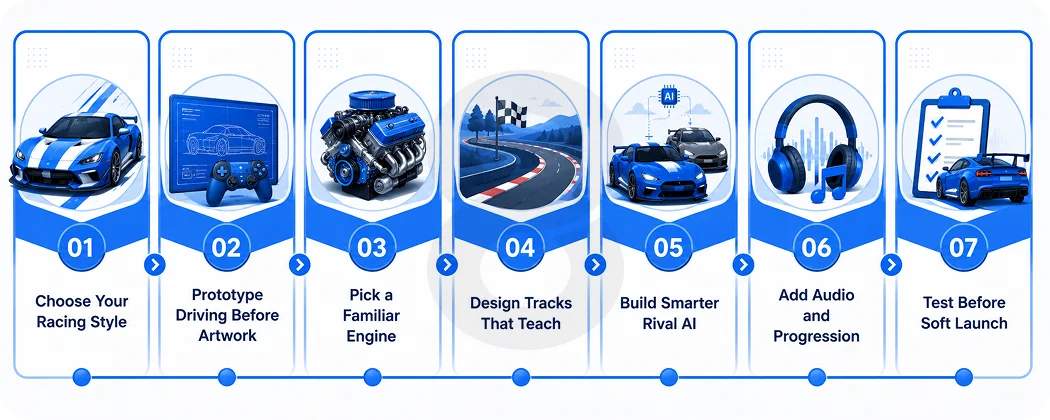
1. Pick arcade, sim, or kart before anything else
These are three different products that happen to share a genre label. Arcade racers favor speed and forgiveness and sell best on mobile. Simulations chase realism and demand serious physics work.
Kart racers add weapons and chaos and live or die on multiplayer. This choice sets your physics complexity, art budget, platform, and audience. Changing lanes mid-project is close to starting over.
Read More: How to Make a Multiplayer Game: A Complete Guide (2026)
2. Grey-box the driving feel first
Before any real art exists, build a flat test track out of untextured blocks and get one car driving on it. Tune acceleration curves, steering response and camera movement until the car is fun on a boring grey rectangle.
If it is fun there, it will be fun everywhere. Experienced teams spend weeks in this phase on purpose, because every later system sits on top of it.
3. Pick an engine your team can actually use
Unity and Unreal both ship capable vehicle tooling, and the honest tiebreaker is what your team already knows. The full engine comparison, with current industry data, is a section below. If you are a solo developer making a low-poly or 2D racer, Godot is a real option too, and it is free.
4. Design tracks that teach the player
Good tracks are lessons in disguise. Early corners teach braking points, and later sections combine them at higher speed. Wide entries forgive mistakes while shortcuts reward mastery. Build every track in grey-box first, run laps, and cut anything that is not fun by lap ten. A racer with eight great tracks beats one with twenty forgettable ones.
5. Give your AI opponents a personality
Rubber-band AI that magically catches up frustrates players, and AI that drives a perfect line every lap bores them. The opponents people remember make small human mistakes. They brake slightly early, defend a line, and occasionally overcook a corner.
This is also where AI game development has moved past scripting, with machine-learning opponents that adapt to a player’s skill instead of following a fixed rubber band.
6. Layer in audio, UI, and progression
Engine audio does more for the sense of speed than most graphics settings. Pitch-shifted engine loops, tire screech, and surface changes are cheap wins.
Menus deserve the same discipline and solid UI and UX design should get a player from app open to green light in under three taps. Progression, meaning new cars and unlockable tracks, is what turns a tech demo into a game people return to.
7. Playtest, tune, then soft launch
Test on the worst devices you plan to support, not the best. Frame drops that would mildly annoy players in other genres make a racer unplayable.
A structured software testing pass should cover physics edge cases, collision bugs, and multiplayer desync if you have it. For mobile, a soft launch in a smaller market tells you whether players finish race three or churn before it.
Unity or Unreal? What 2,300 Developers Told GDC
The engine debate generates more forum arguments than any other decision in game development, and the current data is more lopsided than most people assume.
GDC’s 2026 State of the Game Industry report, built on responses from more than 2,300 industry professionals, found that 42% of developers now name Unreal Engine as their primary engine, against 30% for Unity. Unreal’s lead is strongest at AA and AAA studios, while a majority of established indie studios still work in Unity.
For a racing game specifically, the split usually looks like this. Unreal game development suits high-fidelity console and PC racers, where the rendering pipeline and Chaos vehicle tooling get you to “looks like a real car on a real track” faster.
Read More: Unity Game Engine: A Game Development Guide for Businesses
Unity game development tends to win for mobile and arcade projects thanks to smaller build sizes, faster iteration, and the most mature mobile toolchain of the major engines. That matters commercially, because mobile generated 52.1% of online racing game revenue in 2025.
The engine also matters less than your team’s fluency in it. A team that knows Unity deeply will ship a better racer in Unity than in an unfamiliar Unreal, every single time. Pick for your people and your platform, not for the forum consensus.
How Much Does It Cost to Make a Racing Game?
Anyone who quotes a single number without asking questions is guessing. Cost follows scope, and racing game scope is driven by four things: platforms, multiplayer, physics depth, and how many cars and tracks you want at launch.
The ranges below reflect what teams typically pay when working with a development partner in 2026. Treat them as planning figures, not quotes.
| Racing Game Tier | Typical Scope | Estimated Budget | Timeline |
|---|---|---|---|
| Simple Mobile Arcade Racer | One Car Class, 5–10 Tracks, Single-player Mode, Ads or Basic In-app Purchases | $30,000–$80,000 | 3–5 Months |
| Mid-tier Cross-platform Racer | Multiple Car Classes, 15+ Tracks, Online Multiplayer, Progression & Live-ops Systems | $150,000–$500,000 | 6–12 Months |
| High-fidelity Simulation | Advanced Vehicle Physics, Licensed Cars or Circuits & Esports-grade Multiplayer | $500,000–$2M+ | 12–24+ Months |
Read More: How Long Does it Take to Make a Video Game
What pushes a project toward the top of each range:
- Online multiplayer (racing netcode is genuinely hard)
- Licensed real-world vehicles (automakers charge for their brands and review every build)
- Custom physics beyond engine defaults
- Launching on several platforms at once
What keeps costs down:
- Shipping on one platform first
- Using quality asset packs for environments
- Cutting the car list to what the first month of play actually needs
If phones are the target, a specialized mobile game development team should also shape the economy from day one. The reason is free-to-play racers live on in-app purchases and ads rather than upfront sales.
When to Bring in a Game Dev Studio (and When Not To)
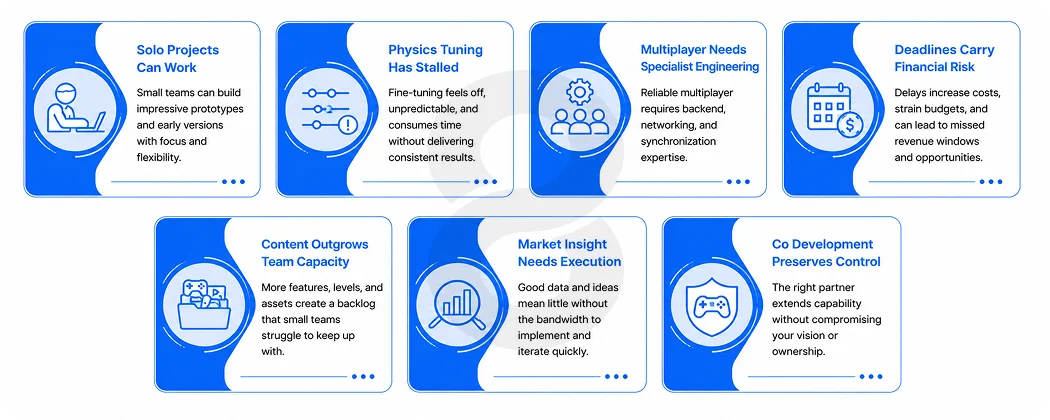
The honest part first. You do not need a studio if you are learning, building a portfolio piece, or making a small arcade racer with engine-default physics and asset-store art. Solo developers ship those every month, and hiring help for one would waste money.
The studio conversation starts when one of these becomes true:
- The handling model has stalled. Vehicle physics programmers are a rare, specialized hire, and if the car still feels wrong after two months of tuning, more months rarely fix it.
- You need online multiplayer. Racing netcode involves client prediction, lag compensation, and anti-cheat. Getting it wrong shows up on screen as cars teleporting through corners.
- Your deadline has money attached. An investor milestone, a marketing window, or a licensing agreement changes the math, and studios are structured to make dates.
- Content is outrunning your capacity. If the design is done but you need twelve cars and ten tracks built to one consistent standard, that is a production problem, and production is what studios do.
- You have the market knowledge but not the team. Plenty of successful games come from founders who understood an audience and hired the build.
A full-service game development studio also brings something a job posting cannot: pre-solved problems. A team that has already shipped racers does not rediscover why the chase camera makes players motion-sick or why the AI pile-up always happens in turn one. Part of what you pay for is skipping mistakes.
There is also a middle path. In a co-development setup, a studio takes defined chunks such as physics, netcode, or art production while your team keeps design and creative direction. For funded indie teams, this is often the best ratio of money to control.
Read More: Simulation Game Development: From Concept to Launch
How 8ration Approaches Racing Game Development
8ration is a game development agency with production teams working in both Unity and Unreal. Its game work runs from mobile arcade titles to cross-platform 3D projects, along with newer categories like blockchain game development for teams building ownership or reward economies into their games.
On racing and driving projects, the process follows the same order of operations as this article. Handling comes first. A grey-box prototype with tuned vehicle feel is the first milestone. Content production does not start until the client has driven it and signed off.
From there, engineering and QA run as parallel tracks with playable builds delivered on a fixed cadence rather than one big reveal at the end.
The team also builds the systems that sit around the race itself, such as matchmaking and garage economy that keeps players coming back for one more upgrade. Adaptive AI opponents are part of that work too. For founders and studios with partial builds already in hand, 8ration takes on co-development engagements as well.
Read More: How Much Does It Cost to Make a Mobile Game?
Start with Grey Box Instead of Trailer
If you take one thing from this guide on how to make a racing game, take the order of operations. Feel first… content second… polish third… and be brutally honest at each gate about whether the current team can clear the next one.
A grey box that is fun to drive is worth more than a cinematic trailer, and it is also the cheapest way to find out whether your idea works. Build that first. Then decide, with real information in hand, whether the rest of the road is one you drive yourself or one you hire a studio to build.