
Somewhere right now a founder is staring at a Stripe dashboard at 1 a.m. wondering why people add a $29 template to the cart and then vanish.
The product is good and the traffic is real. So why does the bank balance say otherwise? Nine times out of ten, the platform underneath is the thing quietly losing money. That’s the part nobody romanticizes, and it’s the part this article is about.
Building a digital product sales platform sounds simple because the product weighs nothing. You skip the warehouses, shipping labels, and inventory counts. But anyone who has actually shipped one knows the weight just moves somewhere else.
It moves into payment infrastructure, file delivery, fraud handling, tax compliance, and hundred small decisions that decide whether a buyer trusts your checkout page for the eleven seconds it takes to enter a card number.
What a Digital Product Sales Platform Actually Does
Strip away the marketing language and a digital product sales platform does three jobs. It takes money without losing any, hands over a file or unlocks access the second payment clears, and keeps doing both at 3 a.m. on a Sunday while everyone who built it is asleep.
That last part sounds trivial until the first weekend something breaks and nobody notices for nine hours. The products themselves vary more than you’d think.
Sellers move everything from ebooks and design templates to software licenses, online courses, stock audio, presets, and memberships, and each one fails in its own special way. The delivery mechanics behind each one differ more than founders expect.
A PDF download needs an expiring link. Courses require gated access and progress tracking, while software licenses bring key generation and activation limits into play. Subscriptions pile on recurring billing, dunning emails, and a cancellation flow that doesn’t trigger chargebacks.
Then there’s the model question. A single seller storefront is one build. A multivendor marketplace where creators upload their own products is a different animal entirely, with vendor onboarding, commission splits, payout schedules, and moderation tools layered on top. Plenty of teams budget for the first and accidentally promise investors the second.
The honest framing is this. You’re not building a website with a buy button. You’re building a small bank attached to a content delivery system, and both halves have to work perfectly or neither matters.
Read More: How to Build an Appointment Scheduling System Like Calendly
Why this Market is Worth the Pain
The numbers behind digital goods are the reason tired founders keep doing this to themselves. The digital goods market is valued at $157.39 billion in 2026 and is growing at a 26.6 percent annual rate, on track to reach $511 billion by 2031.
A number like that signals a structural shift in what people pay for, not a niche. Zoom out further and global digital commerce is projected to grow from $8.06 trillion in 2026 to over $29 trillion by 2035, with mobile devices already driving around 65 percent of browsing revenue.
Whatever you build, most of your buyers will meet it on a phone screen first. Design for that or watch your conversion rate explain it to you later.
The creator economy feeds this directly. Coherent Market Insights pegs it at $248.95 billion in 2026, heading past $1 trillion by 2033. Every one of those creators eventually wants to sell something they made, and most of them are unhappy with the 10 percent cut marketplaces take. That dissatisfaction is your market.
Margins are the other pull. A digital product costs nearly nothing to reproduce. Once the platform exists, every additional sale is mostly profit. The catch, and there is always a catch, is that the platform itself is where all the cost and all the risk concentrate.
Core Features You Cannot Launch Without
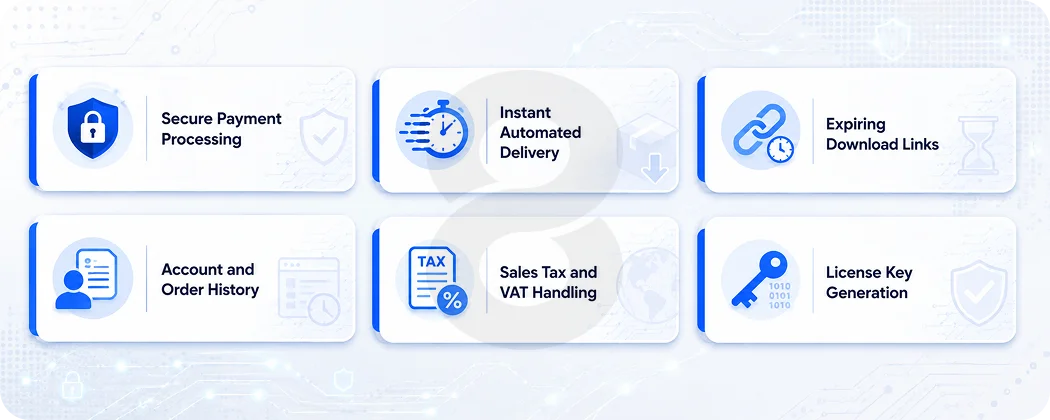
Every founder has a feature wishlist three pages long. Most of it can wait. The table below is the honest split between what your launch needs and what your roadmap can hold.
Feature |
Launch or Later |
Why It Matters |
| Secure payment processing (Stripe, PayPal) | Launch | No payments, no business. Multiple gateways reduce failed checkout losses. |
| Instant automated delivery | Launch | Buyers expect the file within seconds. Delay equals refund requests. |
| Expiring download links | Launch | Stops one purchase from becoming a free public link. |
| Account and order history | Launch | Buyers lose files. Letting them re-download cuts support tickets in half. |
| Sales tax and VAT handling | Launch | Digital goods tax rules vary by country and ignoring them gets expensive. |
| License key generation | Launch if selling software | Manual key delivery does not scale past day one. |
| Coupons and discounts | Later | Useful, but not worth delaying launch. |
| Affiliate system | Later | Powerful growth lever once you have product proof. |
| Subscriptions and memberships | Later, unless core to model | Recurring billing adds real complexity. Add it deliberately. |
| AI recommendations | Later | Needs purchase data to be useful anyway. |
Content protection deserves its own paragraph because founders consistently underweight it. Watermarking PDFs with the buyer’s email, limiting download attempts, and streaming video instead of offering raw files won’t stop a determined pirate. Nothing will. What it does is stop casual sharing, which is where most of the actual revenue leakage happens.
The checkout flow is where everything is won or lost. Offer guest checkout, saved payment methods, mobile optimized forms, and as few fields as legally possible. Every extra input field is a measurable drop in completed purchases.
Read More: Best B2B Software Solutions for Small Businesses (2026 Guide)
The Build Process: Step by Step
There’s a tempting version of this process where you skip straight to development. That version costs the most. The boring sequence below exists because every shortcut in it has already been paid for by someone else.
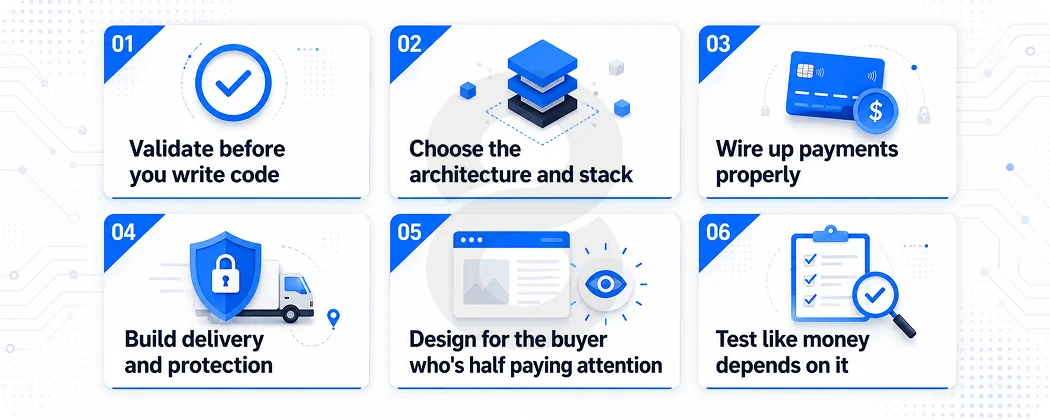
Validate before you write code
Sell something manually first. A payment link with a Google Drive folder and a thank you email is enough. If twenty strangers won’t buy your product through a janky manual flow, a beautiful platform won’t fix that.
Validation also tells you what kind of platform to build. You’ll learn whether you need a single storefront or a marketplace, downloads or gated access, one time purchases or subscriptions.
Each answer changes the architecture, and changing architecture mid build is how budgets double.
Choose the architecture and stack
Most modern builds land on a familiar pattern. React or Next.js on the front, Node.js or Laravel behind it, PostgreSQL for transactional data, and cloud storage with a CDN like CloudFront for file delivery.
The CDN part matters more than it sounds. Serving a 2GB video course from a basic server falls over the first time fifty people buy during a launch.
Teams that already run an in-house product sometimes skip hiring an agency entirely and just fill skill gaps through staff augmentation, which keeps architectural decisions inside the company.
Wire up payments properly
Stripe handles cards, subscriptions, and most fraud screening. PayPal still converts a surprising chunk of buyers who refuse to type card numbers anywhere.
The unglamorous work sits in the edges, like webhook handling for failed payments, idempotency so a double click doesn’t charge twice, and automated tax calculation through something like Stripe Tax.
Chargebacks on digital goods are brutal because there’s no shipping proof, so log delivery events obsessively. That log is your only evidence in a dispute.
Build delivery and protection
Generate unique, expiring, signed URLs for every purchase. Stamp buyer details into documents. Stream premium video through token authenticated players instead of handing out MP4s.
For software, automate license issuance and validation through an API. None of this is exotic engineering. All of it gets skipped by teams in a hurry, and all of it gets retrofitted later at triple the cost.
Design for the buyer who’s half paying attention
Real buyers shop from a phone, in a queue, with 4 percent battery. Product pages need previews, clear file format details, and social proof.
The path from landing to receipt should survive a distracted thumb. This is standard discipline for any team doing serious mobile app development, and it transfers directly to commerce web builds.
Test like money depends on it, because it does
Test failed payments, declined cards, double purchases, refunds, expired links, and concurrent downloads. Then soft launch to a small list before the public push. Every bug found by a friendly early buyer is a bug that didn’t become a one star review.
Build Custom or Rent a Platform
This is the decision founders agonize over most, so here’s the comparison without the sales pitch from either side.
Factor |
SaaS Platform (Gumroad, Shopify, etc.) |
Custom Build |
| Upfront cost | $0 to $5,000 | $40,000 to $250,000+ |
| Time to launch | Days | 3 to 6 months |
| Transaction fees | 3 to 10 percent forever | Payment processor fees only |
| Branding control | Limited, template based | Total |
| Feature ceiling | Hard limits, app workarounds | Whatever you can fund |
| Data ownership | Partial, platform dependent | Full |
| Scaling costs | Fees grow with revenue | Infrastructure grows with usage |
| Lock in risk | High | None |
The honest read is that SaaS wins early and custom wins later, and the crossover point arrives faster than people expect. A platform doing $50,000 a month on a 10 percent fee structure is handing over $60,000 a year. That’s most of a custom MVP, every year, for the privilege of renting.
The smarter pattern is sequencing. Validate on a rented storefront, then migrate to a custom digital product sales platform once revenue proves the model.
Teams that go custom from day one without validation are gambling. Teams that stay on SaaS three years past product market fit are paying a tax on indecision.
Companies that handle eCommerce store development end to end see both failure modes constantly, and the fix is almost always timing, not technology.
One more uncomfortable truth. Migration is never as clean as the plan says. Customer accounts, purchase history, and active subscriptions all have to move without breaking. Budget for that pain upfront.
What It Actually Costs
Vague cost ranges help nobody, so here are the real bands based on current market rates. A lean single seller MVP with payments, delivery, and basic protection lands between $40,000 and $80,000 with an experienced offshore or hybrid team.
A mid tier build with subscriptions, affiliate tracking, and richer analytics runs $80,000 to $150,000. A multivendor marketplace with vendor payouts, moderation, and AI driven discovery starts around $150,000 and climbs past $250,000 without much effort.
Where does the money actually go? Backend engineering eats the largest share, usually around 40 percent, because payment logic, delivery security, and data modeling are where complexity hides.
Design takes 15 to 20 percent. QA takes another 15, and skimping there is how launch week becomes refund week. The remainder covers project management, DevOps, and the integrations nobody scoped properly.
Then come the costs that never appear in the proposal. Maintenance runs 15 to 20 percent of build cost annually. Payment gateway fees take roughly 3 percent of every sale forever. Cloud and CDN bills scale with file sizes and traffic. Tax compliance tooling adds a monthly line item once you sell across borders.
Geography moves these numbers hard. The same scope quoted at $150 an hour in the US often lands at $40 to $60 with a strong offshore partner doing custom software development, which is the difference between an MVP and a full product for the same check.
Where AI Earns Its Place
AI is now the default checkbox on every platform pitch deck, and most of it is decoration. A few applications genuinely move revenue, and they’re worth naming specifically.
Recommendation engines come first. Showing a buyer who purchased a Notion template the matching dashboard pack lifts average order value in a way generic “related products” grids never did.
Semantic search comes second. Buyers who type “spreadsheet for tracking freelance invoices” should find your product even if your title says something completely different. Fraud scoring is the third, quietly flagging the stolen card patterns that digital goods attract because resale is instant and shipping addresses don’t exist.
Dynamic pricing and automated content tagging round out the useful list. Everything else, the AI chatbots and AI generated product descriptions, can wait until the core platform prints money. Teams exploring this seriously usually bring in dedicated AI development expertise rather than bolting on an API call and calling it a feature.
The sequencing rule holds here like everywhere else. Get the data in place first and build models second. AI features built before the platform has purchase history are guessing with extra steps.
Read More: How to Build a Dealer Management System for Modern Businesses
The Mistakes That Quietly Kill These Platforms
The failures in this space rarely look dramatic. Nobody’s server catches fire. The platform just slowly stops mattering, and the autopsy usually finds one of the same five wounds.
Overbuilding before validating is the most common. Teams spend six months and $120,000 on a marketplace nobody asked for, when a $500 landing page test would have killed the idea in a week.
Ignoring mobile is the second, which takes discipline to mess up in 2026 and yet here we are, with checkout forms that require pinch zooming to find the card field.
Treating tax compliance as a someday problem ranks third. The EU charges VAT on digital goods based on the buyer’s location, not yours, and several US states now tax digital products too. Retroactive compliance costs multiples of doing it right initially.
Fourth is launching without delivery logging, which turns every chargeback into an automatic loss. The fifth one stings the most. Building the platform and assuming buyers will arrive.
A digital product sales platform with no email list, content engine, and launch audience is a beautifully engineered empty room. Marketing isn’t a phase after development. It runs parallel to it, or the launch lands on silence.
None of these are technology problems. They’re sequencing problems, and sequencing is fixable with experience you can borrow instead of earning the expensive way.
Read More: How to Hire a Full Stack Developer in 2026: The Complete Guide for Tech Founders
Where 8ration Fits Into a Platform Build
Most teams arrive at this kind of project with one of three gaps. Some have a validated product and an audience but no engineering capacity.
Others have an in-house team that’s strong on the core product but has never built payment infrastructure or secure delivery systems. A third group has a half finished platform from a previous vendor that stalled somewhere between the demo and a real launch.
8ration has spent the past decade working across all three situations. The team has shipped commerce and marketplace products like Allie, a C2C platform connecting local buyers and sellers, which means the hard lessons around vendor payouts, transaction disputes, and checkout conversion were learned on live products rather than theory.
That experience shapes how projects get scoped. Discovery comes before estimates, architecture decisions get documented and explained, and the boring layers like delivery logging and tax handling are planned into the first phase instead of patched in after the first chargeback.
Engagement models flex with the gap being filled. A full build covers everything from validation workshops through post launch monitoring. Teams that only need specific skills, say a payments engineer or a React specialist for four months, can pull individual developers into their existing workflow instead of hiring an entire agency.
And stalled projects start with a code audit that produces an honest written assessment, including the occasions when the right answer is salvaging the existing codebase rather than rebuilding it.
The practical starting point is a conversation about what exists today, what revenue model the platform needs to support, and what the next six months should produce.