


If you are a game studio trying to budget your next project, here is the number you actually need: 2D animation for games typically costs $8,000 to $20,000 per minute of finished content, while cinematic quality 3D animation runs $15,000 to $50,000 or more per minute.
Both figures can swing dramatically based on scope, style, and who you hire. The format you choose is not just an aesthetic call. It is a financial decision that shapes your entire production pipeline, timeline, and long term asset strategy.
This guide breaks down every pricing variable that game studios face, from character cycles and cutscenes to full CGI trailers, so you stop guessing and start budgeting with real numbers.
The Question Nobody Answers Honestly: How Different Is the Price, Really?
The animation industry loves to quote per minute rates as if every minute is equal. It is not. A minute of idle walking cycles for a mobile RPG has nothing in common with a minute of orchestral scored cinematic combat. Same duration, wildly different budget.
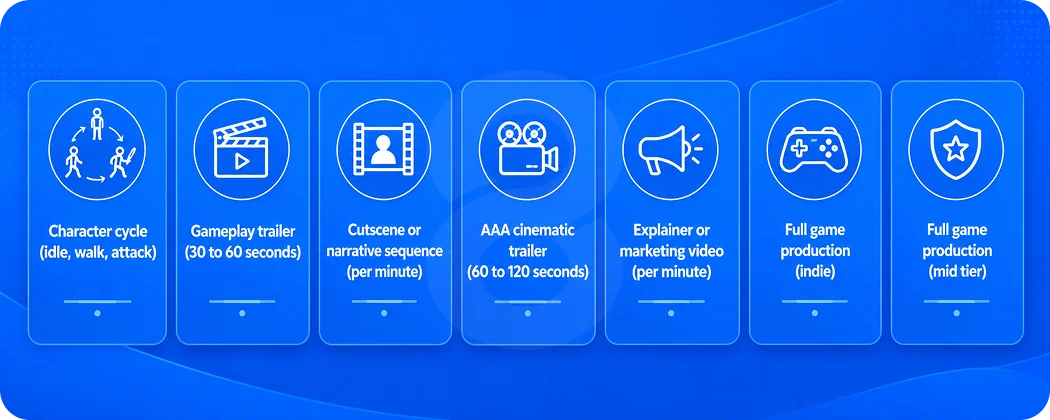
Here is what the actual ranges look like once you account for project type:
| Animation Type | 2D Cost Range | 3D Cost Range |
|---|---|---|
| Character Cycle (Idle, Walk, Attack) | $150 to $500 per Cycle | $400 to $1,200 per Cycle |
| Gameplay Trailer (30–60 Seconds) | $3,000 to $12,000 | $10,000 to $30,000 |
| Cutscene or Narrative Sequence (Per Minute) | $8,000 to $20,000 | $15,000 to $50,000 |
| AAA Cinematic Trailer (60–120 Seconds) | $20,000 to $80,000 | $80,000 to $500,000 or More |
| Explainer or Marketing Video (Per Minute) | $5,000 to $15,000 | $8,000 to $25,000 |
| Full Game Production (Indie) | $10,000 to $80,000 | $50,000 to $250,000 |
| Full Game Production (Mid-Tier) | $50,000 to $200,000 | $100,000 to $500,000 or More |
Ranges reflect studio level production. Freelancer rates sit 50 to 70 percent lower with corresponding quality variance.
The gap between 2D and 3D is real but it is not always the deciding factor. What closes or widens it is asset reuse, production scope, and your long term roadmap.
Read More: How Much Does It Cost to Make a Mobile Game?
Why 3D Costs More (And When That Changes)
Three dimensional animation involves production stages that simply do not exist in 2D pipelines. Before a single frame of motion is created, a 3D project requires concept modeling, UV mapping, texturing, rigging, simulation setup, scene lighting, and test renders. Each of these is a billable phase with its own specialist.
At a minimum, a standard gaming asset in 3D runs $3,000 to $12,000 per minute, while AAA character animation and cinematic cutscenes jump to $15,000 to $50,000 or more. Photorealistic outputs with motion capture, real time rendering through Unreal Engine Lumen, and original orchestral scoring can push beyond $500,000 for a single two minute trailer. That is the Blizzard benchmark for cinematic quality at that tier.
The turning point arrives with asset libraries. Once a studio has built a 3D character rig, that rig can be reused across trailers, in game cutscenes, social clips, and press kit animations. The second and third productions using that character cost a fraction of the first. In 2D, you largely start over each time. For game studios planning multi year franchises, 3D frequently delivers better cost per use economics.
Read More: 30 Best Character Design Ideas for Your Next Gaming Venture
Studios like 8ration that offer both dedicated 2D animation and professional 3D animation services can help you choose the format that aligns with your franchise roadmap before you commit a single dollar.
2D Animation Pricing Breakdown for Games: What You Are Actually Paying For
2D is not a single style. It is a spectrum. And where your project lands on that spectrum determines cost more than almost any other variable.
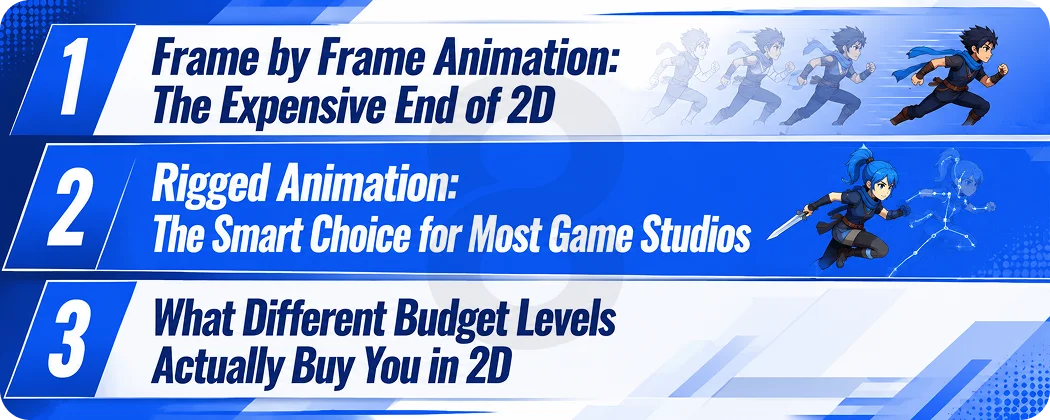
Frame by Frame Animation: The Expensive End of 2D
Frame by frame animation, sometimes called traditional or hand drawn, requires illustrating every frame individually. A one second sequence at 24fps means 24 unique drawings. This is the most expensive 2D approach and is typically reserved for premium cutscenes, animated game trailers with a hand crafted aesthetic, and anime influenced titles. Expect costs to start at $12,000 to $20,000 per finished minute at quality studios.
Rigged Animation: The Smart Choice for Most Game Studios
Rigged or puppet animation using tools like Spine or Moho uses pre built character skeletons that can be posed and keyframed rather than redrawn. This is the standard for most game production work. A single character animation cycle in Spine runs $150 to $500 depending on complexity, making it the most cost efficient way to fill a game with responsive, polished movement.
What Different Budget Levels Actually Buy You in 2D
At $5,000 to $10,000, you are typically getting a stylized 2D explainer or a short gameplay showcase. Solid motion graphics, a few character rigs, limited scene variety, and stock adjacent audio. Appropriate for indie launches, App Store preview videos, and social media campaigns.
At $20,000 to $50,000, you are entering narrative cutscene territory: multiple characters with full expression rigs, detailed environments, scene transitions, voiceover sync, and custom sound design. The kind of content that anchors an RPG story beat or opens a console title.
Above $100,000, you are commissioning feature quality 2D cinematics. The territory of premium anime style sequences used in high profile indie hits or mid tier console RPGs.
3D Animation Pricing Breakdown for Games: Where the Money Goes
Pre Production Costs Nobody Talks About
The invoice for a 3D animation project often surprises studios because the most expensive work happens before a single frame is animated. Modeling a production ready 3D character costs $1,000 to $5,000 per character at mid tier studios before animation even begins. Full body rigging adds $500 to $2,000 per character, and facial rigging for cutscene quality expression adds another $1,500 to $4,000. Pre production alone can represent 30 to 40 percent of your total project cost. This is not waste. It is infrastructure.
The Rendering Variable: Why 3D Timelines Run Longer
At standard 24fps, one minute of animation requires 1,440 individual frames to be rendered. High end cinematic renders with volumetric lighting, particle systems, and real world material shading can take hours per frame. Studios factor render farm costs, cloud GPU resources, and hardware into their quotes. This is a real cost with no 2D equivalent.
Real time rendering engines like Unreal Engine have changed this math significantly. Lumen and Nanite allow near cinematic quality at vastly reduced render times. This is why many game studios are now producing impressive 3D cinematics at budgets that would have been impossible five years ago. Working with a studio experienced in Unreal game development gives you access to this pipeline efficiency from day one.
Production Cost by Studio Tier in 3D
| Provider Type | 3D Cost Per Minute |
|---|---|
| Freelancer | $500 to $3,000 |
| Small Studio (2–5 People) | $3,000 to $7,000 |
| Professional Studio | $8,000 to $25,000 |
| Cinematic or Broadcast Quality | $25,000 to $50,000 or More |
| AAA Cinematic (Blizzard Tier) | $200,000 to $1,000,000 or More |
The 9 Variables That Actually Determine Your Quote
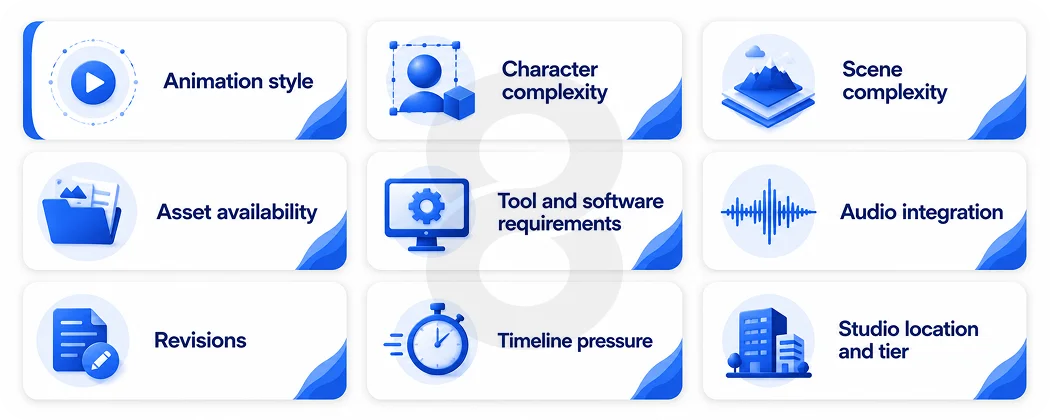
Forget per minute averages as standalone figures. These are the real levers that determine what you will be invoiced.
Animation style drives more variation than any other factor. Frame by frame 2D costs more than rigged 2D. Stylized 3D costs significantly less than photorealistic 3D.
Character complexity multiplies cost fast. A detailed character with full facial rigging costs 3 to 5 times more to animate than a simple silhouetted figure.
Scene complexity compounds with every additional element. Multiple simultaneous characters, dynamic environments, particle VFX, and destructible geometry all push costs upward.
Asset availability is the most controllable variable. If you bring existing 3D models and rigs, production costs drop significantly. If everything is built from scratch, budget accordingly.
Tool and software requirements shape specialist costs. 2D tools like Adobe Animate and Toon Boom are relatively accessible. 3D pipelines involving Maya, Houdini, or Cinema 4D require specialist skills and often expensive render infrastructure.
Audio integration is frequently underestimated. Professional voice acting adds $1,000 to $5,000 per minute. Custom music composition and sound design can add a similar amount on top.
Revisions are the most avoidable budget leak. Most studios include 2 to 3 revision rounds. Additional changes are billed hourly. Clear briefs and storyboards are the cheapest cost saving tool available.
Timeline pressure always adds cost. Rush delivery carries a 20 to 50 percent premium. A six week project compressed into three weeks does not halve the timeline. It increases the team size and the bill.
Studio location and tier affect rates but not as much as people assume. US based studios typically charge $150 to $200 per hour. Eastern European and Southeast Asian studios offer comparable quality at 20 to 50 percent lower rates. The tier of specialist matters more than the postcode.
Read More: Unity Game Engine: A Game Development Guide for Businesses
When 2D Is the Right Call (And When It Is Not)
Choose 2D When Your Project Fits These Conditions
Choose 2D when your game has a defined flat or painterly art style and 3D would break visual consistency. Select it when you are an indie studio with a budget under $50,000 for all animation needs, or when your characters require expressive, hand crafted movement quality that sells the aesthetic.
2D also wins when you need fast iteration cycles, since it allows you to test and revise concepts faster than a 3D pipeline allows. Platforms where performance optimization matters more than visual depth, especially mobile, tend to favor 2D as well.
When 3D Is the Clearly Better Investment
Do not choose 2D when your game world is fully three dimensional and 2D cinematics would create tonal dissonance. If you plan multiple trailers, ads, and cutscenes reusing the same characters, 3D is almost always the better financial decision.
Your target demographic and market position may also demand photorealistic or dimensional visuals that 2D simply cannot deliver. And for VR or AR projects, 3D spatial integration is a technical requirement, not a preference.
Studios building for web3 game environments where NFT character assets need to serve both in game use and marketing distribution often benefit from 3D pipelines that produce assets once and deploy them across every channel.
The most common mistake game studios make is choosing based on aesthetics alone. Budget over a full production cycle, not just the first deliverable, before deciding.
Read More: Ideas for Game Development: How Businesses Can Enter the Gaming Market
Hidden Costs That Blow Game Studio Budgets
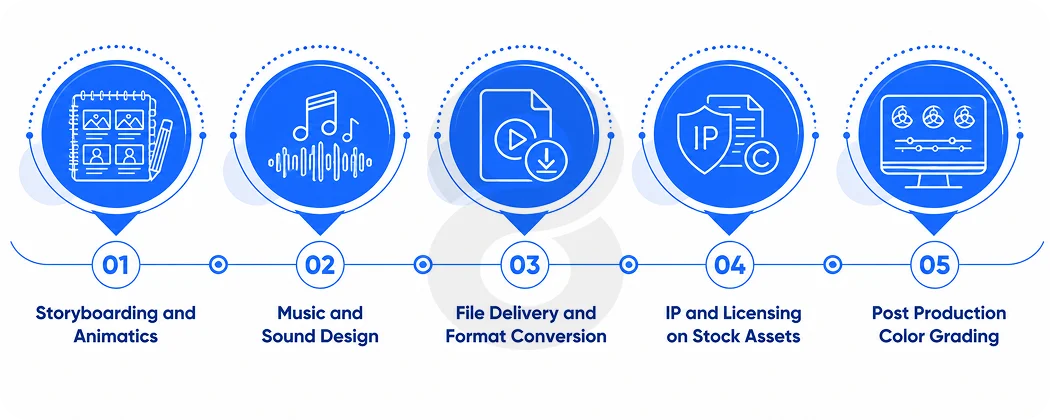
Industry data consistently shows that studios underestimate their animation budgets by 25 to 40 percent. The culprit is rarely the animation itself. It is the surrounding production infrastructure that adds up invisibly.
Storyboarding and Animatics
A proper pre production animatic is the most cost effective thing you can commission. It prevents expensive mid production pivots by locking in pacing, camera direction, and narrative beats before any animation begins.
Skipping this phase does not save money. It transfers the cost into revision fees that arrive later and hit harder. Budget $1,500 to $5,000 for a solid animatic on a 60 to 90 second cinematic project. If your studio partner does not offer this as a standard deliverable, ask for it explicitly before signing.
Music and Sound Design
A complete cinematic without a proper audio layer is only half finished. Custom orchestral scoring, professional Foley sound effects, and mixed audio mastering typically add $3,000 to $15,000 to a cinematic project depending on length and complexity.
Many animation studios quote animation only and leave the audio discovery to happen separately after the visual work is approved. Make sure your brief and your contract both include audio scope, even if it is handled by a separate specialist, so you are not blindsided at the finish line.
File Delivery and Format Conversion
Different platforms, game engines, and distribution channels require different export specifications. Unity and Unreal Engine each have distinct animation import requirements, and failing to address these in your production brief creates delays and additional billable hours at the worst possible moment, usually right before a launch deadline.
Confirm with your animation team before production begins which export formats are included in the scope and which will require additional conversion work. This is a five minute conversation that saves days of back and forth.
IP and Licensing on Stock Assets
Using stock character rigs or background elements without proper licensing creates downstream legal exposure that can surface long after delivery. It is one of the most overlooked risks in animation production for game studios that are trying to keep early phase costs low.
Always clarify asset ownership in your contract. If your studio partner is using third party assets in your deliverables, you need to know what licenses govern those assets and whether you have full commercial rights for the channels you plan to publish across.
Post Production Color Grading
Particularly in 3D cinematic production, color grading and compositing represent 20 to 25 percent of the post production budget. It is not a finishing touch.
It is a full production phase that ensures visual coherence between shots rendered at different times, creates the cinematic tone that makes premium game trailers feel premium, and prepares the final output for broadcast, digital, and social platform specifications.
Studios that skip or rush this phase deliver work that looks noticeably different from professional benchmarks even when the underlying animation is excellent.
Read More: What Are the Main Stages of Video Game Development
2D vs 3D at Different Budget Levels: Realistic Scenarios
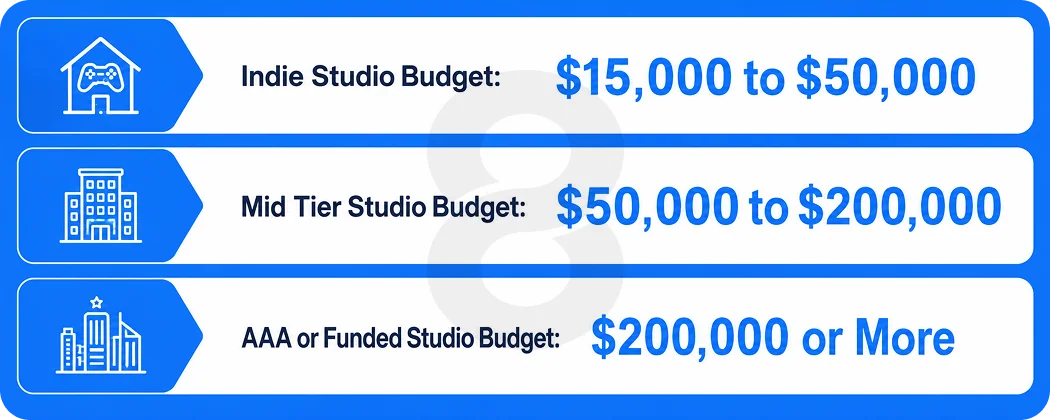
Indie Studio Budget: $15,000 to $50,000
At this level, 2D is almost always the better investment unless your game is already built in 3D with existing assets. A $20,000 2D animation budget can deliver a polished 60 to 90 second gameplay trailer with character cycles, custom backgrounds, motion design, and sound. That is enough to run a successful crowdfunding campaign or secure App Store featuring.
3D at $15,000 to $20,000 produces serviceable marketing content but typically at a stylized or mid tier quality level. The pre production overhead of 3D leaves less room for the actual animation work.
Mid Tier Studio Budget: $50,000 to $200,000
This is where the decision becomes genuinely strategic. At $100,000, 2D delivers 4 to 8 minutes of high quality cinematic content with narrative depth, voice acting, and original music. At the same budget, 3D delivers 2 to 4 minutes of stylized cinematic content but builds a reusable asset library worth multiples of the initial spend for future campaigns.
If your release is a one time launch, 2D maximizes content volume. If you are building a franchise, 3D maximizes long term return. Working with an experienced game development partner at this stage helps map the decision against your full release roadmap before you commit.
AAA or Funded Studio Budget: $200,000 or More
At this level, the conversation shifts from which type to what pipeline. Most AAA titles use a hybrid approach: 3D character rigs and environments as the foundation, with hand animated 2D elements such as UI, stylized effects, and cutaway sequences for aesthetic contrast and cost efficiency. This is how studios produce visually distinctive titles that do not look like everything else in the market.
Read More: What Are AAA Games? Breaking Down the Biggest Titles in Gaming
How 8ration Serves Game Studios Across Animation Formats
8ration has been building digital products, with game development and animation as two of its core practice areas. The team works across the full spectrum of game animation, from mobile 2D character cycles to Unreal Engine cinematic sequences, serving studios from indie to mid tier scale across PC, console, and mobile platforms.
Rather than pushing every project through a fixed workflow, 8ration scopes each engagement based on the game’s existing asset state, target platforms, release timeline, and reuse requirements. For studios already built in Unity or Unreal Engine, the team integrates directly with the existing tech stack.
Read More: How to Hire the Best Game Development Team for Your Project