



It’s a Friday night and you are staring at a blank time entry for Tuesday. The work from that day is finished and already half forgotten. Was the call with the Hendersons 0.4 hours or 0.6? Did the back and forth with opposing counsel count as billable work or just noise between tasks?
Three days later, nobody can say for sure. So you shrug, round down to be safe, and another chunk of real, completed work quietly slides off the books forever.
That moment, multiplied across every attorney in your firm, every week of the year, is the entire problem in one image. The work got done but the billing never followed.
The data on this is grim. According to Bloomberg Law’s Attorney Workload and Hours Survey, lawyers reported working an average of 48 hours a week while billing only 36. That twelve hour weekly gap works out to about 600 hours a year per attorney spent on things no client ever pays for.
Clio’s research puts it even more bluntly, finding the average lawyer bills just 2.9 hours out of a standard eight hour day. So the question that should keep firm owners up at night is not whether their people work hard enough. They are exhausted. The question is why so little of that work turns into revenue.
A lot of the time, the honest answer is the software. Or the lack of it. The right legal software for law firms closes the gap by catching the time you already worked, organizing the cases you are already running, and getting bills out the door before the details go fuzzy.
Why Legal Software for Law Firms Stopped Being Optional
For years, a decent firm could run on a calendar, shared drive, billing spreadsheet, and a lot of human memory holding the whole thing together. That worked until it did not.
You can see the shift in where the money is going. Legal tech was worth about $33.97 billion in 2025, and the projections have it passing $77 billion by 2034, with practice management tools growing faster than almost anything else in the category.
Numbers that size do not come from firms chasing a trend. They come from thousands of partners who sat down with their books one day, did the math on what manual admin was actually costing them, and decided the spreadsheet era was over. The bleeding never shows up as one line item, which is exactly why it took so many firms so long to notice it.
And the bleeding is specific. Missing just 15 minutes of billable time a day costs a single attorney around $18,000 a year. Delay your time entries and the damage compounds. Record them at the end of the day and you lose about 10 percent of the hours. Wait until the next morning and a quarter is gone. Let a week slide by and half the billable time vanishes.
Good legal practice management software stops the slow leak. It captures time as work happens, keeps every matter in one place, and turns billing from a dreaded monthly chore into something that mostly takes care of itself. The firms that figured this out are keeping more of the hours they already work.
Where Ready Made Legal Platforms Quietly Fail
Off the shelf platforms are genuinely good at getting you started. You sign up, import some contacts, watch a tutorial, and you are running by lunch. The trouble shows up about six months later, when your firm’s actual way of working keeps colliding with the software’s opinion about how a firm should work.
Maybe you handle contingency, hourly, and flat fee matters under one roof, and the billing module only really respects one of those models. Your intake process has five careful steps, but the tool gives you two text fields. The vendor has never heard of the court rules and filing requirements in your practice area.
So your team builds workarounds. Someone keeps a side spreadsheet. Another person pastes data between systems by hand every Friday. The tool you bought to kill admin work starts generating its own admin work, and nobody at the firm can quite say when that happened either.
A purpose built system flips the relationship. Instead of reshaping your firm to fit the product, you get custom software shaped around your firm from the first planning session.
Custom legal software for law firms can model your matter types, your approval chains, your fee arrangements, and your reporting exactly as they exist in your practice, not as a generic vendor imagined them for an average customer who does not exist.
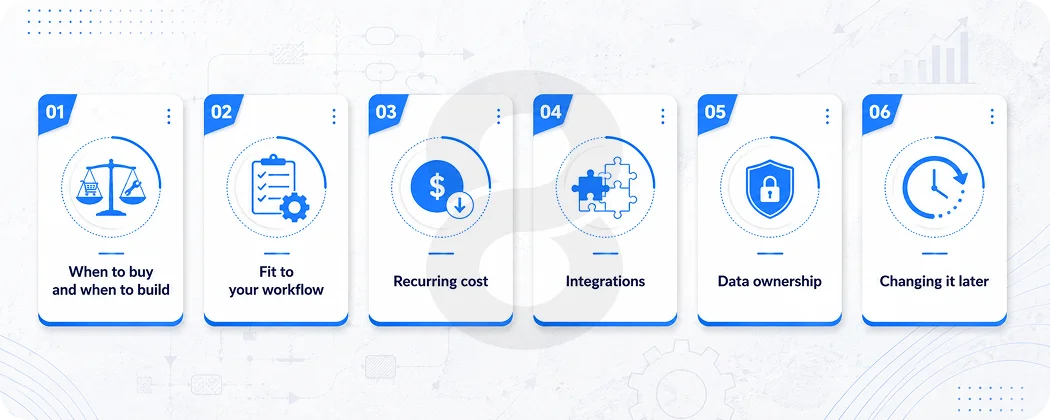
When to buy and when to build
This is not a sermon claiming custom always wins. For a two person practice running standard hourly matters, a subscription tool is often the smart, cheap, sane choice. The build conversation gets serious in three situations. Your workflow is genuinely yours and the workarounds are multiplying.
You are stitching three or four tools together to cover gaps and paying for all of them. Or the data trapped inside someone else’s platform has become a strategic risk you can no longer ignore.
What You Deal With |
Ready Made Platform |
Custom Built Platform |
| Fit to your workflow | You adapt to its structure | It maps to your matters and fee types |
| Recurring cost | Per seat fees forever, rising over time | Higher upfront, lower long run cost at scale |
| Integrations | Whatever the vendor supports | Connected to your filing, accounting, and email exactly how you need |
| Data ownership | Lives on the vendor’s terms | Sits with your firm under your control |
| Changing it later | Wait for a roadmap you do not control | Built and updated on your schedule |
What Custom Legal Software Does for Case Management, Billing, and Workflow
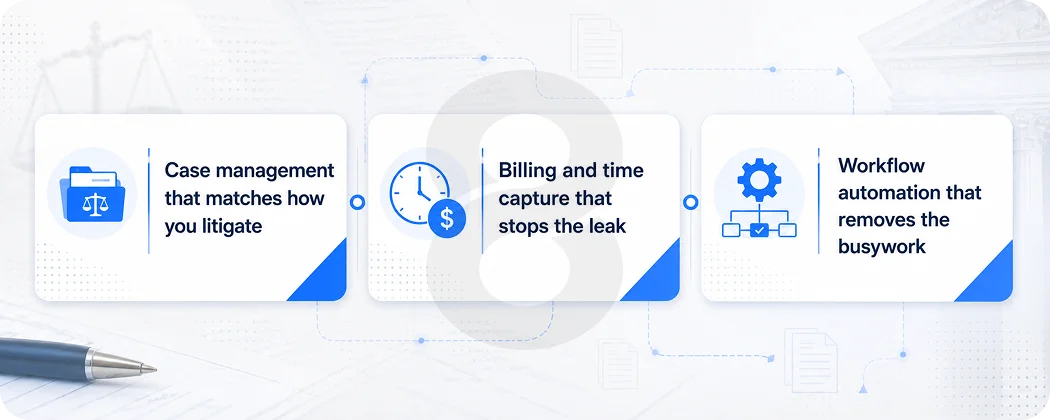
Strip away the marketing language and the value of legal software for law firms comes down to three jobs done well. Hold every case in one organized place.
Bill accurately without anyone hating their life. Move work through the firm without tasks falling between people. Here is what each one looks like when it actually works.
Case management that matches how you litigate
Matter management is the spine of the whole system. Every document, deadline, note, email, and contact tied to a single case, reachable in seconds instead of dug out of three inboxes and a paralegal’s memory.
A custom approach lets you organize matters by your practice areas and your stages, with the court deadlines and document templates each matter type actually needs. Litigation matters get discovery timelines and motion calendars.
Transactional matters get closing checklists and signature tracking. Plenty of firms pair this with proper intake and client relationship tracking so a promising lead never gets lost in the gap between the first phone call and the signed engagement letter.
Read More: Best Case Management Software for Law Firms: Build vs Buy Explained
Billing and time capture that stops the leak
This is where most of the hidden money lives. The strongest setups capture time passively, watching the work as it happens and suggesting entries instead of waiting for an attorney to reconstruct the day at midnight.
From there, invoicing generates straight from logged work. The system applies the right rate to the right matter, respects the fee arrangement, handles trust accounting rules without manual reconciliation, and gets bills out while the work is still fresh in everyone’s mind.
Faster, cleaner invoices also get paid faster, which is its own quiet win for cash flow that compounds month after month.
Read More: Best Law Firm Billing Software: Why Custom Solutions Beat Off-the-Shelf Tools
Workflow automation that removes the busywork
The third job is moving things along without anyone nagging. Automated reminders fire before deadlines instead of after them. Document assembly fills templates from matter data so nobody retypes a client’s address for the fortieth time.
Status updates reach clients without an attorney drafting them by hand. Clio’s research found that growing firms lean on automation twice as much as stable firms, and firms with wide AI adoption are nearly three times more likely to report revenue growth than firms that have not adopted it at all.
The pattern holds across firm sizes. Take repetitive work off your most expensive people and let them do the work only they can do.
The Daily Problem |
What the Software Does |
What Changes |
| Time logged from memory at day’s end | Captures activity as it happens, suggests entries | More hours billed, less revenue lost |
| Documents scattered across drives and inboxes | One organized home per matter | Find anything in seconds |
| Clients calling for status updates | Self serve portal with live case progress | Fewer interruptions, happier clients |
| Drafting the same documents over and over | Templates filled from matter data | Hours back per week per attorney |
| Billing month built by hand | Invoices generated from logged work | Faster bills, faster payment |
A growing share of this now runs on AI development. Modern tools can read, sort, and summarize case documents in a fraction of the time a paralegal would need, flag the clauses that matter in a contract stack, and pull key dates out of discovery files automatically.
Read More: How to Build a Contract Management System for Law Firms
Clio’s analysis suggests up to 74 percent of hourly billable tasks could be automated to some meaningful degree, which says less about replacing lawyers and more about how much of a lawyer’s day was never really legal work to begin with.
The Security Question Firms Avoid Until It Costs Them
Here is the uncomfortable truth. Law firms are a goldmine for attackers. You hold trade secrets, financial records, settlement terms, personal data, merger details, and privileged communications, all gathered in one place.
Criminals know it, and they have noticed that most firms defend that goldmine with less rigor than a mid sized retailer protects its inventory system.
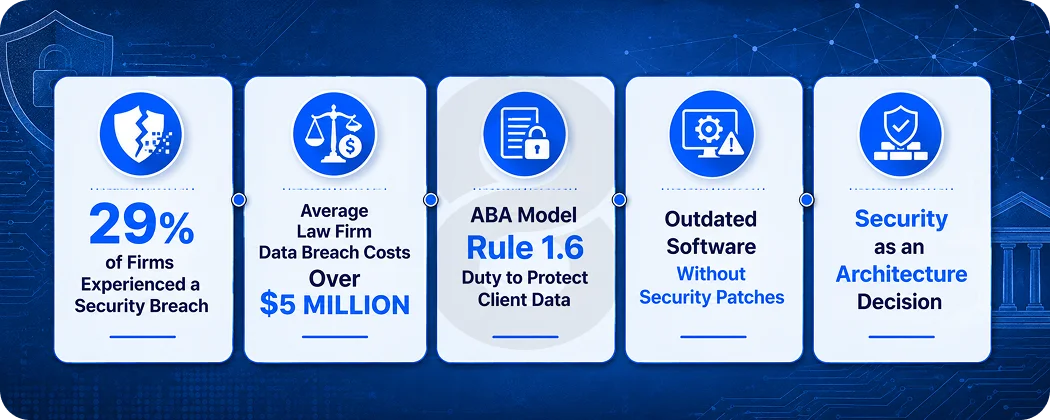
The numbers back the worry. Roughly 29 percent of firms experienced a security breach in a recent year according to the American Bar Association (ABA), and the firm reporting on law firm cyberattacks shows incidents trending up, not down.
The Financial and Ethical Fallout
The cost is not small. For law firms, the average data breach has climbed past $5 million, and the majority of breached firms lose sensitive client information in the process.
Beyond the financial hit, attorneys carry an ethical duty under ABA Model Rule 1.6 to make reasonable efforts to protect client data. A breach drains money first, and professional liability with bar consequences can follow right behind it.
With a custom platform, security stops being a checkbox on someone else’s feature list. Encryption, who can see what, audit trails, backups, all of it gets designed around your actual obligations in the very first architecture meeting, while there is still time for the answers to shape the system.
Compare that to the alternative, which is signing up for a generic tool and quietly hoping its defaults happen to cover your jurisdiction and your practice areas. Hope is doing a lot of work in that sentence.
It gets worse when you remember the ABA found a large share of firms still running software so old it stopped getting security patches years ago, which in attacker terms is a door propped open with a brick.
Building security in from day one costs a fraction of cleaning up after the day it fails. Ask anyone who has lived through the second scenario. They tend to have strong opinions and a very specific look on their face when the topic comes up.
How 8ration Approaches Legal Software Projects

A lot of agencies will happily build whatever you describe, hand over the code, and disappear at launch. That is rarely the useful version of this work. The useful version starts earlier and ends later.
It begins with sitting beside your team and finding where the hours and the money leak before a single line of code gets written. Most firms are surprised by what that mapping reveals. The leak is almost never where the partners assumed it was.
That diagnostic first approach is how 8ration builds legal software shaped around how your matters actually move. Case management, billing, time capture, document automation, client portals, and the AI pieces that handle document review all get built to match your practice areas and fee structures rather than forcing your firm into someone else’s mold.
Nobody needs a longer feature list. The aim is software that disappears into the background so completely that your attorneys forget it exists and just practice law.
Firms also do not need a sprawling rebuild on day one, and pretending otherwise is how projects die. Sometimes the smarter move is starting with the single workflow bleeding the most money, usually time capture or billing, proving the value in a quarter, and expanding from there.
And when a firm already has its own technical lead but needs more hands to move faster, bringing in experienced engineers who slot into your existing team keeps the project moving without the overhead of a fully external build.
The end state for good legal software for law firms is honestly pretty boring, and that is the highest compliment available. The system works so quietly that you stop thinking about it. You only notice that the Friday night time entry ritual is gone, and nobody misses it.