

Everyone has a better idea than Tinder. Some of them are correct. However, there is a difference between a good idea and a successful product, and the difference lies in dollars, hours of development time, and post-launch nights without sleep.
The online dating market is expected to reach $10.77 billion by 2026 and is expected to increase by 9.3% per year. Dating apps have over 350M users globally but the majority of revenue goes to a few big names. It’s not just a good concept if you want to get a slice.
The retention rate on day-1 is only 26%. After day 7, 12% of users are still using the product. Everything you do after you sign up, everything you do after you match, everything you do on the website, is judged in that first 24 hours. This is where the dating app development cost becomes vital before giving your money to the founder.
How Much Does It Cost to Make a Dating App in 2026?
There’s no clean single number here. Anyone who gives you one without asking questions is guessing. The dating app development cost depends on what you’re building, where your team is, and how honest you’re being with yourself about the features users actually need.
That said, here’s a realistic range based on where the market sits in 2026:
| App Type | Feature Scope | Estimated Cost |
|---|---|---|
| Basic MVP | Profiles, swipe, text chat | $25,000 to $60,000 |
| Mid-range | Geolocation, filters, push notifications, payment integration | $60,000 to $150,000 |
| Advanced and AI-Powered | AI matching, video calls, identity verification, moderation | $150,000 to $300,000+ |
| Enterprise Scale | Full AI, multi-region compliance, real-time features, proprietary algorithms | $300,000 to $400,000+ |
In 2026, dating app development usually costs $15,000 to $60,000 for a basic MVP and $70,000 to $350,000+ for full-scale apps with AI matchmaking, video calls, and multi-region compliance.
Most competitive products realistically fall in the $60,000 to $150,000 range, covering strong design, matching logic, safety systems, and monetization. Lower budgets typically mean stripped-down features or unrealistic pricing aimed at closing deals rather than building viable products.
Read More: Mobile App Development Cost 2026
Key Factors Influencing Dating App Development Cost
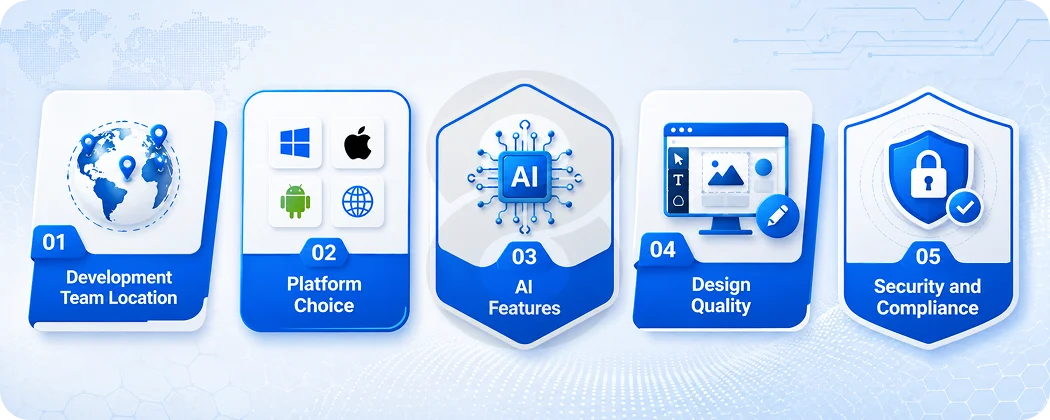
Development Team Location
This is the biggest variable by far. Developer hourly rates vary considerably, sitting at $100 to $150 per hour in the USA and Western Europe, $40 to $70 in Eastern Europe, and $20 to $50 in India. A three-to-six month build might cost $50,000 with an offshore team and $200,000+ with a US agency. Neither choice is wrong. They’re just different tradeoffs between cost, communication overhead, and timezone alignment.
Platform Choice
Building natively for iOS and Android separately costs 15 to 30% more than using a cross-platform framework like Flutter or React Native. For most early-stage products, cross-platform is the smarter call.
AI Features
This is where 2026 really is different from 2022. Dating apps with no AI matching, AI moderation or AI safety features are not competitive. Those features costs something. You can get an additional $30,000 to $60,000 for your build with a machine learning matching system. Content moderation AI adds another $10,000 to $25,000. These aren’t extras anymore. They’re table stakes.
Design Quality
Custom UI/UX design comes with a higher price tag than templates but is the differentiating factor between apps that are used and those that are abandoned during the first week of use. With the first-week retention rate at 12%, this is the last thing that needs to be skimmed.
Security and Compliance
Dating apps handle sensitive personal data including location, photos, payment information, and private messages. End-to-end encryption, GDPR/CCPA compliance, and identity verification aren’t optional in any market you’d want to operate in. Budget for them upfront.
Feature-by-Feature Cost Breakdown
Every feature you add multiplies development time. Here’s what the major components actually cost, broken out honestly.
Core features every dating app needs
| Feature | Estimated Development Cost |
|---|---|
| User registration and profiles | $3,000 to $8,000 |
| Swipe and matching interface | $5,000 to $12,000 |
| Real-time text chat | $5,000 to $10,000 |
| Push notifications | $2,000 to $4,000 |
| Basic search and filters | $3,000 to $7,000 |
| Admin panel and moderation tools | $5,000 to $10,000 |
These essential features typically consume 500 to 800 developer hours. That’s your floor. Everything beyond this list is what separates an MVP from a competitive product.
Advanced features where costs climb fast
| Feature | Estimated Development Cost |
|---|---|
| AI and ML matching algorithm | $15,000 to $40,000 |
| Video calling via WebRTC | $8,000 to $25,000 |
| Video profiles | $8,000 to $25,000 |
| Identity verification | $5,000 to $15,000 |
| In-app payments and subscriptions | $5,000 to $12,000 |
| Geolocation features | $4,000 to $8,000 |
| AI content moderation | $10,000 to $25,000 |
| Virtual gifting and in-app purchases | $6,000 to $15,000 |
A machine learning matching system that considers explicit preferences, implicit signals like who you message first and how long conversations last, and collaborative filtering drives 40 to 80% higher mutual match rates than rule-based filters. Users feel that difference. It’s worth the investment if you’re serious about retention.
AI-powered identity verification integrations add $5,000 to $10,000 to build and $0.50 to $2.00 per verification in ongoing API costs. That ongoing API cost is something a lot of founders forget to plan for.
Developer Rates by Region: Where Your Money Actually Goes
One of the most practical decisions in the entire process is where you hire. This table gives you a real sense of the spread:
| Region | Hourly Rate | Notes |
|---|---|---|
| USA and Canada | $100 to $250/hr | Highest quality oversight, timezone alignment, premium cost |
| Western Europe | $80 to $150/hr | Strong quality, favorable for European market products |
| Eastern Europe | $40 to $90/hr | Reliable quality, growing AI talent pool |
| India and South Asia | $20 to $50/hr | Cost-effective, large talent pool, strong output when well-managed |
| Southeast Asia | $25 to $60/hr | Growing ecosystem, solid cross-platform expertise |
Working with a dating app development company in USA means paying for local expertise, project management, and communication that doesn’t require 9 p.m. calls. For some founders, that’s worth every dollar. For others, an offshore team with solid references and structured processes gets the same outcome at 40% of the price.
What doesn’t change across regions is the cost of bad decisions. Unclear requirements, scope creep, and underfunded design phases hurt your timeline and budget wherever your team is based.
The Hidden Costs Nobody Puts in the Estimate
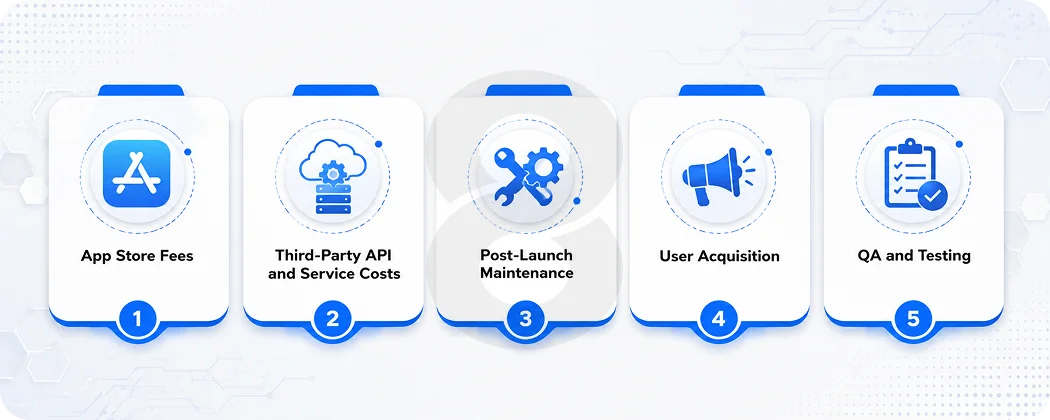
Here’s where a lot of first-time founders get hurt. The development quote covers development. It doesn’t always cover everything else you need to have an actual product in market.
App Store Fees
Apple charges $99/year for the App Store. Google Play is a one-time $25. Neither is expensive, but both come with review processes that can delay your launch by days or weeks if your app trips content filters, which dating apps sometimes do.
Third-Party API and Service Costs
This is where ongoing spend adds up fast. Cloud hosting on AWS or Google Cloud runs $500 to $3,000/month at moderate scale. Payment processing through Stripe takes 2.9% plus $0.30 per transaction. SMS verification services, analytics platforms, and push notification tools each add monthly fees that nobody mentions in the initial estimate.
Post-Launch Maintenance
Most experienced teams will tell you that maintenance runs 15 to 20% of your original development cost annually. For a $100,000 build, that’s $15,000 to $20,000 per year in bug fixes, OS updates, performance optimization, and feature additions. Plan for it from day one.
User Acquisition
This one’s the big one that technical people forget. Building the app is only half the problem. Dating apps require a critical mass of users to work, and nobody wants to be the only person on the platform. Paid services generated nearly 70% of dating app market revenue in 2025. Getting users to that paywall requires marketing spend that can easily equal or exceed your development budget in year one.
QA and Testing
A dating app has real-time features, payment flows, location services, and user-generated content, all of which need thorough testing across devices. Budget 15 to 20% of your development cost for QA. Skipping it means finding bugs in production, which is infinitely more expensive.
Read More: iOS App Development Cost in 2026: A Detailed Guide
iOS vs Android vs Cross-Platform: What Should You Build First?
iOS drives approximately 80% of mobile revenue in the dating app industry. If you’re targeting the US market and need to prove monetization fast, start there. Those users skew higher-income, more willing to pay, and more likely to leave reviews.
If you’re targeting a broader global audience or an Android-dominant market, that math changes. Building cross-platform with Flutter or React Native gives you both platforms at significantly lower cost than two separate native builds. The tradeoff is some loss of native polish, though for most dating apps that gap has narrowed considerably.
A solid iOS app development process starts with knowing which platform your early adopters actually live on.
| Platform Strategy | Approximate Cost Premium | Best For |
|---|---|---|
| iOS only (Native) | Baseline | US and UK markets, early monetization |
| Android only (Native) | Similar to iOS | Emerging markets, broad global reach |
| Cross-platform via Flutter or React Native | +10 to 15% over single native | Budget-conscious builds, faster time to market |
| Both native iOS and Android | +40 to 60% over single platform | Enterprise, well-funded, established market |
AI Features in Dating Apps: What They Cost and Why They Matter
This section has shifted most in recent years AI in dating apps is now the baseline not a differentiator Strong compatibility prediction can double or triple message initiation rates as users quickly sense smarter matching boosts retention usage and engagement
AI Matching and Recommendation Engine
This is the core of what makes modern dating apps work. Machine learning models that analyze behavioral signals, like who you message, how long conversations last, and what profiles you skip, drive dramatically better match quality than static preference filters. Budget $15,000 to $40,000 for a real implementation.
AI Content Moderation
Content moderation at scale is a non-negotiable for any dating platform. Users sending inappropriate images, fake profiles, and harassing messages are realities of the space. Automated moderation catches most of it before it damages your user experience. Budget $10,000 to $25,000 to build it in from the start.
Identity Verification
Users explicitly check for verification badges before engaging with matches. This has moved from a nice-to-have to a trust signal that affects whether people actually use your app. AI-powered identity verification solutions like Persona or Onfido add $5,000 to $10,000 to your build cost plus ongoing per-verification API fees.
AI-Powered Onboarding
The drop from day-1 to day-7 retention is steep in dating apps. Even small improvements in onboarding quality translate to real revenue. AI that adapts the onboarding flow based on user behavior, asking smarter questions, surfacing better initial matches, and reducing time-to-first-conversation, can meaningfully move that number.
The AI development conversation for a dating app starts before the first wireframe. What behavioral signals will train your model? What data do you collect in onboarding? How does your algorithm improve over time? These aren’t questions to answer after launch.
Read More: Flutter App Development Cost in 2026
Monetization Models: How Dating Apps Actually Make Money
You can’t talk about dating app development cost without talking about how you get it back. The revenue model affects the features you build, the UX you design, and how much you can afford to spend acquiring users.
Paid services generated nearly 70% of dating app market revenue in 2025, with subscriptions leading while revenue from micro-transactions and virtual gifting is growing.
| Revenue Model | How It Works | Best For |
|---|---|---|
| Freemium subscription | Free basic access, paid tier unlocks features | Mass-market apps |
| Premium-only | All features behind a paywall from day one | Niche, high-intent audiences |
| In-app purchases | Virtual gifts, boosts, super-likes sold individually | Engagement-focused revenue |
| Advertising | Banner or native ads for free users | High-volume apps |
| Hybrid | Subscription plus in-app purchases plus ads | Enterprise scale, maximizes LTV |
Most modern apps run hybrid models. A freemium base brings users in, subscriptions convert the serious ones, and in-app purchases generate additional spend from engaged users who don’t want to commit to monthly billing.
Build your monetization layer into the product architecture from the start. Payment gateway integration, subscription management, and in-app purchase flows are not things you want to retrofit into an existing codebase six months after launch.
How Long Does It Take to Build a Dating App?
Timeline and cost move together. Here’s a realistic view of what different build scopes require:
| App Type | Estimated Timeline |
|---|---|
| Basic MVP | 2 to 4 months |
| Mid-range with AI matching | 4 to 6 months |
| Full-featured with video and compliance | 6 to 9 months |
| Enterprise-scale platform | 9 to 14 months |
These timelines assume a competent team with clear requirements. Scope changes mid-build, unclear requirements, or underfunded design phases push everything back. The single best thing you can do to protect your timeline is to invest in discovery and wireframing before development starts. A week of UX work upfront saves a month of rebuilding later.
The startup app development process works best when the product vision is clear, the MVP scope is constrained, and the team has experience shipping dating or social apps specifically. Domain knowledge matters more than people expect in this space.
Read More: Mobile App Development Timeline: 2026 Guide
Niche vs General: Does Your Dating App Concept Affect the Cost?
General dating apps compete directly with Tinder, Bumble, and Hinge. That’s a difficult position for a new entrant without serious marketing budget. Niche dating apps built around religion, profession, lifestyle, or community have smaller but far more engaged user pools.
The development cost difference between niche and general isn’t dramatic. The features are largely the same. The AI requirements shift though. Niche apps need precise compatibility signals and strong community moderation rather than broad matching across millions of profiles.
What changes significantly is user acquisition cost. A niche app can reach its audience through targeted channels at far lower cost per install than a general app competing in a saturated market. That’s a real business advantage that affects your total investment picture, not just your development budget.
Read More: 20 Popular Dating Apps for 2026
Maintenance, Updates, and the Real Long-Term Cost
Dating apps demand continuous investment unlike other categories. OS updates break features, security patches are mandatory, paying subscribers expect new features, content moderation needs refinement, and AI matching requires ongoing engineering.
Budget 15–20% of original development costs annually for maintenance. A $100,000 build needs $15,000–$20,000 yearly; a $250,000 platform requires $37,000–$50,000. These aren’t optional; they’re essential to remain functional and competitive.
Your development partner matters. One who disappears after launch leaves you scrambling when updates break critical features like push notifications. Ongoing maintenance relationships are worth the investment.
Read More: The Real Cost of App Maintenance: What Budget Percentage Should You Allocate?
Build a Dating App Users Actually Want to Open Again
Most dating apps fail because they focus on features instead of user behavior. At 8ration, we build dating platforms around engagement, trust, and retention from the very first screen.
From AI-driven matchmaking and seamless messaging to identity verification and monetization systems, every feature is designed with growth in mind. We help founders launch scalable dating apps that not only attract users but keep them coming back long after the first match.