


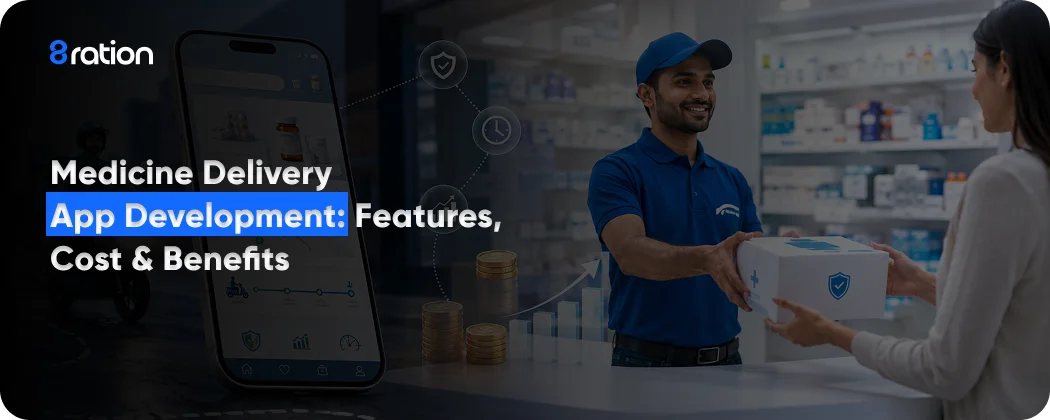
Three weeks into a medicine delivery app development project, somebody on the team finally says out loud what everyone’s been thinking. The pharmacy partner still can’t keep their stock numbers straight, and no amount of clever code fixes a partner who updates inventory once a day on a good day.
On a slide, none of this looks hard. Patient opens the app, uploads a prescription, and medicine shows up an hour later. Everyone nods in the meeting.
Then the build actually starts. Pharmacist licensing turns into its own small project. HIPAA paperwork shows up that nobody budgeted time for. The delivery fleet needs real routing instead of a placeholder map pin. And the payment system has to talk to insurance providers too, quietly, without ever dropping an order.
That gap between the slide and the actual build is the whole subject of online medicine delivery app development, once you’re past the pitch. What to build first. What it actually costs once the estimate stops being a guess. Where teams quietly burn through budget without anyone noticing until it’s mostly gone.
What is Medicine Delivery App and How Does It Work
A medicine delivery app is a mobile or web platform that lets someone order prescription drugs or over the counter products and get them delivered, usually within a few hours rather than a few days. That’s the simple version. The honest version involves four separate user experiences stitched together into one product.
Patients need to search for medicine, upload a prescription, pay and track an order. Pharmacists need a queue of incoming prescriptions to verify, stock levels to manage, and a way to flag anything that looks off.
Delivery agents need assigned routes, proof of delivery, and earnings they can actually see. And someone on the business side needs a dashboard that shows whether the whole operation is making money or losing it.
Most online medicine delivery app development projects fall apart not because any single piece is hard but because nobody planned for how these four groups interact. A pharmacist approves an order.
The system has to tell the delivery agent… delivery agent updates a status… the patient has to see that update within seconds. That coordination, more than any single feature, is what separates a working pharmacy app from a demo that looks fine in a pitch meeting.
Read More: Custom Pharmaceutical Software Solutions: A Guide for Growing Pharma Companies
Benefits of Medicine Delivery App Development for Pharmacies and Startups
Ask anyone who has tried to refill a prescription at 9pm on a Friday why this market exists, and you’ll get your answer fast. Pharmacies close. Chronic conditions don’t wait for business hours. And a generation that already orders groceries and dinner through an app sees no reason medicine should work differently.
The numbers back up the gut feeling. Analysts at Fortune Business Insights put the global online pharmacy market at around 177 billion in 2026, with projections pushing past 733 billion by 2034. That’s not a niche anymore. It’s a sector pharmacy chains, hospital systems, and venture funded startups are all fighting over at the same time.
What’s pulling people toward this specific corner of healthtech, rather than general medical apps, is the recurring nature of the demand. Someone managing diabetes or high blood pressure doesn’t order once.
They order every month, sometimes every few weeks, for years. That kind of repeat behavior is rare in consumer apps, and it’s exactly why investors keep funding this category even when the regulatory overhead scares off less patient founders.
None of this means the market is easy to win. It means the upside is large enough that cutting corners on compliance or logistics costs you the business faster than it would in almost any other app category.
How Medicine Delivery Apps Work From Prescription to Doorstep
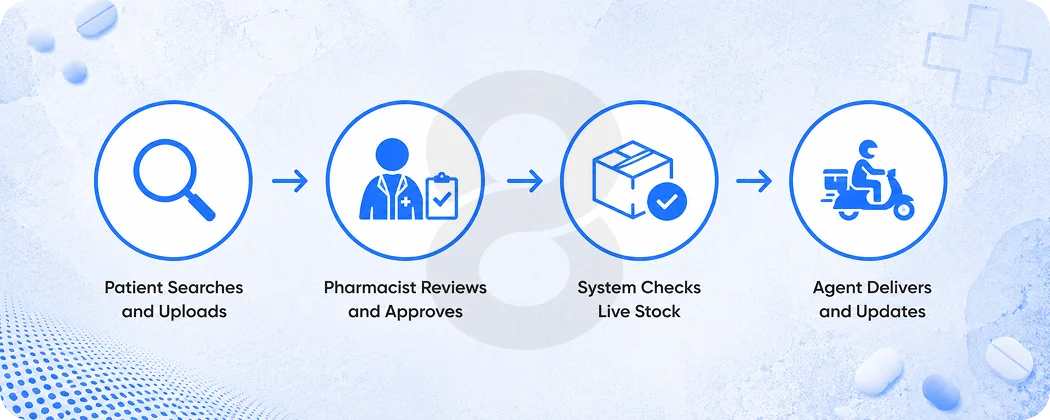
Strip away the marketing language and a medicine delivery app does the same eight or nine things every time, just with different polish depending on the budget behind it.
A patient’s identity gets checked first, and that’s not just box ticking. Nobody wants a stranger ordering controlled substances under somebody else’s name, so that step happens before anything else does.
From there it’s the usual routine. Search for the medicine. Upload the prescription if one’s needed. The system runs that image against pharmacy records, or lets OCR do the heavy lifting and pull the drug name and dosage straight off the page.
A real pharmacist still reads every prescription that comes through. That part never gets automated away. What AI actually does well is catch the orders worth a second look. A dosage that doesn’t add up. A prescription that’s expired. Handwriting nobody can make out. Flag those, and the pharmacist stops rubber stamping everything and starts spending time where it actually counts.
Once approval comes through, the order goes hunting for stock. Whichever pharmacy in the network actually has the medicine gets it, paired with whoever’s closest to deliver, and then payment runs in the background.
Most apps support cards, wallets, and increasingly insurance claims processed automatically rather than through a phone call.
The delivery agent picks up the order, follows an optimized route, and updates status at each stage so the patient isn’t left guessing.
After delivery, the system logs everything, the verification, the approval, the route, the timestamp, because in healthcare, an audit trail isn’t nice to have. It’s the difference between passing an inspection and getting your license pulled.
Read More: 10 Telehealth Mobile App Success Stories: What Worked and What Didn’t
Medicine Delivery App Business Models Compared
Every founder wants to jump straight to features, but the business model decides almost everything downstream, including which features even make sense.
The aggregator model works like a marketplace. You don’t hold inventory. You connect users to a network of independent pharmacies, take a commission on each order, and let the pharmacies handle stock and fulfillment.
It’s the fastest way into the market and the lowest upfront cost, but you’re also depending on partners who may update their inventory whenever they get around to it.
The inventory based model flips that. You own the stock, run the warehouse, and control quality and delivery speed directly. Margins can be better here, but so is the capital required, and you’re now running a logistics business as much as a software company.
A hybrid setup tries to get the best of both. Fast moving items sit in your own inventory for quick turnaround, while specialized or rare medicines route through partner pharmacies. It costs more to build than a pure aggregator, but it gives you more control over the experience that actually drives repeat orders.
Here’s how the three stack up against each other in practice.
| Business Model | Investment Needed | Who Controls Fulfillment | Best Fit |
|---|---|---|---|
| Aggregator | Low | Partner pharmacies | Startups testing demand fast |
| Inventory Based | High | You, directly | Pharmacy chains with existing stock |
| Hybrid | Medium | Split between both | Growing platforms scaling city by city |
Must Have Features of a Medicine Delivery App
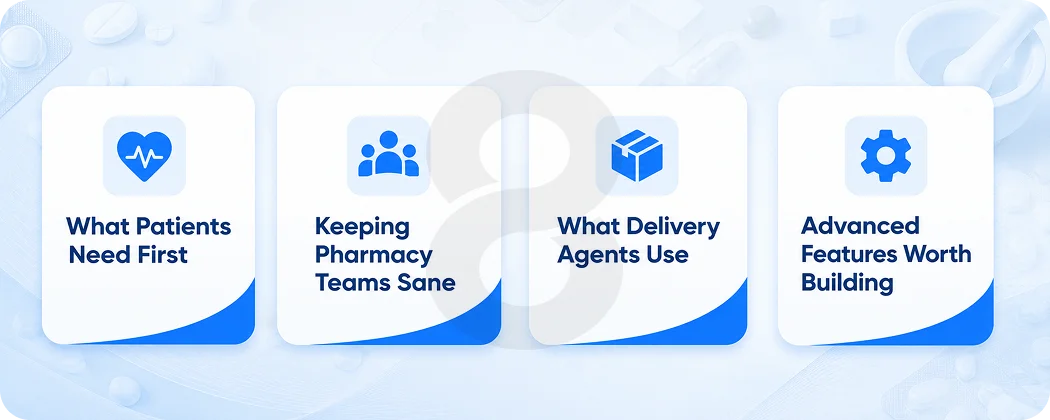
Feature lists for medicine delivery app development always look the same on paper, search, cart, payment, tracking. The difference between a good app and a forgettable one is in the details nobody puts on a slide.
What patients need to see first
The patient side of the app is what makes or breaks adoption, since this is the one piece every single user touches. Registration needs to be quick, ideally through phone number or social login, with biometric login available for anyone coming back a second time.
Search has to handle typos and brand versus generic names, because most people don’t know the generic name of what their doctor prescribed. Once something’s in the cart, checkout should show real time pricing, including any insurance adjustment, before the patient confirms.
What’s easy to underestimate is reorder behavior. A patient managing a chronic condition shouldn’t have to search for the same medicine every month. One tap reorder, pulled from order history, is what turns a one time user into someone who opens the app on a schedule instead of out of necessity.
This is the core of the patient facing app that most of the platform gets built around.
What keeps a pharmacy team from drowning
Pharmacists using this system every day need something closer to an operating tool than a consumer app. An order queue sorted by urgency, clear flags on anything that needs manual review, and inventory numbers that update the moment something gets sold rather than at the end of the day.
Stock outs are the most common complaint pharmacy partners raise once they go live. A medicine shows as available, the patient orders it, and then someone discovers it sold out an hour earlier through a walk in customer the system never knew about.
Real time sync between in store point of sale systems and the app’s inventory layer fixes most of this, though it’s one of the more expensive integrations to get right.
Sales analytics matter here too, not as a nice dashboard for investors, but because pharmacies use it to decide what to restock and when.
What delivery agents actually use
Delivery agents don’t care about your roadmap. They care about three things, a clear list of pickups, a route that doesn’t waste their time, and a payout number that updates without them having to ask support.
GPS based routing that adjusts for traffic in real time matters more here than almost any other feature on this list because a late delivery of medicine reads very differently to a customer than a late pizza.
Status updates at pickup and delivered keep both the patient and the pharmacy informed without anyone picking up a phone.
The advanced stuff worth a second sprint
Once the basics work without falling over, a few additions start paying for themselves fast. Subscription based refills for chronic medication guarantee recurring revenue and solve a real problem for patients who genuinely cannot afford to forget a dose.
Telemedicine integration lets someone get a video consultation and a prescription in the same session, which removes a step that used to require an entirely separate appointment.
AI earns its place here too, mostly in ways that aren’t flashy. AI assisted prescription scanning extracts dosage and drug names from a photo so a pharmacist isn’t squinting at handwriting all day.
On the other hand, AI driven recommendations can quietly suggest a refill or a related product based on order history, the same way any decent ecommerce engine works.
HIPAA and GDPR Compliance for Pharmacy App Development
HIPAA compliant app development doesn’t show up as a line item you check off once the product works. It gets into the database structure itself, who’s allowed to pull which record, and how long anything sits in the system before it gets archived or wiped for good.
Serve patients in the United States and HIPAA decides how health information gets stored, moved, and accessed, with actual penalties waiting on the other side of getting it wrong.
Bring GDPR into the mix the moment anyone in the European Union signs up, and now a user can ask you to delete their data entirely. That sounds simple until you’re staring at medical records you’re also required by law to hold onto.
Here’s a number that never makes it into the pitch deck. The FDA’s own guidance puts the count of 35,000 active online pharmacies running at any given moment, and the National Association of Boards of Pharmacy figures only about 5 percent of them actually meet US pharmacy laws and practice standards. Sit with that for a second. Ninety five percent of what’s out there isn’t playing by the rules.
That gap is the entire reason visible licensing, real pharmacist credentials, and actual verification aren’t some marketing checkbox. It’s the difference between a platform that can charge for trust and a sketchy site giving medicine away for less because it’s cutting every corner that costs money.
Most founders learn this the hard way, usually on their own production database, mid launch, with users already on the app. The smarter route is finding a team that’s already done healthcare specific compliance work somewhere else first, so the expensive mistakes happen on someone else’s timeline instead of yours.
Medicine Delivery App Development Cost in 2026
Nobody wants to have this conversation. Skip it anyway, and it finds you later, usually at a worse time, usually mid build. The honest number moves depending on how many panels you’re stacking in, what needs to talk to what, and whether AI makes it into version one or gets pushed to version two the way everyone always promises it will.
Read More: Artificial Intelligence in Medicine: Transforming Healthcare with Smart Technology
Keep it simple and you’re looking at a basic MVP. Patient registration, search, prescription upload, payment, tracking that actually works, one platform only. That lands somewhere between $25,000 and $45,000, and 3 to 4 months before it’s something real you can show people.
Add a pharmacy panel, a delivery agent app, and coverage across both iOS and Android, and now you’re in mid tier territory, $45,000 to $85,000, stretched across 5 to 7 months.
Once AI recommendations, telemedicine, subscription management, and the kind of analytics dashboard investors love screenshotting all get bolted on, the number climbs into enterprise range. $85,000 through $160,000 or more, and 8 months starts sounding optimistic the moment a second integration shows up late.
| Build Level | Cost Range | Typical Timeline | What You Get |
|---|---|---|---|
| Basic MVP | $25,000 to $45,000 | 3 to 4 months | Registration, search, prescription upload, payment, basic tracking |
| Mid Tier | $45,000 to $85,000 | 5 to 7 months | Pharmacy panel, delivery agent app, cross platform support |
| Enterprise | $85,000 to $160,000+ | 8+ months | AI recommendations, telemedicine, subscriptions, advanced analytics |
Read More: Telemedicine App Development Cost in 2026: Complete Breakdown
Post-Launch Expenses for a Medicine Delivery App
None of those numbers cover what shows up after launch. Apple wants $99 a year just to keep your developer account breathing, and Google charges $25 once and then leaves you alone. Hosting usually sits between $150 and $600 a month, which feels fine right up until order volume climbs into the thousands and that bill stops looking small.
Maintenance quietly eats another 15 to 20 percent of whatever the build cost, every single year, because security patches and OS updates don’t check your roadmap before they show up uninvited. Marketing needs real money too.
Plan on $5,000 to $10,000 just to get a first real wave of users through the door. And legal review for compliance documentation adds another $2,000 to $5,000 that almost nobody budgets for, until that invoice lands and ruins the afternoon.
Common Challenges in Medicine Delivery App Development
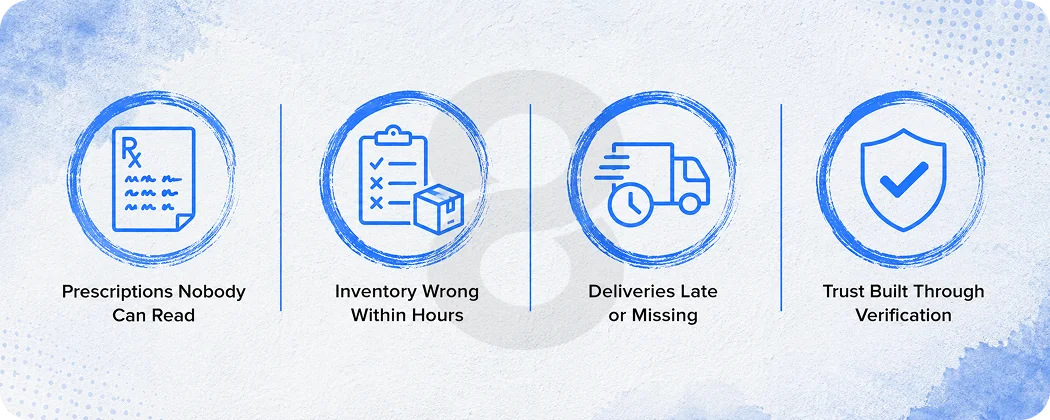
Every pitch deck for one of these apps runs the same smooth animation. Patient uploads, pharmacist approves, a little dot crawls across a map, and a notification says delivered. Nobody puts a slide up for what actually breaks first, and something always does.
These four show up in nearly every medicine delivery build, no matter the budget or the team behind it. None of them are exotic problems. All of them get underestimated anyway.
Prescription images that nobody can read
Blurry photos, doctor handwriting that looks like a seismograph reading, and prescriptions missing half the required information show up constantly.
The fix isn’t picking one verification method. It’s layering OCR for a first pass and a licensed pharmacist for the final call, with a clear rejection flow that tells the patient exactly what to fix and reupload.
Inventory that’s wrong the moment you check it
In an aggregator model especially, a partner pharmacy might update their stock once a day, or whenever someone remembers to. That gap between real inventory and what your app shows causes most order cancellations.
Direct integration with pharmacy point of sale systems closes that gap, though it’s one of the costlier pieces of this kind of build to get right, since every pharmacy partner tends to run different software.
Deliveries that show up late, or not at all
A late dinner is annoying. Late medicine for someone managing a heart condition is a different category of problem entirely.
Reliable last mile delivery comes down to realistic time windows instead of exact promises, route optimization that actually accounts for traffic, and a backup plan when a delivery agent calls in sick mid shift.
Getting anyone to trust you with their health data in the first place
New users hesitate before uploading a prescription to an app they’ve never heard of, and that hesitation is reasonable.
Visible pharmacy licensing, clear pharmacist names attached to verification, and a cash on delivery option for the first few orders all chip away at that hesitation faster than any amount of marketing copy.
How 8ration Builds Medicine Delivery Apps That Pass Audits
8ration has spent years building the kind of platforms that don’t get the easy version of this problem, healthcare, on demand logistics, and software that has to work correctly the first time because there’s no quiet rollback when someone’s medication is involved.
For this category of build specifically, that experience translates into a few concrete things. A team that’s already built on demand delivery platforms understands routing, live tracking, and provider matching well before the first wireframe gets drawn, instead of learning those problems on your timeline.
Compliance isn’t bolted on at the end either. HIPAA and GDPR requirements get built into the database structure and authentication flow from the first sprint, which is a lot cheaper than retrofitting them after an audit flags something.
8ration also brings AI capability into the parts of the app where it actually earns its place, prescription scanning, smart reminders, and recommendation logic, rather than stuffing a chatbot in just to say the app has AI.
What this comes down to is a team that’s done the unglamorous parts of online medicine delivery app development before, the licensing logistics, the compliance documentation, the integration with pharmacy systems that don’t always want to talk to each other, so the founder doesn’t have to learn all of it under deadline pressure.
Read More: Telemedicine App Development Solutions: A Complete Guide for 2026