


Telemedicine app development solutions are mainly categorized into enterprise-level systems, remote patient monitoring tools, and AI-first platforms. Together, these solutions support everything from virtual consultations to continuous care and advanced diagnostics.
The healthcare sector has experienced one of the most radical changes ever. What started as a convenience niche has become a mainstay of modern medicine. Telemedicine app development solutions that allow patients to visit the doctor at the comfort of their living room. Allow hospitals to expand their reach beyond physical structures and provide healthcare businesses with a powerful competitive advantage in the digitally-driven world.
The world telemedicine market will have a value of more than 300 billion dollars in 2026, with an incredible rate of expansion. Investing in the development of telemedicine software is no longer a choice but a necessity. This guide will deconstruct all you should know when developing a telemedicine platform, including the basics of features and technology stack, and selecting the appropriate telehealth app development firm.
What Are Telemedicine App Development Solutions?
Telemedicine app development solutions define the entire ecosystem of tools, platforms, and services that enable the remote delivery of healthcare through digital channels. These solutions are uniting real-time video visits, electronic health records, prescriptions, appointment booking, and payment under a single integrated digital roof.
On the fundamental level, telemedicine software applications facilitate communication between patients and medical clinics. They may be constructed as freestanding mobile applications, browser-based systems or wholly integrated hospital management systems. Telemedicine platform development varies depending on the scale and application scope. With a minimum of a simple video consultation application and a maximum of an enterprise-scale telehealth ecosystem with millions of users and multiple specialties.
Telemedicine app development solutions aim to achieve a single objective: delivering quality healthcare at affordable and efficient rates, regardless of geography.
The global telehealth market size was valued at USD 186.41 billion in 2025 and is projected to grow from USD 219.31 billion in 2026 to USD 1,272.81 billion by 2034, exhibiting a CAGR of 24.60% during the forecast period. North America dominated the telehealth market with a market share of 45.29% in 2025.
Why 2026 Is the Right Time to Invest in Telemedicine Software Development
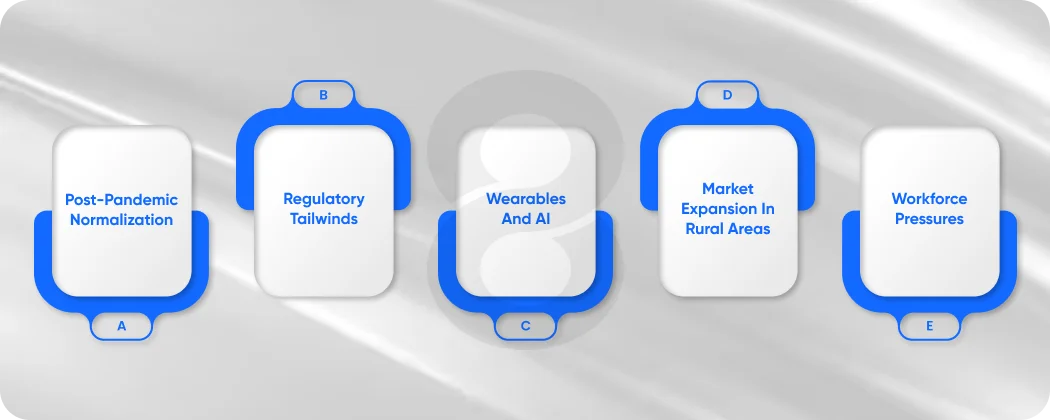
Several converging forces render 2026 the most appropriate time to invest in telemedicine software development:
- Post-pandemic normalization: The behavior that has been developed during the COVID-19 period has changed the behavior of patients forever. Research always demonstrates that a substantial proportion of patients who have used telehealth during the pandemic are willing to use it to hold routine visits, mental health sessions, chronic disease management, and follow-up appointments.
- Regulatory tailwinds: To formally acknowledge and recompense telehealth, governments in North America, Europe, and the Asia-Pacific revised their regulatory frameworks. This has significantly reduced the business risk of organizations that have invested in telemedicine software development services.
- Wearables and AI: Remote patient monitoring has become not only possible, but actually clinically valuable, owing to the proliferation of AI-powered diagnostic tools, consumer wearables (smartwatches, continuous glucose monitors, blood pressure cuffs). The current telemedicine software applications can now directly import real-time biometric data into the consultation interface.
- Market expansion in rural and underserved markets: Healthcare needs in rural areas, in developing countries, and in underserved urban areas are
- enormous. The major vehicle that healthcare providers can access these populations through is the telemedicine app development solutions, which do not require the prohibitive cost of physical infrastructure.
- Workforce pressures: Physician shortages and burnout are issues that are being encountered by healthcare systems in different parts of the world. Solutions in telehealth app development companies that facilitate asynchronous care, AI-assisted triage, and intelligent scheduling assist healthcare organizations to accomplish more using the same number of providers.
Read More: Modern Healthcare App Features – Top 10 Essential Additions for 2026
Basic Characteristics of an Effective Telemedicine System
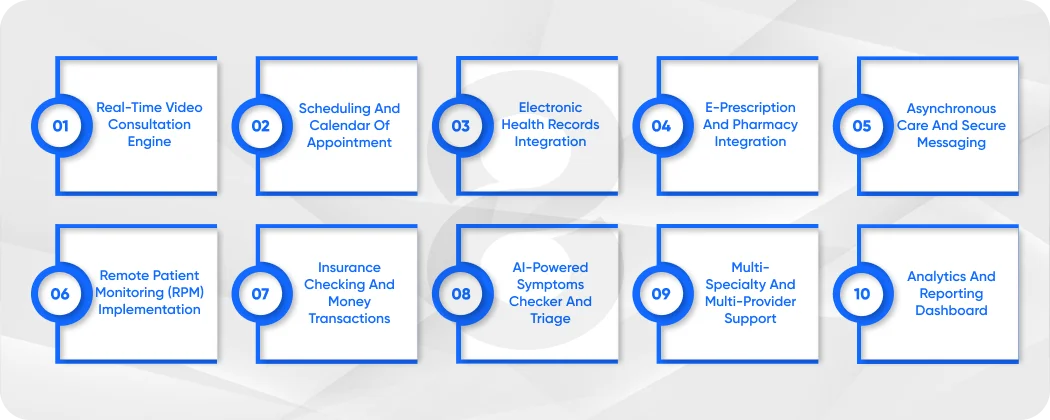
The feature set is what ultimately defines your platform in terms of clinical efficacy and commercial success when you contract a telehealth software development company to create your solution. The following are the non-negotiable elements of any serious project of telemedicine platform development:
1. Real-Time Video Consultation Engine
This is the core of any telemedicine software application. The video engine should provide low-latency communication between the patients and the providers in HD quality. It needs to be operating on high-speed broadband as well as lower-bandwidth mobile networks. The software development of modern telemedicine systems is based on WebRTC architecture, frequently supplemented with third-party SDKs such as Twilio Video, Agora, or Daily.co, to attain sub-200ms latency and adaptive bitrate streaming.
2. Scheduling and Calendar of Appointment
The telemedicine app development solutions are based on a powerful scheduling module. It must be able to manage provider availability, time zone, patient self-booking, automatic reminders (SMS and email), and third-party calendar support like Google Calendar and Outlook. Sophisticated telemedicine software applications have AI-based appointment schedulers that forecast the no-show rate and dynamically schedule appointments.
3. Electronic Health Records Integration
To be clinically useful and not merely a communicative tool, a telemedicine platform needs to be integrated with the current EHR systems. The industry standards in health data interoperability are HL7 FHIR and DICOM standards. An effective telehealth application development firm will create FHIR-compliant APIs. That enable your telemedicine software to read and write Epic, Cerner, and Athenahealth records of patients and other large EHR systems without problems.
4. e-Prescription and Pharmacy Integration
Prescription-free telemedicine is incomplete. Contemporary telemedicine software development services integrate with approved e-prescribing networks such as SureScripts in the US. Allowing physicians to send prescriptions directly to a patient’s preferred pharmacy during consultations. More experienced telehealth software development companies handle the additional regulatory layers required for prescribing controlled substances.
5. Asynchronous Care and Secure Messaging
Not all clinical interactions need a live video call. Asynchronous telemedicine (patients presenting text, image, or video symptoms and getting
a clinical response within a specified timeframe) is the most cost-efficient in the field of dermatology, behavioral health, and monitoring chronic conditions. Software applications of telemedicine, facilitating both synchronous and asynchronous models of care are much more flexible and commercially viable.
6. Remote Patient Monitoring (RPM) Implementation
RPM is among the most rapidly developing areas of telemedicine platform development. The telemedicine software applications can constantly check the vital signs of blood pressure, glucose levels, oxygen saturation, and heart rate by combining with Bluetooth and cellular-enabled medical devices.
7. Insurance Checking and Money Transactions
Ease of billing is essential in patient retention. The software used in telemedicine must have in-built features to support payment via credit card or HSA/FSA account as well as directly submitting an insurance claim. On-the-fly insurance eligibility checks. Ensuring that a patient has a plan that includes telehealth services before the consultation session would greatly minimize billing issues and enhance the customer experience.
8. AI-Powered Symptoms Checker and Triage
The most popular telemedicine app development solutions currently embrace AI triage bots that pre-consult patients, scan their medical history, estimate their risk stratification, and direct patients to the necessary level of care. This will ease the clinical workload and make sure that patients with high acuity are attended to with more urgency.
9. Multi-Specialty and Multi-Provider Support
Development of an enterprise-grade telemedicine platform should support various specialties, including primary care, cardiology, psychiatry, dermatology, and pediatrics, each with its own clinical workflow, documentation template, and billing code. Role-based access controls make sure that clinicians only have access to the data and functionality related to their specialty.
10. Analytics and Reporting Dashboard
To healthcare administrators and business owners, an effective analytics layer of telemedicine software applications does offer actionable data on the volume of consultations. Waiting time, patient satisfaction levels, provider utilization, revenue per consultation, and population health patterns.
The global telemedicine market size was estimated at USD 141.19 billion in 2024 and is projected to reach USD 380.33 billion by 2030, growing at a CAGR of 17.55% from 2025 to 2030. The global telemedicine market is experiencing a transformative surge, propelled by industry consolidation, strategic partnerships, and a growing wave of healthcare consumerism.
Telemedicine Software Development Technology
It is the right technology stack that makes the difference between a resilient, scalable telemedicine platform and a brittle, maintenance-intensive system. The following is the list of telemedicine software development companies that are leading in 2026:
- Frontend: React.js or Vue.js to build web applications, React Native or Flutter to build cross-platform mobile apps. These frameworks enable the use of one codebase to support iOS, Android, and the web with close-to-native performance.
- Backend: Node.js, Python (Django or FastAPI), or Go to provide high-performance API services. The standard platform development architecture of telemedicine on a large scale is microservices. Where a single component (scheduling, video, billing, EHR) can be updated and scaled independently.
- Real-Time Communication: WebRTC is the peer-to-peer video gold standard. Selective Forwarding Unit (SFU) architectures that are driven by Janus or Mediasoup are used in large-scale deployments with group consultations or webinars.
- Database: PostgreSQL, relational data (patient records, appointments, billing), MongoDB, flexible document, Redis, session management, real-time data caching, and time-series databases such as InfluxDB, RPM sensor data streams.
- Cloud Infrastructure: AWS, Google Cloud Platform, or Azure. Cloud configurations that are HIPAA compliant are required. The development of most telehealth app companies deploy containerized applications through Docker and Kubernetes to achieve scalability and fault tolerance.
- Security: All clinical communications should be end-to-end encrypted, authentication should be performed by using OAuth 2.0 and OpenID Connect, role-based access control, audit trails, and penetratio
- n testing. The compliance frameworks of HIPAA (US), GDPR (Europe), and PIPEDA (Canada) should become part of the architecture.
- AI/ML: Checkers of symptoms, clinical note summarization, risk stratification model, and predictive no-show algorithm: TensorFlow, PyTorch, or cloud-native AI services (AWS SageMaker or Google Vertex AI).
Read More: 10 Benefits of Artificial Intelligence in Healthcare
Types of Telemedicine App Development Solutions
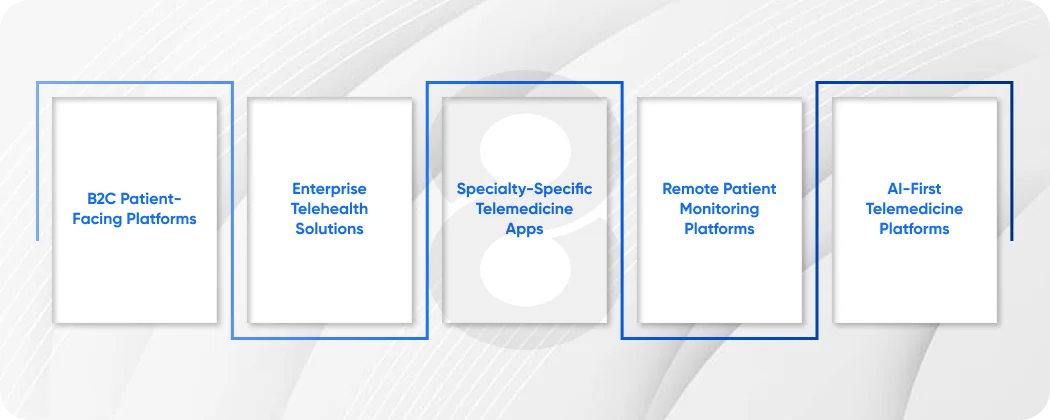
Telehealth software programs are not all developed with the same intent. Diversifying into different product lines will aid in scoping your investment right:
B2C Patient-Facing Platforms
Applications such as the consumer-facing version of your telehealth product, in which patients explore providers, make appointments, and hold consultations. In the market, examples are Teladoc Health and MDLive. A competitive B2C telehealth app will need considerable investment in UX design, marketing infrastructure, and provider network management.
Enterprise Telehealth Solutions
Hospitals, insurance companies, employers, and government health agencies deploy these white-label or custom telemedicine software development solutions within their networks. These solutions integrate deeply with existing clinical systems and require a strong compliance architecture.
Specialty-Specific Telemedicine Apps
Specialized telemedicine software applications designed to support one specialty, mental health sites (BetterHelp model), and dermatology sites with photo-based triage. Physical therapy sites with motion tracking, or neonatology sites with NICU remote monitoring. Specialty apps can also have better clinical results and reduced cost of development compared to general-purpose platforms.
Remote Patient Monitoring Platforms
Constructed with the purpose of continuous data gathering of medical equipment. Such telemedicine platform development projects are becoming more applicable to post-acute care, cardiac monitoring, diabetes management, and oncology support.
AI-First Telemedicine Platforms
These platforms represent the newest addition to telemedicine app development solutions, relying on large language models and computer vision. As the primary clinical interface, while bringing in human physicians only for complex cases or prescription refills.
Regulatory Compliance in Telemedicine Software Development
Compliance is not a check box, it is an ongoing architectural discipline. A software development company that considers serious telehealth issues must integrate the following requirements within the system:
- HIPAA (United States): Patient health information (PHI) should be encrypted both at rest and on transit. All cloud vendors should have business associate agreements. Audit trails should also record all access to patient data. Security risk assessment should be done once every year.
- GDPR (European Union): EU regulations require telemedicine software applications to obtain explicit patient consent for data processing and provide data deletion request mechanisms. Appoint Data Protection Officers where applicable, and conduct Privacy Impact Assessments.
- Type II Certification of the SOC 2: Although it is not healthcare-specific, SOC 2 certification signals to enterprise buyers that your telemedicine platform has undergone rigorous independent audits of its security, availability, and confidentiality controls
- State and National Licensing: In the US, physicians are required to be active license holders within each respective state in which they practice through telehealth. The provider credentialing module in your telemedicine software development company must develop license management and geographic restriction into the platform.
- FDA Regulation (diagnostic software): FDA Software as a Medical Device (SaMD) guidelines comply with in case your telemedicine software applications include AI diagnostic tools or are interconnected with Class II or III medical devices. This involves clinical validation studies, quality management systems, and possibly premarket approval.
How to Select the Appropriate Telehealth App Development Company
The choice of partners in the telemedicine software development will greatly define the quality, speed and compliance posture of the final product. The following is an organized plan to assess possible partners in the telehealth app development company.
Healthcare Domain Expertise
Video calling applications can be developed by generic software agencies. The thing that they are not good at is the clinically sound, HIPAA-compliant and EHR-integrated telemedicine platform. Find a telehealth software developer firm with no less than 3-5 output telemedicine software applications with verifiable clinical implementation histories.
HIPAA and Security Credentials
Ask about their engineering patterns with regard to security. Do they conduct HIPAA risk assessments? Does it have a CISO or healthcare compliance head? Have they undergone independent penetration testing of their applications?
Full-stack Capability
Services includes UX research and design, frontend and backend engineering, cloud infrastructure, QA, and continued support. The existence of fragmented teams between different vendors results in coordination failures that are expensive in healthcare scenarios.
Post-launch Support Model
Medical applications must be maintained constantly, security patches, regulatory changes, and device additions. Get the post-launch support structure and the SLA promises of the telehealth app development company clear prior to entering into any contract.
Patient and provider UX Track Record
Ask users of past projects to provide testing data. The telemedicine platform that doctors perceive to be cumbersome will not be adopted, regardless of how technical the platform is. Failure of patient UX directly influences clinical results.
Case studies and References
Request contacts of 2-3 customers whose telemedicine software development projects are alive and in production. Inquire of those clients directly on the quality of communication, meeting deadlines, and responsiveness in case of any problems.
Read More: 13 Must-Have EHR Features in 2026 for Efficient Healthcare Management
Budget Estimate to Develop Telemedicine Platform
By knowing the investment environment, you can plan a realistic budget on which to develop solutions that can help in the development of telemedicine apps:
MVP (Minimum Viable Product)
An efficient telehealth software development firm can implement a lean telemedicine application with video consultation, scheduling, and a basic patient profile in 4–6 months. With an estimated cost of $80,000 to $150,000.
Mid-Market Platform
Incorporation of EHR, e-prescribing, payment processing, and RPM features will take 8-12 months and costs between $200,000 and $400,000.
Enterprise Telemedicine Platform
Multi-specialty, AI triage, analytics, and custom EHR extension. Enterprise-scale security architecture development is a 12-18-month engagement that costs between 500,000 and 1,500,000 (or more) to develop.
Ongoing Operations
Allocate an extra 15-25% of initial development cost each year towards security maintenance, feature additions, infrastructure expenses and regulatory compliance efforts.
The Future of Telemedicine Application Solutions
Several groundbreaking changes will shape the future of telemedicine software development over the next five years.
- Ambient AI documentation: AI systems that read, organize, and hand in clinical notes automatically during the visit, removing the documentation load that contributes to physician burnout.
- Primary care autonomous AI: Telemedicine software applications based on large language models that can process most primary care encounters on their own, and where physicians review and approve AI-generated assessments asynchronously.
- Augmented Reality Examinations: Remote physical examinations with AR that enable the physician to examine by guiding the patient through a sequence of self-examination steps through the use of real-time visual.
- Proactive Population Healthcare: Telemedicine systems based on longitudinal patient data to determine at-risk groups and initiate proactive contact before the emergence of acute events
- Blockchain-secured Health Data: Patient-owned, decentralized health records that patients can share with their providers via cryptographically secure methods of consenting via the telemedicine software application.
Transforming Healthcare Through Telemedicine
The digital transformation in healthcare is gaining momentum, and telemedicine is at its center. Companies that invest in the development of telemedicine apps today will be placed in a long-term growth and innovation. The trick is to develop solutions that are secure, scalable, and people-centric.
8ration provides end-to-end development of telemedicine, integrating healthcare knowledge and modern technologies to develop effective digital solutions. In compliance with deployment, we make sure that all aspects are in line with industry standards.
With the ongoing change in healthcare, telemedicine platforms will characterize the way care is provided. The 8ration allows you to create solutions that are not only able to address the current demands but also determine the future of healthcare.