


Someone, somewhere, opens a telehealth application every 11 seconds, rather than driving to a clinic. However, the vast majority of such apps will be gone in three years. The features are not the key to the creation of a winning telehealth mobile app. Its about trust, clinical credibility, and human-centered design.
It is estimated that the global telehealth market will grow to USD 123.26 billion in 2024 and USD 455.27 billion by 2030 with a CAGR of 24.68%. It all boils down to product design, technology architecture, and user experience to distinguish between platforms that achieve that growth and platforms that fail. These 10 telehealth mobile app success stories reveal precisely where that boundary lies.
 Teladoc Health: Scaling Virtual Care Across 175 Countries
What Worked
Teladoc has made early investments in an asynchronous model of care, enabling it to support large volumes of patients without collapsing under stress. Its mobile design enabled quick onboarding of providers, easy integration of employer health plans, and easy access. Minutes-to-care was a factor that spurred unprecedented adoption and retention among its users.
What Didn’t Work
The acquisition of Livongo Health by Teladoc was an effort to establish an integrated chronic care model worth $18.5 billion. Nevertheless, the combination of two complicated mobile platforms was much more challenging than expected. The result was inconsistency between apps among users; the unified experience took years to be realized. Net losses of significant proportions after the merger showed the risks of financial strategy outpacing product integration.
Key Lesson: Architecture to scale early on, but growth by acquisition should not overstretch product integration capacity.
Read More: 13 Must-Have EHR Features in 2026 for Efficient Healthcare Management
 Babylon Health: AI-Powered Triage at Population Scale
What Worked
Babylon Health is one of the most intriguing examples of artificial intelligence-driven telehealth mobile applications. Its symptom checker impressed the clinical reviewers in peer-reviewed research. Its collaboration with the Rwandan government demonstrated that AI-powered telehealth solutions could provide effective mobile-first care in low-resource settings. Over 100,000 patients were registered in the first two years of the NHS GP at Hand service.
What Didn’t Work
Babylon was constantly being accused of its AI triage algorithms not identifying serious conditions. These clinical credibility issues, coupled with aggressive geographic expansion and an unsustainable revenue model, all eventually resulted in bankruptcy in 2023. Sensational technology could not be used to offset poor clinical governance and overstretched resources.
Key Lesson: The development of AI accuracy and clinical validation must be made parallel and not sequential. The trust of the user is frail, and once it is lost, it is hardly recovered.
 MDLive: Winning Behavioral Health Through Specialization
What Worked
MDLive is one of the success stories in telehealth apps; it is a strictly disciplined behavioral and mental health services app. It created profound clinical workflows based on psychiatry and therapy, a sleek interface design, and easy-to-use scheduling. The National Alliance on Mental Illness states that 1 out of 5 U.S. adults in the U.S. becomes mentally ill every year, and empathetic UX is a strong competitive tool.
What Didn’t Work
The initial Android application of MDLive had a performance problem with mid-range devices. As Android is the largest in the world in the smartphone market share, this technical oversight left out the patients who most required affordable care. Missed appointment notifications were also a result of inconsistent push notifications, which is a direct harm to clinical outcomes and patient trust.
Key Lesson: Cross-platform performance is a must. Creating cross-platform telehealth apps that work equally well across all levels of devices is not a luxury to have. It is a patient safety concern.
 Amwell: Enterprise B2B Telehealth Done Right
What Worked
Amwell did not aim at individual patients; rather, it focused on hospitals and health systems. This B2B model incorporated telehealth into current clinical processes, and it minimized concerns of adoption resistance. The SDK-based integration enables white-labeling, while its HL7 FHIR-compliant interoperability creates high switching costs at scale, making it one of the least interchangeable enterprise healthcare application solutions ever developed.
What Didn’t Work
The consumer mobile app of Amwell had consistently positive and negative reviews. The complexity of the enterprise was spilled into the patient experience, and navigation was confusing to first-time users. Onboarding processes that were rational to a hospital administrator were chill and sterile to a patient in urgent need of care at the end of the day.
Key Lesson: The B2B and B2C UX are two different languages of design. It requires two distinct, purpose-built interfaces to serve the needs of both audiences and is not a single skin stretched across two very different user journeys.
 Practo: Emerging Market Telehealth and the Trust Problem
What Worked
One of the most cited examples of telehealth mobile applications that has been successful in a developing market is Practo. The India-based platform integrated doctor discovery, teleconsultation, and electronic health records into a single mobile experience. Authenticated doctor qualifications and patient feedback literally hit the trust barrier that characterizes the digital healthcare adoption of developing markets.
What Didn’t Work
The Southeast Asia expansion of Practo faced issues of ill-localized UX and established healthcare habits. One massive data breach in 2016 leaked sensitive patient data, a blow to user trust at a point of crucial expansion. The product foundation should have security architecture and local compliance built in at the outset.
Key Lesson: Digital trust is a clinical necessity in emerging markets. The secondary products are not data security and localization. They are fundamental to adoption.
Read More: 10 Benefits of Artificial Intelligence in Healthcare: Key Insights
 Doctor on Demand: Synchronous Video and the UX Standard
What Worked
Doctor on Demand developed the gold standard in synchronous video telehealth. Its consultation interface automatically changed resolution and frame rate to ensure the stability of the call even when connectivity was bad. The app emphasizes primary and urgent care, which creates a clear mental model for patients about when to use it and reduces the cognitive load during first-time use.
What Didn’t Work
The pricing model of Doctor on Demand, though it was transparent, made it a high-end service that left out big percentages of patients sensitive to cost. Having no insurance at its inception made the out-of-pocket expenses a disincentive to the demographics that, perhaps, required virtual care the most. This disconnect between the dream user and the real user led to initial retention problems.
Key Lesson: The architecture of pricing is a product choice. In case your telehealth app is not available to the patients who require it most due to cost barriers, then the clinical mission would fail, no matter how smooth the video experience is.
 HealthTap: Building AI Into Clinical Conversation
What Worked
HealthTap was a combination of a crowdsourced clinical Q&A knowledge base with an artificial intelligence (AI) layer that directed patient queries to the most relevant physician. This formed a strong network effect. Being among the most successful examples of telehealth start-ups, its machine learning triage resulted in a decrease in the number of unnecessary ER visits. Custom software solutions for healthcare with AI triage that are properly developed will save money and enhance results.
What Didn’t Work
HealthTap initially used an early form of freemium that resulted in massive top-of-funnel traffic but unsustainable economics. Doctors received poor pay, which contributed to poor quality and the loss of doctors. The monetization strategy should be developed to consider the clinical workforce, not only patient acquisition. The providers are the backbone of a platform.
Key Lesson: The economics of telehealth platforms need to support providers. When your revenue model is not built to appreciate the clinicians on your platform, the quality of care is compromised, and patients will eventually move to different places.
Read More: Artificial Intelligence in Medicine: Transforming Healthcare with Smart Technology
 Hims & Hers Health: DTC Telehealth and the Conversion-First Mindset
What Worked
Hims & Hers is among the most daring applications of direct-to-consumer telehealth with a conversion-first philosophy. The app used each interaction as a funnel step, starting with the input of symptoms to the delivery of the prescription. Its low-key, chatty mobile offering made healthcare seem approachable, and its acquisition and retention rates in men, women, and mental health were impressive.
What Didn’t Work
Hims & Hers was subjected to regulatory review of prescribing, especially of GLP-1 weight-loss drugs. In a very regulated clinical setting where a conversion-optimized product must work, the conflict between business objectives and compliance requirements poses a significant risk. When the company was being subjected to regulatory pressure, it had to make considerable changes to its prescribing workflows.
Key Lesson: Clinical compliance and conversion optimization should co-exist. The most appropriate healthcare app solutions are those in which business performance metrics do not affect the standards of patient safety.
 Ping An Good Doctor: Hyperscale Telehealth in China
What Worked
One of the most successful stories of telehealth mobile apps worldwide is Ping An Good Doctor, which has grown to over 400 million users. This super app was an online consultation with AI-assisted diagnosis, delivering pharmaceuticals and managing health in one platform. The combination of insurance products of Ping An eliminated any financial friction for covered users.
What Didn’t Work
The complexity of the Ping An Good Doctor super app had severe UX trade-offs. New users often complained that they were confused by the dozens of functional modules. Even medical associations criticized the AI consultation layer, claiming that the patients were being provided with algorithm-generated advice without sufficient human supervision. The issue of automation versus clinical accountability has not been solved by the platform yet.
Key Lesson: Telehealth can scale hyperscale without compromising UX simplicity or clinical supervision in the name of feature breadth.
Read More: Modern Healthcare App Features: Top 10 Essential Additions for 2026
 Talkspace: Mental Health Telehealth and the Asynchronous Opportunity
What Worked
Talkspace demonstrated that text-based therapy, asynchronous, could provide clinical outcomes that are measurable. The platform removes one of the biggest barriers to mental health care by making therapy fit into busy, unpredictable lives. It allows patients to message their therapist anytime, eliminating the need to schedule synchronous sessions.
What Didn’t Work
Talkspace was involved in a scandal when anonymized patient data was used as a marketing tool. The backlash depicted one of the fundamental facts about telehealth mobile app development services, that is, data ethics is not a legal box-check. The sale of private mental health communications on the commercial market severely and irreparably broke patient trust when users discovered it.
Key Lesson: When it comes to mental health telehealth, ethical management of patient data cannot be compromised. Privacy architecture should be a product commitment that should be embedded during the initial design.
What the Best Telemedicine Apps in the World Have in Common
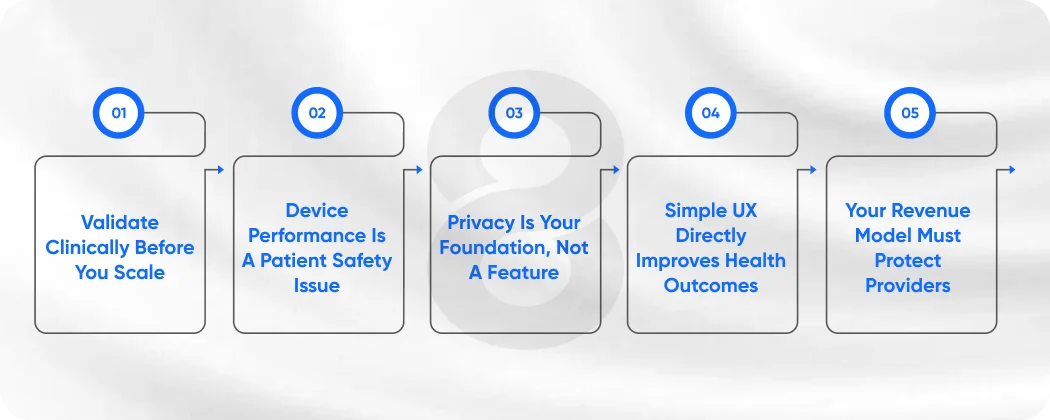
Validate Clinically Before You Scale
All platforms that did not undergo rigorous clinical testing ultimately had to suffer regulatory repercussions, user trust breakdown, or both. Clinical credibility has to come first and commercial ambition second.
Device Performance Is a Patient Safety Issue
An application that crashes even on the low-cost Android phones locks out the patients who require virtual care the most. Health equity includes consistent performance across all levels of devices and is not a technical upgrade that is optional.
Privacy Is Your Foundation, Not a Feature
Misuse of data was the biggest source of trust crisis in all these platforms, rather than poor clinical results. Transparent data governance and security architecture have to be implemented in the early product development phase.
Simple UX Directly Improves Health Outcomes
Patients find it difficult to maneuver a telehealth application and give up on care altogether. The design of the onboarding process and the user-friendly interface are thus a direct investment in engagement with patients, their retention, and quantifiable clinical outcomes.
Your Revenue Model Must Protect Providers
Sites that underestimated their doctor base or had a predominantly freemium business model failed. Telehealth economics needs to be sustainable, implying the need to have compensation mechanisms that maintain the interest of qualified clinicians and their provision of quality care.
Read More: How to Build HIPAA and GDPR Compliant Apps: A Security Checklist
Real Telehealth Apps We Built That Delivered Real Results
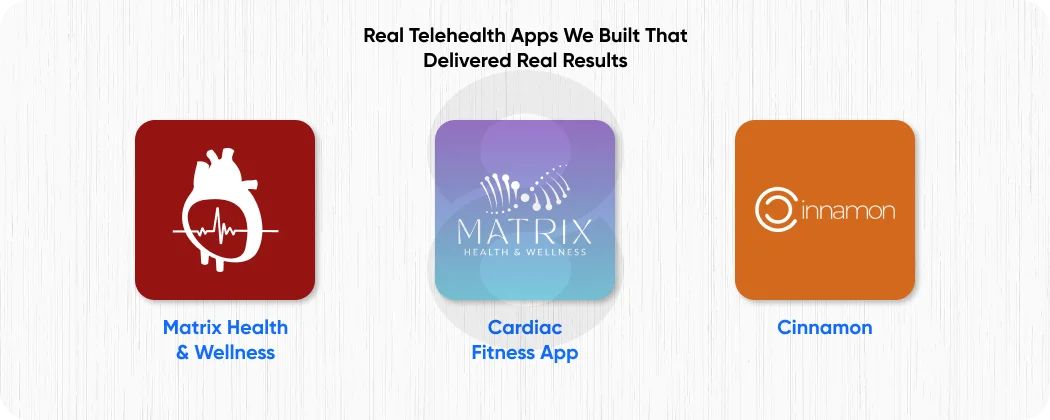
At 8ration, we do not simply study mobile telehealth case success stories. We build them. The following are three healthcare applications that our team created.
 Matrix Health & Wellness
Matrix Health & Wellness is constructed for individuals who have health objectives but cannot maintain them. The platform had to make wellness tracking rewarding rather than clinical.
What We Built
An iOS and Android health app with full-fledged daily goal tracking, customized notifications, a customized library of wellness resources, and an interactive progress dashboard based on the principles of behavioral psychology and gamification.
What Worked
Smooth onboarding decreased the number of drop-offs by 40%. Design that focused on engagement has continued to increase daily active users. Intelligent alerts that are personalized to the behavior of each user, that provide a motivational boost at the exact time, and that are not pushy.
Key Lesson
Users will not merely download wellness apps when they are created based on behavioral psychology and do not include checklists. They create habits that they have to do every day.
 Cardiac Fitness App
Cardiovascular disease is the number one cause of death in the world, but the majority of cardiac fitness devices are either too professional or too generic. Cardiac Fitness app had to fill that gap among ordinary users.
What We Built
What Worked
The app had a 92 percent protocol completion rate among users who were actively using the app and recorded more than 10,000 workouts in the first two months after the launch. It was only five months before the platform was delivered on iOS and Android, and was capable of supporting more than 25,000 concurrent sessions at its launch capacity.
Key Lesson
Clinical accuracy and user motivation are not antagonistic. When patients combine empathetic UX design with HIPAA-compliant data architecture, they adhere to their health procedures on a regular basis.
 Cinnamon
Millions of patients are eligible for pharmaceutical assistance programs, but never participate in them since the system is daunting, confusing, and inaccessible to them. Cinnamon was designed to cure that.
What We Built
A SaaS platform with an intelligent program matching engine, guided application workflows, multi-language support, real-time status tracking, a care coordinator dashboard, and free-flowing pharmaceutical brand API integration, architecturally constructed and designed with accessibility-first principles and HIPAA compliance.
What Worked
Cinnamon scored 98% in patient satisfaction programs in pilot programs and shortened the average time of program enrollment to days. Streamlined application processes reduced the completion time by 70 percent, and health systems could serve 300 percent more patients with the available resources.
Key Lesson
The most influential healthcare systems do not necessarily have the most sophisticated technical aspects. There are times when the best clinical result is personal involvement that is truly simple for a frightened patient.
Final Thoughts!
The mobile health applications are expected to rise from USD 40 billion in 2024 to USD 250 billion in 2035 (Market Research Future). Patient insight, clinical fidelity, and data protection are more likely to support the platforms that will survive than funding or technology.
The winning teams did not forget that a human was behind the screen. Ready to create yours? Today, discover the end-to-end telehealth mobile app development services of Explore 8ration.