


Nobody opens a restaurant because they love spreadsheets. Most owners get into this business for the food and regulars who order the same thing every Friday.
Then someone mentions a mobile app and suddenly there is a quote sitting in the inbox that ranges from fifteen thousand dollars to two hundred thousand, with no clear reason why two agencies landed so far apart.
So here’s the part nobody wants to say out loud on a sales call. There isn’t a fixed price tag for this. Restaurant app development cost moves with whatever you’re actually asking someone to build.
A one-location app that just takes orders and a multi-location platform running live tracking, loyalty points, and an AI-driven recommendation engine, both get filed under the same casual label, “a restaurant app,” but they are two completely different projects with two completely different invoices.
This guide breaks it down the way an agency would explain it over coffee. It walks through real ranges, factors, and costs nobody mentions until the invoice shows up.
What Restaurant App Development Cost Looks Like
Ask ten restaurant owners what this should cost and odds are good you get ten different numbers. The market doesn’t hand out one tidy figure. It’s easier to think in three.
A starter build sits at the bottom of that range. Digital menu, online ordering, basic payment processing, one location and you’re looking at $15K to $40K. Push past that into loyalty points, table reservations, and POS integration across one or two locations and the number climbs to somewhere between $40K and $90K.
Chains and delivery-heavy brands usually land in the third bucket and sometimes a separate app just for couriers. That tier starts around $90K and $180K is common rather than rare.
The online food delivery market worldwide is on track to pull in $1.51 trillion in 2026, with projecting growth of 6.24 percent a year through 2031. Owners are watching that number too, which is part of why so many single-location restaurants are finally building their own ordering apps instead of handing a delivery platform a cut on every single order.
Read More: Best POS System for Restaurant: Build a Custom POS Solution Instead of Buying Software
The jump from $15K to $180K trips a lot of first-time buyers up, and honestly, it should. Two owners can describe almost the exact same idea on the same call and walk away with quotes thirty thousand dollars apart, usually because one agency assumed POS integration was already in scope and the other never asked.
What Moves the Price Up or Down
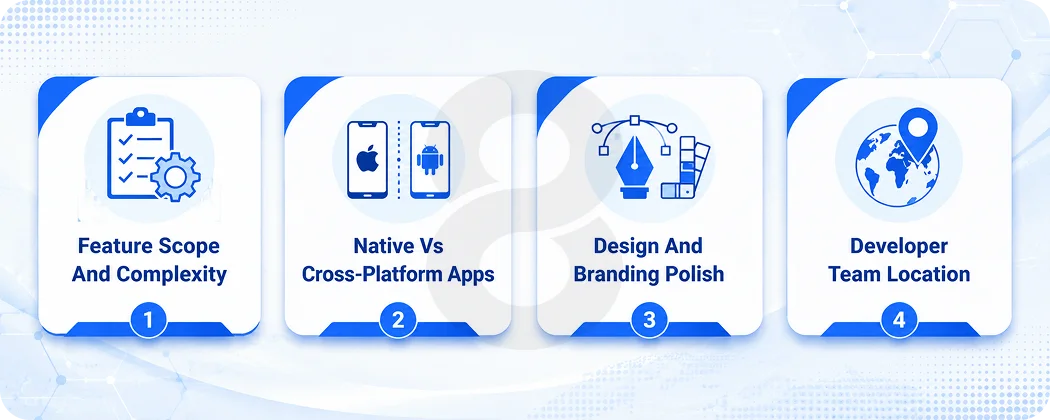
The three tiers above are a starting point. What actually pushes your restaurant app development cost toward the low end or the high end of each range comes down to four things, and almost none of them are about the menu screen.
Feature scope is the biggest lever
This is the one that surprises people the most. A clean menu and a checkout flow are maybe twenty to thirty hours of work for an experienced team. Live order tracking, AI-driven menu suggestions, loyalty wallet, and kitchen display system integration are not.
Features account for the largest single chunk of any restaurant app quote, often more than half the total budget. The fix is not cutting features blindly. It is figuring out which ones actually move revenue in month one and which ones just sound good in a pitch deck.
Native apps or cross-platform
Native development gets the smoothest performance on the market and full access to things like camera scanning or biometric login. The tradeoff shows up immediately in the budget since two codebases mean double the frontend work and testing on everything that touches the interface.
Most single location restaurant apps skip that tradeoff entirely and build on a cross platform framework like Flutter or React Native instead, running one codebase across both phones. It’s the right call for a three-location pizza chain still figuring out whether the app even works for its customers.
It stops being the right call once a brand is pushing millions of orders a month and every extra millisecond of load time starts costing real money.
Design complexity and how polished it needs to look
There’s a real gap between dropping a logo into a template and commissioning a fully custom, animated interface, and that gap is mostly where design budgets disappear.
Chains with a strong visual identity, the kind people recognize from the packaging alone, tend to pay for the expensive version on purpose, because the app has become part of the brand and not just a place to tap “order.”
That shows up as custom illustration, motion on the menu cards, a checkout flow that somehow still feels like the dining room itself. None of that comes cheap, and for the right brand, it shouldn’t.
A neighborhood spot building its first app rarely needs any of that yet, and pouring money into polish before the ordering flow even reliably works tends to protect a brand that nobody’s using.
Read More: How to Make a Restaurant App: Cost, Features & Step-by-Step Guide
Where the development team sits
This one moves the number more than almost anything else. The same exact feature set can cost three to four times more depending on which region builds it, before a single design decision even gets made.
| Region | Hourly Rate (USD) | What You’re Trading Off |
|---|---|---|
| North America | $100 to $180 | Highest cost, easiest time zone overlap, strong for complex compliance work |
| Western Europe | $90 to $140 | High quality, still a meaningful time zone gap for US clients |
| Eastern Europe | $40 to $70 | Strong technical talent pool, moderate overlap |
| South Asia | $20 to $45 | Lower cost, needs clear specs and an async-friendly workflow |
| Latin America | $30 to $70 | Closer time zone overlap with US clients, growing talent pool |
Restaurant App Types and What Each One Costs
Not every restaurant app is solving the same problem, and that is half of why restaurant app development cost varies so much between quotes from different agencies.
A café running its own ordering app and a marketplace juggling a dozen restaurants and a courier fleet both get called “a food app,” and that’s about where the similarity ends.
Here’s how the main types break down, roughly in the order owners bring them up.
| App Type | Best For | Cost Range |
|---|---|---|
| Single-restaurant ordering app | Independent restaurants and small local chains | $15,000 to $40,000 |
| Restaurant chain or multi-location app | Regional and national chains managing several branches | $40,000 to $90,000 |
| Table reservation and booking app | Fine dining and reservation-heavy concepts | $20,000 to $50,000 |
| Cloud kitchen management app | Delivery-only brands without a dine-in space | $25,000 to $60,000 |
| Delivery aggregator or marketplace app | Platforms connecting multiple restaurants, couriers, and customers | $60,000 to $200,000+ |
Most independent restaurant owners only need the first row on that table. The marketplace model at the bottom is a different business entirely, closer to building a small delivery platform than a restaurant app, and it carries the matching price tag.
Read More: Best Apps for Delivery Drivers to Inspire Your Next Delivery App
Plenty of owners ask for aggregator-level features when what they actually need is a sharper single-location app with a better menu and faster checkout.
A family-run Italian spot in Dallas doesn’t need a courier-matching algorithm. It needs a fast ordering flow, a menu that loads in under two seconds, and a checkout that doesn’t lose the cart when someone’s connection drops.
Picking the row that fits the business, not the one that sounds most impressive, saves a lot of budget before any contract gets signed.
The Features That Quietly Blow Up Your Budget
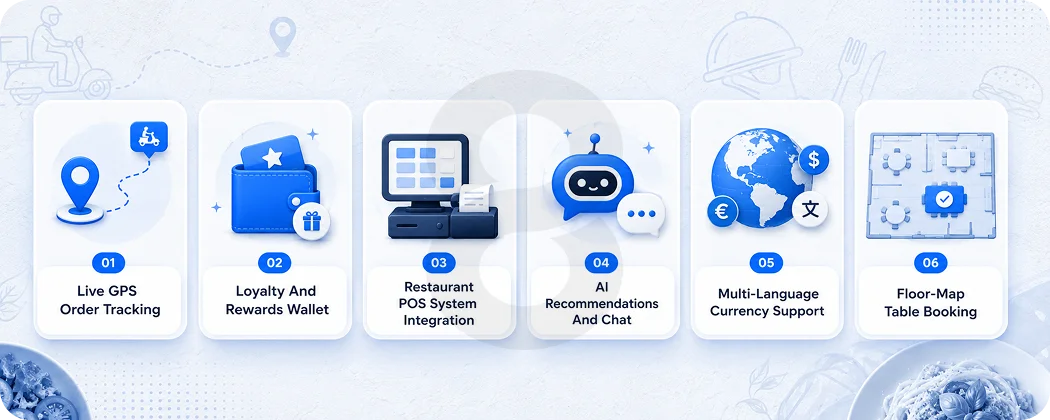
Every restaurant owner asks for roughly the same wish list on the first call. Most of these features are reasonable on their own. Stacked together and you’ll know that they are why a $25K quote turns into $70K by the time the contract gets signed.
- Live GPS order tracking sounds simple until the app is paying for real-time location pings every few seconds across every active delivery.
- A loyalty and rewards wallet needs its own database logic, fraud checks, and admin tools.
- POS integration means the app has to talk cleanly to whatever kitchen or register system is already running and every POS vendor has its own quirks and documentation gaps.
- AI driven recommendations and chat support need real training data and ongoing tuning.
- A floor-map style table booking tool takes real design and engineering time most owners underestimate badly.
Hidden Costs Nobody Mentions Until You’re Already Committed
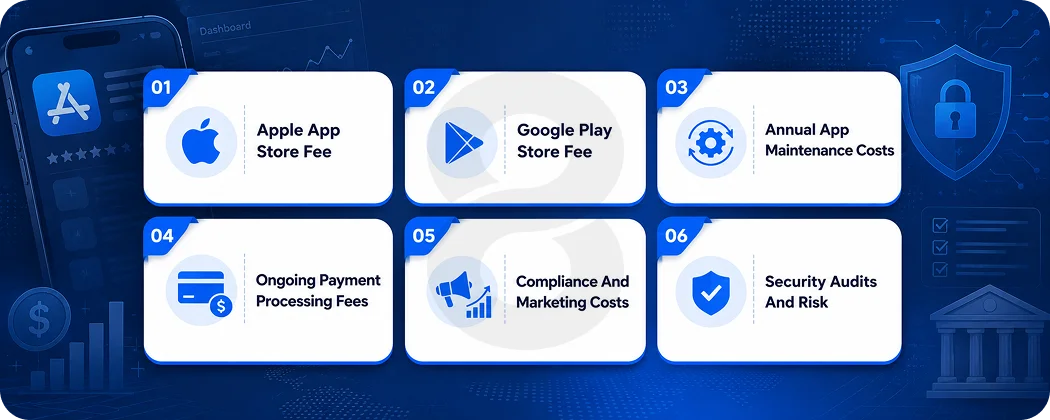
The build is just the first invoice. A handful of other costs show up after the app actually launches, and they rarely come up on the first sales call, probably because nobody wants to be the one who brings them up.
App store fees and commissions
Start with the app stores themselves. Getting onto iOS means paying for an Apple Developer Program membership, and Apple’s own enrollment page puts that at $99 a year. Android is the easier one here.
Google charges a single one-time $25 registration fee through the Play Console and then leaves you alone. Both stores still take their cut on in-app purchases though, somewhere between fifteen and thirty percent depending on revenue tier.
Yearly maintenance and updates
Maintenance is the bigger number. Most agencies quote fifteen to twenty-five percent of the original build cost every year just to keep the app patched, compatible with whatever the next OS update breaks, and clear of the bugs that always seem to surface the moment real customers start using it on a busy Friday.
On a $50,000 app, that’s $7,500 to $12,500 a year, gone before anyone’s even thought about new features.
Payment processing and compliance
Payment processors take a cut too, usually around three percent per transaction plus a small flat fee, and that number never shows up in a development quote because it has nothing to do with development.
Add basic PCI compliance work for handling card data safely, some app store optimization just to get found in search, and a marketing push to land the first wave of downloads, and the first year after launch often costs more than the launch itself did.
Security audits worth paying for
Security audits are the easiest line item to skip when money’s already tight, and skipping them is usually a mistake worth avoiding. An app holding saved cards, home addresses, and order histories is a genuine target, and one breach costs far more in legal fees and lost trust than the audit ever would have.
Most agencies fold a basic security review into the build by default, but it’s worth asking outright before signing anything instead of finding out after launch that it quietly got left off the scope.
Why the stakes keep rising
None of this is getting easier either. The National Restaurant Association’s 2026 outlook has industry sales hitting $1.55 trillion this year, with operators leaning harder on digital ordering and automation just to protect margins that are already paper thin.
An app people actually use stopped being optional a while ago. For a lot of restaurants, it’s becoming the line between holding onto margin and quietly losing it.
How to Keep Your Restaurant App Development Cost Under Control
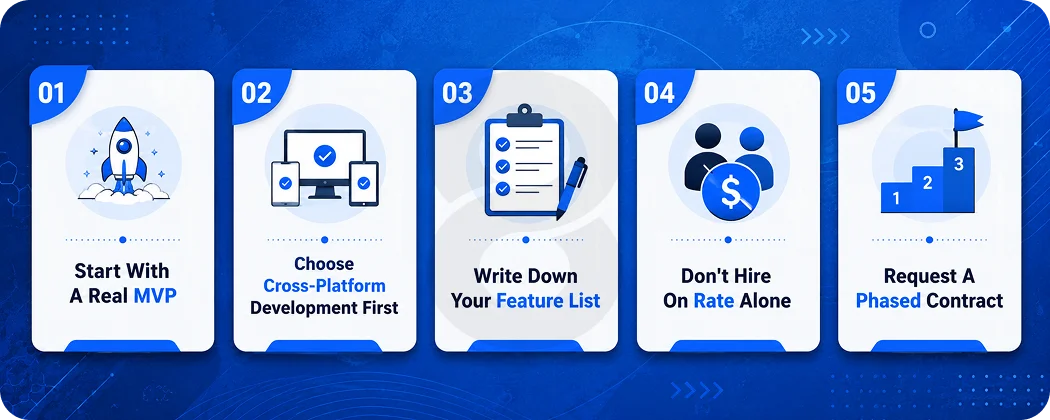
How to Keep Your Restaurant App Development Cost Under Control
None of this locks an owner into the top of every range. A handful of decisions made early, before any code gets written, tend to keep the number closer to the bottom without quietly stripping out what the app can actually do.
Start with a real MVP
Start smaller than feels comfortable. A real minimum viable product means ordering, payments, and a clean menu, full stop, not a watered-down version of everything on the wish list.
The loyalty wallet and the AI-driven recommendations can wait until real order data says customers actually want them, instead of guessing upfront and building something nobody touches.
Go cross-platform for version one
Cross-platform is the right call for almost every first version. Unless the concept genuinely needs something native-only, advanced AR menu previews or deep hardware access most restaurants will never touch.
There’s little reason to pay for two codebases before knowing whether the idea even works. A native rebuild is always on the table later, once real users have proven the concept is worth the extra spend.
Write the feature list first
Before calling an agency, write the feature list down. It doesn’t need to be polished, a notepad scribble works fine.
Owners who walk into that first meeting with something concrete on paper tend to get tighter, more accurate quotes than the ones who describe the idea out loud and leave the agency to guess what they actually meant.
Don’t hire on rate alone
Hourly rate alone is a bad way to pick a partner too. A cheaper team that misreads the brief twice ends up costing more, in rework and blown deadlines, than a pricier team that gets it right the first time.
Ask for a phased contract
One more thing worth asking for, a phased contract instead of one lump sum for the whole build. Pay for ordering and payments first, confirm it actually works the way it’s supposed to, then decide whether the budget for loyalty tools or AI-driven features still makes sense. That structure gives an owner a real exit ramp if priorities shift halfway through.
Agencies that push back hard on breaking a project into phases are usually more interested in locking in the full number upfront than in building the thing that actually fits the restaurant.
How 8ration Builds Restaurant Apps That Pay for Themselves
8ration works with restaurant owners who want an app that earns its budget back and says big NO to one that exists only because the competition down the street has one.
It starts with the same scoping conversation already covered above, pinning down which features actually matter for this specific concept before anyone writes a line of code.
From there, the team builds a native app designed to survive a Friday dinner rush rather than freeze at the worst possible second, alongside custom software that finally gets the point of sale, the kitchen display, and the inventory system talking to each other instead of running as three separate islands.
Restaurants chasing repeat business get something more specific too. 8ration builds AI-powered recommendation engines trained on what a particular customer actually orders.
Brands selling merchandise, meal kits, or a branded hot sauce on the side can also get an online store built in, instead of bolting on some separate platform that clashes with everything else the app is doing.
This isn’t a generalist team guessing its way through a new industry either. 8ration has built specifically for restaurants and food delivery brands before, so the team already knows a reservation-heavy fine dining concept needs a different scope than a delivery-only cloud kitchen, and plans accordingly from the first conversation.
Most of these projects run three to six months, kickoff to launch, with the exact number depending on which of the three tiers from earlier actually matches what’s getting built.
Launch is not treated as the finish line either. 8ration’s team stays on for monitoring, performance fixes, and feature updates after the app goes live, which matters more than it sounds like on paper.