


Kickoff calls for these projects tend to follow a pattern. Someone on the leadership team says “we need custom software” like it’s a purchase order, not a multi month commitment involving fifteen stakeholders who all want different things. Then six months in, the budget’s gone, the roadmap’s a mess, and everyone’s asking why the thing still doesn’t do what the sales deck promised.
That’s the honest starting point for this guide. B2B software development isn’t hard because the code is hard. It’s hard because businesses are messy, requirements shift, and the people who approve the budget are rarely the people who use the product every day.
What B2B Software Development Actually Means
B2B software development is the process of building software that one business sells, licenses, or deploys for another business to use. Think CRMs, ERPs, vendor portals, procurement platforms, and internal operations tools that never show up on App Store charts because they were never meant to.
This differs from B2C work in ways that matter. A consumer app needs to hook someone in seconds. A B2B platform needs to survive a procurement committee, a security review, and a training rollout across departments that didn’t ask for it.
The B2B SaaS market alone is projected to reach roughly $1.58 trillion by 2031, growing at a 26.24% compound annual rate. That growth reflects how expensive and error prone manual processes have become across nearly every industry.
Why B2B Software Development Is Harder Than It Looks
Coordination cost is what most people underestimate. A consumer app answers to one type of user. A B2B platform answers to the end user, the department head, the IT security team, the finance team approving the invoice, and sometimes a compliance officer who shows up in week eight asking why nobody looped them in earlier.
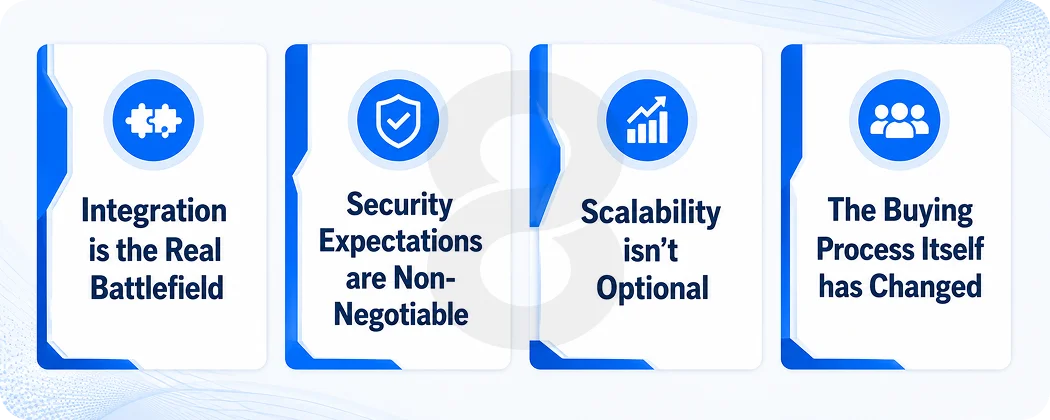
Integration is the Real Battlefield
Most B2B buyers already run five to fifteen other tools. New software has to talk to existing CRMs, accounting systems, and sometimes an old on-premise database nobody wants to touch. A clean integration layer built around APIs and modular architecture makes or breaks adoption. Building good software is one thing. Building software that plays nicely with someone else’s decade-old tech stack is a completely different skill.
Security Expectations are Non-Negotiable
B2B software often handles financial data, customer records, or operational information that a breach would turn into a lawsuit. Enterprise buyers now run their own security audits before signing anything, and vague answers about encryption or access control quietly kill deals.
Scalability isn’t Optional
A tool built for fifty users needs to work for five thousand without a rebuild. Businesses that succeed with early adopters expect to expand fast, and software that can’t grow with them becomes technical debt inside eighteen months.
The Buying Process Itself has Changed
Recent research on B2B software buying found that decisions now typically involve a network of over twenty people across a company, and buyers frequently arrive at the first sales conversation already 60 to 80 percent decided based on research done before anyone from the vendor side even spoke to them.
Read More: Collaboration Software Development in 2026: Features, Benefits & Cost
The Core Components Of A Solid B2B Software Build
Every serious B2B platform, regardless of industry, tends to share the same structural bones. Skip one of these and the gap shows up later, usually at the worst possible time.
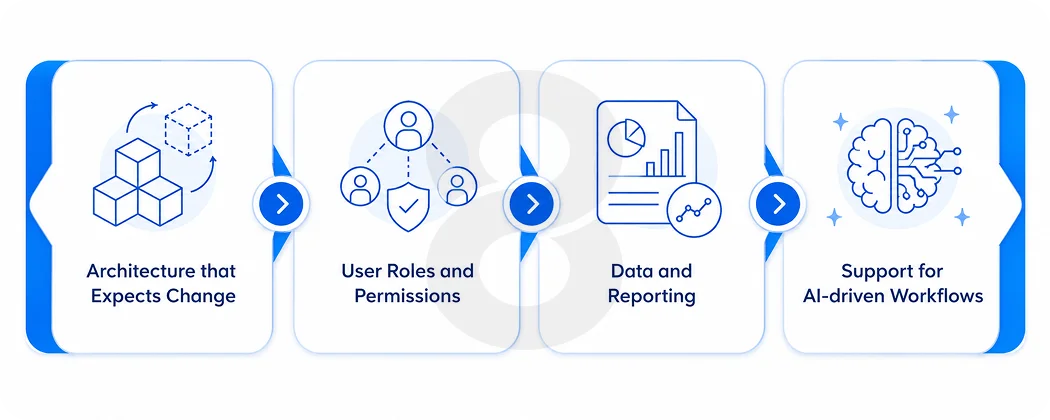
Architecture that Expects Change
Requirements shift constantly in B2B work because businesses themselves shift. A modular, API-first structure allows features to be added or vendors swapped without tearing the whole system apart. Monolithic builds that seemed fine at launch tend to become the reason a company can’t move fast three years later.
User Roles and Permissions
B2B tools rarely have one type of user. A logistics platform might need separate views and permissions for warehouse staff, fleet managers, and finance. Getting role-based access wrong early means retrofitting it later, which is expensive and disruptive.
Data and Reporting
Businesses buy software to make decisions faster. If the platform can’t surface clean, exportable data and dashboards, it becomes a data graveyard nobody trusts. This is one area where custom builds tend to beat off-the-shelf tools, since reporting needs are rarely generic.
Support for AI-driven Workflows
AI copilots, predictive analytics, and automated decision support have moved from a future feature to an expected baseline in enterprise software. Buyers increasingly assume some layer of intelligent automation exists somewhere in the product, even if it’s just smart notifications or predictive alerts.
| Component | Why It Matters | Common Mistake |
|---|---|---|
| Modular architecture | Allows scaling and integration without rebuilds | Locking into a rigid monolith too early |
| Role-based access | Different departments need different views | Treating all users the same |
| Data & reporting layer | Drives adoption and decision making | Building dashboards nobody actually reads |
| Security & compliance | Required for enterprise sign-off | Bolting it on after launch instead of designing for it |
| API connectivity | Businesses run many tools, not one | Building a closed system with no integration path |
For companies exploring how automation and predictive tools fit into this, working with a team that understands AI development specifically, not just general coding, tends to shorten the path from idea to something that actually ships.
Read More: ERP System Development: Complete Guide for Businesses
Choosing Custom Development Versus Off-The-Shelf Software
This question comes up in almost every early conversation, and the honest answer depends on how differentiated a company’s process actually is.
Off-the-shelf tools are cheaper upfront and faster to deploy. If a workflow looks like most other companies in the same industry, a configured SaaS product will probably work fine. But the moment a process is genuinely different, or the goal is a competitive advantage built around how a company operates, off-the-shelf software starts fighting back instead of helping.
Low-code and no-code platforms sit somewhere in the middle, and adoption of them is rising fast, largely due to the ongoing shortage of experienced developers. But low-code tools tend to hit a ceiling once complexity, integration depth, or performance requirements go up. Plenty of companies start on low-code and end up rebuilding on custom infrastructure once they outgrow it.
| Factor | Off-the-Shelf Software | Custom B2B Software |
|---|---|---|
| Upfront cost | Lower | Higher |
| Time to launch | Fast (days to weeks) | Longer (months) |
| Fit to unique workflows | Limited | Built around the business’s process |
| Scalability | Depends on vendor roadmap | Fully controlled |
| Long-term cost | Recurring licensing fees add up | Ownership, but maintenance required |
| Competitive advantage | Minimal, same tool as competitors | Can be a real differentiator |
Benefits Of Investing In Custom B2B Software Development
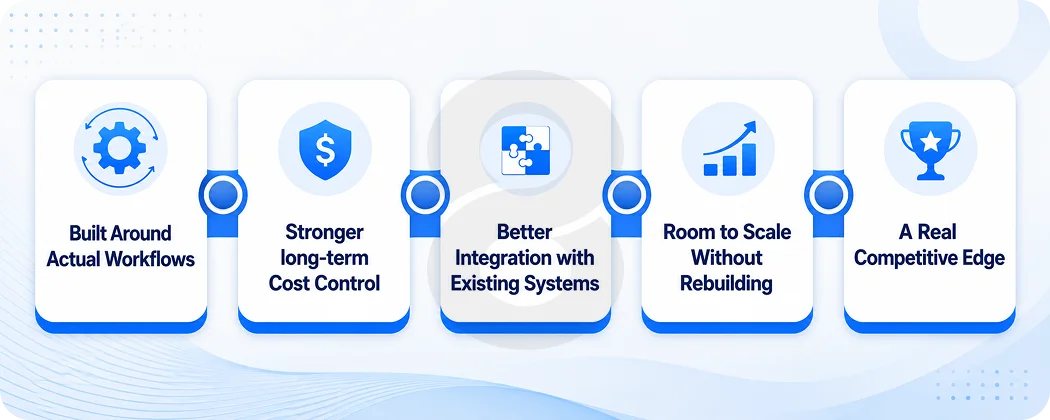
Custom B2B software rarely pays off overnight, but the return compounds once the platform is actually running the business rather than fighting it. The advantages below cover why companies keep choosing custom builds over generic tools once their operations reach a certain scale.
Built Around Actual Workflows
Generic software forces a business to adapt its process to fit the tool. Custom software flips that. The platform is shaped around how the company already operates, which cuts down on workarounds, manual patches, and the frustration of forcing square processes into round software.
Stronger long-term Cost Control
Licensing fees for off-the-shelf tools add up fast once a company scales past a certain user count. Owning a custom platform shifts spending toward maintenance and improvement rather than recurring per-seat charges that climb every renewal cycle.
Better Integration with Existing Systems
A custom build can be designed from the start to connect cleanly with a company’s CRM, accounting software, and internal tools. That reduces the manual data entry and duplicate records that plague companies stitching together multiple unrelated platforms.
Room to Scale Without Rebuilding
Off-the-shelf software often hits a ceiling as user counts or data volume grow. Custom platforms built on modular architecture can expand alongside the business, avoiding the costly rebuild that many companies eventually face with rigid, generic tools.
A Real Competitive Edge
Every competitor can buy the same off-the-shelf tool. A custom platform built around unique processes, data, or customer relationships becomes something competitors cannot simply purchase, which turns the software itself into part of the business’s advantage.
Read More: CRM App Development: Complete Guide to Custom CRM Software & Mobile Apps
How Much Does B2B Software Development Cost
Cost depends entirely on scope, and honest ranges are more useful than a single number pulled from thin air. A basic internal tool with a handful of workflows often falls in the lower range below, while a full enterprise platform with integrations, custom reporting, and mobile companion apps can run well past six figures.
| Project Type | Typical Cost Range | Typical Timeline |
|---|---|---|
| Basic internal tool | $15,000 to $40,000 | 6 to 10 weeks |
| Mid-complexity platform | $40,000 to $120,000 | 3 to 6 months |
| Enterprise-grade system | $120,000 and up | 6 months or more |
Locking a fixed price before scope is clear usually backfires, since vague requirements produce vague quotes and budget overruns later. A discovery phase before pricing gives a far more reliable estimate.
Common Mistakes That Derail B2B Software Projects
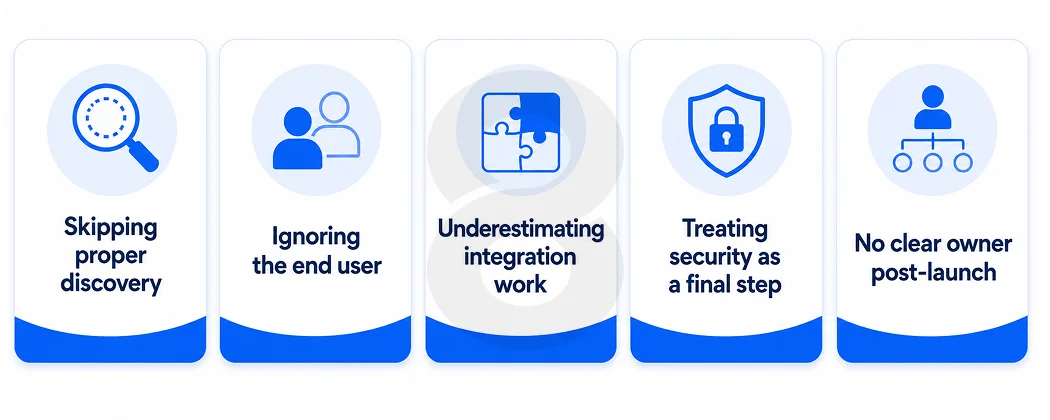
These failure patterns repeat across the industry more than most teams expect going in.
Skipping proper discovery. Teams get excited and want to start building immediately. Without a clear discovery phase, requirements keep shifting mid-build, which is the single biggest driver of budget overruns.
Ignoring the end user. Executives approve the budget, but frontline employees actually use the software every day. Building for the buyer’s opinion instead of the user’s daily workflow tanks adoption even when the software technically works.
Underestimating integration work. Connecting new software to legacy systems almost always takes longer than planned, and budgets rarely account for it properly.
Treating security as a final step. Bolting on compliance and security controls after the core build is finished is slower and riskier than designing for them from the start.
No clear owner post-launch. Software needs maintenance, updates, and someone watching usage data. Projects that end at launch day with no ongoing plan tend to decay fast.
Where AI, Automation, And Data Are Taking B2B Software Next
Enterprise buyers now expect intelligence built into the product, not sold as an add-on. Predictive maintenance in manufacturing tools, smart routing in logistics platforms, and automated risk scoring in fintech software have all shifted from differentiator to baseline expectation.
Global IT spending on software is on track to exceed $6 trillion in 2026, and a meaningful share of that growth is tied directly to AI-embedded platforms and automation tooling rather than traditional feature updates. Companies that ignore this shift risk shipping software that feels dated the moment it launches.
This doesn’t mean every B2B platform needs a chatbot bolted onto the homepage. It means the underlying architecture should support intelligent features as they become necessary, rather than requiring a rebuild every time the market moves.
Read More: Offshore Software Development Guide: How to Find the Right Partner
How 8ration Approaches B2B Software Development
8ration partners with businesses to build custom B2B platforms across industries where “close enough” software isn’t good enough, including logistics, fintech, healthcare operations, and enterprise CRM systems. The approach starts with actual discovery, not a templated proposal, since the biggest cost overruns in this industry come from scope that was never properly defined in the first place.
The team builds around modular, API-first architecture so platforms can integrate with existing enterprise systems instead of forcing a company to rip out tools that already work. Security and role-based access get designed in from the start rather than added after a client’s compliance team flags it during review.
For companies exploring how automation, predictive analytics, or intelligent recommendation engines could fit into their platform, that work runs through dedicated specialists rather than a general dev team learning as it goes.
The team has also built dedicated mobile companion tools for B2B platforms where field teams, drivers, or on-site staff need access away from a desk, ecommerce backends for B2B marketplaces handling bulk ordering and vendor management, and blockchain-based systems for companies needing transparent transaction records. That range matters because most real B2B projects touch more than one discipline before they’re finished.