


Most people still associate Roblox with a blocky game for 10-year-olds. The stats are quite different.
Last year, Roblox accounted for almost 67% of the growth in the video game industry outside China and recorded 10.25 billion hours in a month for players, joining Netflix in the discussion of screen time. According to CEO David Baszucki, the audience is getting older, at 27% of age-verified users spending 50% more time and 40% more money, compared to younger users.
Roblox’s top numbers say it all: There are 3.6 million active developers, 7 million experiences, and 4.9 billion dollars in revenue generated in 2025, an increase of 36% from the previous year.
How Roblox Game Development Actually Works
Unlike building a mobile game or building a Unity game, Roblox game development is unique, and this is important both technically and commercially.
The tools: Roblox Studio and Luau
All elements on Roblox are created using Roblox Studio, an absolutely free desktop program for Windows and Mac. It features an integrated hosting platform, multiplayer infrastructure, physics engine, and an immediate access distribution platform with 70+ million daily players.
The platform is based on its own version of Lua 5.1, called Luau. It’s light, it’s teachable and the developer documentation is one of the better platform docs out there. It can be used for anything from basic obstacle courses to complex RPGs and simulation experiences.
What’s relevant to businesses: Roblox Studio is free. Publishing is free. Your audience is waiting for you. This is one of the rare development routes that enables you to make real money without making any initial investment.
Read More: Top 20 Software for Game Development: From Concept to Launch Made Easy
What the development process looks like
| Phase | What It Involves | Typical Timeline |
|---|---|---|
| Concept and Design | Gameplay loop, art direction, monetization model | 1–3 weeks |
| Core Build | 3D environments, Lua scripting, UI systems | 4–12 weeks |
| Multiplayer and Backend | Server logic, data stores, security | 2–6 weeks |
| Testing and QA | Retention testing, bug fixes, performance | 2–4 weeks |
| Launch and Live Ops | Publishing, updates, community management | Ongoing |
Simple games take 4-6 weeks. The development time for commercial/scalable Roblox games ranges from 3-6 months or more. The best studios have Lua scripters, 3D modelers, UI designers, monetization experts and live-ops experts. That’s where the expertise of a seasoned game development team comes in handy, as having a product-thinking approach is more important than just technical execution to keep players engaged at scale.
AI is changing the build timeline
Introduced in 2025, Roblox’ “Code Assist” and “Material Generator” systems allow creators to develop 3D assets or game logic based on a plain-language description. Time to development can be cut by 65–95% with AI-supported development approaches, as they can create playable prototypes in minutes. That’s a significant change for brands looking to test a concept before fully investing the budget.
Monetization in 2026: How Creators and Brands Actually Make Money
In 2026, monetization on Roblox has become much more complicated, and the financials are increasingly moving to the adult creators and brands.
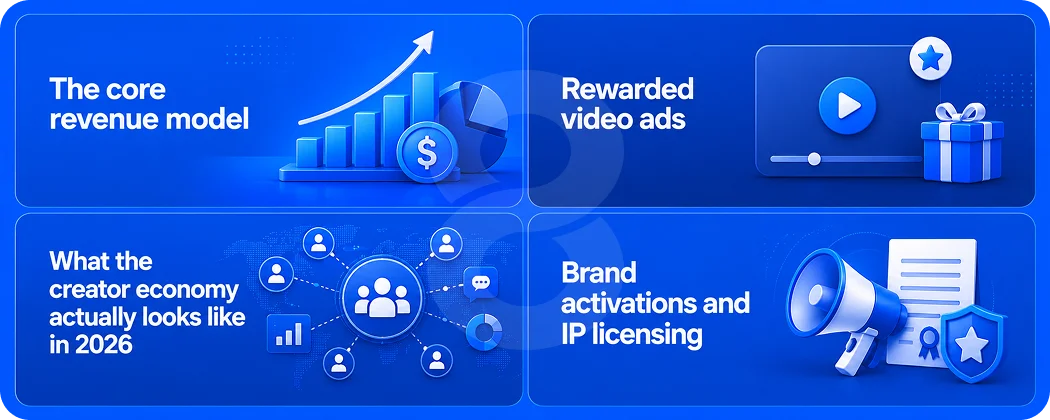
The core revenue model
There are two main in-experience revenue tools: Game Passes (one-time) and Developer Products (repeatable). Developers keep 70% of the Robux earnings while Roblox keeps 30% of the marketplace fee. This rate has been increased to $0.0038 per Robux for the standard DevEx, as of September 2025.
The larger 2026 update: If you are a verified U.S. player aged 18+, you can now get a $0.0054 per Robux rate for any Robux you spend, as of June 8. This is a 42% increase in the payout. It’s Roblox saying if you make games for older players, we’ll pay you more.
Rewarded video ads
Rewarded Video Ads allow players 13+ to view short, full-screen ads and receive in-game customization currency, extra lives and more. In the brand lift study, Roblox had an 87% positive attitude toward the format. By integrating with Google Ad Manager, the platform now brings the Roblox ad inventory to programmatic demand via Google’s Display & Video 360.
What the creator economy actually looks like in 2026
In 2025, Roblox paid out over $1.5 billion to creators, compared to $923 million in 2024. The top 1k creators earned a mean of $1.3M per creator. Let’s face it, most experiences are not worth much. This is a winner-take-most, hit-driven economy, similar to the app store.
| Monetization Method | Revenue Share | Best For |
|---|---|---|
| Game Passes | 70% of Robux | One-time perks, early access |
| Developer Products | 70% of Robux | Consumables, in-game currency |
| Premium Payouts | Engagement-based | High-retention experiences |
| Rewarded Video Ads | Variable | Games with large DAU, 13+ users |
| Paid Experience Access | Up to 70% | Premium branded experiences |
Brand activations and IP licensing
In July 2025, Roblox introduced a new self-serve License Manager for IP owners, who will include Lionsgate, Netflix, Sega and Kodansha with properties such as Squid Game and Stranger Things. Sonic Speed Simulator is the first game to reach 1 billion visits.
If your mobile app development team is already considering an in-app purchase model, Roblox monetization is no exception, as it follows the same psychological tricks that drive in-app purchases: Free Entry, Paid Progressions, Cosmetic Unlocks.
Read More: What Are the Main Stages of Video Game Development
What It Costs to Build on Roblox in 2026
Here’s the honest breakdown.
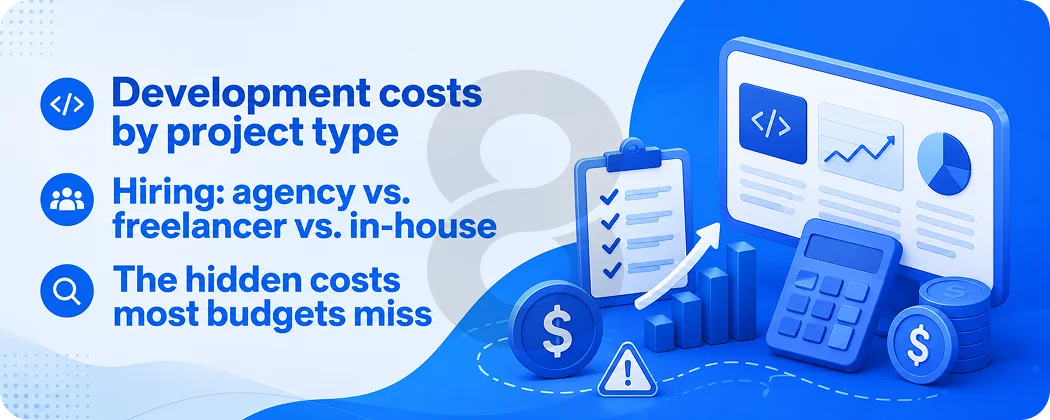
Development costs by project type
| Project Type | Estimated Cost | Timeline |
|---|---|---|
| Simple Experience / Obby | $4,000–$15,000 | 4–6 weeks |
| Mid-Scale Game with Monetization | $20,000–$60,000 | 8–16 weeks |
| Brand Activation / Virtual World | $60,000–$120,000+ | 3–6 months |
| Large Live Service Experience | $80,000–$200,000+ | 6+ months |
The spread is huge because the scope variance is huge. Many monetization opportunities will be different from an obstacle course to a branded virtual world with social areas, live events, and analytics integration running in tandem.
Hiring: agency vs. freelancer vs. in-house
The average rates for freelancers are $30-120/hour, for agencies $40-140/hour, and for full-time in-house team members, $110k – $180k per year. A full-service agency is the safest choice for most businesses that are first-time users of Roblox. The knowledge gained on the platform is not something that can be acquired quickly and architecture errors are very costly once they are in production.
The hidden costs most budgets miss
Additional engineering costs for server hosting, third-party middleware and moderation tools can cost between 15–25% of initial engineering estimates. Live-ops is the one that comes as a surprise to businesses the most. An average retainer developer will cost you less than $5,000 per month (25-50%). That is only a portion of the marketing dollars required to reacquire players that went away due to update apathy.
Games that are updated bi-weekly make 5-10 times more than static games. With this statistic alone as evidence, it is an argument for making building update cycles part of the original budget. Firms that have the capability of producing their own AI have been turning to AI tools to cut down on the expense of continuous content production.
Building Experiences That Actually Retain Players
Sadly, for most existing Roblox experiences, it is not poor design that is to blame – it’s poor retention design. It’s a feeling that is familiar to anyone who has shipped a mobile product.
Games that have 3+ testing rounds have 2.3x the retention rate. It’s not a time to skip testing because something is due sooner. It’s a leveraging factor of all the other things.
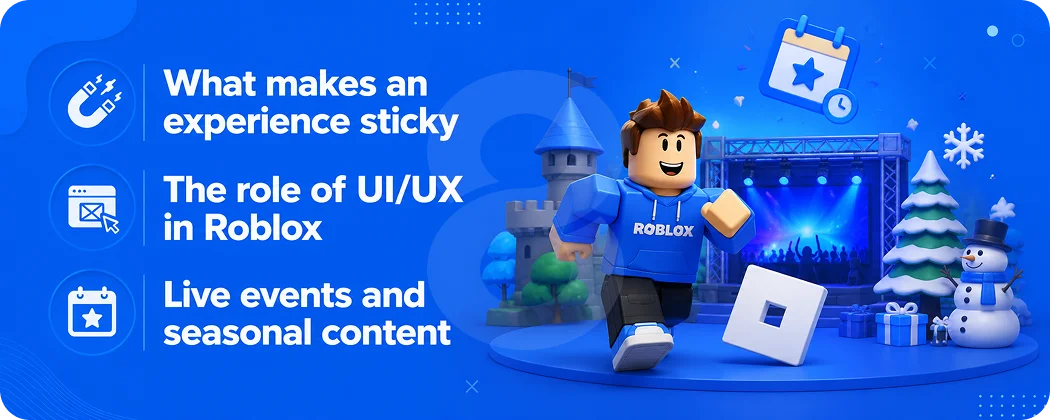
What makes an experience sticky
The mechanics that makes Roblox stickers is not complicated: Unconfused progression, social loops, frequent novelty and ownership. What’s unique about Roblox is that it’s extremely social, even without any games. Players bring their friends. Friends bring accountability. The social graph can do half the retention work when designed to do it.
Outside the top 10, engagement rose by 43% year-over-year, while Robux spend grew by 41% in Q1 2026, making up 65% of the overall Robux spend growth. It doesn’t have to be the next Brookhaven to be sustainable and monetizable.
The role of UI/UX in Roblox
Older Roblox players have standards for aesthetics. The user experience from the start, whether clunky or confusing, makes users less likely to stick around for the gameplay. The engagement of skilled UI/UX design teams can significantly impact D1 retention. It’s not about how it looks good. It’s the feeling of being apparent.
Live events and seasonal content
Grow a Garden is the quickest Roblox experience to reach one billion total visits and has the concurrent user record of all farming simulator games. Genre was less important than time, community energy, and continual updates. Brands can look forward to a content calendar strategy here. Re-engagement and discovery are stimulated by seasonal events, limited items or community challenges.
Read More: How to Hire the Best Game Development Team for Your Project
The Competitive Landscape: Who’s Building on Roblox in 2026
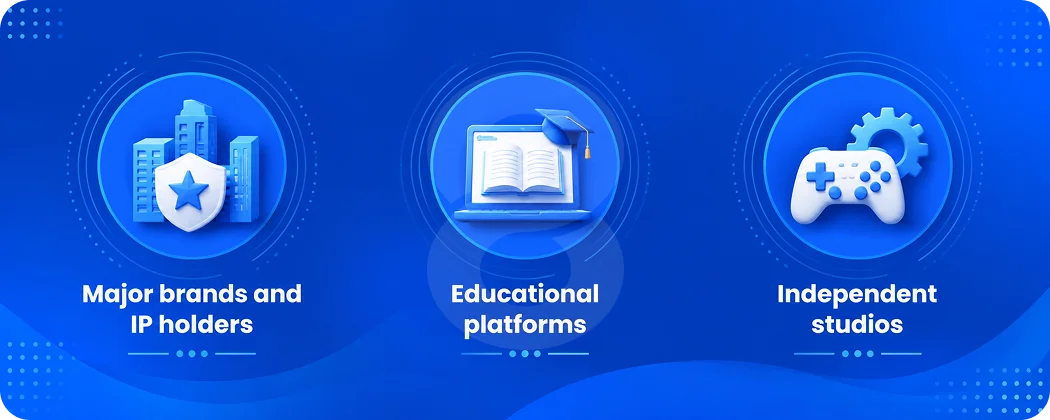
Major brands and IP holders
Nike, Gucci, Ralph Lauren, Chipotle, Vans, Warner Bros, and many others have built branded Roblox experiences. The ones that worked share a common trait: they built actual games, not billboards. Sonic Speed Simulator worked because it was fun, not just because it had Sonic in it.
Educational platforms
Educational institutions and enterprises are using Roblox to teach coding, logistics, creativity, and soft skills. EdTech companies building here access a captive, engaged audience in a context where learning already happens organically.
Independent studios
The top 500 developers each earned more than $200,000 in 2025. That tier operates as professional studios with designers, data analysts, and community teams. For businesses entering Roblox, these studios are both competition and potential co-development partners.
For companies already investing in blockchain development or digital asset infrastructure, Roblox’s evolving economy around virtual ownership is worth watching. Creators will soon manage cross-platform avatars and interoperable assets that travel between digital ecosystems.
What’s Next for Roblox in 2026 and Beyond
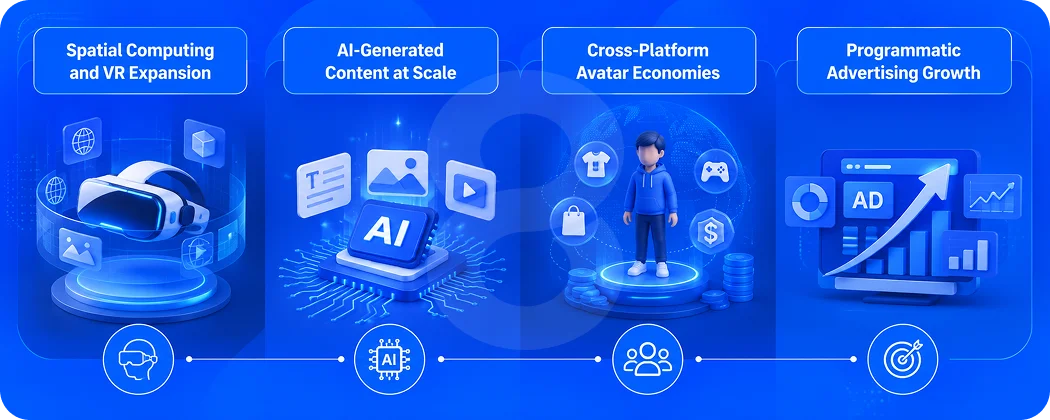
Spatial Computing and VR Expansion
Roblox is already available on Meta Quest headsets, and that footprint is growing. As spatial computing matures, experiences built today will have a natural upgrade path into fully immersive environments. Businesses that build now are essentially future-proofing their presence before the hardware catches up to the ambition.
AI-Generated Content at Scale
Roblox’s native AI tools are getting serious. Code Assist, Material Generator, and generative environment tools are already in creators’ hands. The next phase involves AI that can personalize in-game experiences per player in real time, which changes everything about how retention and monetization get designed from the ground up.
Cross-Platform Avatar Economies
Players increasingly want their digital identity to travel with them. Roblox is moving toward interoperable avatars and assets that work across platforms. For brands, this means virtual merchandise and digital collectibles built inside Roblox could eventually carry value well beyond the platform itself, opening entirely new revenue streams.
Programmatic Advertising Growth
Roblox’s integration with Google Ad Manager and expansion into Amazon DSP, Liftoff, Index Exchange, and Magnite signals a serious advertising infrastructure buildout. For businesses, this means Roblox stops being just a development opportunity and starts functioning as a media channel with measurable reach, targeting, and return on ad spend.
Read More: 9 Best Game Engines for Mobile Development: Comprehensive Guide
What to Look For in a Roblox Development Partner
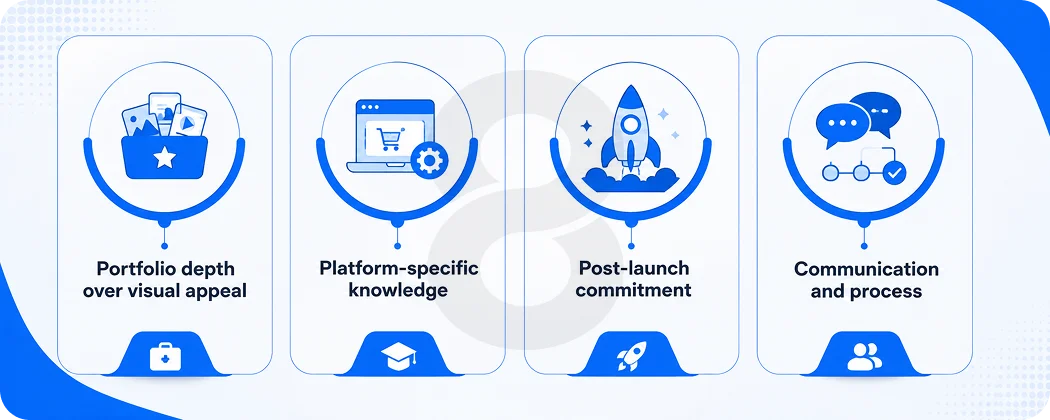
Getting the wrong studio on a project like this costs six months and a six-figure budget.
Portfolio depth over visual appeal
Ask for retention curves, not screenshots. A game that looks great but drops 90% of players on day one is a failed product. Ask for D1, D7, and D30 retention numbers. If a studio can’t answer that, they’re not thinking about your ROI.
Platform-specific knowledge
There’s a difference between game developers and Roblox developers. The platform has its own monetization mechanics, discovery algorithm, and community culture. A good studio knows Lua scripting, data storage, multiplayer networking, device optimization, and security as a unified system, not separate skills.
Post-launch commitment
Roblox is a live service platform. A partner who disappears after launch has handed you an incomplete product. Quarterly refactors, bi-monthly content drops, and annual platform upgrades aren’t optional extras. They’re part of the product.
Communication and process
Misaligned expectations on scope, timeline, and creative direction are the root cause of most failed projects. Companies that already work with custom software development partners will recognize this immediately. The technical execution is the easier part. Alignment is the hard part.
Read More: How Long Does it Take to Make a Video Game
Why Businesses Choose 8ration for Roblox Development
Building on Roblox takes more than Lua knowledge. It takes product thinking, retention strategy, and a team that treats your experience like a live business, not a one-time deliverable.
At 8ration, our game development team combines technical depth with commercial thinking, from concept and scripting to monetization design and ongoing live-ops. If you’re serious about building something that grows, we’re the team to build it with.