




Type the phrase into Google and you get a wall of listicles. The pool underneath is worse. Clutch’s financial services directory lists more than 9,000 firms, and plenty of them built one banking dashboard three years ago and have described themselves as fintech specialists ever since.
Working out which of them understands payment rails and what a regulator will ask for is a couple of afternoons you probably cannot spare. So we spent them. Every profile below carries the same fields so you can read them side by side. Ratings and review counts, what they charge, the smallest project they will take. Then one line on what that firm is good at, which is the part most of these lists leave out.
After the list you get rate benchmarks split by region and by seniority, project costs mapped to scope, and a short set of questions worth bringing to a sales call.
How We Selected These Fintech Development Companies
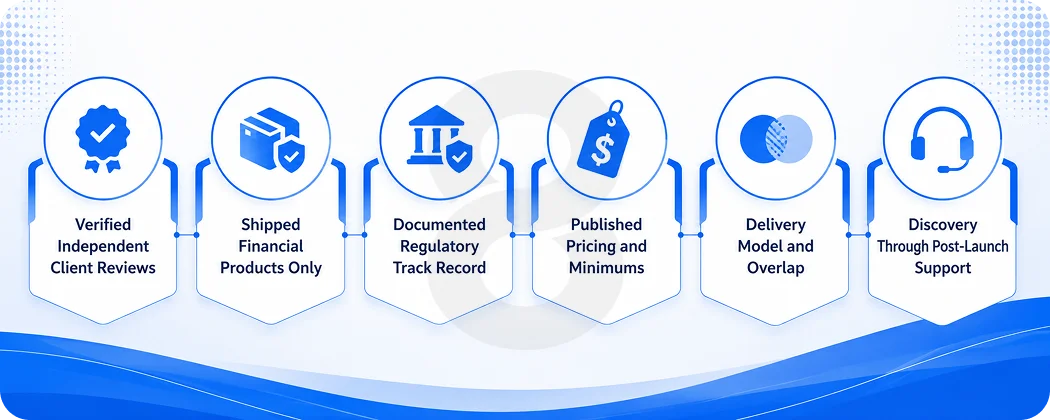
The starting pool was the Clutch financial services rankings, which listed 9,002 providers when we pulled the data in July 2026. Clutch verifies reviews through interviews and documentation, so it filters out the worst of the self-reported portfolio inflation. It does not filter for fintech depth, which is where the screening work happened. Six criteria decided who made the list.
- Verified independent reviews: Rating and review volume on third-party platforms, weighted toward firms with recent financial services projects rather than a large but ageing review count.
- Shipped financial products: Delivered payment systems, lending platforms, banking software, or trading tools that we could find and verify. Bolting a Stripe integration onto a retail app does not make a firm a fintech developer.
- Regulatory track record: Documented work against PCI DSS, KYC and AML obligations, or GDPR. Timing mattered as much as the list. Compliance either shapes the build from the first sprint or gets ticked off in the last one, and the audit is where that difference surfaces.
- Pricing transparency: A published minimum project size and hourly band. Firms that keep both private tend to quote whatever the room will bear, and we wanted these twelve to cover budget tiers that are genuinely different from one another.
- Delivery model and overlap: Where the team actually sits, how many hours of your working day they overlap with, and whether the firm takes a project on or just rents you engineers.
- End to end capability: Some firms stay with a product from discovery through deployment and keep supporting it afterwards. Others hand over the repository on launch day and move on. We ranked the first kind higher.
Fintech Development Companies: A Quick Comparison
All figures below come from each company’s Clutch profile as listed in July 2026.
| Company | HQ | Rating | Min. Project | Hourly Rate | Best For |
|---|---|---|---|---|---|
| 8ration | New York, NY | 4.9 (14) | $25,000+ | $100–$149 | Blockchain payment rails and crypto banking products |
| Kindgeek | Lviv, Ukraine | 4.8 (63) | $50,000+ | $50–$99 | Core banking systems for paytech companies |
| Django Stars | Kyiv, Ukraine | 4.8 (61) | $10,000+ | $50–$99 | Debt management and financial data platforms |
| S-PRO | Lviv, Ukraine | 4.9 (46) | $25,000+ | $50–$99 | Crypto exchanges and digital banking builds |
| Geniusee | Warsaw, Poland | 5.0 (71) | $50,000+ | $25–$49 | Fintech UX paired with backend engineering |
| Vention | New York, NY | 4.9 (101) | $50,000+ | $50–$99 | Enterprise scale and long-running engineering teams |
| Simform | Orlando, FL | 4.8 (86) | $25,000+ | $25–$49 | Cloud-native financial backends and API platforms |
| DeepInspire | Lviv, Ukraine | 5.0 (18) | $25,000+ | $50–$99 | Boutique delivery for financial services clients |
| Leobit | Lviv, Ukraine | 4.9 (59) | $25,000+ | $25–$49 | Legacy loan system modernization |
| OAKS LAB | Prague, Czechia | 5.0 (32) | $25,000+ | $50–$99 | Banking and finance platform builds |
| Iron Forge | Palm Beach Gardens, FL | 4.8 (21) | $25,000+ | $150–$199 | Blockchain work with onshore US delivery |
| Empat | San Francisco, CA | 5.0 (147) | $10,000+ | $25–$49 | Early-stage MVPs on constrained budgets |
The 12 Best Fintech Development Companies
Twelve firms, ranked, though the ranking is the least interesting part of the list. The Best for line in each profile is where the decision gets made, since an agency that is perfect for a lending platform can be the wrong call for a crypto exchange.
 8ration
- Operating since: 2014
- Team size: 50 to 249
- HQ: 477 Madison Avenue, New York, NY
- Other locations: Toronto, Dubai, Kuwait City, Karachi
- Clutch rating: 4.9 across 14 reviews, with 5.0 on quality, schedule, and cost
- Pricing: $25K minimum project, $100 to $149 per hour
- Certifications: ISO 9001 and ISO 27001
Best for: blockchain-based payment infrastructure, crypto banking products, and fintech teams that want a US-hours delivery partner without US agency pricing.
8ration organizes its financial work into six lines: custom financial software, fintech integration, fintech cybersecurity, legacy modernization, fintech consulting, and embedded finance.
The blockchain side is where the specialization is sharpest. The company runs dedicated practices for crypto wallet, smart contract, decentralized exchange work, and crypto banking app, which is a narrower and deeper stack than most generalist agencies carry.
There is nothing exotic in the stack, which in fintech counts as a point in its favour. Backends run on Node.js, Python, Java with Spring, or .NET. The front end is React and Next.js, data sits in PostgreSQL and Redis, and deployment goes out to AWS or Azure through Docker and Kubernetes.
Financial services work in its public portfolio includes VMDO Financial Group, a financial advisory platform, and Allie Marketplace, a consumer marketplace built around secure payments and real-time transaction handling.
Consider 8ration if: you are building on blockchain rails or launching a payments product and want an engineering partner in the New York time zone with a security certification you can actually verify.
 Kindgeek
- Founded: 2014
- Team size: 50 to 249
- HQ: Lviv, Ukraine
- Clutch rating: 4.8 across 63 reviews
- Pricing: $50K minimum project, $50 to $99 per hour
Best for: building or replacing a core banking system inside a paytech company.
Kindgeek has spent most of its history inside financial software, which shows in the project list. One highlighted engagement covers a full banking system for a paytech firm, including the interface layer, payment gateway integrations, and the security protocols around them. That is a different class of work from building a consumer wallet on top of someone else’s core.
Consider Kindgeek if: your project is a core banking or payment processing platform and you want a team that has built one before.
 Django Stars
- Founded: 2008
- Team size: 50 to 249
- HQ: Kyiv, Ukraine
- Clutch rating: 4.8 across 61 reviews
- Pricing: $10K minimum project, $50 to $99 per hour
Best for: data-heavy financial platforms and lending products built on Python.
Django Stars concentrates on custom software and web development, split roughly evenly between the two. Its financial work includes a debt management platform and an analytics platform for a financial data distribution company. Reviewers keep landing on the same observation, which is that the team wants to argue about the problem before anyone opens an editor. That habit earns its keep while your requirements are still moving.
Consider Django Stars if: your product runs on Python and the data model is the hard part. It helps too if you want engineers who will tell you the brief is wrong.
 S-PRO
S-PRO
- Founded: 2014
- Team size: 50 to 249
- HQ: Lviv, Ukraine
- Clutch rating: 4.9 across 46 reviews
- Pricing: $25K minimum project, $50 to $99 per hour
Best for: digital banking builds and regulated crypto exchange work.
S-PRO covers ideation through maintenance, with web development and AI making up the largest slices of its service mix. Its most cited financial project is CoinMENA, a Sharia-compliant crypto exchange built with a Middle East financial institution and licensed by the Central Bank of Bahrain. Building for a central bank licensing regime is a useful signal about how the team handles regulatory scrutiny.
Consider S-PRO if: you are launching a digital bank or an exchange in a jurisdiction with an active licensing authority.
 Geniusee
- Founded: 2017
- Team size: 250 to 999
- HQ: Warsaw, Poland
- Clutch rating: 5.0 across 71 reviews
- Pricing: $50K minimum project, $25 to $49 per hour
Best for: fintech products where interface quality drives adoption as much as the backend does.
Geniusee splits its work between custom software, mobile, AI, and DevOps, and it holds partnerships with AWS, Galileo, Plaid, and Finicity. Those integrations matter in fintech, because Plaid and Finicity are how most US products get bank account connectivity without building it themselves. Its portfolio covers banking portals, digital banking products, eWallets, and wealth management systems.
Consider Geniusee if: you need strong design alongside engineering and you are building on US bank connectivity infrastructure.
 Vention
- Founded: 2002
- Team size: 1K to 10K
- HQ: New York, NY
- Clutch rating: 4.9 across 101 reviews
- Pricing: $50K minimum project, $50 to $99 per hour
Best for: enterprises that need a large, durable engineering bench rather than a project team.
Vention spreads across eleven service lines, from blockchain and cloud consulting to enterprise app modernization and DevOps. Its early financial work includes a Python marketplace platform for a trading company. Review after review lands on the same phrase, which is that Vention felt less like a vendor and more like part of the payroll. That is what you get from a firm whose engagements are measured in years rather than sprints.
Consider Vention if: you are scaling an existing financial platform and need to add capacity without slowing down.
 Simform
- Founded: 2010
- Team size: 1,000 to 9,999
- HQ: Orlando, FL
- Clutch rating: 4.8 across 86 reviews
- Pricing: $25K minimum project, $25 to $49 per hour
Best for: API-driven financial platforms and backend systems that need to survive traffic growth.
Simform’s centre of gravity is cloud engineering and distributed backend architecture. Its fintech work covers API-driven financial platforms, scalable backend environments, and cloud-based transaction systems designed around infrastructure that will still hold together in three years. Cloud consulting and systems integration account for a fifth of its service mix.
Consider Simform if: your bottleneck is backend architecture and transaction throughput rather than interface design.
 DeepInspire
- Founded: 2001
- Team size: 10 to 49
- HQ: Lviv, Ukraine
- Clutch rating: 5.0 across 18 reviews
- Pricing: $25K minimum project, $50 to $99 per hour
Best for: financial services clients who want senior attention rather than a large team.
DeepInspire is the smallest firm on this list, and that is the point. Sixty percent of its work is custom software development, and financial services sits among its top industries alongside IT and education. Recent client feedback covers automated data exchange work that improved accuracy and hit its deadline.
Consider DeepInspire if: your project is mid-sized and you would rather have five senior engineers than twenty mixed ones.
 Leobit
- Founded: 2014
- Team size: 50 to 249
- HQ: Lviv, Ukraine
- Clutch rating: 4.9 across 59 reviews
- Pricing: $25K minimum project, $25 to $49 per hour
Best for: modernizing legacy loan and lending systems without a full rebuild.
One of Leobit’s highlighted projects is app development and testing for a financial services company, covering both a client-facing web application and a legacy loan system. Legacy lending modernization is unglamorous work that many agencies avoid, and having done it before changes how a team scopes the risk.
Consider Leobit if: you have an ageing lending or loan servicing system and a limited appetite for rewriting it from scratch.
 OAKS LAB
- Founded: 2015
- Team size: 50 to 249
- HQ: Prague, Czech Republic
- Clutch rating: 5.0 across 32 reviews
- Pricing: $25K minimum project, $50 to $99 per hour
Best for: banking and finance platform builds where the client wants proactive product input.
OAKS LAB lists custom software development as 40% of its work, with cybersecurity, enterprise modernization, and mobile filling out the rest. A client on a banking and finance platform project described the team as proactive to the point of bringing ideas unprompted, which is a specific and repeatable pattern across its reviews.
Consider OAKS LAB if: you want a partner that will challenge the product direction rather than only execute the ticket queue.
 Iron Forge Development
- Founded: 2018
- Team size: 10 to 49
- HQ: Palm Beach Gardens, FL
- Clutch rating: 4.8 across 21 reviews
- Pricing: $25K minimum project, $150 to $199 per hour
Best for: blockchain fintech work delivered entirely onshore in the US.
Iron Forge covers custom software, blockchain, enterprise modernization, and UI and UX design, with financial services among the industries it serves. Eighteen of its projects were delivered for US clients. One client described the combination of a large firm’s expertise with a small team’s attention, and that framing shows up repeatedly in reviews.
This is the most expensive option here by a clear margin, and some reviews flag project management as an area that could improve. The trade is rate against full onshore delivery.
Consider Iron Forge if: onshore delivery is a hard requirement, whether for procurement reasons or client-side policy.
 Empat
Empat
- Founded: 2017
- Team size: 250 to 999
- HQ: San Francisco, CA
- Clutch rating: 5.0 across 147 reviews
- Pricing: $10K minimum project, $25 to $49 per hour
Best for: early-stage founders who need something real in front of users before the next raise.
Empat carries 147 reviews, more than anyone else on this list, and takes projects from $10,000, which is also the lowest floor here. The work skews mobile and AI. Rather than quoting per project, it sells fixed-price packages scoped separately for pre-seed, seed, and Series A companies. One of those packages is a technical feasibility audit built for investors who want to assess code quality before a deal closes.
The firm makes an argument that lands in fintech: startups shipping fast on no-code and AI tooling accumulate technical debt that surfaces as an unscalable codebase after funding.
Consider Empat if: you are early, capital-constrained, and need something real in front of users or investors within a quarter.
How Much Do Fintech Development Companies Charge in 2026
Fintech developer rates run from about $25 an hour up to $200. Full builds cover a wider spread. A validation MVP starts around $50K, while an enterprise platform carrying real ledger complexity and a heavy regulatory load can pass $350K.
That spread is wide because fintech pricing is not standardized. The same engineer commands very different rates depending on which regulatory environment their work is exposed to.
Hourly rates by region
| Region | Typical Hourly Rate |
|---|---|
| United States and Canada | $90 to $200+ |
| Western Europe | $70 to $150 |
| Latin America | $40 to $110 |
| Central and Eastern Europe | $50 to $90 |
| South and Southeast Asia | $25 to $60 |
Premium submarkets push the top of these bands higher. Zurich, London, New York, and Singapore all command a surcharge, driven by the density of compliance talent and proximity to banking partners rather than by coding ability.
Rates by seniority
One to three years in, a fintech developer bills somewhere around $25 to $60 an hour. Mid level engineers roughly double that, landing between $60 and $110. Senior engineers and architects start at $110 and run to $200.
Fintech is a poor domain for junior-heavy teams. Payment logic, ledger integrity, and regulatory exposure carry legal consequences that a developer two years into their career cannot reasonably own. If a proposal comes in far below the regional band, the usual explanation is team composition rather than efficiency.
Total project cost by scope
| Scope | Typical Cost | What It Covers |
|---|---|---|
| Validation MVP | $50,000 to $90,000 | One core flow, limited integrations, enough to test demand |
| Production Platform | $150,000 to $300,000 | Full PCI DSS and KYC compliance, live payment rails, hardened security |
| Enterprise Platform | $350,000+ | Complex ledgers, multi-jurisdiction regulation, deep core integrations |
Two cost drivers get less attention than they deserve. Security depth is the first. Basic authentication and transport encryption barely move a budget. But add biometric login, fraud detection, and end to end encryption and the total climbs by 20 to 30 percent.
Compliance timing is the second. Bring regulatory requirements into a codebase that already exists and you pay two to three times what you would have paid to build them in at the start. The fix rarely stays at the surface. It reaches down into the data model, which is why the number gets so ugly.
Read More: Fintech App Development Cost: Full Breakdown by Feature, Team & Region
Platform choice sits alongside both. Shipping a single-platform build first cuts initial mobile app development cost by 30% to 40% against launching natively on iOS and Android at once.
How to Choose a Fintech Development Company
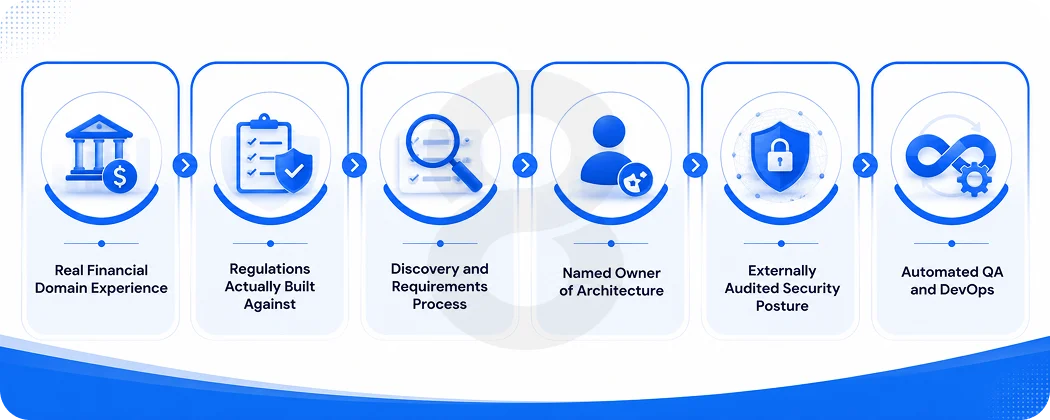
Six questions separate firms that have built regulated financial software from those that list it as an industry tag. Ask all six before you sign anything.
Do they have real financial domain experience
Every agency claims financial services experience because the industry filter on their directory profile is free to tick. Ask for two case studies inside your specific subdomain. If you are building a lending platform, a payments case study is adjacent but not the same. Loan origination, servicing, and collections each carry rules that a payments team has never had to learn.
Which regulations have they actually built against
Name the frameworks that apply to you and ask for evidence against each. PCI DSS if you touch card data, KYC and AML obligations if you onboard users, SOC 2 if you sell to enterprises, GDPR if you serve EU residents. The follow-up question matters more: does compliance sit inside their development lifecycle or does it get checked once at the end? The second answer is where audit failures come from.
The bar has also moved recently. According to the PCI Security Standards Council, PCI DSS v4.0 introduced 64 new or updated requirements, and the 51 that had been treated as future-dated best practices became mandatory on 31 March 2025. Any vendor whose PCI knowledge stopped at version 3.2.1 is working from a retired standard.
How do they run discovery and requirements
Incomplete requirements are the leading cause of mid-project rework, and rework is where fintech budgets die. Ask the vendor to walk you through their discovery process and to show you a scoping document from a previous financial project. Thin, poorly structured documentation predicts scope creep with depressing reliability. A firm with a real software consulting practice will have this material ready.
Who owns the architecture
Ask for the name of the person who will design your system architecture and what else they have designed. A vendor who applies the same universal stack to every project is optimizing for their own delivery convenience rather than your growth curve. Architectural mistakes in financial systems compound, and fixing them late costs far more than getting them right at the start.
What does their security posture look like
ISO 27001 or SOC 2 certification tells you an external auditor has reviewed the vendor’s security management, which is a stronger signal than a signed NDA. Ask about past security incidents and how each was handled. A firm claiming a decade with zero incidents is either lucky or not answering the question, and the useful information is in the response process rather than the incident count.
How is quality assurance handled
Ask what proportion of the test suite is automated and whether DevOps is part of the delivery pipeline. Manual patching in a financial system is a slow-motion outage waiting for a release day. A vendor with a dedicated software testing practice will talk about unit coverage, static analysis, and peer review as routine rather than as premium add-ons.
Red Flags When Hiring a Fintech Development Company
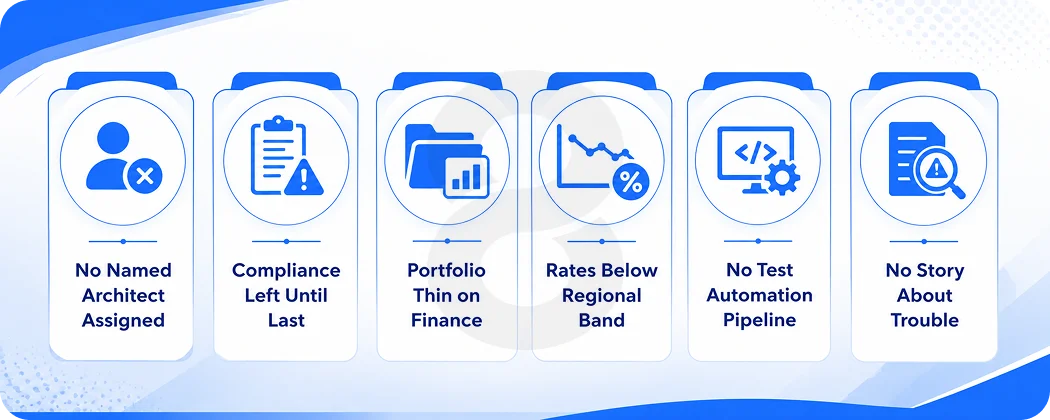
Six warning signs come up often enough in post-mortems to be worth naming directly.
- If nobody owns the technical design, the design is whatever the first available developer decides.
- Vendors who schedule a compliance review after the build is done are budgeting for a rewrite without telling you.
- Twenty sectors listed and no named financial project usually means the finance work was one integration on a retail app.
- Rates well below the regional band with no explanation. Sometimes this is genuine cost arbitrage. More often it is a team weighted toward junior developers on a domain that punishes inexperience.
- No test automation or DevOps in the process description. Manual QA and deployment in a system that moves money is an operational risk you will inherit.
- Project managers who cannot describe a project going wrong. Every long engagement hits trouble. A PM with no story about handling it has either not run one or is not telling you.
Read More: Fintech App Development: Complete Guide to Secure Financial Apps
Which Fintech Development Company Fits Your Project
The list above is easier to use once you know which slice of it applies to you.
Early stage MVP on a tight budget
Empat and Django Stars both open at a $10K minimum, and Empat publishes fixed-price packages aimed specifically at pre-seed and seed companies. Expect to trade some senior attention for the price, and plan the discovery phase carefully so the scope holds.
Blockchain, crypto, and digital asset products
8ration and S-PRO both run deep blockchain practices, with 8ration covering wallet, DeFi staking platform, and exchange infrastructure, and S-PRO carrying a licensed exchange in its portfolio. Iron Forge is the onshore option if US-only delivery is required.
Regulated banking and lending platforms
Kindgeek for core banking, Leobit for legacy loan modernization, and OAKS LAB for platform builds where you want product challenge alongside engineering. All three have shipped inside the regulatory perimeter rather than around it.
Enterprise scale and platform modernization
Vention and Simform both operate at four-figure headcount and are structured for long engagements. Vention suits capacity expansion on an existing platform, and Simform suits backend and cloud architecture work. Either can be engaged through staff augmentation if you want to keep product ownership in house.
Design-led fintech products
Geniusee pairs interface work with backend engineering and holds Plaid and Finicity partnerships, which shortens the path to US bank connectivity. DeepInspire is the smaller alternative when you want senior designers directly on the project.