



Your competitor can buy the same model you did. They can buy it this afternoon, wire it into a support queue by Friday, and have something live before the end of the month. Nothing about that purchase is hard to copy.
That is the uncomfortable fact sitting underneath most AI strategy conversations. Spending keeps climbing, access is effectively universal, and what everyone is buying arrives pre-built and identical for anyone who pays the invoice. Stanford’s 2026 AI Index says it without hedging: with capability no longer a clear differentiator, competitive pressure is shifting toward cost, reliability, and real-world usefulness.
So the useful question is not which model to adopt. It is what you can build around the model that a rival cannot replicate by signing the same vendor contract.
Why AI by Itself Stopped Being a Competitive Advantage
For about two years, having any AI in production was a talking point. That window has closed, and the closing shows up in two separate datasets that rarely get read together.
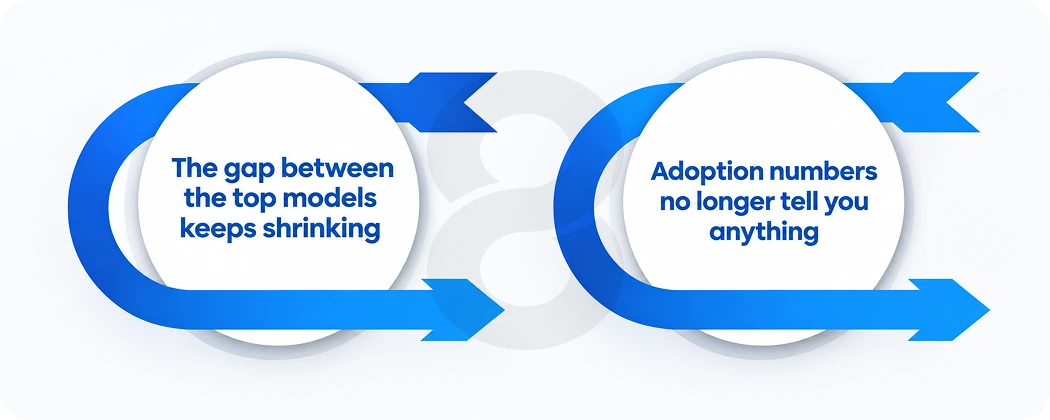
The gap between the top models keeps shrinking
Stanford’s AI Index tracked benchmark performance through 2025 and found the distance between leading models collapsing across language, reasoning, coding, and math. When the best available system is only marginally better than the next one, and both are a credit card away, model choice stops being a strategic decision and becomes a procurement one.
That has a knock-on effect most boards have not priced in. If the technology itself no longer separates anyone, then every dollar spent on access is a dollar spent staying level with the field.
Adoption numbers no longer tell you anything
US Census Bureau data shows 19.8% of businesses using AI in a business function as of early May 2026, with the six-month band running between 17% and 20%. Among firms with at least 250 employees, that figure reaches 37%. Fewer than 20% of firms with four or fewer employees report the same.
Sector matters more than the headline. Information sits at 39.7% and finance and insurance at 33.9%, both well above the national rate, so a company in either one is already competing against rivals with production systems rather than slide decks.
Read the spread carefully. Adoption is common enough that using AI says nothing about you, and uneven enough that larger operations are compounding process changes while smaller ones are still evaluating. Neither group has a moat yet. One of them has a head start on building one.
What Actually Makes an AI Advantage Durable
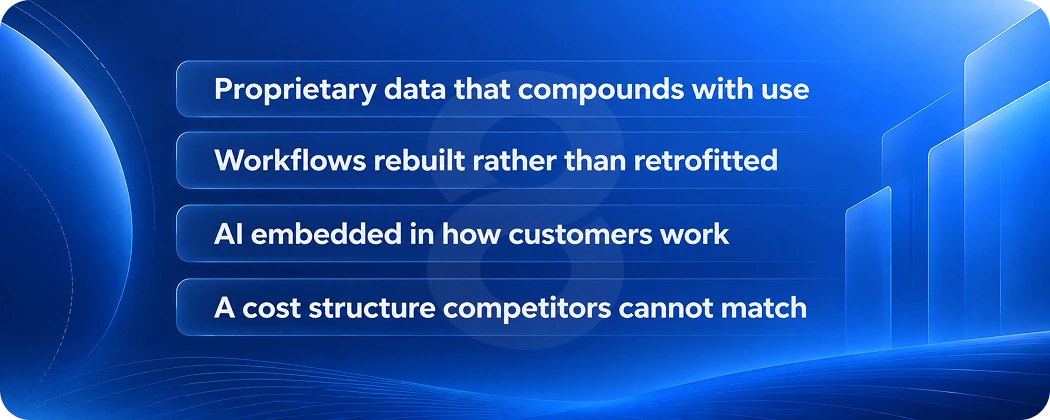
A moat is anything a competitor cannot copy by writing a check. Four things pass that test, and none of them are technologies you buy.
Proprietary data that compounds with use
Models are shared. Your transaction history, claim outcomes, routing decisions, and support resolutions are not. A system trained on how your business actually operates gets more accurate as volume accumulates, and a competitor starting today begins at zero regardless of budget.
This is the one advantage that widens over time instead of decaying. It is also the one most companies skip, because cleaning and structuring operational data is slower and less exciting than deploying a chatbot.
Workflows rebuilt rather than retrofitted
McKinsey’s 2026 State of AI survey, which ran from May to June 2026 across 1,719 respondents in 97 nations, found that nearly three-quarters of high performers fundamentally redesigned workflows because of AI, up from 55% a year earlier. Among everyone else, one in four had done the same.
Inserting AI into an existing process gives you a faster version of that process. Rebuilding the process around what AI can do changes the shape of the work, removes handoffs, and produces something a competitor cannot reverse-engineer from the outside because they can only see your output, not your operating model.
AI embedded in how customers work
When intelligence lives inside a customer’s daily operations, switching vendors means rebuilding their process. That is a different kind of stickiness than a discount or a long contract, and it is the reason custom software development tends to outperform configured platforms on retention.
A cost structure competitors cannot match
One in five respondents in the McKinsey survey said AI operating costs, including tokens, were already constraining their use. Cost per unit of work is becoming a competitive variable in its own right. A company that has engineered its inference costs down can price in ways a competitor running everything through premium endpoints simply cannot follow.
The Gap Between AI Adopters and AI Performers

Two large studies, run by different firms with different methods, landed on nearly the same number. That agreement is worth paying attention to.
Six percent, and it has not moved
McKinsey classifies AI high performers as organizations attributing at least 5% of EBIT to AI while describing the impact as significant. That group accounts for 6% of respondents, unchanged from the previous year. Broader EBIT impact of any size sits at 37%, also flat, even though 44% now report AI scaling across the enterprise and 80% say AI improved their individual productivity.
Productivity at the desk is not reaching the income statement. Hours saved get absorbed into other work, or into slack, unless somebody has decided in advance what the freed capacity is for and how that decision gets measured.
What the leaders do differently
BCG’s study of 1,250 companies, The Widening AI Value Gap, found 5% of firms qualifying as future-built, 35% scaling, and 60% reporting minimal returns despite real spending. The future-built group posted 1.7 times the revenue growth, 1.6 times the EBIT margin, and 3.6 times the three-year total shareholder return of their peers.
BCG also found something that should redirect a lot of roadmaps. Around 70% of AI’s potential value sits in core business functions such as R&D, sales, marketing, and manufacturing, which is to say the parts of the company that already generate revenue rather than the innovation group set up to think about the future.
McKinsey’s high performers back this up from another angle. They are twice as likely to report senior leaders visibly committed to AI work, and twice as likely to have defined processes for measuring whether an initiative worked. In a regulated setting such as fintech software development, that measurement discipline is usually what decides whether a promising model ever reaches a customer-facing process.
Five AI Competitive Advantage Strategies Worth Committing To
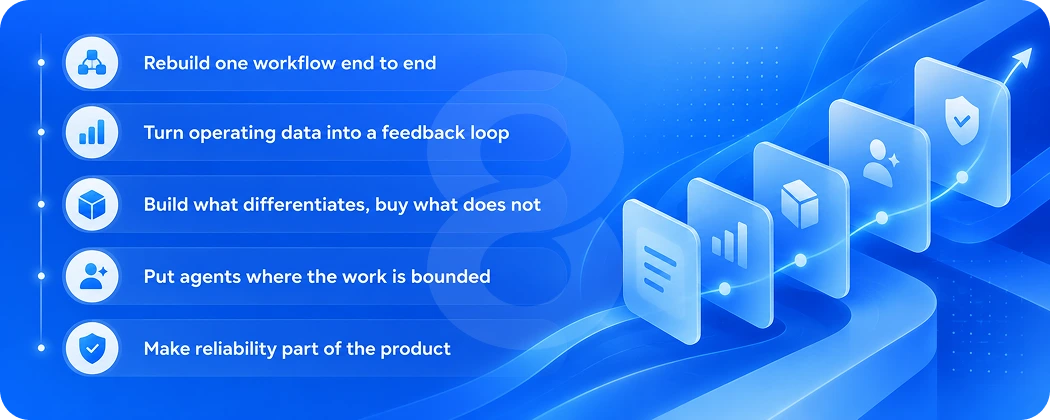
None of these require a frontier research team. They require picking a narrow enough problem to finish and a wide enough one to matter.
Rebuild one workflow end to end
Pick a process with clear inputs, measurable outputs, and enough volume that a change registers financially, such as claims intake or order exception handling. Then redesign it on the assumption that AI takes the parts it is good at, rather than bolting a model onto the version you already have.
McKinsey’s cost-reduction findings cluster in supply chain management, service operations, and manufacturing, which are exactly the areas where the job is bounded and the output is countable. Revenue gains show up most often in marketing and sales, followed by product development. Start where the scoreboard already exists.
Turn operating data into a feedback loop
Every decision your system makes should produce a record of whether it was right. That record is the asset. Without it, you are renting someone else’s intelligence indefinitely; with it, your version of the system gets better in ways theirs cannot.
The work here is mostly plumbing. Instrumentation, labeling, retention policy, and the system integration that connects the model back to the source systems where outcomes actually land.
Build what differentiates, buy what does not
Nearly a third of McKinsey’s respondents, 32%, said their organization decided against buying at least one software product or feature because they could build it in-house with agentic coding tools. Among high performers, that figure reaches nearly half.
The dividing line is straightforward. If a capability is how you compete, owning it protects the advantage. If it is billing or payroll, buy it and move on.
Put agents where the work is bounded
BCG found agents accounting for 17% of total AI value in 2025, with an expected rise to 29% by 2028. McKinsey found 40% of large enterprises scaling agents, up from 27%.
The pattern that works is narrow scope with a clear definition of done. Agentic AI development pays off in workflows where success is verifiable, and disappoints in open-ended ones where nobody can say whether the agent did the job correctly.
Make reliability part of the product
High performers are markedly more active in managing AI risk, including technical vulnerabilities and unauthorized or unintended actions. In regulated sectors this is not overhead. A platform that can show its audit trail wins deals that a faster competitor loses at the compliance review.
How To Tell If You Are Building a Moat or Renting One
Run each AI investment through one question: if a competitor started tomorrow with the same budget, how long until they match this? The answer sorts your portfolio quickly.
| AI Investment | How Long The Edge Holds | Why |
|---|---|---|
| Off-The-Shelf Model Access | No Edge At All | Same Vendor, Same Pricing Page |
| Website Chatbot | Weeks To Months | Feature Parity Is One Sprint Away |
| AI Added To An Existing Workflow | Six To Twelve Months | The Process Stays Visible From Outside |
| Workflow Rebuilt Around AI | Years | Rivals Must Reorganize, Not Just Buy |
| Model Trained On Your Operating Data | Compounds Indefinitely | Data Accrues Only From Your Own Volume |
| AI Embedded In Customer Operations | Compounds Indefinitely | Switching Means Rebuilding Their Process |
Most AI budgets concentrate in the top two rows. Most AI returns come from the bottom three.
There is a practical version of this test. Ask what happens to the advantage if your vendor doubles its prices or shuts down. If the answer is that you lose everything, you were renting.
What It Costs To Build an AI Advantage
Pricing depends on how much of the stack you own. A generative AI feature layered onto an existing product is a different project from a system trained on your own data with monitoring and human review built around it.
The variables that move the number most are data readiness, integration depth with systems you already run, and how much oversight the use case demands. Ongoing inference and monitoring costs then continue after launch, which is the line item most first-time budgets forget.
Mistakes That Turn AI Spending Into a Cost Center
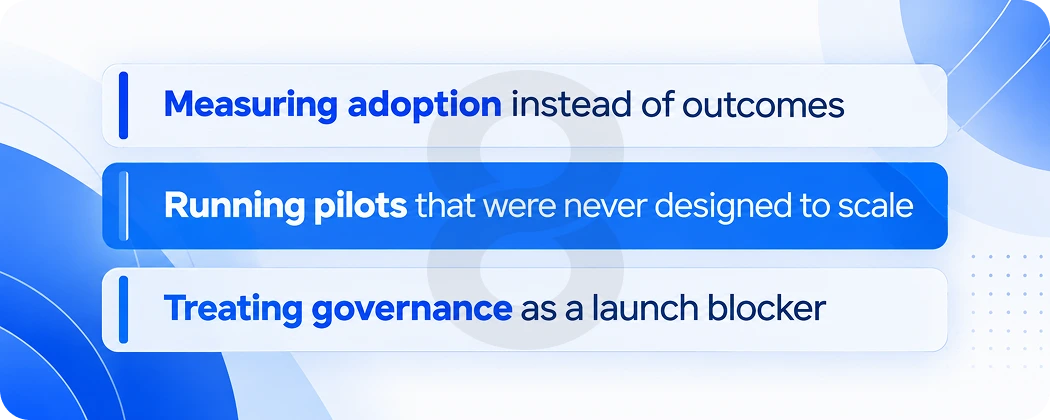
The failure modes repeat across industries and company sizes, which makes them easy to check for before they cost you a year.
Measuring adoption instead of outcomes
Seat counts and query volume tell you people are using something. They say nothing about whether the business earns more or spends less. McKinsey’s split between 80% individual productivity and 37% EBIT impact is what that measurement gap looks like at scale.
Running pilots that were never designed to scale
A pilot built on exported spreadsheets and manual review cannot become production without being rebuilt. Scope the first version as a small production system with real integration into a logistics platform or whatever the operational system of record happens to be.
Treating governance as a launch blocker
Review processes, escalation paths, and audit logs are cheaper to design at the start than to retrofit after an incident. They are also what lets you deploy into higher-stakes processes, which is where the returns live.
Hiring an AI Development Company To Build Something Durable
The right partner argues with your brief. If a team agrees to everything in the first call and sends a proposal for exactly what you described, they are selling delivery hours rather than an outcome.
Look for three things in particular. Ask what they would refuse to build and why. Ask how they would measure whether the system worked six months after launch. Ask to see a project where the AI was load-bearing rather than decorative.
8ration builds AI systems that run inside operations rather than alongside them, which usually means the engagement starts with a process and a number rather than a model choice.
On Chem Savy, an agriculture diagnostic app, the team trained image recognition across more than 200 crop diseases at 92% accuracy, validated at 89% through agricultural expert partnerships, and shipped iOS and Android in eight months. Average disease response time fell from five days to under two minutes, and regular users documented a 34% improvement in crop yield protection. The model was the smaller half of that job. Field-usable interfaces, offline capability, and localized treatment data did the rest.