


A dispatcher who wants to know where a truck is should not have to open a map, filter by unit number and squint at a timestamp. Chatbot APIs for fleet tracking integration let that dispatcher type the question in Teams or say it out loud and get the answer from live telematics data within seconds. The same connection lets a customer ask for an ETA over WhatsApp and lets a driver check his remaining drive time without touching a screen.
Fleets already have the data. North America had 19.2 million active fleet management systems at the end of 2024, and Berg Insight expects that number to reach 33.2 million by 2029.
Tracking platforms commonly expose GPS position, engine data and driver logs through an API. What most fleets lack is a way for people to ask that data a plain question and trust the reply.
What a Chatbot API Does Inside a Fleet Tracking Stack
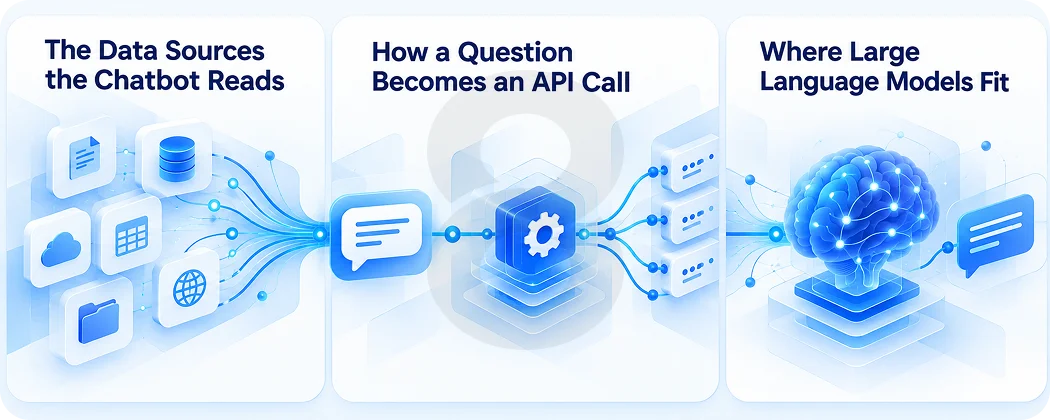
A fleet chatbot has three moving parts. The tracking platform holds the data and the chatbot layer understands the question. A middleware service connects the two and decides what each user is allowed to see.
The Data Sources the Chatbot Reads
Telematics devices plugged into the vehicle report GPS position, speed, ignition status, odometer readings and engine fault codes. Heavy trucks send much of this over the J1939 network. Electronic logging devices add hours-of-service records, and fuel cards add purchase data. Dispatch and TMS software holds the loads, stops and customer details that give a location its meaning.
A chatbot that only reads GPS can tell you a truck is on I-80. A chatbot that also reads the load record can tell you the truck is 40 minutes from its second stop and running late.
How a Question Becomes an API Call
When someone types “Where is unit 88?”, the chatbot first identifies the intent (a location lookup) and the entity (unit 88). The middleware then calls the tracking platform’s REST endpoint for that vehicle, receives a JSON response with coordinates and a timestamp, and passes it back. The chatbot converts the coordinates into a street address or a landmark and replies in a sentence.
For alerts the flow runs the other way. The tracking platform fires a webhook when a geofence is crossed or a fault code appears, and the chatbot pushes a message to the right person on the right channel.
Where Large Language Models Fit
Older chatbots relied on fixed intents and needed a training phrase for every way a person might ask a question. Large language models with function calling handle the variety of real speech much better. The model reads the question, picks which API function to call and fills in the parameters. Your code makes the actual call. The model never touches the tracking database directly, and that separation keeps answers grounded in real data.
Teams that want this layer built for them usually start with AI chatbot development and add the tracking connection on top.
| Component | What it does | Common examples |
|---|---|---|
| Telematics device | Collects GPS, engine and driver data from the vehicle | OBD-II dongles, hardwired GPS units, ELDs |
| Tracking platform API | Stores the data and returns it on request | REST endpoints, webhooks, data feeds |
| Middleware | Authenticates users, calls the tracking API and formats replies | Node.js or Python service, API gateway |
| Chatbot or LLM layer | Reads the question and picks the right function | Dialogflow, Rasa, Microsoft Bot Framework, LLM with function calling |
| Channel | Where people ask and receive answers | Microsoft Teams, Slack, WhatsApp, SMS, in-cab voice |
Dispatch desk buried in “where’s my truck” calls?
Talk to 8ration’s AI team about a chatbot that answers location questions straight from your telematics feed.
Button: Book a Free Consultation
Use Cases of Chatbot APIs for Fleet Tracking Integration
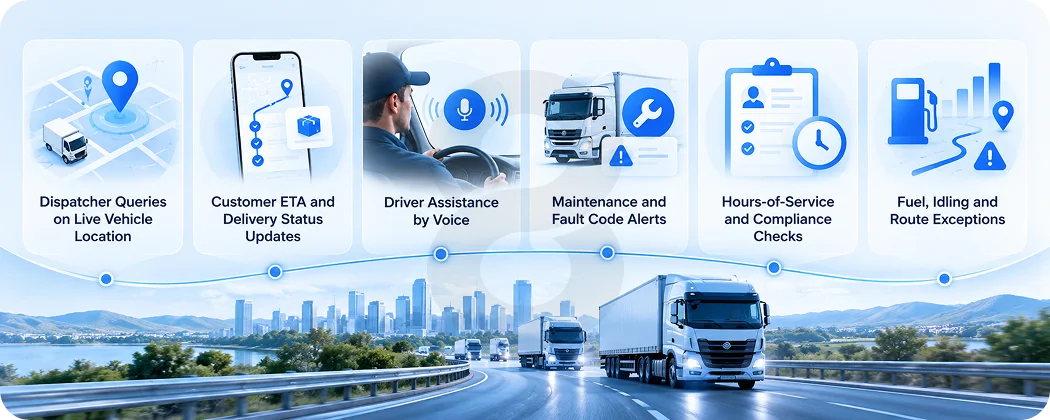
Each use case below answers a question someone on your team or a customer already asks every day. Pick the ones that take the most phone time today and build those first.
Dispatcher Queries on Live Vehicle Location
Dispatchers ask the same questions all shift. Which truck is closest to this pickup? Has unit 12 left the yard? Which drivers are still idle after their last drop? A chatbot connected to the tracking API answers these in the chat tool the dispatcher already has open. It can also run a nearest-vehicle search and return the three closest available trucks with their distance to the pickup.
Customer ETA and Delivery Status Updates
Shippers and receivers want to know when the load arrives. A customer-facing bot reads the vehicle position and the remaining route and then replies with an ETA. The bot needs a load number or order ID to verify the caller and should only show the vehicles tied to that customer’s shipments. The same bot can send a proactive message when a truck enters a geofence around the delivery site.
Driver Assistance by Voice
Drivers should not be typing while the wheels turn. A voice assistant connected to the ELD and the dispatch system lets a driver ask how many drive hours remain, where the next fuel stop on the approved list is, or what the delivery instructions say for the next stop. Building this layer draws on AI voice assistant development and speech recognition tuned for cab noise.
Maintenance and Fault Code Alerts
When a vehicle reports a diagnostic trouble code, the tracking platform can fire a webhook. The chatbot translates the code into plain language, tells the maintenance lead which unit threw it and where that unit is, and asks whether to book it into the shop. A fleet manager can also ask which vehicles are due for service in the next 500 miles.
Hours-of-Service and Compliance Checks
Under FMCSA rules, a property-carrying driver can drive a maximum of 11 hours within a 14-hour window after 10 consecutive hours off duty. Dispatchers who assign a new load without checking remaining hours create violations. A chatbot that reads ELD data can answer “Can the driver on unit 22 take the Fresno run?” with a yes or no plus the remaining drive time.
Fuel, Idling and Route Exceptions
Managers can ask which trucks idled more than an hour yesterday, which vehicles left their planned route, or where a fuel purchase happened away from the truck’s GPS position. These questions used to need a report export and a spreadsheet. A chatbot runs the query against the API and returns a short list.
| Use case | Who asks | Data the API returns | Typical channel |
|---|---|---|---|
| Live location lookup | Dispatcher | GPS position, timestamp, status | Teams, Slack, web chat |
| ETA and delivery status | Customer, broker | Position, route, stop sequence | WhatsApp, SMS, web widget |
| Remaining drive hours | Driver, dispatcher | ELD duty status and clocks | In-cab voice, driver app |
| Fault code alert | Maintenance lead | DTC, unit ID, location | Push notification, Teams |
| Idling and route exceptions | Fleet manager | Engine hours, geofence events, fuel data | Web dashboard chat |
Benefits of Integrating a Chatbot With Fleet Tracking
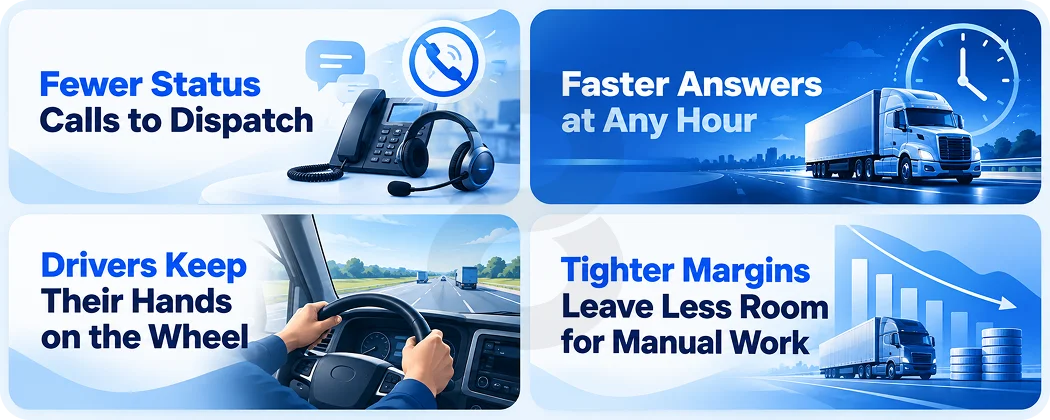
The gains come from removing the human relay between a question and data that already exists. Fleets feel the change first at the dispatch desk, and rising trucking costs make the case stronger every year.
Fewer Status Calls to Dispatch
Every “where’s my load” call pulls a dispatcher away from planning. When the customer or broker can get the answer from a bot, the dispatcher keeps working on exceptions that need a person. Those are the late loads, the breakdowns and the driver who just called in sick.
Faster Answers at Any Hour
A bot answers at 3 a.m. the same way it answers at noon. Night-shift receivers and overseas customers get a reply without waiting for the office to open. Customer service teams are moving in that direction. A Gartner survey of 187 customer service leaders found that 85% planned to explore or pilot customer-facing conversational GenAI in 2025.
Drivers Keep Their Hands on the Wheel
Voice access to load details and hours means fewer reasons to pick up a phone while driving. It also means fewer calls from drivers to dispatch for information that sits in a system both of them can reach.
Tighter Margins Leave Less Room for Manual Work
Trucking costs keep climbing. The American Transportation Research Institute reported that operating costs hit $2.336 per mile in 2025. That figure is 3.4% higher than the year before and the highest in the history of its report. Truckload and refrigerated carriers ran operating margins below 1%, and carriers cut non-driver staff by 7.8%. With fewer people in the office, a tool that answers routine questions frees the staff who remain for work that needs judgment.
How to Implement a Chatbot API for Fleet Tracking
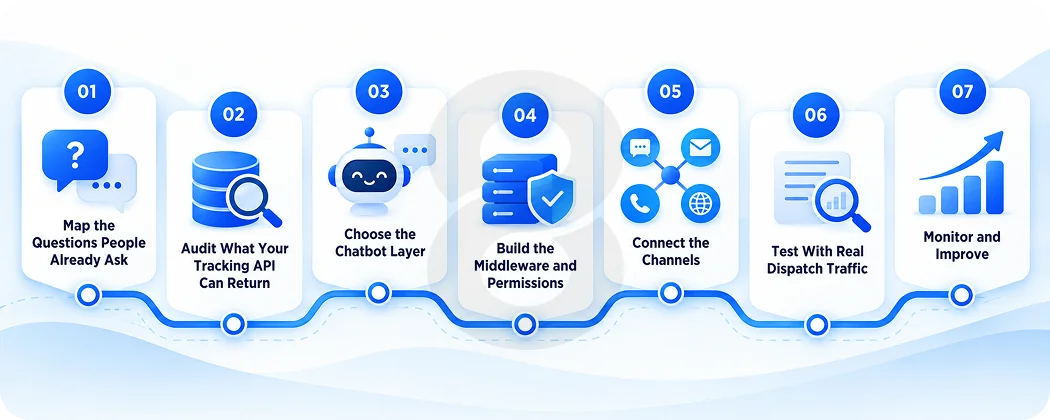
A working integration follows a fixed order. Start with real questions and real data, then pick tools. Teams that reverse this order end up with a bot that talks well but cannot answer what dispatch needs.
Map the Questions People Already Ask
Pull a week of dispatch call logs, customer emails and driver messages. Group the questions by type and count them. The top ten by volume become the first release. Questions that need a human decision, like approving overtime, stay with humans.
Audit What Your Tracking API Can Return
Read the API documentation for your telematics provider. Check which endpoints exist for location, trips, ELD logs, fault codes and geofence events. Note the rate limits, the authentication method (usually OAuth 2.0 or an API key) and how fresh the position data is. Ping intervals vary by device, and many units report less often once the vehicle is parked. If your TMS and tracking platform do not share vehicle IDs, plan a mapping table now. Software integration services cover this kind of system-to-system work.
Choose the Chatbot Layer
A rules-based platform like Dialogflow or Rasa suits a small, fixed set of questions with strict wording. An LLM with function calling suits open-ended questions and multi-step requests. Many teams combine the two and route simple intents through rules while the model handles the rest. Fleets that want the bot to take actions, such as reassigning a load after checking hours, move toward agentic AI development, where the system plans and runs several API calls in sequence.
Build the Middleware and Permissions
The middleware is where most of the engineering happens. It authenticates every user, maps each one to the vehicles they may see and calls the tracking API on their behalf. It caches responses to stay inside rate limits and logs every query for audit. A customer must never see another customer’s trucks, and a driver should only see his own logs.
Connect the Channels
Dispatchers live in Teams or Slack. Customers prefer WhatsApp, SMS or a web widget. Drivers need voice inside a mobile app or the in-cab tablet. Each channel has its own API and message limits, so launch with one or two and add the rest once the core answers are reliable.
Test With Real Dispatch Traffic
Run the bot in shadow mode for two weeks. Dispatchers ask it questions alongside their normal process and flag every wrong or slow answer. Test edge cases on purpose: a truck with no signal in a tunnel, a unit number that does not exist, a driver whose ELD shows an unassigned drive.
Monitor and Improve
After launch, track which questions fail, how long answers take and how often people fall back to calling dispatch. Gartner found that 61% of service leaders had a backlog of knowledge articles that needed editing. A fleet bot faces the same problem with outdated SOPs and stop instructions, so assign someone to keep that content current.
| Phase | Main task | Output |
|---|---|---|
| Discovery | Collect and rank real questions | Prioritized question list |
| API audit | Test endpoints, limits and data freshness | Data map and gap list |
| Design | Pick chatbot layer, channels and permission model | Architecture document |
| Build | Middleware, intents or functions, channel connectors | Working pilot |
| Pilot | Shadow mode with dispatchers | Error log and fixes |
| Launch and monitor | Roll out channel by channel | Usage and accuracy reports |
Planning a chatbot on top of your telematics?
8ration’s engineers can audit your tracking API and map out the integration before any code gets written.
Button: Schedule an API Review
Problems That Stall Fleet Chatbot Projects
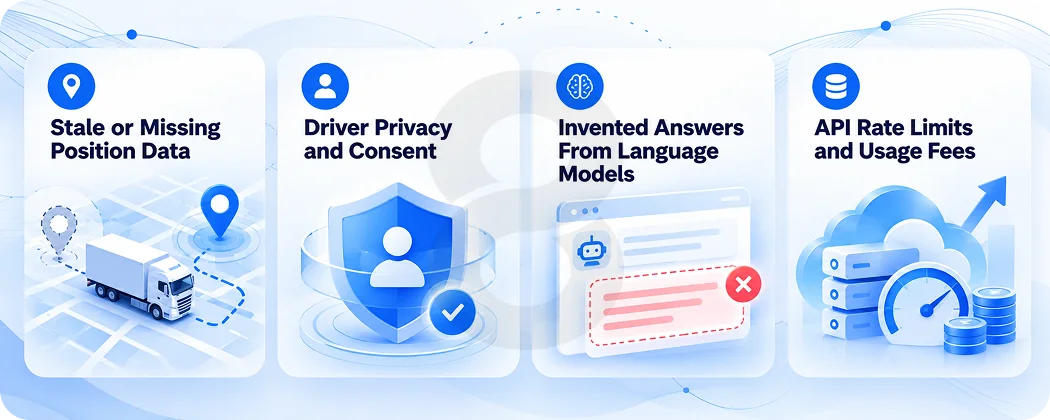
Most failed projects trip over data quality, privacy rules or answers the model invents. Knowing these problems early lets you design around them instead of patching them after drivers and customers lose trust.
Stale or Missing Position Data
A vehicle in a dead zone stops reporting. If the bot returns the last known position without saying when it was recorded, the answer looks current and is wrong. Every location answer should include the timestamp, and the bot should say so plainly when the data is older than a set threshold.
Driver Privacy and Consent
Location data tied to a named driver is personal data in many jurisdictions. GDPR applies in Europe, and several US states have their own privacy laws. Limit who can query a driver’s location, stop sharing positions when the driver goes off duty in a personal vehicle, and keep query logs for audits.
Invented Answers From Language Models
An LLM asked about a truck it has no data for may still produce a confident reply. Force the model to answer only from function results, and return a fixed “I don’t have data for that unit” when a call fails. Test this behavior before launch.
API Rate Limits and Usage Fees
Some telematics providers cap requests per minute or charge for API access. A popular bot can hit those caps fast. Cache recent positions for a short window and batch requests where the provider allows it.
What Shapes the Cost of a Fleet Chatbot Integration
No two fleet chatbots cost the same, because the price follows the scope. The number of data sources matters most. A bot that reads one tracking API is a smaller job than one that joins tracking, ELD, TMS and fuel card data.
Channels add cost too, and voice for drivers takes more work than a Teams bot for dispatchers. An LLM layer brings per-request usage fees that grow with traffic. Permission rules for customer-facing access add middleware work.
Ongoing costs include hosting, model usage, API fees from your telematics provider and someone to maintain the content the bot relies on.
Wondering what a fleet chatbot integration would cost?
Use 8ration’s cost calculator to get a rough estimate for your data sources, channels and features.
Button: Calculate Your Cost (link to the cost calculator)
How 8ration Builds Chatbot Integrations for Fleets
We build conversational systems that read from the platforms fleets already run. Our AI team designs the chatbot and language model layer, and our integration engineers build the middleware that connects it to telematics APIs, ELD data and dispatch software.
For carriers and 3PLs we pair that work with our logistics software development practice so the bot fits the way loads, stops and drivers are already managed.
Some projects start at the hardware end. When a fleet needs custom devices or sensor data that its current platform does not expose, our IoT app development team handles device communication and data pipelines.
For vehicle makers and dealers we draw on our automotive software development work. We start every engagement with the API audit described above, because what the tracking platform can return decides what the bot can answer.