


Merchandising teams decide which products to buy and in what depth, which stores get which sizes and when a price should drop. AI merchandising hands the analysis behind those calls to machine learning and generative models. The models read sales, stock, prices and shopper behavior together and return a recommendation that a planner can accept or change.
The prize is large on paper. McKinsey puts the value of generative AI for retailers at $240 billion to $390 billion, which equals a margin gain of 1.2 to 1.9 percentage points across the industry. Few retailers have collected it yet. In the same research 90% of retail executives said they had started experimenting with gen AI. Only 26% were scaling it in internal operations, and just 2 of the 52 executives surveyed had implemented it across their whole organization.
Most of the real work in AI retail merchandising sits in that gap between a promising pilot and a system planners trust every Monday morning.
What AI Merchandising Covers in a Retail Business
Merchandising follows a product through its whole life inside a retailer. A buyer picks it and a planner decides how many units to order and where they go. A pricing analyst sets the first price and later the markdown. Online teams write the product page and decide where the item ranks in search.
AI in merchandising can support each of those steps. Older merchandising software followed rules a person wrote, such as marking down an item once sell-through fell below a set level. Machine learning works the other way round. It studies past results, finds the patterns that predicted them and updates its view as new sales arrive each night. Generative AI adds a different skill: it writes product descriptions, fills in missing attributes and answers shopper questions in plain language.
A sensible start is one decision that costs money today, often forecasting or markdowns. The tools also sit inside wider retail software development work, since a model is only useful when its output lands in the planning, pricing and store systems a team already runs.
How AI-Powered Merchandising Works Behind the Scenes
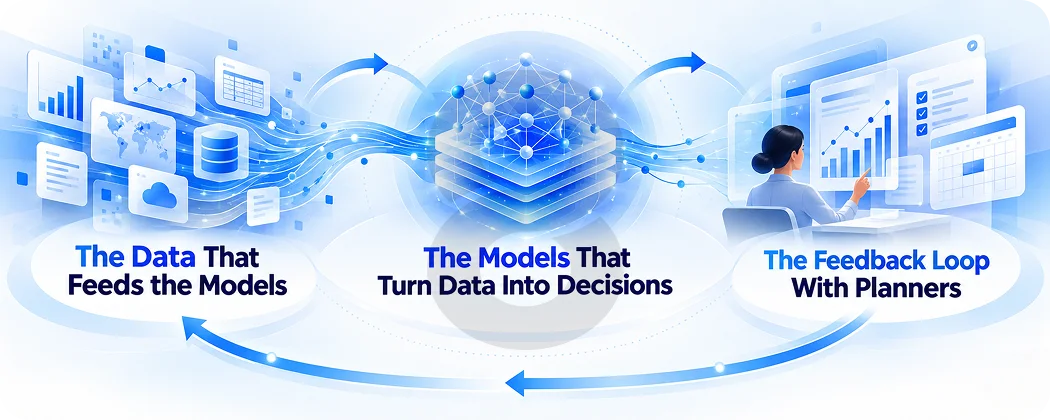
If you are weighing AI for your merchandising team, it helps to know the three parts every system shares: incoming data, models that turn it into recommendations and planner feedback that improves the next answer.
The Data That Feeds the Models
Point-of-sale history is the base layer, ideally by store, by SKU and by day. Inventory positions across stores, warehouses and in-transit stock come next. Product attributes such as color, size, fabric, brand and price tier let a model compare a new item with similar ones that have sold before. Price and promotion history shows how shoppers reacted to past discounts.
Online retailers add search terms, clicks, add-to-cart events and returns. Some also pull in weather and local events, because demand for a raincoat moves with the forecast.
The Models That Turn Data Into Decisions
Different decisions call for different models. Demand forecasting uses time-series and gradient-boosted models to predict unit sales per store and per week. Price elasticity models estimate how volume shifts when a price changes. Recommendation models rank products for each shopper. Computer vision reads shelf photos. Large language models handle product copy and conversational search. Retailers without an in-house data science team can get forecasting through AI predictive analytics tuned to their own sales history.
The Feedback Loop With Planners
A planner who disagrees with a forecast should be able to override it and say why. Those overrides become training data. Over a few seasons the model learns its blind spots and the planner learns which recommendations hold up. Skip this loop and planners will ignore even an accurate system.
Where AI in Merchandising Pays Off
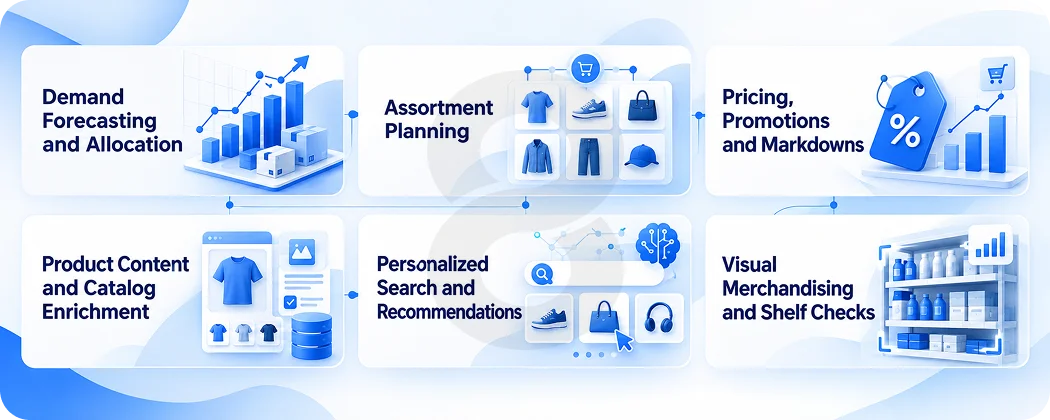
The strongest results come from decisions that repeat often, cover many SKUs and have a clear outcome to measure. These are the places retailers put AI for merchandising to work and what each needs.
Demand Forecasting and Allocation
A model predicts demand for every item in every store, then allocation logic splits the first shipment and the replenishment orders to match. The goal is fewer stockouts in busy stores and less dead stock in quiet ones.
Assortment Planning
Assortment models help buyers decide which items to carry, how many variants to offer and which stores get the wider range. They also spot when two products eat into each other’s sales.
Pricing, Promotions and Markdowns
Pricing models estimate how each product’s sales respond to a price change. Markdown optimization then plans the timing and depth of discounts so a season’s stock clears with the least margin given away. Promotion models predict the lift from an offer and the sales it pulls from neighboring products.
Product Content and Catalog Enrichment
Generative models draft product titles and descriptions, tag missing attributes and translate copy for new markets. Teams with large catalogs use generative AI development to clear content backlogs far faster than writing every page by hand. A merchant still reviews the output before it goes live.
Personalized Search and Recommendations
Online merchandising happens in search results and product grids, where AI ranks items for each visitor based on behavior and context. Conversational shopping assistants built through AI chatbot development let shoppers ask for “a waterproof jacket under $100” and get a filtered answer.
Visual Merchandising and Shelf Checks
Computer vision compares shelf photos with the planned layout and flags gaps, misplaced items and missing price tags. Store teams get a task list instead of walking every aisle.
| Use case | What the AI does | Data it needs | Main users |
|---|---|---|---|
| Demand forecasting | Predicts unit sales by SKU, store and week | Sales history, inventory, calendar, promotions | Planners, allocators |
| Assortment planning | Recommends which items and variants each store carries | Sales, product attributes, store profiles | Buyers |
| Pricing and markdowns | Sets prices and plans discount timing and depth | Price history, elasticity, stock levels | Pricing analysts |
| Product content | Writes copy and fills missing attributes | Product data, images, brand guidelines | Ecommerce and catalog teams |
| Search and recommendations | Ranks products for each shopper | Clickstream, purchases, catalog | Digital merchandisers |
| Shelf monitoring | Checks shelves against the planned layout | Shelf photos, planograms | Store operations |
Traditional vs AI Retail Merchandising
AI changes what merchants spend their week on. The table compares the two ways of working.
| Area | Traditional merchandising | AI retail merchandising |
|---|---|---|
| Forecasting | Last year’s sales plus planner judgment, often in spreadsheets | Models trained on sales, stock, promotions and outside signals, updated daily |
| Allocation | Store clusters set once a season | Store-level quantities that adjust as sales come in |
| Pricing | Fixed markdown calendars and rules | Prices and discounts set by item based on estimated demand response |
| Assortment | Chain-wide ranges with manual local edits | Store-specific ranges based on local demand patterns |
| Product content | Written by hand, one item at a time | Drafted by generative AI and reviewed by a merchant |
| Planner time | Mostly gathering and cleaning data | Mostly reviewing exceptions and making judgment calls |
Planners do not disappear in the right-hand column. They stop rebuilding the same spreadsheet each week and start working the exceptions the model cannot explain.
Agentic AI Merchandising and What It Changes
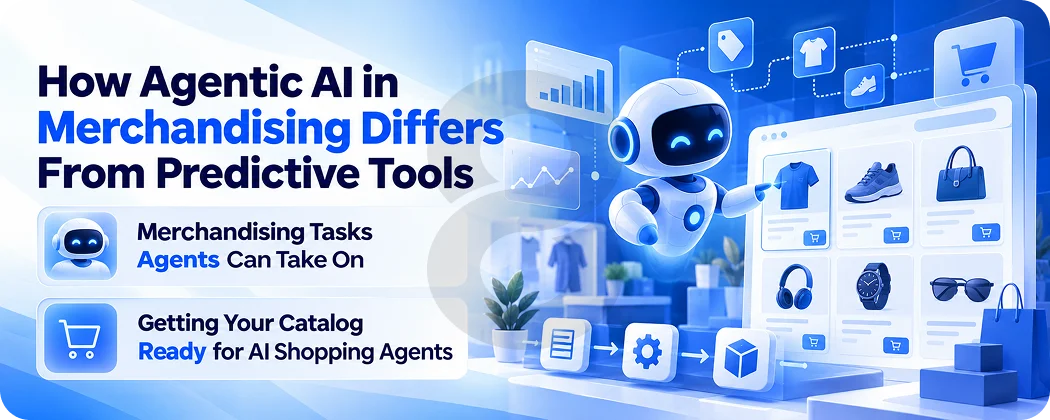
Agentic AI moves your merchandising tools from suggesting actions to carrying some of them out. What agents can handle, where people keep control and how you prepare your catalog will shape every choice that follows.
How Agentic AI in Merchandising Differs From Predictive Tools
A predictive model answers a question. It says this store will sell 40 units next week. An agent takes a goal, such as keeping weeks of supply inside a target band, and works toward it. It checks stock, reads the forecast, drafts a transfer between stores and either sends it for approval or executes it when the change falls inside limits the merchant set.
Adoption is early but moving. In NVIDIA’s State of AI in Retail and CPG survey 47% of respondents said they were using or assessing agentic AI. 20% already had active AI agents and 21% expected to have agents within the next year.
Merchandising Tasks Agents Can Take On
Agents suit tasks with a clear goal and a measurable result. In merchandising that includes watching sell-through and proposing markdowns, rebalancing stock between stores, flagging catalog items with missing attributes and fixing them, and building a first draft of a promotion calendar.
The control model matters as much as the agent. A common pattern starts with agents that recommend and wait for a click. Over time the retailer lets agents act alone on small, reversible changes and keeps human sign-off for anything that moves price perception or large amounts of stock. Teams building these workflows often work with an agentic AI development partner to set the guardrails, logging and approval steps.
Getting Your Catalog Ready for AI Shopping Agents
Agentic AI in merchandising also reaches outside the store, as shoppers start sending their own agents to find and buy products. McKinsey’s agentic commerce research projects that by 2030 the US B2C retail market alone could see up to $1 trillion in orchestrated revenue from agentic commerce, with global projections as high as $3 trillion to $5 trillion.
McKinsey says product directories will need to be optimized for agent readability, with semantic and behavioral metadata embedded in catalogs. It also points to commerce platforms that can support dynamic pricing and inventory-aware recommendations. A product page written only for human eyes may never reach a shopper whose agent cannot read it.
What Retailers Report After Adopting Merchandising AI
NVIDIA’s 2026 survey found that 91% of retail and CPG respondents were using or assessing AI and 90% planned to raise their AI budgets in 2026. On results, 89% said AI had increased annual revenue, with 30% putting the gain above 10%. On costs, 95% said AI had reduced annual costs, and 37% put the saving above 10%. Respondents also cited better employee productivity (54%) and operational efficiencies (52%).
These are self-reported figures from companies describing their own results. They point the same way as McKinsey’s research: the value shows up for retailers that move past pilots, and scaling is the hard part.
Common Barriers to AI Merchandising and How to Clear Them
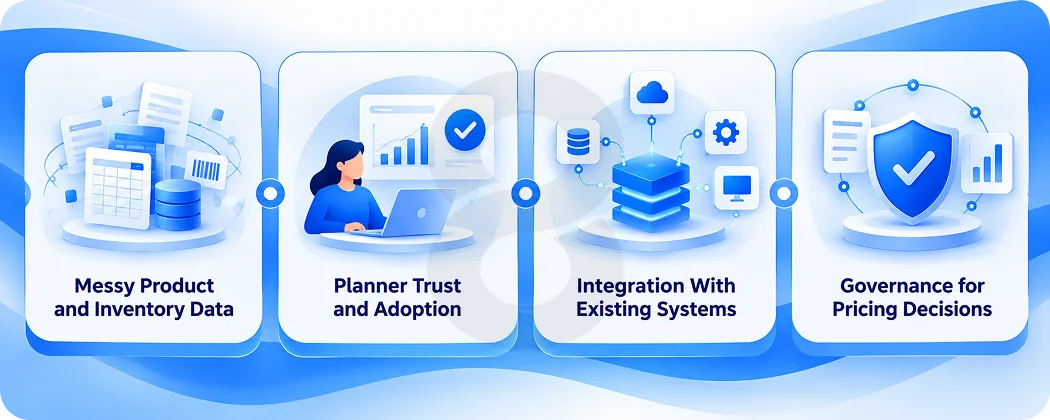
Many AI merchandising projects stall for reasons outside the model. Here are the problems you are most likely to hit first and the steps that help teams get past them.
Messy Product and Inventory Data
Missing attributes, duplicate SKUs and stock counts that disagree between systems cap any model’s accuracy. Audit the categories you plan to pilot and fix their gaps first. The rest of the catalog can wait.
Planner Trust and Adoption
Planners who cannot see why a model made a call will override it. Show the main drivers behind each recommendation and track model forecasts against planner overrides. Trust grows when both sets of numbers sit side by side.
Integration With Existing Systems
Recommendations stuck in a separate dashboard get ignored. They need to flow into the ERP, planning tool, PIM and ecommerce platform the team opens every day. That plumbing is often the largest part of the build, so many retailers bring in AI integration services rather than leaving it to the data science team.
Governance for Pricing Decisions
Automated pricing needs limits. Set floors and ceilings, cap how far a price can move in one step, log every change and review outcomes by store and customer segment. These rules matter more once agents can act without a click.
How to Roll Out AI for Merchandising Step by Step
A staged rollout keeps risk low and gives you proof before you commit a larger budget.
- Pick one decision with a clear money outcome, such as markdowns in one category or allocation for one product line.
- Audit the data that decision depends on and fix the worst gaps.
- Decide whether to buy a platform, build a custom model or combine the two. An AI consulting review can help if the answer is unclear.
- Run a pilot with a control group of stores or categories so you can measure lift against business as usual.
- Put the output inside the planner’s daily tools and capture every override.
- Scale to new categories once the pilot beats the control, then add agentic steps for the tasks planners approve most often.
What Drives the Cost of an AI Merchandising Solution
Price follows scope. These factors move an AI merchandising budget the most.
| Cost driver | What pushes cost up | What keeps cost down |
|---|---|---|
| Use case scope | Several decisions at once across all categories | One decision in one category for the pilot |
| Data readiness | Scattered, inconsistent data across many systems | Clean sales, stock and product data in one place |
| Integrations | Custom links to legacy ERP, POS and PIM systems | Modern platforms with documented APIs |
| Model approach | Fully custom models trained from scratch | Pretrained models fine-tuned on your data |
| Agentic features | Agents that act alone with approval flows and audit logs | Recommendation-only tools with human sign-off |
| Ongoing upkeep | Frequent retraining, monitoring and new features | Stable categories with slower demand shifts |
How to Choose AI Merchandising Service Companies
AI merchandising service companies include software vendors that sell a packaged platform and development firms that build custom systems around your data. Packaged tools start faster. Custom builds suit unusual categories, legacy systems or a retailer that wants to own its models.
Judge AI merchandising service providers on these points:
- Have they shipped forecasting, pricing or catalog projects for retailers with a similar number of SKUs and stores?
- Can they explain how they will connect to your ERP, POS, PIM and ecommerce platform?
- Do they show planners why a model made each recommendation?
- How do they measure results, and will they run a controlled pilot before a full rollout?
- Who owns the trained models and the data pipelines once the project ends?
Ask for a pilot plan with a defined success metric before you sign a long contract. A partner that will not commit to a measurable pilot is asking you to take the risk alone.
How 8ration Approaches AI Merchandising Projects
We build custom AI systems for retailers and ecommerce brands, and merchandising is one of the areas where our work in data, models and integration comes together. Our custom AI development work covers demand forecasting, pricing models and recommendation engines trained on a client’s own sales history.
On the content side we fine-tune language models for product descriptions and attribute tagging through our LLM fine-tuning practice, so the copy follows each brand’s tone and catalog rules. For retailers moving toward agentic workflows we design agents with approval steps, pricing limits and full action logs.
We also build software for ecommerce businesses, fashion brands and grocery apps, and each sector brings its own merchandising problems. Fashion deals with short seasons and size curves. Grocery deals with perishables and daily replenishment. A typical engagement starts with a short discovery phase, picks one decision to pilot and measures it against a control before scaling.