A mobile app development team usually runs to a product manager, a UI/UX designer, mobile developers, backend developers, QA engineers, and a DevOps engineer, with a business analyst and a security specialist added as the project gets bigger. How many of each depends on scope rather than ambition.
The harder question is not which roles exist. It is which ones you can skip, which ones you cannot, and what happens when a business assumes its web team can absorb the work. That assumption is where most first app projects go wrong, and it is expensive in a way that only shows up at submission.
This covers the roles, realistic team sizes by project type, what the team costs, and the specific mobile constraints that catch web-experienced teams by surprise.
Why Your Business Needs a Structured Mobile App Development Team
An efficient mobile app development team will make sure that your app is stable, secure, scalable, and business-focused. No matter what app you are building, it can be eCommerce app, EV charging app, fintech mobile solution, or enterprise software, you require individuals who can:
- Understand customer needs
- Ideas to UX-supported features
- Develop clean, stable, and scalable code
- Test the app thoroughly
- Assure of performance and security
- Promote and support the app post-launch
Without structured roles and experience, apps experience lag time, bugs, cost overruns, or failure. These issues can be addressed by having a committed mobile app development team, which will make sure that there is an experienced person in charge of every duty.
Read More: How to Create an App on Android: Step-by-Step Guide for 2026
Key Roles in a Mobile App Development Team
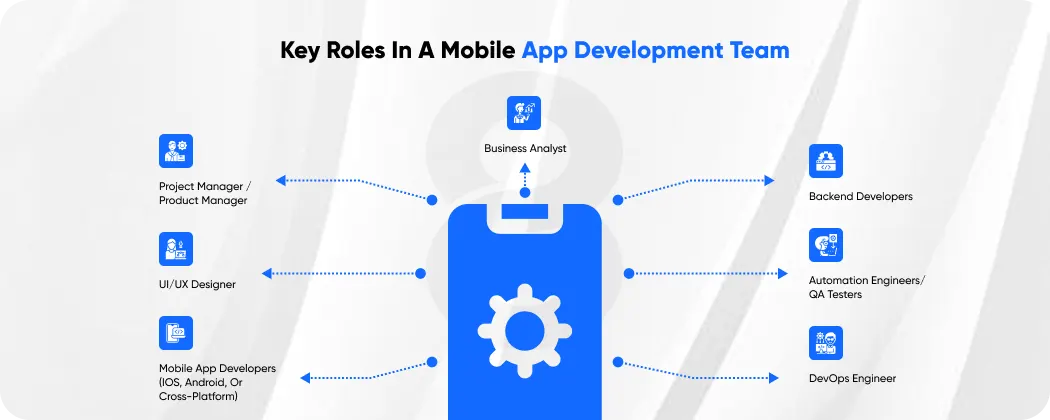
The list below is the full set. Very few projects need all of them on day one, and the section after this covers what a realistic team looks like at each size. Treat this as the menu rather than the order.
1. Product or project manager
Owns scope, sequencing, and the decisions nobody else can make. On mobile specifically this role also owns the release calendar, because store review windows sit outside your control and have to be planned around rather than reacted to. A project without this role does not move slower. It moves in several directions at once.
2. UI/UX designer
Wireframes, prototypes, user research, and the platform conventions that decide whether an app feels native or ported. Mobile app design is a different discipline from web design, and the next section covers why in detail. A designer who has only worked on web will produce screens that look correct in Figma and wrong on a phone.
3. Mobile developers
Native iOS developers work in Swift and against Apple Human Interface Guidelines. Native Android developers work in Kotlin and against Material Design. Cross-platform developers use Flutter or React Native to serve both from one codebase. The choice affects headcount directly, since cross-platform can halve the client-side team on a feature set dominated by lists, forms, and API calls.
4. Backend developers
Server-side architecture, authentication, databases, and the API layer every client consumes. Mobile adds a requirement web does not have, which is supporting several app versions at once. Users do not update on your schedule, so the backend has to keep serving the version from four months ago while you ship the new one.
5. QA engineers
Functional, performance, security, and device compatibility testing, plus automation as the suite grows. Software testing carries more weight on mobile than on web because you cannot patch a bad release in ten minutes. What ships is what users have until the next review clears.
6. DevOps engineer
Build pipelines, signing, release automation, monitoring, and cloud infrastructure. This is the role most often cut from small teams and most often regretted, because manual builds and manual signing produce release-day failures at exactly the wrong moment.
7. Business analyst
Turns business requirements into specifications developers can build against. Genuinely optional below a certain size, where a strong product manager covers it. Genuinely necessary above it, particularly in regulated industries where requirements arrive as policy documents rather than user stories.
8. Security and compliance specialist
Not a role the standard team list includes, and one that belongs on any fintech, healthcare, or data-heavy build. Mobile apps ship credentials, cache data on devices you do not control, and face store-level privacy disclosure requirements that change without much notice. Retrofitting compliance after an audit costs more than staffing for it.
9. AI engineer
New to this list in 2026 and increasingly hard to leave off. DORA research covering nearly 5,000 technology professionals found 90% now use AI in their daily work, while AI adoption continued to relate negatively to delivery stability in teams without strong automated testing and fast feedback loops. If your product has AI features, or your team is shipping AI-assisted code, someone needs to own that. AI development capability is a team composition question now, not a future one.
Read More: How to Make an App that Makes Money
What Web Teams Miss When Building Their First App
Most businesses approaching a first app already have a web team, and assume the skills transfer. Some do. The four constraints below do not exist in web development at all, and each one has ended a launch date.
Store review is a scheduling constraint, not a formality
Apple publishes that roughly 90% of submissions are reviewed within 24 hours, which is accurate and misleading at the same time. That figure blends trivial metadata updates from established accounts with brand-new apps. A first submission from a new account realistically takes several days, and a rejection restarts the clock entirely.
Google Play is faster on updates and slower on first releases. The one that surprises people most is the testing gate. Google requires personal developer accounts created after 13 November 2023 to run a closed test with at least 12 testers opted in for 14 continuous days before they can even apply for production access, and that application review usually takes up to another 7 days. Organization accounts follow a different path, so the first practical decision is which account type you register under. Teams that discover this in month five lose two to three weeks they had not budgeted.
Rejections themselves cluster around a small set of causes: incomplete privacy disclosures, screenshots and descriptions that do not match the build, missing demo credentials for gated features, and guidelines that read as ambiguous until a reviewer interprets them. An experienced mobile team knows which of these bite. A web team learns them one rejection at a time.
Platform design conventions are not preferences
iOS and Android expect different things, and ignoring those expectations is what makes an app feel unfinished. Navigation sits in bottom tabs with swipe-back gestures on iOS, and follows Material Design patterns on Android. The system typefaces differ, San Francisco against Roboto, and so do the spacing scales built around them. Haptics, animation curves, and transition timing differ again.
None of these are visible in a design review. All of them are visible to a user within about ten seconds, as a vague sense that something is off. Web teams frequently ship what amounts to a website in a native wrapper, and users read it as low quality without being able to say why.
Device fragmentation makes testing a different job
Web testing covers a handful of browsers. Mobile testing covers screen sizes, pixel densities, hardware capability, memory limits, and several concurrent OS versions, which is particularly acute on Android. An app has to behave on a current flagship and on a three-year-old budget device with a fraction of the RAM.
Then there is the category of problem web development simply does not have. Incoming calls and notifications interrupting a flow, backgrounding and foregrounding state, battery consumption, and behaviour when the network drops mid-request. These are the defects that generate one-star reviews, and they never appear in a desktop test pass.
Releases cannot be rolled back
This is the difference that reshapes how a mobile team works. A bad web deploy is reverted in minutes. A bad mobile release requires a new build, a fresh submission, a review, and then users actually updating, which many will not do quickly. Staged rollouts exist for this reason, moving from a small percentage of users upward so problems surface before everyone has them.
|
Release Task |
Web |
Mobile |
|
Deploy a fix |
Minutes, under your control |
New build, store review, then user updates |
|
Roll back a bad release |
Immediate |
Not possible, requires a forward fix |
|
Coordinate platforms |
One target |
iOS and Android on separate review clocks |
|
Support old versions |
Everyone is on current |
Backend serves several app versions at once |
|
Emergency hotfix |
Ship it |
Request expedited review and hope |
Mobile App Development Team Size by Project Type
Team size tracks complexity, integration count, and regulatory load rather than feature count. The pattern below reflects how teams are typically staffed at each stage.
|
Project Type |
Team Size |
Typical Composition |
|
Basic MVP, one platform |
5 to 7 |
PM, designer, 1 or 2 mobile devs, backend dev, QA, part-time DevOps |
|
Medium build, booking, social, commerce |
8 to 12 |
Above plus a second platform, dedicated DevOps, second QA, business analyst |
|
Enterprise, fintech, healthcare |
12 to 20 plus |
Above plus security and compliance, data engineering, release management, support |
The growth from small to large is mostly not developers. It is QA, DevOps, compliance, and support, which is the part founders consistently underestimate when they scope a team from the MVP outward.
Mobile App Development Team Cost
Two numbers matter here and they answer different questions. What individual roles cost tells you whether to hire. What a whole project costs tells you whether to start.
Developer salaries by role
The Stack Overflow Developer Survey, which collected responses from around 49,000 developers, reported these US median total compensation figures.
|
Role |
US Median Total Compensation |
|
Engineering manager |
$200,000 |
|
Back-end developer |
$175,000 |
|
Mobile developer |
$170,000 |
|
Front-end developer |
$145,000 |
|
Full-stack developer |
$138,000 |
Why location changes the maths
The same survey put an engineering manager at $200,000 in the US, $118,000 in Germany, and $52,000 in India. That spread is the single largest variable in a team budget, larger than seniority or stack, and it is the reason distributed and outsourced teams remain the default for most non-enterprise app builds.
The trade is coordination cost. A four-hour timezone overlap works. A one-hour overlap turns every decision into a next-day event, which shows up as schedule rather than as budget.
Whole-project cost
|
App Type |
Timeline |
Indicative Cost |
|
Basic app, one platform |
3 to 6 months |
$20,000 to $50,000 |
|
Medium complexity |
6 to 10 months |
$50,000 to $150,000 |
|
Advanced or enterprise |
10 to 18 months |
$150,000 to $500,000 |
What moves a project between those bands is third-party integrations, real-time features, AI or ML components, security and compliance standards, and custom dashboards. The app development cost guide breaks the drivers down in detail.
In-House, Agency, or Staff Augmentation
This decision usually gets made on budget alone, which is how businesses end up with the wrong model at the wrong stage. Each one solves a different problem.
|
Model |
Works Best When |
Main Drawback |
|
In-house team |
The app is the product and will run for years |
Slow to assemble, expensive to idle between releases |
|
Agency or full outsourcing |
You need a complete team and a defined outcome |
Less day-to-day control, handover quality varies |
|
Staff augmentation |
You have some capability and specific gaps |
You still have to manage delivery yourself |
|
Hybrid |
Core product in-house, specialist skills brought in |
Requires clear ownership boundaries to work |
The hybrid model has become the common answer for funded startups. Product and one or two senior engineers stay in-house, and platform-specific or short-duration work comes through staff augmentation. It keeps product knowledge inside the company while avoiding a permanent hire for a six-week iOS problem.
Read More: How Much Does it Cost to Develop an App
How to Hire a Mobile App Development Team
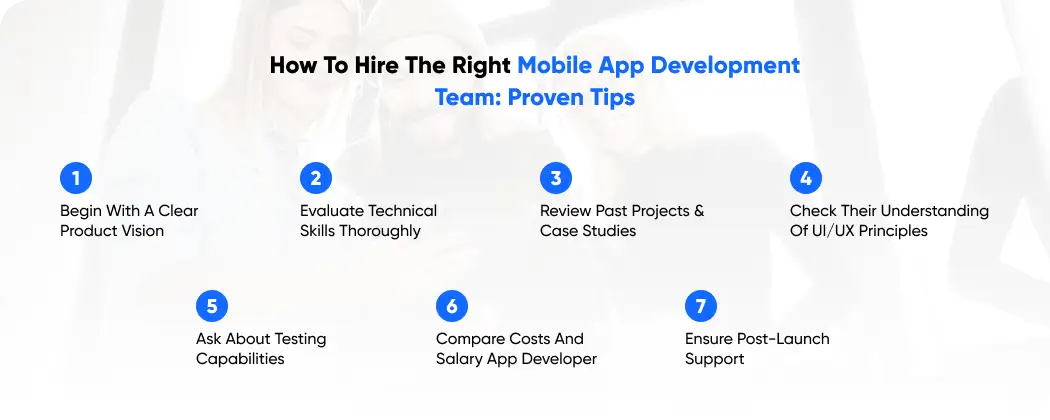
The evaluation below is ordered by how much signal each step gives you. Most businesses do them in reverse, starting with rates and ending with portfolio, which is how the cheapest unsuitable team gets chosen.
Start with a clear product definition
Purpose, target users, the features that must exist at launch, business goals, budget, and timeline. Vague briefs produce padded estimates, because a team pricing an unknown scope prices the worst case. The clearer the definition, the tighter and more comparable the quotes.
Review shipped apps, not case study pages
Ask for live App Store and Google Play listings, then download them. Look at ratings, recent reviews, update frequency, and whether the apps have been maintained past launch. A portfolio page shows what a team designed. A store listing shows what they shipped and whether it survived contact with users.
Test mobile-specific depth
Any competent team can describe an API integration. Ask instead how they handle offline state, background refresh, push notification delivery on both platforms, store rejection appeals, and staged rollouts. The answers separate teams who have shipped mobile from teams who have shipped web and are willing to try.
Check design capability against platform conventions
Ask how their designs differ between iOS and Android and why. A team that says the designs are identical across platforms is telling you something useful, and it is not good news.
Ask what their QA actually covers
Manual and automated coverage, real device testing rather than simulators only, performance on low-end hardware, and security testing. Ask which physical devices they test on. A specific answer means a device lab exists. A general answer usually means a simulator.
Compare total cost, not hourly rate
Hourly rates, retainers, licensing, third-party service costs, and post-launch maintenance. A cheaper rate attached to a longer timeline and a heavier rework cycle is not cheaper. Ask each candidate to quote the same defined scope so the comparison means something.
Confirm what happens after launch
Apple and Google both ship annual OS releases that break things, and both periodically raise minimum API requirements. Ongoing maintenance is not optional on mobile the way it can be for a brochure site. Get the post-launch arrangement in writing before you sign, not after the first OS update breaks your camera flow.
Mistakes Businesses Make When Hiring an App Team
These come up repeatedly and none of them are about picking a bad vendor. They are about scoping the team wrong before the vendor conversation starts.
- Assuming the web team can absorb it. Store review, platform conventions, device fragmentation, and release mechanics are all new work with no web equivalent.
- Cutting DevOps from a small team. Manual builds and manual signing fail on release day, which is the least recoverable day in the mobile calendar.
- Treating QA as a phase. On a platform where you cannot roll back, testing is continuous or it is decorative.
- Registering the wrong Google Play account type. A personal account triggers the 12-tester closed testing gate, and finding that out late costs weeks.
- Budgeting to launch. OS updates, store policy changes, and device releases all arrive whether or not there is money left.
- Comparing hourly rates across different scopes. Quote the same defined scope to every candidate or the numbers are meaningless.
Building Your Mobile App Team With 8ration

8ration provides complete mobile app development teams and individual specialists, across native iOS, native Android, and cross-platform builds. The same group covers backend, QA, DevOps, and post-launch maintenance, which matters on mobile because the release mechanics that catch teams out sit between those disciplines rather than inside any one of them.
If you already have engineers and need to fill specific gaps, hiring mobile developers through staff augmentation is usually faster and cheaper than recruiting for a role you need for one release cycle.
The useful first conversation is about scope rather than headcount. What has to ship in release one, which platforms, what regulatory load applies, and who owns the product decisions. Those four answers determine the team, and getting them settled before hiring is what keeps a team from being assembled around the wrong shape of project.