



Hardcore gamers seek out the ‘Soulslike’ genre to experience a new level of difficulty and immerse themselves in unique, interactive environments. These players are driven to conquer challenges by mastering precise combat and managing limited resources within atmospheric worlds guarded by formidable bosses.
It is hard to imagine that a game has influenced the expectations of players like Dark Souls has in the history of modern gaming. Published by FromSoftware, the game not only brought with it a punitive difficulty but also redefined how combat was perceived, the way the environment was used to tell stories, the use of stamina, and risk-and-reward cycles.
With time, it spawned a whole new subgenre that is currently commonly called Soulslike. Also, the best games similar to Dark Souls are something developers and players, today, are actively seeking to play, read, and get inspired by.
Moreover, whether you are a studio thinking about your next AAA release, a team in indies trying to prototype a new combat system, or even someone who has been working on game development, you need to know how these games work.
The global Soulslike game market is expected to expand from around $1.2 billion in 2024 to approximately $3.5 billion by 2033, reflecting a strong CAGR near 15.5% as player demand for immersive and challenging experiences rises.
To get into the list, we may first address a popular question.
What Is a Soulslike Game?
It is good to answer a question that many people like to ask before delving into the list, which is, what is a Souls-like game, or what is a Soul-like game?
A Soulslike (or Soul Games) genre usually incorporates:
- Fighting mechanisms that are stamina-based
- Extremely poor ability in skill-based development
- Bonfire/checkpoint mechanics
- The narrative is contextual rather than overt
- Risk-reward (e.g., resources lost on death)
- The design of an interconnected world
An experience such as Souls is not simply hard; it is meant to be learned through failure. This design philosophy can now be seen in so many of the most popular soulslike games taking over contemporary action RPGs.
Why Games Like Dark Souls Are Still Popular
Funny enough, nowadays, numerous popular games use Soulslike DNA even in non-RPG games. Furthermore, this confirms: gamers desire the systems that would have their way of rewarding patience, accuracy, and strategy.
To the developers, Soulslike mechanics can provide:
- Strong player retention
- Deep replayability
- Organic difficulty scaling
- Involvement of the community (guides, builds, speedruns)
At this point, we will deconstruct the games that are the best, like Dark Souls, and what makes each of them worth studying.
 Elden Ring
The next in the Souls formula, Elden Ring is an amalgamation of violent fights and an expansive open world, making it one of the most popular games of the present and an example of what any modern Souls-like game is supposed to resemble.
Why it matters for developers:
- The open-world level is streamed seamlessly
- Without hand-holding, nonlinear exploration
- The emergent difficulty scale
Elden Ring demonstrates that a game like Dark Souls can reach a global audience through nonlinear exploration, a continuous stream of interconnected worlds, and adaptable difficulty. Consequently, it offers invaluable lessons for any studio seeking creativity at the scale of large-scale project development.
 Bloodborne
Bloodborne is a remix of the Souls formula, with its pouncing speed, violent combat, and Gothic horror aesthetics. It is not a game like Souls that requires people to use accuracy, self-assurance, and continuous forward movement instead of defense.
Key inspiration points:
- A rally system that promotes offensive play
- Lovecraftian art direction
- Tight level loops
In the case of developers creating games in the style of Dark Souls, Bloodborne shows that combat rhythm, atmosphere, and risk–reward mechanics can reshape player behavior. At the same time, it preserves the challenge and distinct identity of the genre.
 Sekiro: Shadows Die Twice
Sekiro is the best Souls-like game that has removed the crutches of RPGs to provide a razor-sharp experience that is about mechanical mastery and is thus a standout in terms of playing the game by timing, reflexes, and skill, and not by conventional stat progression.
Technical highlights:
- Posture-based combat system
- Perfect parry dependency
- Minimal stat grinding
Furthermore, as an example of studios working with Unreal game development, Sekiro demonstrates how parry-driven combat loops, posture systems, and animation timing can transform a game such as Dark Souls into a fully skill-based game.
 Nioh 2
Nioh 2 places complexity at center stage through its Souls-like combat, extensive loot systems, and combat stances. As a result, it stands among the best Dark Souls-like games for players who value deep customization and mechanical complexity.
Why developers love it:
- Stance-based combat trees
- Loot-driven progression
- Diablo-style stat layering
As a developer of layered combat systems, Nioh 2 can demonstrate that a game such as Souls can be built to offer very high levels of depth and variety of progression and can be replayed without reducing speed or responsiveness.
 Lies of P
Lies of P is a burdensome creative gamble by taking Soulslike fighting in a dark narrative reinterpretation, which makes an impact as a unique game, similar to Dark Souls, that values originality, precision gaming, and narrative immersion.
Standout features:
- Weapon assembly mechanics
- Precision parry windows
- World design based on narrative
This title reinforces the view that games in the vein of Dark Souls can achieve creativity and success when developers integrate weapon systems, parry windows, and narrative design into a single gameplay loop.
 The Surge 2
The Surge 2 substitutes medieval fantasy with industrial sci-fi, a game based on Souls-like mechanics but centered around mechanical dismemberment, the environmental narrative, and tech-based progression systems adapted to futuristic worlds.
Design lessons:
- Specialized dismemberment of limbs
- Technological developmental processes
- Machinery environmental storytelling
The Surge 2, as a source on 3D game development, places special emphasis on the use of combat mechanics and world-building to distinguish a game such as Souls in an ever-growing, saturated genre.
 Hollow Knight
Hollow Knight demonstrates that with proper design, the DNA of Souls can be entirely transferred to a 2D game, providing stiff combat, secrecy-filled lore, and exploration-based gameplay that solidifies it as one of the best games like Dark Souls.
Why it belongs here:
- Checkpoint punishment
- Cryptic lore
- Skill-based boss design
Hollow Knight, in the case of indie teams, is an example that games like Dark Souls do not need realism: instead, they need tight systems, the design of the atmosphere, and a rigorous level of architecture.
The broader role-playing video games market will grow to $16.6 billion by 2030, and the action RPG subsector (where Soulslike mechanics have found a natural home) has had a consistent annual growth rate.
 Code Vein
Code Vein is an anime Soulslike defined by its distinctive anime aesthetics. Likewise, it has earned a reputation for balancing narrative depth, user-friendly systems, and visually striking combat.
Key elements:
- AI companions
- Blood Code class switching
- Pipelines of anime-inspired art
In the case of Unity-based teams that develop Unity games, Code Vein demonstrates how the pipeline of stylized art and the generalizability of class systems can introduce the Souls-like game formula to wider audiences.
 Mortal Shell
Mortal Shell adopts a minimalistic approach, presenting a small but brutal game like Dark Souls and reducing systems to their bare minimum without sacrificing any tension, ambiance, and combat pace.
Why it stands out:
- Shell-swapping mechanic
- Harden combat control ability
- Compact world design
The title is a powerful prompt to remember that smaller studios could make some really powerful games, such as Dark Souls, with their emphasis on the main mechanics and their weight, along with the ability to manage the scope.
 Lords of the Fallen (2023)
Lords of the Fallen 2023 has refined its identity through modern mechanics and exists as a polished Souls-like game with an easy approach, good display, and layered world design.
What it does well:
- Dual-realm traversal
- Better blending of animation
- Better onboarding systems
When studios return to older franchises, games like Souls show how developers can improve the onboarding process and refresh player interest through refined animation. Moreover, deeper systems help revitalize the experience without abandoning the core principles of the genre.
 Blasphemous
Blasphemous fuses Souls-inspired mechanics with pixel-art brutality. Meanwhile, it stands as a strong example of how Dark Souls-style games can thrive in two-dimensional spaces, telling stories through atmosphere, timing, and striking visuals.
Design inspirations:
- Pixel-perfect combat timing
- Visual storytelling
- Checkpoint systems that are inspired by souls
It reaffirms the notion that what constitutes a Souls-like game is not on the basis of dimension but rather on challenge, punishment, and progression that is based on mastery.
 Ashen
Ashen
Ashen is a friendlier visual presentation with unforgiving battle, cutting its niche with co-op Souls-like games with asynchronous multiplayer and emotionally driven environments.
Why it works:
- Asynchronous cooperative games
- Simplified UI
- Narration of the environment on an emotional scale
Moreover, it is a worthy example of how to incorporate cooperative mechanics without compromising on difficulty, and as such, this Souls-like game will be valuable to multiplayer-oriented game development teams to study.
 Remnant: From the Ashes
Remnant: From the Ashes is a bold attempt to combine the third-person shooting and the Soulslike systems, resulting in a hybrid game, akin to Souls, but focused on flexibility, procedural gameplay, and collaboration.
Technical strengths:
- Generation on the procedural level
- Hybrid combat loops
- Multiplayer scaling systems
Moreover, Remnant provides developers in the genre fusion domain with insight into how games like Dark Souls can evolve through modern shooter gameplay and scalable multiplayer.
 Salt and Sanctuary
Salt and Sanctuary brings the oppressive Dark Souls air to a side-scrolling game, making it beheaded among the best games like Dark Souls due to its richness, difficulty, and precision of its mechanics.
Why it matters:
- Deep skill trees
- Punishing enemy placement
- Atmospheric world design
Furthermore, it emphasizes the ways games like Dark Souls can perform well with lower budgets with the help of strict design, well-built progression, and deliberate difficulty.
 Thymesia
Thymesia is a narrowly scoped experience that entirely revolves around parry-based warfare, thus making it an efficient but thin Souls-like game for those interested in understanding how to command scale.
Key lessons:
- Tight parry windows
- Cooldown management of abilities
- Lean progression systems
For studios focused on combat feel, Thymesia demonstrates that a game like Dark Souls can succeed when developers refine mechanics, timing, and player feedback to a high standard.
Common Design Patterns Across the Best Games Like Dark Souls
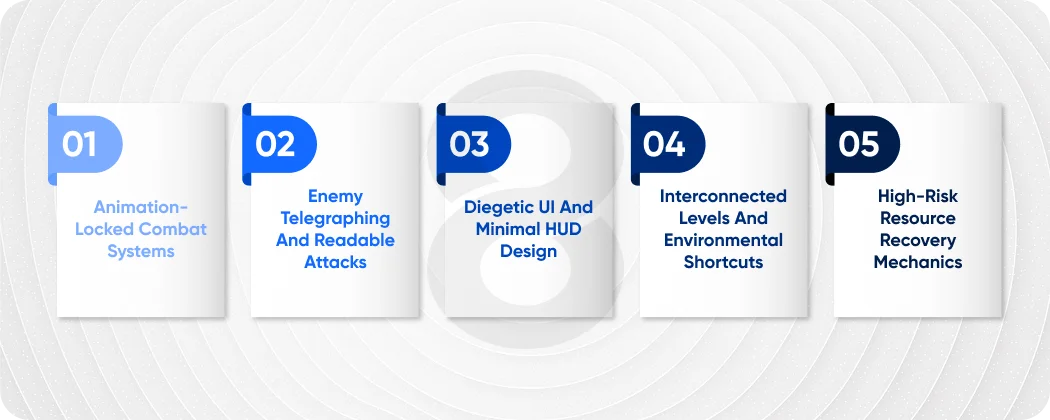
In the finest games, such as Dark Souls, game developers regularly use combat limitations, setting narrative, and risk-based progression that support mastering, equity, and learning in players via repetition, failure, and informed decision-making instead of artificial difficulty spikes.
Animation-Locked Combat Systems
Animation-locked combat enforces commitment to each action, discouraging button-mashing while promoting tactical timing, stamina management, and positioning. As a result, it reinforces the calculated, heavyweight combat experience that defines the core values of the Soulslike genre.
Enemy Telegraphing and Readable Attacks
Clear telegraphing helps players understand the enemy, makes the difficulty feel fair, and allows them to learn attack strategies, respond strategically, and improve through trial and error—turning recurring deaths into learning opportunities rather than frustrating roadblocks in a high-stakes engagement.
Diegetic UI and Minimal HUD Design
Diegetic UI elements are more immersive, adding information to the game world and eliminating on-screen clutter, and compelling the user to interpret environmental features, animations, and sound design instead of constant feedback through the interface.
Interconnected Levels and Environmental Shortcuts
Environmental shortcuts give rewards of exploration in that they have the effect of returning the player to a known checkpoint, alleviating frustration on unsuccessful attempts, and strengthening the world’s integrity, spatial memory, and a feeling of control over previously hostile locations.
High-Risk Resource Recovery Mechanics
The high-risk resource recovery systems increase tension by compelling players to replay risky zones following death to achieve a balance between punishment and opportunity and to stimulate calculated risk-taking, spatial awareness, and emotional investment in the outcomes of the moment-to-moment gameplay.
How 8ration Helps You Build the Next Generation of Soulslike Games
At 8ration, we take the inspiration of iconic Soulslike titles and turn them into scalable high-performance gaming experiences. Our knowledge in Unreal, Unity, 3D, and immersive mobile game development enables us to design combat systems, AI behaviors, and in-game progression systems that are in line with the expectations of players in the current century.
We assist studios and startups in transforming radical ideas into technically feasible, market-ready games, regardless of whether they are prototypes or finished products. Our approach ensures every project becomes an iconic contender in today’s highly competitive gaming industry.
Final Thoughts!
Ultimately, masterpieces like Dark Souls succeed not through sheer difficulty, but because they respect the player’s intelligence, demand patience, and reward mastery with deeply earned progress.
These titles are lessons that can be applied long-term, whether you are studying the most popular Soulslike games, creating a game similar to Souls, or planning a scalable RPG. Soulslikes in such a trend market survive because they focus on the craft over the convenience, and when done correctly, they not only challenge the player, but they also make an impression.