


The cost of Augmented Reality app development typically falls between $20,000 and $300,000+, varying based on the complexity and features required.
The future of Augmented Reality (AR) is not a concept anymore, but it is a part of our reality. AR has created a new paradigm of the digital experience that is immersive, be it a gaming application (like Pokemon Go) or retail application that provides you with an opportunity to see furniture in your living room. As companies in all industries are looking to maximize the use of AR to engage with customers, train them, market their products, and entertain them, the question again emerges as follows:
How Much Does AR Cost?
Knowing the AR App Development Cost is crucial to startups, enterprises, and app development teams so they can properly budget, not get surprised, and plan their AR strategy with certainty. This guide will also dissect the cost of the augmented reality app development into detail, as well as all of the factors that define the price, industry standards, per-feature price analysis, and cost variance based on geographical locations.
What is Augmented Reality App Development?

It is necessary to know what AR development involves before getting into how much augmented realitycostst.
The development of augmented reality enables developers to create applications which project digital content. This content includes images and animations and 3D objects and interactive elements which users can view through their device cameras and sensors. AR functions as an enhancement for the real world whereas Virtual Reality (VR) creates a complete virtual world for users to experience.
Examples of AR Applications:
- Retail and E-commerce: New applications such as IKEA Place will enable clients to see the furniture in their homes prior to making a purchase.
- Gaming: Pokémon Go is the game that brings digital characters to the real-world place.
- Medical: AR applications are used to train medical workers and simulate surgery.
- Education: AR is able to create interactive lessons that can visualize complex things in 3D.
- Industrial / Field Service: AR can assist employees in overlapping instructions on machines to either repair or maintain them.
The use case is important because it determines the complexity of augmented reality app development. Even a basic AR application, such as the demonstration ofa 3D product view, is much cheaper than the development of an interactive AR game with SLAM tracking and multiplayer features. This knowledge allows us to estimate the cost of development of an AR app more precisely.
The global augmented reality market size was USD 149.57 billion in 2025, accounted for USD 207.16 billion in 2025, and is expected to reach around USD 2,804.82 billion by 2034, expanding at a CAGR of 38.5% from 2025 to 2034. The North American augmented reality market size reached USD 28.07 billion in 2023.
Read More: 40 Best Technology Stacks for Mobile App Development
The Major Factors that Affect the Cost of AR App Development
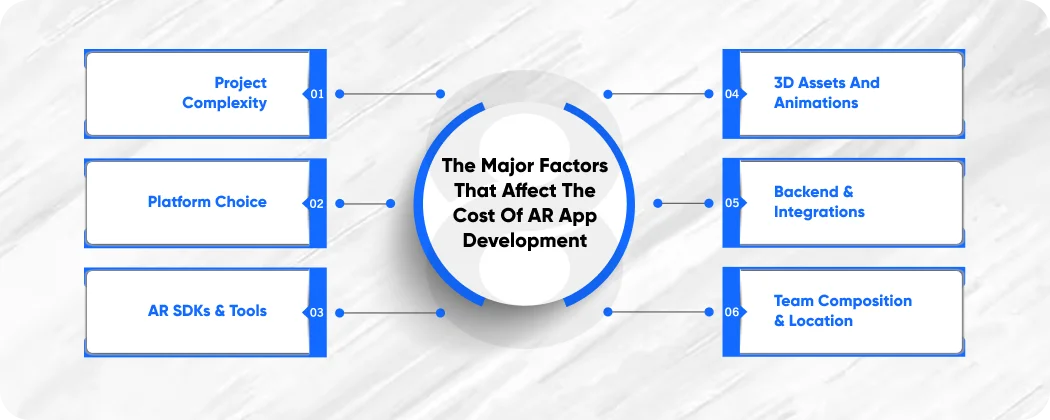
Different factors affect the AR app development cost, and each has its own contribution to the final cost. We will divide the most crucial cost drivers.
1. Project Complexity
The difficulty of your AR application directly influences the costs of AR. AR apps may be differentiated into three primary categories:
|
Complexity Level |
Features |
Estimated Cost (USD) |
|
Simple AR |
Basic overlays, image recognition, simple animations |
$15,000 – $40,000 |
|
Moderate AR |
3D objects, interactive content, basic physics |
$40,000 – $150,000 |
|
Advanced AR |
SLAM tracking, multiplayer AR, and real-time object interactions |
$150,000+ |
Example:
The easiest example of an AR retail application could be to see furniture in one’s room. An average AR application may enable people to interact with the furniture in three-dimensional space, whereas an advanced AR application may enable several users to engage in the real-time interaction of the virtual objects.
2. Platform Choice
Whether you are developing on iOS or Android, or both? The choice of the platform has a major impact on the cost of developing the augmented reality app:
|
Platform |
Cost Impact |
|
iOS Only |
Lower development cost, stable hardware, ARKit integration |
|
Android Only |
Moderate cost, varied device compatibility |
|
Both Platforms |
Higher cost due to separate development and testing |
|
Wearables (AR Glasses) |
Very high due to specialized SDKs and devices |
Native development guarantees optimal performance but is more expensive, whereas cross-platform frameworks, such as Unity or React Native, allow for reducing costs at the cost of efficiency or fluent AR performance.
3. AR SDKs & Tools
The AR Development cost will be determined by the AR development frameworks and SDKs used:
- ARKit (Apple) iOS AR applications
- ARCore (Google) Android AR apps
- Unity + AR Foundation – Cross-platform development
- Vuforia – Marker AR tracking
- Wikitude – Tracking solution hybrid between iOS and Android
There are SDKs available at no cost, whereas others need a license, which increases the development cost of augmented reality apps.
4. 3D Assets and Animations
AR experiences are inseparable from high-quality 3D models, textures, and animations:
|
Asset Type |
Cost Range |
Impact on AR App Development Cost |
|
2D Graphics |
Low |
Minimal cost impact |
|
Pre-Built 3D Models |
$500 – $5,000 |
Moderate |
|
Custom 3D Models |
$5,000 – $50,000 |
High |
|
Animated 3D Characters |
$10,000+ |
Very High |
The 3D assets can be an important investment that can greatly improve the user experience, but augmented reality costs a lot.
5. Backend & Integrations
A lot of AR applications require cloud storage, real-time information exchange, analytics, or user authentication. Backend services increase the AR app development cost:
|
Feature |
Estimated Cost (USD) |
|
Cloud Storage |
$5,000 – $15,000 |
|
User Accounts & Authentication |
$3,000 – $10,000 |
|
Real-Time Multiplayer |
$20,000 – $80,000 |
|
Analytics & Reporting |
$5,000 – $15,000 |
6. Team Composition & Location
AR app development cost depends largely on the team’s knowledge and the location of the development team:
|
Role |
Hourly Rate (USD) |
|
AR Developer |
$50 – $150 |
|
3D Artist/Animator |
$40 – $120 |
|
Backend Developer |
$40 – $120 |
|
QA Tester |
$30 – $80 |
|
Project Manager |
$50 – $150 |
Regional differences:
|
Region |
Hourly Rate (USD) |
|
North America |
$100 – $200 |
|
Western Europe |
$80 – $150 |
|
Eastern Europe |
$40 – $90 |
|
South Asia |
$20 – $60 |
It is important to select the appropriate team. Although low-cost areas can minimize the initial costs of developing AR Apps, quality and rework may add to the total cost.
AR App Development Cost by Industry & App Type
AR applications in the industry have become essential to industries such as manufacturing, logistics, oil and gas, aviation, and heavy machinery. Such applications apply the development of augmented reality apps to simplify complicated functions, minimize mistakes, and enhance the safety of workers. Owing to this fact, the AR App Development Cost of industrial solutions tends to be comparatively higher than normal retail or entertainment apps because of the technical complexity and precision needs.
Main characteristics of the industrial AR applications:
1. Real-Time Instruction Overlays
AR applications can superimpose instructions on equipment step by step. To illustrate the point, a digital annotation can be displayed in the form of digital notations and may be displayed on a machine that needs to be repaired by a worker who shows the bolts to take off or parts to replace. This minimizes the possibility of human error and enhances efficiency.
Cost Impact: To apply our real-time true overlays, AR tracking algorithms are complex and thus
2. Spatial Mapping and Object Recognition
The 3D version of object recognition creates a 3D map of the objects, which can be accessed at any location on the map. Spatial Mapping and Object Recognition: This 3D version of object recognition works by mapping the objects into a 3D map that can be reached at any point on the map. AR applications used in industries can scan the environment, detecting equipment or work areas. Mapping physical space is done by the use of technologies such as SLAM (Simultaneous Localization and Mapping). This gives virtual items the perfect match with actual things.
Cost Impact: SLAM integration is associated with augmented reality app development that is particularly expensive in large facilities or outdoor industrial settings.
3. Remote Support and Co-operation
High-technology AR applications enable technicians at a distance to communicate with remote specialists, and the user can see what s/he sees and give instructions. This involves broadcasting live video and AR scribbles.
Cost Impact: Features of real-time collaboration increase the cost of development and maintenance.
4. Safety Compliance Features
AR applications in such industries as oil & gas or manufacturing should have high safety and operational standards. More testing, certification, and assurance add to the cost to develop augmented reality app.
Cost Breakdown for Industrial AR Apps:
| AR App Type | Features | Estimated AR App Development Cost (USD) | Notes |
| Moderate Industrial AR | Equipment instructions, 3D object placement, basic analytics | $100,000 – $200,000 | Suitable for medium-scale operations |
| Advanced Industrial AR | SLAM tracking, real-time collaboration, IoT integration, complex 3D mapping | $200,000 – $350,000+ | Large enterprises, multi-site deployment |
| Enterprise AR Solutions | Multi-user, cross-location collaboration, predictive maintenance integration | $350,000 – $500,000+ | Highly customized, robust industrial-grade applications |
The global mobile augmented reality (AR) market size was estimated at USD 37.73 billion in 2024 and is predicted to increase from USD 49.59 billion in 2025 to approximately USD 529.93 billion by 2034, expanding at a CAGR of 30.24% from 2025 to 2034.
Hidden Costs & Challenges in AR App Development

The AR app development cost is something that can be underestimated when establishing your AR app plan. There are numerous concealed considerations that have the potential to greatly add to the overall investment. The compatibility of the device is probably one of the most common traps; in order to ensure that your app can be compatible with iOS, Android, and (perhaps) AR wearables, one will need to do much testing and optimization. Similarly, compatibility issues can also arise due to various modifications to AR SDKs like ARKit, ARCore or Unity that might require additional hours of development and QA. Another important parameter is performance optimization. AR apps consume a lot of resources, and developers have to make sure that it renders without issues, have low latency, and consume less battery, which raises the cost to develop an augmented reality app.
Cloud infrastructure to support real-time data streaming, security, and compliance needs (particularly in healthcare and enterprise-level AR apps), and the development of high-quality 3D assets and animation are other costs that remain hidden. The omission of such factors may render How much does AR cost even greater than it would have been initially.
Key Hidden Costs & Challenges:
- Wide testing of devices on a variety of platforms
- SDK update and version compatibility problems
- Smooth 3D rendering performance optimization
- Backup, real-time data feeds and backup, and cloud hosting
- Compliance requirements, security requirements, and data encryption requirements
- Good-quality three-dimensional models and interactive animations
- Recommendations on lowering AR App development cost
Read More: Mobile App Development Process – From Idea to Launch
Tips to Reduce AR App Development Cost
Although the development of AR applications may be costly, there exist multiple methods to cut down on costs and avoid ruining the experience of users being ruined. Giving the minimum viable product (MVP) gives you a chance to test ideas before investing in a lot of features. The cost of building the augmented reality application is also decreased by the use of pre-built AR SDKs such as ARKit, ARCore, or Vuforia instead of integrating the augmented reality core functionality into the new application. Reusing or buying 3D assets rather than creating a model each time might also save a lot of time and money. Also, neglecting complexity and considering the most important features beforehand, it is possible to avoid unnecessary complexity and make the project of creating an AR app affordable.
Tips to Reduce Cost:
- Release MVP to test basic functionality
- Take ready AR SDKs and frameworks
- Repurchase or reuse 3D assets and animations
- Focus on the central features and add extra functionality at a later stage
- Outsource non-core to a team of specialists
- Make the use of device emulators optimal to employ physical testing
Read More: MVP Development Cost 2026 – The Executive’s Budgeting Guide
How to Make an AR App: Step-by-Step Guide
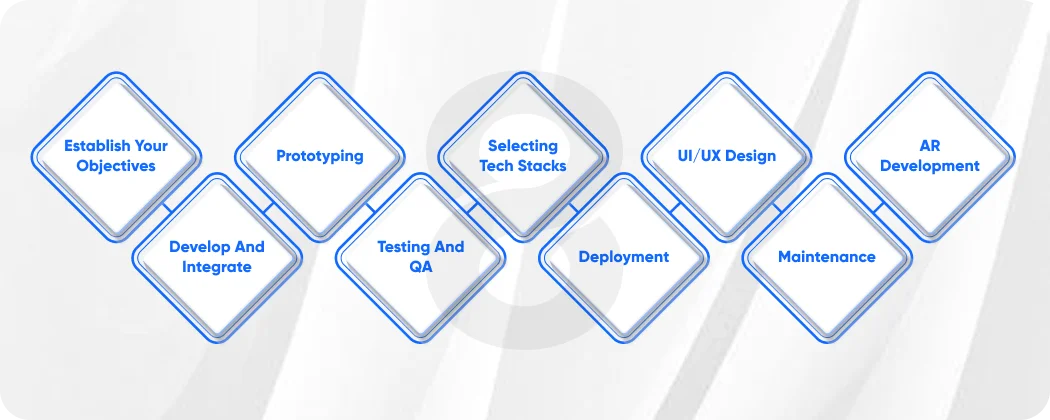
1. Establish Your Objectives and Target Audience
Whether you are developing an education application, a healthcare solution, or an AR game, it is imperative to have a purpose for the app. The definition of the target audience will assist in identifying the most significant features and making decisions concerning design, platform, and functionality. This action is of paramount importance as it forms the basis of the cost of augmented reality app development, as well as time and resources are spent in a cost-efficient manner and the app will satisfy the expectations of the user.
2. Conceptualization and Prototyping
The second thing to do after setting the objectives is to conceptualize the app and make prototypes. This includes coming up with wireframes and mockups that illustrate the user interface and AR interaction in the app. In the case of augmented reality apps, considerations should be made as to how the virtual objects will interact with the real world, how they will navigate, as well as the gestures and controls that they will be using. Prototyping enables developers and other stakeholders to find out the validity of the ideas before anything gets written in actual code to minimize the likelihood of costly changes later on, and to assist in the management of the cost to develop an AR app.
3. Select the Appropriate Technology Stacks
The third step is the choice of the technology stack and AR SDK. The decision between ARKit in iOS, ARCore in Android, Unity with AR Foundation to create a cross-platform application or Vuforia to create an app based on markers may influence the capabilities of the app and the AR app development cost greatly. All SDKs have advantages and disadvantages, like the ability to work with real-time communication, SLAM tracking, or multiplayer AR. The selection of the appropriate platform provides an effective development and prevents potential unforeseen costs in the future.
4. Design UI/UX for AR
The design of the user experience of AR applications is more intricate compared to standard applications since it entails spatial interaction and overlay on the real world. The designers should also make sure that 3D objects are made natural to the user in terms of appearance and that gestures or navigation controls are intuitive. All the aspects that should be considered are animations, lighting, and scaling of objects. A good UI/UX enhances the interaction and usability, but it also affects the development cost of an augmented reality application because a quality AR interface will need skilled designers and extra time.
5. Core AR Development
The fifth one is the creation of the AR application. This involves the installation of the AR engine, 3D models, programming, and precise tracking of virtual objects in real-world spaces. The programmers will need to streamline the application to ensure its functionality on all devices, and this has a direct impact on the cost of AR in itself. The cost to develop an AR app will naturally rise when complex apps are made with real-life multiplicity, advanced physics, or complex 3D conditions.
6. Develop and Integrate Backend
The majority of AR applications need to have a backend to handle data, user accounts, cloud staging, or stay up to date with collaborating. This stage will entail the development of APIs, server configuration and connection to other platforms where necessary. Scalability, security, and reliability are achieved through proper backend development. This step may be skipped or underestimated, which may result in increased cost of the augmented reality app development in the long-term because of the performance problems or frequent updates.
7. Testing and Quality Assurance
AR apps have to test performance, accuracy in tracking objects, cross-device compatibility, and battery life. Holistic QA gives a user experience that is free of problems and minimizes the possibility of expensive after-launch corrections. The step is essential in managing the total cost of AR app development since the more complex an application is, the longer the testing cycle will take.
8. Deployment
After testing and readiness of the app, it should be deployed in app stores. Deployment encompasses platform requirements, submitting the application to be reviewed, and setting up backend services to be used in live implementation. It is because proper deployment makes the app available to the target audience and minimizes the possible delays that might lead to the overall cost of creating an AR app.
9. Maintenance and Updates
The last process is continuous maintenance and upgrades. Also, AR applications have to be updated regularly to ensure their compatibility with new models of devices, new OS versions, and AR SDK releases. Maintenance is also involved in fixing bugs, improving performance, and adding features to the product on the basis of user feedback. Maintenance planning is necessary in determining the amount of money AR cost can imply because it may take 15-30% of the original development estimate per year.
Future Trends Affecting AR App Development Cost

The future of AR app development is destined to determine the extent of AR prices. The hardware development, like AR glasses and mixed reality gadgets, will hike the cost of augmented reality applications development since apps will have to run on new platforms and work effectively on diverse devices. The implementation of AI and machine learning will improve such features as the recognition of objects and tracking gestures, but will also contribute to the cost to develop an AR app because more complex requirements in terms of development and processing will be required.
There will still be a role for cloud and edge computing, as real-time data, multi-user experience, and AR streaming services will still need constant infrastructure, which increases the overall AR app development cost. Training, maintenance, and remote collaboration AR usage will further raise costs to the enterprise due to security and compliance demands, as well as the requirements of backend integration. Lastly, since users want quality images and experiences, the costs of 3D assets and animations will increase, having an effect on the amount of AR that costs both consumer and enterprise applications.
Your Next AR Experience Starts Here – Estimate the Cost with 8ration

AR is fast defining the future of apps in all industries, including retail and games applications, in the field of healthcare, and enterprise solutions. The AR app development cost is imperative to businesses that would like to take advantage of immersive experiences without wasting money. The complexity of apps, the platform used, the creation of 3D assets, the integration of the back end, and maintenance, among others, will all contribute to the cost of AR. The trend of AI usage, AR wearables, cloud computing, and enterprise adoption in the future makes this type of app development even more costly, which is why planning should be taken more seriously than ever before. With an initial approach, an effective prototype, and efficient resource optimization, businesses can afford costs and provide high-quality AR experiences.
As a firm that aims to create an AR application most efficiently, 8ration can provide the services of creating an AR application with effective use of both technical skills and appealing design, which guarantees the highest efficiency and returns. Concept to deployment 8ration assists clients in the intricacies of AR projects and offers solutions on scale based on your industry and budget. Every time you need to decrease cost to create an AR; or create an advanced, multidimensional AR experience, 8ration will make sure your project is successful in achieving your business objectives and providing a smooth user experience.