



Integrating AI into the real estate industry provides a proactive approach, converting raw data into actionable foresight. It allows users to predict trends and calculate investment opportunities with high accuracy in property valuations.
The market of real estate is rapidly becoming digitalized, as technologies in the sphere of artificial intelligence (AI) and data science develop. In an ever-growing and more complex market, with data-heavy processes, traditional decision-making cannot compete. According to JBI, the global AI in real estate market is projected to grow from USD 222.65 billion in 2024 to USD 1,408.82 billion by 2030, expanding at a 36% CAGR through 2030.
This is where the AI-based real estate applications apply predictive analytics to offer smarter insight, automate operations, and unlock growth. The benefits of AI in the real estate industry are the focus of this change, as they enable predicting tendencies, personalized experience, optimal pricing, and risk reduction.
Since residential solutions to predictive analytics and AI in business, real estate, developers, investors, and realtors are able to make highly accurate, thoughtful decisions through predictive analytics.
Understanding AI Predictive Analytics in Real Estate Apps
Predictive analytics is a term used to describe a machine learning algorithm coupled with statistical modeling and past data that is used to forecast the future. Predictive analytics in combination with AI real estate solutions will be a powerful engine of property value forecasting, pattern identification, and market anticipation.
Typically, data used as input in AI predictive analytics in real estate applications includes:
- Historical property prices
- Market demand and supply trends
- Demographic and location-based insights
- User behavior within apps
- Economic indicators and interest rates
AI models become more apt and practical with time due to continuous learning. This feature is the foundation of intelligent real estate apps and most of the benefits of AI in the real estate industry, including residential, commercial, and development.
Benefits of AI in Real Estate Apps Through Predictive Analytics
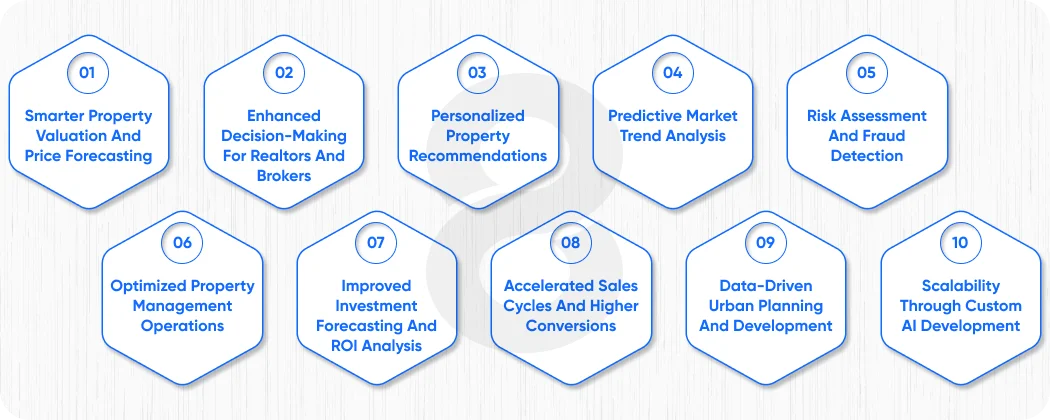
1. Smarter Property Valuation and Price Forecasting
One of the most important dimensions of real estate decision-making is accurate property valuation. Conventional valuation models are based on a lot of manual appraisals and little historical information. By contrast, AI predictive analytics considers thousands of variables at a go.
Through the screening of similar characteristics, place attractiveness, price changes, and economic periods, AI provides accurate cost estimations. This not only helps the buyers and sellers but also enhances trust in the digital platforms.
Automated valuation models are one of the most important AI benefits in the field of real estate, where the errors in the prices are also minimized, and the efficiency of the transactions is also enhanced.
2. Enhanced Decision-Making for Realtors and Brokers
Realtors work in high-pressure environments where time and precision are everything. Predictive analytics enables real estate professionals to have future insights as opposed to reactive data.
- Some major AI benefits for realtors include:
- Predicting buyer intent based on browsing behavior
- Identifying high-conversion leads
- Recommending optimal listing times
- Forecasting neighborhood growth
When these features are integrated in real estate applications, the agents will be able to prioritize the opportunities, execute deals quickly, and provide better client experiences.
3. Personalized Property Recommendations
The digital experiences provided to modern users are hyper-personalized, and real estate apps are not an exception. AI algorithms will be used to evaluate user preferences, search history, budget, and history of interaction to suggest properties that are most likely to be close to the needs of the individual.
This personalization not only enhances user interaction but also boosts conversion of users. Consequently, this can result in one of the most effective advantages of AI in real estate, which is the possibility of making intelligent matchmaking between buyers and properties based on predictive models.
4. Predictive Market Trend Analysis
It is much better to know where the market is going as compared to knowing its historical past. Predictive analytics will allow the real estate applications to predict the market trends, including:
- Upcoming price surges or declines
- Emerging high-demand locations
- Seasonal buying and selling patterns
This is particularly critical in AI within commercial real estate, where it is common to have decisions to do with big capital and long-term planning. Investors will be able to minimize risks and capitalize on returns by using AI-based insights.
5. Risk Assessment and Fraud Detection
The real estate deals are associated with high financial risk, such as false listings, overpricing, and untrustworthy tenants. Predictive analytics is an AI-based technology that provides a better level of risk management by identifying anomalies and trends that may point to fraud.
As an illustration, AI is able to highlight suspicious price changes, suspicious transaction patterns, or inconsistent records. Such high-tech security measures serve as a safe bet in the AI in the real estate sector and safeguard the user and the platform proprietor.
According to Zipdo, predictive analytics and AI adoption are rising sharply, with 48 % of real estate professionals using AI predictive tools to identify investment opportunities.
6. Optimized Property Management Operations
Predictive analytics is an essential aspect of property management applications that predict the demands of maintenance, turnover of tenants, and rental income trends. With the help of historical data, AI can forecast the probability of repairs, which will minimize the maintenance costs and downtime.
This efficiency of operation demonstrates the increased topicality of AI in real estate development, where long-term performance of assets and the lifecycle are essential success factors.
7. Improved Investment Forecasting and ROI Analysis
Forecasts play an important role in deciding the profitability of investors. Predictive analytics is an AI-driven system that analyzes the yield of rentals, their potential to appreciate, and their vacancy risk with amazing accuracy.
The applications of AI in real estate investment have the following features:
- ROI projections
- Cash flow simulations
- Risk-adjusted investment scoring
These features show the practical AI benefits in the real estate sector to both institutional investors and individual buyers.
8. Accelerated Sales Cycles and Higher Conversions
AI reduces the sales funnel by determining how ready buyers are and suggesting the most appropriate properties. Automated follow-ups, intelligent notifications, and predictive scoring of leads mean that the right information is sent at the right time to the prospect.
As a result, AI predictive analytics real estate apps will have an increased deal closure and user satisfaction.
9. Data-Driven Urban Planning and Development
Predictive analytics is used in the planning of large-scale real estate development to determine the best place to develop a property, the growth of the population, and future demand. These are priceless insights that can be used to develop sustainable urban ecosystems.
Through the incorporation of AI in real estate development, the stakeholders of the real estate will be able to align the development of construction projects with the future market demands, eliminating the overdevelopment and underutilization of real estate.
10. Scalability Through Custom AI Development
Off-the-shelf AI tools do not tend to answer specific business problems. That is why tailored AI development has become an indispensable part of the real estate platforms that strive to reach the level of scaling.
Individual AI models may be created to handle specific datasets, respond to particular markets, and integrate with other existing systems. By employing the most sophisticated AI application, companies will be able to access competitive advantages and future-proof their digital real estate solutions.
Read More: 50+ AI App Ideas Generating Millions in Revenue
Role of AI in Commercial and Enterprise-Level Real Estate Apps
Predictive analytics is invaluable to enterprise platforms in AI in commercial real estate. These platforms operate huge data sets in various regions, properties, and asset types. AI facilitates centralized intelligence by matching various data points to operable insights.
- Key enterprise-level benefits include:
- Portfolio performance optimization
- Predictive lease management
- Demand forecasting for commercial spaces
- Strategic asset allocation
Such functions support the strategic value of AI in the development of the real estate business.
Critical Considerations for AI Predictive Analytics
The benefits of AI in the real estate sector are considerable, but there is a need to plan the implementation. The obstacles are the quality of data, the complexity of integration, and ethical issues like data privacy.
Successful AI adoption depends on:
- Clean, structured, and continuously updated datasets
- Scalable infrastructure
- Transparent AI models
- Compliance with data protection regulations
Custom AI development with the help of trained AI engineers will make the implementation process more successful in the long run.
Read More: Artificial Intelligence Like ChatGPT – Build Powerful AI Tools for Your Business
Future Outlook: AI-Driven Real Estate Apps

The field of predictive analytics will also change as the AI models become more sophisticated, and instead of forecasting trends, they will be able to prescribe actions. Future real estate applications will predict as well as suggest the best course of action automatically.
The future of AI real estate platforms is autonomous property appraisal and AI-controlled deals, which will alter the manner in which customers, sellers, and investors engage with property markets.
How 8ration Delivers AI-Powered Predictive Analytics for Smarter Real Estate Apps
Our company, 8ration, focuses on creating smart real estate applications, which run on advanced AI predictive analytics to spur quantifiable business results.
Our professional team specializes in scalable AI development and custom AI development solutions, depending on the type of real estate business that needs it, allowing us to achieve accurate forecasting, smarter insights into the property, and decisions based on the data.
Through the convergence of profound domain knowledge and state-of-the-art AI technologies, 8ration is enabling real estate brands to grow and thrive while minimizing risk and becoming increasingly competitive in an ever-more data-driven real estate ecosystem.
Final Thoughts!
Predictive analytics becoming part of the AI-based real estate tools is no longer a luxury; it is a must. The advantages of AI in real estate are changing the industry on all levels by making decisions based on data, increasing personalization, minimizing risks, and enhancing the efficiency and productivity of operations.
AI predictive analytics is establishing innovation standards, whether it is the empowerment of realtors, commercial investment optimization, or sustainable development. Those companies that adopt the current state of AI development and predictive intelligence will be the top-performing companies in the real estate sector tomorrow.