


The cost to build an app like Uber in 2026 falls into three bands. A single-city MVP with booking, GPS, and card payments runs $40,000 to $80,000 and takes 14 to 16 weeks. A growth build with automated driver matching and surge pricing runs $100,000 to $180,000 over 18 to 22 weeks. An enterprise platform with AI dispatch, multi-city support, and predictive analytics starts at $200,000 and passes $300,000 as the city count grows, over 24 to 28 weeks.
Founders who ask us what an app like Uber costs are usually asking something else underneath it. They want to know what drives the number up, which parts they can defer, and whether the whole thing pays back before the money runs out.
The market case is real but frequently overstated in articles like this one, because analysts count different things. Grand View Research puts the global ride sharing market at USD 96.9 billion by 2030, growing 13.7% a year from 2025. Other firms report figures three or four times higher because they count the gross value of every booking rather than platform revenue, and because “ride hailing” and “ride sharing” are not the same segment. Check the definition before you put any of these numbers in a deck.
What follows is the cost of building an app like Uber broken down by feature, by phase, by team location, and by platform, plus the running costs that show up after launch and usually get left out of the first budget. If you are still deciding whether to build at all, the taxi booking app development page covers the product side.
Why Uber-Like Apps Still Attract Heavy Investment in 2026
Money keeps going into ride-hailing because the category has splintered. Uber and Lyft own the dense urban corridors, but medical transport, rural routes, school runs, corporate fleets, and airport-only services are all still fragmented, and most of them are still being dispatched by phone.
The engineering bar has moved though, and that is where the cost went. Riders now expect the app to know demand is coming before it arrives, so the dispatch layer is a forecasting problem rather than a queue. EV fleets need charge-aware routing, which means the router has to hold state about the vehicle and not just the road. And a platform built for one city rarely survives contact with the second one, because fare rules, driver licensing, and payout law are local.
None of that shows up in the app screens. It shows up in the backend, which is why two ride-hailing apps that look identical can differ by $150,000. If you are moving into on-demand app development from a fleet or taxi business, that gap is usually the thing that blows the budget.
What Goes Into an App Like Uber
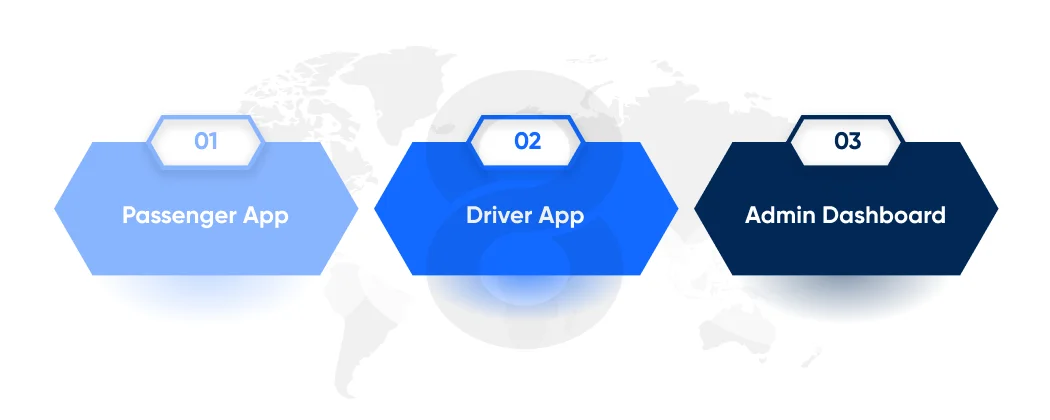
An app like Uber is four builds, not one. You are paying for a passenger app, a driver app, an admin backend, and the dispatch service that connects them, and the last one is invisible to everybody except the people paying for it.
Founders costing this out for the first time usually price the two mobile apps and treat the rest as an afterthought. In practice the backend takes more hours than either app.
1. Passenger app
This is where revenue enters. Account creation and identity checks, address search, ETA display, fare preview, payment, and the trust signals around driver identity all live here.
Two things drive the cost. Location accuracy is expensive because a bad pin costs you the booking, and payment handling is expensive because you are moving money on behalf of two other parties. Everything else on this screen is comparatively cheap.
2. Driver app
Supply lives here, and it decides whether the platform works at all. Document upload and verification, background check status, live navigation, job offers with an accept window, earnings, and online or offline availability.
Performance matters more than polish. A driver app that drains the battery or drops the socket connection loses you drivers, and driver churn is the most expensive problem in this business. Budget accordingly.
3. Admin backend
The least visible layer and the one most often underbuilt. Live operations monitoring, fare and commission rules, incentive campaigns, driver and rider records, dispute handling, refunds, and reporting.
Underbuild it and your ops team runs the business out of a database client at two in the morning. Rebuilding it later costs roughly double what it would have cost to do properly the first time.
4. Dispatch and matching service
This is the actual product. It holds every available driver’s position, indexes them geospatially, scores candidates against a request, offers the trip, and reassigns when the offer times out. It also carries surge logic and ETA prediction.
Nobody sees it, everybody notices when it is bad, and it is consistently the single most expensive component in the build.
Read More: 20 Best Android Automotive Apps to Help You Build Your Own
Typical Uber-Like App Development Timeline
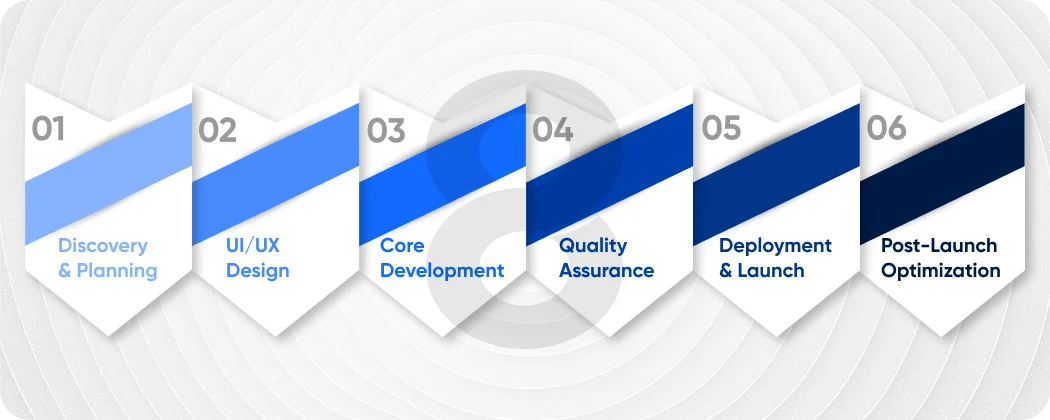
An app like Uber takes 14 to 28 weeks to build, depending on which of the three tiers you are in. An MVP lands around 14 to 16 weeks and an enterprise platform around 24 to 28. Phases overlap, so the calendar is shorter than the sum of the parts.
The one phase founders try to skip is the first one, and it is the only one that reliably pays for itself.
1. Discovery & Planning
Timeline: (2-3 Weeks)
Estimated Cost: $5,000 – $12,000
This stage outlines the product roadmap and eliminates costly changes in the future.
Includes:
- Requirements & scope definition
- Prioritization of feature (MVP vs advanced)
- Monetization strategy & cost modeling
- Technology and architecture planning
- Security planning through compliance
Discovery is the cheapest place to change your mind. Cutting a feature here costs a conversation. Cutting it during core development costs the sprint that built it and the QA that tested it.
2. UI/UX Design
Timeline: (3-4 Weeks)
Estimated Cost: $8,000 – $20,000
Design pays attention to the usability, speed, and reliability, which are vital to ride-hailing apps.
Includes:
- Passenger and driver user journeys
- Wireframes for all screens
- High-fidelity UI design
- Testing prototypes: interactive and usability
- High UX has a direct positive impact on retention and conversion rates
3. Core Development
Timeline: (6-12 Weeks)
Estimated Cost: $35,000 – $110,000
This is the highest cost aspect as a result of engineering complexity.
Includes:
- Passenger application (booking, live tracking, payments)
- Driver application (availability, navigation, earnings)
- Analytics dashboard and admin panel
- APIs, databases, back-end services
- Instant GPS, alerts, payment gateway
The features, such as multi-city scaling, AI dispatching, and surge pricing, increase the costs.
4. Quality Assurance
Timeline: (2-4 Weeks)
Estimated Cost: $5,000 – $15,000
The QA operates simultaneously with the development to minimize delays.
Includes:
- Regression testing & functional testing
- Load & performance testing
- Security & compliance checks
- Testing of real devices and OS compatibility
- Ongoing QA reduces the failure of post-launch and stores rejection
5. Deployment & Launch
Timeline: (1 Week)
Estimated Cost: $2,000 – $5,000
Concentrated on production roll-out.
Includes:
- Google Play and App Store submission
- Store control & maximization
- Production server setup
- Launch monitoring
6. Post-Launch Optimization (Ongoing)
Estimated Monthly Cost: $2,000 – $10,000+
Includes:
- Performance optimization
- Feature enhancements
- Bug fixes & security updates
- Dynamics & user behavior data
Plan on spending roughly 15% to 20% of the build cost every year afterwards, which is the range most agencies quote for maintenance retainers on platforms this size. The first year usually runs higher because launch surfaces problems no test environment reproduces.
| Phase | Old cost | New cost |
|---|---|---|
| Discovery & Planning | $5,000 – $12,000 | $4,000 – $12,000 |
| UI/UX Design | $8,000 – $20,000 | $6,000 – $22,000 |
| Core Development | $35,000 – $110,000 | $22,000 – $200,000 (duration 6–14 weeks) |
| Quality Assurance | $5,000 – $15,000 | $4,000 – $40,000 |
| Deployment & Launch | $2,000 – $5,000 | $2,000 – $6,000 |
| Post-Launch | $2,000 – $10,000+ | $2,000 – $12,000 / month |
Read More: How Much Does it Cost to Develop an App
App Complexity: How It Impacts Uber-Like App Development Cost
Complexity in this category is almost entirely a backend question. The rider screens look much the same whether you spent $40,000 or $300,000. What changes is how many drivers the dispatch service can hold in memory, how fast it reassigns a declined trip, and whether the fare engine can run different rules in different cities without a redeploy.
A limited build lets a human do the hard parts. Fixed fares, manual driver approval, and a dispatcher who assigns trips by hand or by nearest-first. It is cheap because there is no intelligence to write.
The moment you automate matching and let pricing move with demand, you are running concurrent state across thousands of moving objects, and the cost profile changes shape. That is when software testing stops being a phase and becomes a permanent cost line, because a matching bug does not throw an error, it just quietly loses you rides.
|
Complexity Scope |
Technical Characteristics |
Engineering Impact |
Estimated Cost Range (USD) |
Typical Timeline |
|
Limited Scope |
Basic booking, standard payments, minimal automation |
Low backend load, fewer integrations |
$40,000 – $80,000 |
14–16 weeks |
|
Moderate Scope |
Real-time tracking, automated matching, surge logic |
Higher API usage, scalable backend |
$100,000 – $180,000 |
18–22 weeks |
|
Advanced Scope |
AI-based pricing, high concurrency, predictive analytics |
Microservices, heavy cloud scaling |
$200,000 – $300,000+ |
24–28 weeks |
How Platform Choice Changes the Cost
Building for one platform instead of two is the largest single saving available before you have written a line of code, and it costs you less than founders expect. Check your target market’s split first. In much of South Asia, Africa, and Latin America, Android sits above 85%, which makes an iOS build a year-two decision rather than a launch requirement.
| Approach | Cost vs Single-Platform Baseline | What You Trade |
|---|---|---|
| Android Only | Baseline | No iOS users at launch. Fine in Android-dominant markets |
| iOS Only | 5% to 10% Above Baseline | Smaller device matrix but a stricter review process |
| Cross-Platform (Flutter or React Native) | 25% to 35% Above Baseline | One codebase on both stores. Native map and background-location work still needs platform-specific code |
| Native iOS and Android | 60% to 80% Above Baseline | Two codebases, two teams, best performance on background GPS |
For ride-hailing specifically, cross-platform is the default recommendation and native is the exception. The exception matters though. Background location tracking on the driver app is the one place where React Native and Flutter both need native modules, so budget for a platform specialist even on a cross-platform build.
Development Team: Who Do You Need to Develop an App Like Uber
Developing an app like Uber that can be scaled needs a team of multidisciplinary individuals who work in parallel. Each of the roles covers a different aspect of the product, such as user experience, performance, and backend infrastructure reliability.
A smaller team can lower initial expenditure, yet tends to lengthen plans and raise risks in the long term. Bigger, organized teams are faster and more stable in the system, particularly where the platform is to grow rapidly.
|
Role |
Responsibility |
Required for MVP |
Required for Scalable Build |
|
Product Manager |
Scope, roadmap, prioritization |
Yes |
Yes |
|
UI/UX Designer |
User flows, interaction design |
Yes |
Yes |
|
Mobile App Developer |
Passenger & driver apps |
Yes |
Yes |
|
Backend Developer |
APIs, logic, database |
Yes |
Yes |
|
QA Engineer |
Testing & validation |
Limited |
Full-time |
|
DevOps Engineer |
Cloud, deployment, scaling |
Optional |
Mandatory |
Development Location: How Geography Affects Cost
The place where your development team is located has a direct impact on the cost of building an app like Uber. Different areas have different hourly rates, and by the way, the communication, time zones, and legal standards are the same or different, the rate of production changes.
To save money, a lot of companies turn to hybrid delivery models, which include taking the best of both worlds in terms of the location, that is to say, placing the team on the ground in a high-cost region for client interaction, while the actual development takes place in low-cost markets.
|
Region |
Average Hourly Rate (USD) |
Cost Efficiency |
Best Suited For |
|
North America |
$100 – $200 |
Low |
Enterprise-grade platforms |
|
Western Europe |
$70 – $150 |
Medium |
Compliance-focused builds |
|
Eastern Europe |
$40 – $80 |
High |
Scalable, balanced solutions |
|
South Asia |
$20 – $50 |
Very High |
Budget-controlled builds |
White-Label Platform or Custom Build
A white-label ride-hailing platform gets you live in 4 to 8 weeks for $10,000 to $40,000, plus a monthly licence. A custom build takes 14 to 28 weeks and starts at $40,000. If you are testing whether anyone in your city wants the service, the white-label route is the honest answer and most agencies will not tell you that.
| Factor | White-Label Platform | Custom Build |
|---|---|---|
| Upfront Cost | $10,000 to $40,000 | $40,000 to $300,000+ |
| Time to Launch | 4 to 8 Weeks | 14 to 28 Weeks |
| Ongoing Licence | $500 to $3,000 / Month Typical | None, but infrastructure applies |
| Source Code | Varies by licence. Often restricted or escrowed | Yours |
| Feature Changes | Limited to the vendor’s roadmap | Unrestricted |
| Best For | Proving demand, taxi fleets going digital, single city | Investor-backed platforms, unusual business models, multi-city plans |
Ranges above reflect what vendors advertise publicly and vary widely by region and licence terms. Read the source-code clause before you sign anything, because that clause is what determines whether you can ever leave.
The switching cost is the real decision. Migrating off a white-label platform once you have drivers and ride history on it is a full rebuild plus a data migration, and it usually costs more than building custom would have in the first place. So the question is not which is cheaper. It is whether you expect to still be on this platform in three years.
How to Reduce the Cost of Building an App Like Uber
Four levers actually move the number. The rest is negotiation theatre.
Launch one-sided
Most ride-hailing MVPs die because they build for a marketplace that does not exist yet. If you already control the supply, a fleet, a taxi association, a corporate contract, you can skip driver acquisition features entirely in v1. Manual driver onboarding through an admin panel instead of in-app KYC saves 80 to 120 hours.
Cut the features that are cheap to add later
In-app chat, ride scheduling, ratings, promo codes, and referral systems are all easy to bolt on once traffic exists. Dispatch, payments, and the driver app are not. Spend the MVP budget on the three that are hard to retrofit.
Move the build, not the product owner
The location table above is the biggest lever on this page. A 500-hour build costs roughly $50,000 to $100,000 in North America and $10,000 to $25,000 in South Asia for the same scope. Hybrid delivery, with a local product owner and an offshore engineering team, is how most funded platforms handle this.
Use managed services instead of building infrastructure
Stripe Connect for driver payouts, Firebase Cloud Messaging for push, Twilio for OTP, and a managed database instead of a self-hosted cluster. Every one of these is a build you are choosing not to do. An MVP development approach that leans on managed services can take 20% to 30% off the first release, and you can always bring things in-house once the volume justifies it.
Passenger App Features and What Each One Costs
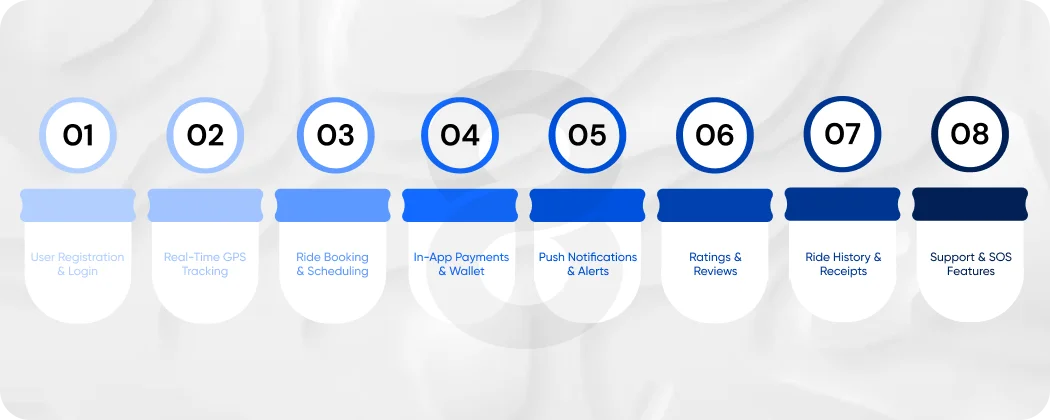
The passenger app runs about 470 development hours in total, or $18,800 to $26,150 at typical offshore rates. GPS tracking, payments, and booking account for roughly 60% of that on their own.
The rest of the app is comparatively cheap, which is why founders who try to cut costs by trimming passenger features usually save very little. The savings are in the backend.
|
Feature |
Complexity Level |
Estimated Development Hours |
Estimated Cost Range (USD) |
|
User Registration & Login |
Basic |
60 |
$2,400 – $3,600 |
|
Real-Time GPS Tracking & Navigation |
Advanced |
120 |
$4,800 – $6,000 |
|
Ride Booking & Scheduling |
Advanced |
80 |
$3,200 – $4,500 |
|
In-App Payments & Wallet |
Advanced |
100 |
$4,000 – $5,500 |
| Push Notifications & Alerts |
Basic |
40 |
$1,600 – $2,200 |
|
Ratings & Reviews |
Basic |
50 |
$2,000 – $2,750 |
|
Ride History & Receipts |
Basic |
50 |
$2,000 – $2,750 |
|
Support & SOS Features |
Advanced |
70 |
$2,800 – $3,850 |
Forecasts for this sector vary by a factor of four depending on what gets counted. Business Research Insights puts the ride-hailing app market at USD 145.8 billion in 2025 and projects USD 798.8 billion by 2035, while Grand View Research’s ride sharing figure for 2030 is USD 96.9 billion. The difference is mostly gross bookings versus platform revenue. Use the second kind of number when you model your own take rate, because the first kind is money that mostly belongs to drivers.
Driver App Features and What Each One Costs
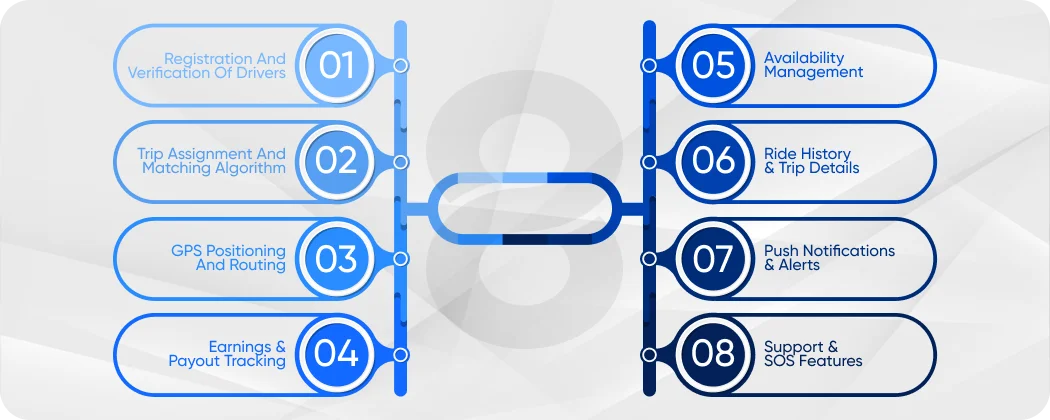
The driver app runs about 620 hours, or $24,800 to $33,000, which makes it more expensive than the passenger app despite having fewer screens. The matching algorithm alone is 140 hours.
Two things account for the gap. Driver verification means handling identity documents, licence checks, and vehicle records, which drags compliance and secure storage into scope. And payouts mean you are holding other people’s money, which is a different regulatory problem from taking a card payment.
|
Feature |
Complexity Level |
Estimated Development Hours |
Estimated Cost Range (USD) |
|
Driver Registration & Verification |
Advanced |
80 |
$3,200 – $4,500 |
|
Trip Assignment & Matching Algorithm |
Advanced |
140 |
$5,600 – $7,000 |
|
GPS Navigation & Route Optimization |
Advanced |
120 |
$4,800 – $6,000 |
|
Earnings & Payout Tracking |
Advanced |
80 |
$3,200 – $4,500 |
|
Availability Management |
Basic |
40 |
$1,600 – $2,200 |
|
Ride History & Trip Details |
Basic |
50 |
$2,000 – $2,750 |
|
Push Notifications & Alerts |
Basic |
40 |
$1,600 – $2,200 |
|
Support & SOS Features |
Advanced |
70 |
$2,800 – $3,850 |
How Do Apps Like Uber Make Money
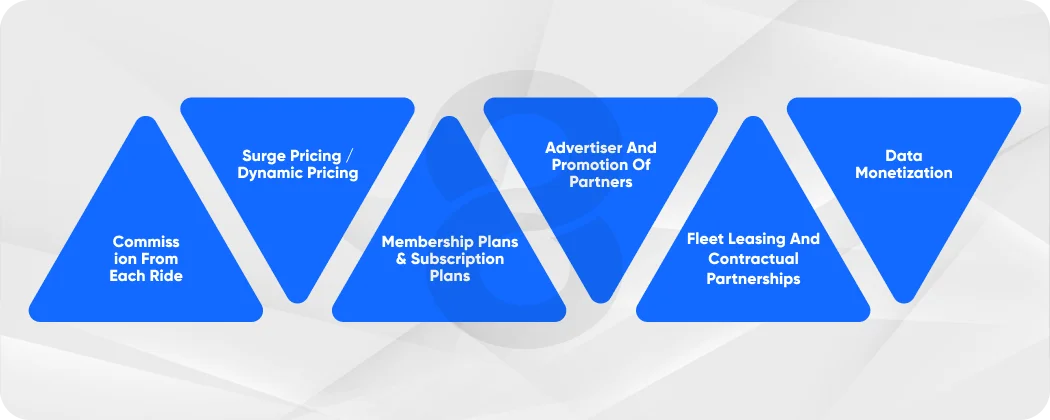
Ride-hailing platforms take a commission of 15% to 30% on every fare, and that is the whole business for most of them. Everything below is what gets added once commission alone stops covering the operating cost.
Where new platforms get this wrong is setting the commission too high in year one. Drivers compare take-home per hour across apps within about two weeks of signing up, and they leave quietly.
The key monetization strategies are the following:
1. Commission from Each Ride
The percentage of all trip fares is the most prevalent source of revenue. Platforms typically charge 15% to 30% per ride, depending on how much competition there is for drivers in that market.
Worked example: on a $20 fare at 25% commission, the platform keeps $5 and the driver receives $15, settled automatically at trip completion.
2. Surge Pricing / Dynamic Pricing
The demand management, which is facilitated by AI, can significantly boost the revenue in times of peak hours, events, or bad weather.
- Surge pricing is a dynamic pricing model that employs algorithms to determine fares according to demand and supply.
- This will encourage a greater number of drivers to go online during peak times so that they can be available to carry out their services.
- Surge lifts revenue per ride during peaks, but it is the most reputation-sensitive lever on this list. Test it in a limited window before you turn it on citywide, and cap the multiplier. Riders forgive a 1.4x. They screenshot a 3x.
3. Membership Plans & Subscription Plans
Other systems include premium subscriptions to those who ride regularly.
- The benefits can be priority booking, reduced fares or reward loyalty
- Generates foreseeable repeat revenue, eliminating reliance on the frequency of individual rides
Worked example: 1,000 subscribers on a $9.99 monthly plan produces $9,990 a month in revenue that does not depend on ride volume.
4. Advertiser and Promotion of Partners
Additional sources of revenue are in-app advertisements and collaborative brand promotions.
- Examples can be food delivery offers, retail discounts, or travel packages to passengers who are waiting in the app
- Offers friction-free monetization without interference with the basic ride-booking experience
5. Corporate accounts and fleet contracts
Companies book rides for staff and clients and want one invoice at month end rather than a hundred receipts. Hospitals, hotels, and logistics firms are the usual buyers.
- Requires a separate billing layer, cost centres, and spend limits per employee
- Revenue per account is high and churn is low, but sales cycles run months rather than minutes
- Often the first genuinely profitable segment for a regional platform
6. Data licensing
Aggregated and anonymised trip data has buyers among city planners, mapping companies, and transport authorities. This only becomes meaningful at scale, and it comes with obligations most founders underestimate.
- Requires real anonymisation, not just stripped names, since trip endpoints identify people
- Falls under GDPR and CCPA depending on where your riders are
- Treat this as a year-three revenue line, not a launch assumption
Key Insight
The most lucrative Uber-like platforms will be those that combine several sources of revenue:
- Base cash flow is given by the commission per ride
- Surge pricing maximizes revenue at high-demand times
- Corporate partnerships and subscriptions generate a stable source of income
Tech Stack for Building an App Like Uber
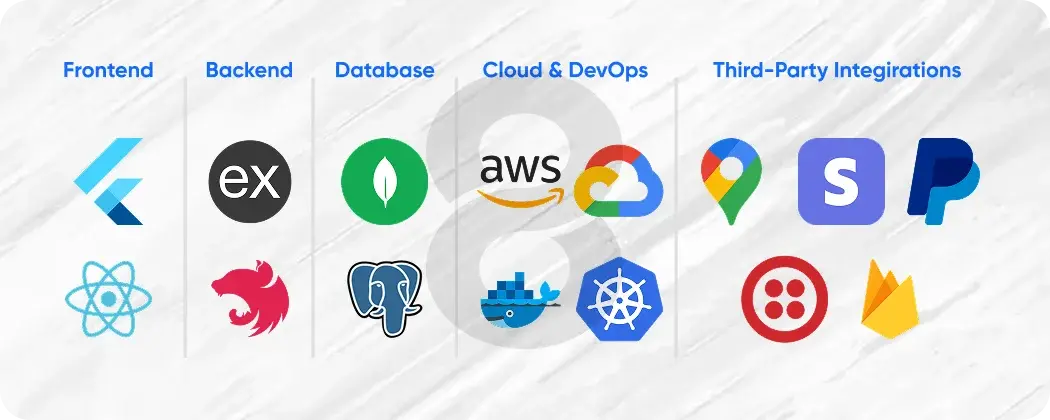
For a 2026 ride-hailing build, the common stack is Flutter or React Native on the front end, Node.js with NestJS on the backend, PostgreSQL for money and MongoDB for trip state, and AWS or Google Cloud underneath. Google Maps Platform handles routing, Stripe Connect handles payouts, and Firebase handles push.
The stack choice that actually matters here is the one nobody lists. You need a persistent connection layer, usually WebSockets through Socket.io, and a geospatial index in Redis so the dispatch service can answer “who is within two kilometres” in single-digit milliseconds. Uber built its own hexagonal grid, H3, for exactly this. Get this layer wrong and no amount of frontend polish will save the product.
Recommended Tech Stack for 2026
1. Frontend, passenger and driver apps
- Flutter / React Native: Cross-platform iOS and Android
- Advantages: Rapid development, single-code base, user-friendly experience, and maintenance
2. Backend
- Node.js: Small, fast, and has the capacity to process high-concurrency requests
- Express.js / NestJS: API designing and server-side logic frameworks
- Advantages: Scalable, real-time communication service and appropriate to support microservices architecture.
3. Database
- MongoDB: Real-time ride tracker and dynamic schema of user, ride, and driver data
- PostgreSQL: Stable transaction activities of payment and reporting
- Advantages: Hybrid of NoSQL due to speed, and SQL due to financial precision
4. Cloud & DevOps
- AWS/ Google Cloud platform: Serverless functions, auto-scaling, storage, and hosting
- Docker and Kubernetes: Microservices Containerization and Orchestration
- Advantages: Good availability, scalability, and good infrastructure
5. Third-Party Integrations
- Google Maps/ Mapbox: Routing, GPS, and navigation
- Stripe / PayPal: In-app payment processing is safe
- Twilio / Firebase: Push, SMS verification and communication APIs
- Advantages: It saves time during development, but is reliable and secure
6. Analytics & Monitoring
- Firebase Analytics / Mixpanel: Measure user activity and app performance
- New Relic / Datadog: Server performance monitoring and error tracking
Why the Tech Stack Matters
The technology stack options have an impact on:
- Development Time: Cross-platform frameworks are made of contemporary time-to-market.
- Maintenance Costs: Trustworthy Backend and cloud infrastructure reduce the long-term costs.
- Scalability: The architecture of microservices enables the platform to support millions of simultaneous rides.
- Expansion of features: The AI-based feature is easy to integrate; EV-based routing or predictive pricing can be made in the future.
Read More: How to Make an App that Makes Money
Hidden Costs & Marketing Investment for an App Like Uber
Running an app like Uber costs $800 to $5,000 a month before you have paid a single person, and maintenance adds 15% to 20% of the build cost annually on top. On a $60,000 MVP that is roughly $9,000 to $12,000 a year in maintenance plus $10,000 to $60,000 a year in infrastructure and API fees.
Map API billing is the one that catches people. Google Maps Platform charges per request, and a ride-hailing app polls the routing and distance endpoints continuously for every active trip. Model this against your projected ride volume before launch, not after the first invoice.
1. Hidden / Backend Costs
Even a fully developed Passenger, Driver, and Admin system relies on several external services and maintenance:
|
Hidden Cost Item |
Description |
Estimated Monthly / Annual Cost (USD) |
|
API Integrations |
Google Maps, Mapbox, Twilio, payment gateways (Stripe/PayPal) |
$200 – $1,500/month |
|
Server & Cloud Hosting |
AWS/Google Cloud instances, storage, auto-scaling |
$500 – $3,000/month |
|
App Store Fees |
Google Play & Apple App Store submission & renewals |
$100 – $500/year |
|
Licenses & Compliance |
Regional legal compliance, transportation licenses, security audits |
$1,000 – $5,000/year |
|
Maintenance & Updates |
Bug fixes, feature upgrades, backend monitoring |
15–20% of total development cost per year |
Licensing, insurance, and compliance
The $1,000 to $5,000 a year in the table above covers software compliance only. Operating a ride-hailing service is separately regulated in most markets and that cost sits outside the development budget entirely.
In the United States, ride-hailing operators are licensed at state level as Transportation Network Companies, and most states require $1 million in liability coverage while a passenger is in the vehicle, with lower limits while a driver is online and waiting. Driver background checks run roughly $30 to $60 per driver through vendors like Checkr, recurring annually in several states. Card data handling brings PCI DSS into scope, though using Stripe’s hosted payment fields keeps you in the lightest tier of that.
Rules differ by state and by country, and some cities regulate separately from the state. Get a local transport lawyer to price this for your specific market before you commit to a launch date. It is the one line on this page where a generic estimate would be actively misleading.
2. Marketing & User Acquisition Costs
Launching an Uber-like platform is not only about building the app; user acquisition also drives adoption and revenue growth. Marketing costs include:
|
Marketing Activity |
Description |
Estimated Cost (USD) |
|
Digital Ads |
Google Ads, Facebook Ads, and Instagram campaigns |
$2,000 – $10,000/month (initial 3–6 months) |
|
Referral Programs |
Discounts and ride credits to attract new users |
$1,000 – $5,000/month |
|
Influencer & PR Campaigns |
Local influencers, launch events |
$2,000 – $15,000/launch period |
|
Content Marketing & SEO |
Blogs, social media, guides like this one |
$1,000 – $3,000/month |
|
Offline Marketing |
Flyers, events, partnerships |
$1,000 – $5,000/quarter |
Our Success Stories: Be Line – Connecting Rural Communities Through Reliable Rides
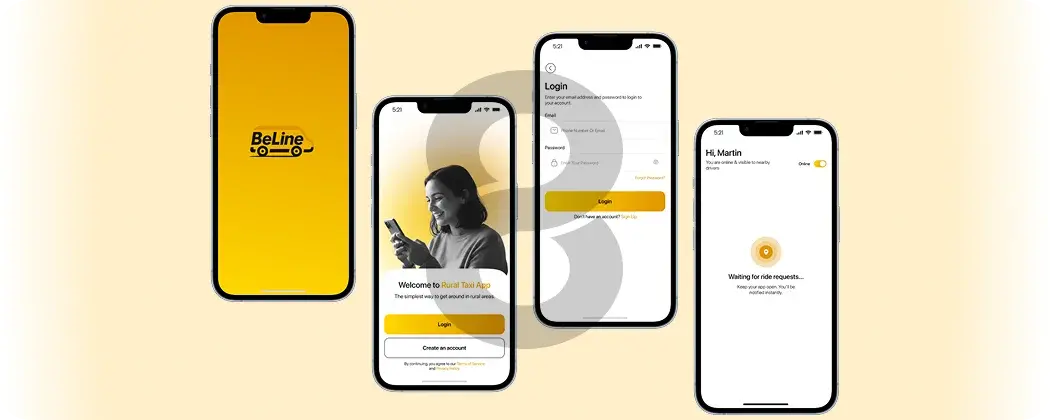
We do care about creating digital solutions, which actually make a difference at 8ration. Be Line is among our most successful projects, and it is a mobile ride-hailing application tailored to the needs of rural communities – an underserved audience by urban transportation solutions.
The Fact: What the Needs Are and What the Constraints Are
Conventional ride-hailing applications target urban areas with a high level of internet penetration and high driver networks. When we started Be Line we soon started to think that the mobility issue in rural areas is a completely different matter:
- Low-connectivity settings or intermittent that most of the places had poor or inconsistent internet.
- Greater travel distance, rural rides are usually a long distance as compared to regular urban trips.
- Restricted availability of drivers, less number of drivers in rural areas as a result of which matching is difficult.
- Trust and familiarity, the users within rural communities are more afforded to personal relationships and reputation and not computer algorithms.
These circumstances required that we should reconsider the normal ride-hailing paradigm, not simply recycle it out of the urban application.
How We Built It: A Solution Built to Rural Realities
Rather than imposing a one-size-fits-all idea, we made Be Line about real field requirements and neighborhood trends:
1. Sensitivity to the Local Community
We also took time to immerse ourselves to the conditions the app will be utilized in, how individuals travel, how they communicate and what drives them. This assisted us in formulating attributes that were not unfamiliar and reassuring to those who were using the smartphone for the first time.
2. Offline Booking System
The network cover is not also guaranteed in most rural areas. Therefore, we have developed an offline-first booking system, which allows customers to make a booking even when the network is unstable, which is synchronized in the background as soon as they have a connection again.
3. Zone-Based Pricing
Instead of surge pricing applied by most urban applications, Be Line applies predictable, fair pricing zones depending on rural distances and affordability.
4. Community-Verified Drivers
We have developed a driver management and local verification system to gain trust. Choosing not to use only digital rating, drivers are checked with references to the community, which increases the confidence of riders.
5. Easy Payments and Multi-Languages
We also introduced several payment methods such as digital wallets, postpaid and cash, and made the app compatible with several local languages to make it appear familiar to the various rural classes of people.
What Sets Be Line Apart
The following are the main capabilities that we provided:
- Offline-first reservation system
- Zone-based fare logic
- Networks of verified drivers by the community
- Multi-language support
- Rural-specific flexible payment options
We focused on being plain, solid, and practical, not flashy, because people in these areas require products that can work where they cannot be connected.
Impact & Results
Results reported by the client, measured over the first twelve months after launch:
- Live in more than 200 rural communities across the service region
- 92% booking completion rate, measured across all bookings including those placed while offline and synced late
- Over 15,000 rides a month at the twelve-month mark
- More than 800 community-verified drivers onboarded
The completion rate is the number we watch on this project, because offline-first booking is only worth building if the deferred bookings actually convert. On urban platforms with reliable connectivity, comparable figures usually sit in the high nineties, so the gap here is smaller than the connectivity conditions would suggest.
What to Budget Before You Start
Building an app like Uber costs $40,000 to $300,000 depending on tier, and running it costs 15% to 20% of that figure every year afterwards. On a $60,000 MVP, plan for roughly $75,000 in year one once API integrations, hosting, store fees, and maintenance are in. That is before marketing.
Marketing is usually the larger number and the one that decides whether the platform survives. Two-sided marketplaces need supply and demand arriving at roughly the same time in the same neighbourhood, and buying both at once is expensive. Budget $2,000 to $10,000 a month for the first six months at minimum, and treat driver incentives as a cost of goods rather than a promotion.
On profitability, be careful with the timelines you will read elsewhere, including earlier versions of this article. Uber took roughly fifteen years to post an annual operating profit. A single-city platform with a controlled cost base and existing supply can reach positive unit economics much faster, sometimes inside two years, but unit economics and company profitability are different things and plenty of platforms have hit the first without ever reaching the second. Model your own break-even from your own take rate and driver acquisition cost. Do not take a number off a blog post.
Hiring a Development Team to Build Your Ride-Hailing App
When you shortlist agencies for a ride-hailing build, ask three things. Have they shipped a dispatch service before, or only the apps around one. What happens to the code and the driver data if you leave. And who is answering the phone at 2am in your launch week, because something will break and it will be the matching layer.
Most agencies can build the passenger app. Far fewer have run a matching algorithm under real concurrency, and that is the part that decides whether the product works.
We have built ride-hailing end to end, including Be Line, where the constraint was intermittent connectivity rather than scale, which forced an offline-first booking architecture most urban platforms never have to attempt. If you want a number for your own scope rather than the ranges on this page, the app development cost calculator is the fastest starting point.