


Most companies say they are using AI now. That sounds impressive until you actually look at what they built. Because, in many cases, teams still use AI as a feature instead of integrating it into the system. It sits on top of the product, performs a small task, and people market it as if it drives the entire product. That is usually the first sign that the thinking is slightly off.
Because real AI app development does not start with tools or models. It starts with understanding where decisions are made, where time gets wasted, and where the system can become smarter without adding complexity. And that is where most teams fall behind. Not because they lack access to AI, but because they do not integrate it properly into how the product actually works.
The Gap Between “Using AI” and Building With AI
This is where things get clearer. A lot of teams are technically using AI. Very few are actually building products around it. There is a difference.
Using AI usually looks like this:
- Adding recommendations
- Automating a small task
- Improving a single workflow
Building with AI looks very different. It affects how the system behaves as a whole.
Through proper AI development, the system starts:
- Making decisions faster
- Reducing unnecessary steps
- Learning from user behavior over time
And with structured AI integration, this does not feel like an extra layer. It feels like the product just works better.
That is where modern AI app development is heading.
At 8ration, we identify decision-heavy areas first and embed AI there instead of forcing it into parts of the product where it does not belong.
Read More: Local vs Remote App Development: Does Location Matter?
Why Most AI Projects Quietly Underperform
This is the part nobody really says openly. A lot of AI projects do not fail completely. They just underperform. They do not deliver the level of improvement that was expected.
And that usually comes down to a few consistent issues:
- The problem was not clearly defined
- The data was not structured properly
- The AI was added too late in the process
- The system was not built to support it
These are not technical problems. They are planning problems, which is why strong software development thinking matters just as much as AI capability. Because if the system is not designed to support intelligence, adding it later becomes messy very quickly.
AI Is Changing How Products Are Designed From the Start
This is where things are shifting the most. Earlier, products were designed first, and then AI was added where possible. Now, AI is influencing design decisions from the beginning.
That means:
- Workflows are simplified because automation is expected
- Interfaces are cleaner because systems handle complexity
- User actions are reduced because predictions handle repetitive steps
This shift is subtle, but it completely changes how products feel. And it is one of the most important aspects of modern AI app development.
Mobile Is Where AI Becomes Visible to Users
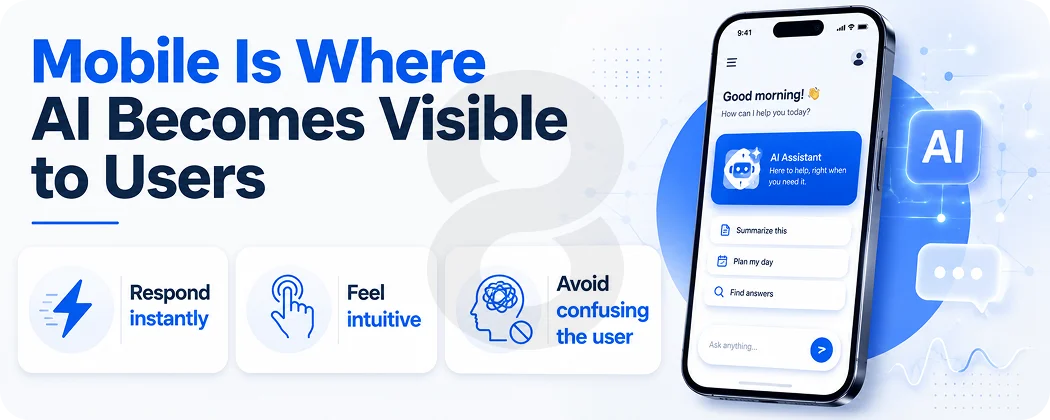
AI might be built in the backend, but users experience it through mobile. That is where things either feel smooth or slightly off. Through proper mobile app development, AI-powered features need to:
- Respond instantly
- Feel intuitive
- Avoid confusing the user
Because if AI makes the experience harder to understand, it defeats the purpose. This is why AI app development and mobile app development need to align closely. At 8ration, we test mobile experiences against real user behavior patterns, not just expected flows, and we keep AI interactions natural.
Enterprise Systems Are Becoming Smarter, Not Just Bigger
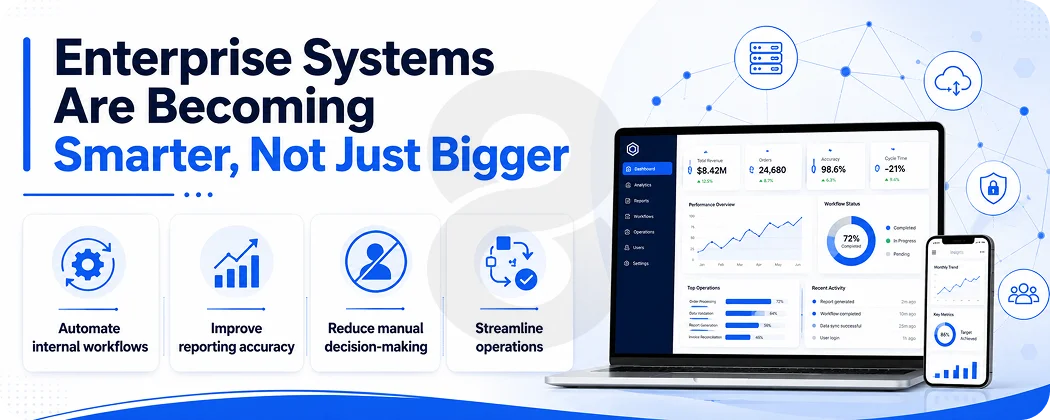
This is another shift that is happening quietly. Enterprise systems used to grow in complexity as they scaled. Now they are expected to become smarter instead. This is where enterprise app development is evolving.
AI is being used to:
- Automate internal workflows
- Improve reporting accuracy
- Reduce manual decision-making
- Streamline operations
But again, this only works if AI is integrated properly into the system. Otherwise, it becomes another layer that people avoid using.
AI as a Feature vs AI as a System
Approach |
What It Looks Like |
Outcome |
| AI as Feature | Small add-ons | Limited impact |
| AI as System | Embedded in workflows | Continuous improvement |
| Late Integration | Added after development | Complex and unstable |
| Early Integration | Built into architecture | Smooth and scalable |
Data Is the Part Most People Underestimate
AI without data is just an idea. And not all data is useful. For AI to actually work properly, data needs to be:
- Clean
- Structured
- Relevant
- Consistent
This is where strong software development practices become critical again. Because if data is messy, the output will be unreliable no matter how advanced the model is. At 8ration, data pipelines are designed early, which helps ensure that AI features are actually usable instead of unpredictable.
Read More: What is Neuro-Symbolic AI? The Future of Reliable Machine Reasoning
Real-Time Intelligence Is Becoming the Standard
Users are no longer comfortable waiting for systems to “learn over time.” They expect immediate responsiveness. This is where real-time AI systems come in.
They allow:
- Instant recommendations
- Live adjustments
- Dynamic system behavior
This is one of the fastest-growing areas in AI app development, because it directly improves how responsive the product feels.
Small Details Are Where AI Actually Adds Value
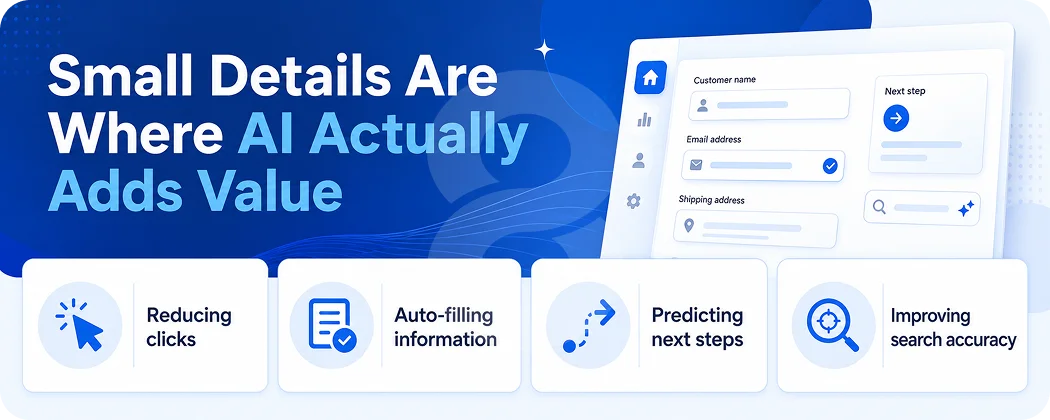
A lot of people expect AI to make big visible changes. But most of the value comes from small improvements. Things like:
- Reducing clicks
- Auto-filling information
- Predicting next steps
- Improving search accuracy
These are not flashy. But they make the product feel significantly better over time. And this is where most well-executed AI app development projects succeed.
If AI Feels Like an Add-On, It Probably Is One
If your product has AI but it feels separate from everything else, then it is not being used properly. Real value comes when AI is part of how the system operates, not something added for the sake of innovation.
Because users do not care whether something is powered by AI. They care whether it makes things easier. And if it does not, it will not be used. That is the difference between adding AI and building with AI.
What Modern App Development Firms Are Doing Differently
This is where things become very clear. Stronger teams are not chasing AI trends. They are applying them carefully.
They:
- Identify real problems before adding AI
- Build systems that support intelligence from the start
- Focus on usability, not just capability
- Test AI features in real environments
75% of enterprise IT work will be AI-augmented by 2030
At 8ration, this approach helps avoid building systems that look advanced but fail in real usage.
Where AI Creates Real Business Impact
Area |
Improvement |
Why It Matters |
| User Experience | Faster interactions | Better retention |
| Operations | Automation | Reduced workload |
| Decision Making | Data-driven insights | Better accuracy |
| Performance | Smarter workflows | Higher efficiency |
| Scalability | Adaptive systems | Long-term growth |
Final Thoughts
AI is not the future anymore. It is already part of how modern systems are built. The difference now is not who is using AI. It is who is using it properly. And that comes down to how well it is integrated into the product. Because the best AI app development does not feel like AI. It feels like the product just works better. And once that happens, users do not question it. They just keep using it.